

 Khizrana Begum
Beauty & Lifestyle Writer
Khizrana Begum writes clear and reader-friendly content covering beauty, lifestyle and related topics.
Read Full Bio of Author →
Khizrana Begum
Beauty & Lifestyle Writer
Khizrana Begum writes clear and reader-friendly content covering beauty, lifestyle and related topics.
Read Full Bio of Author →
 Sameena Begum
Health, Technology & Digital Content Reviewer
Sameena Begum reviews content for clarity, accuracy and overall reader usefulness.
Read Full Bio of Reviewer →
Sameena Begum
Health, Technology & Digital Content Reviewer
Sameena Begum reviews content for clarity, accuracy and overall reader usefulness.
Read Full Bio of Reviewer →
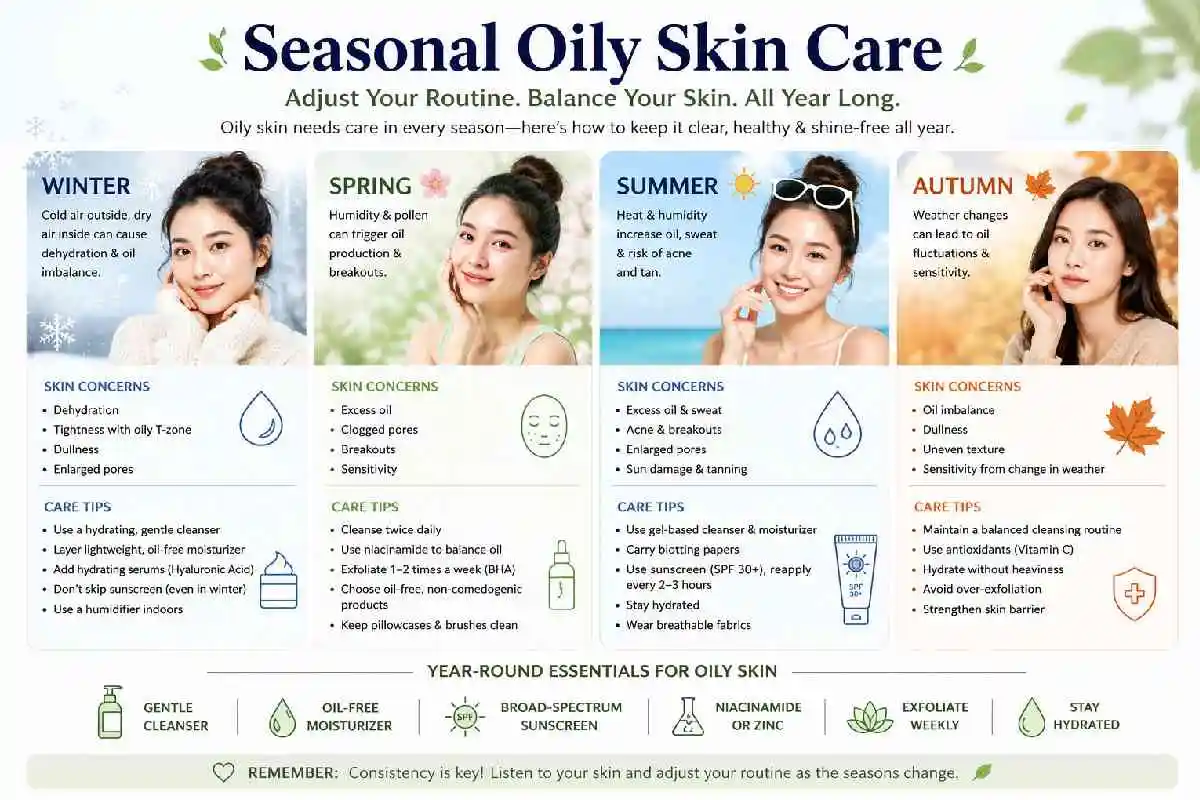
Seasonal Oily Skin Care: Oily skin can never always behave the same from one season to the next. Hot, humid, rainy, AC-filled office air, chilly wind, changes in perspiration from season to season can cause your skin to be greasy one season and unexpectedly dehydrated another. What was ideal for your skin in April might become clogging in August and, paradoxically, cause your skin to flake and tighten in December.
The purpose of caring for seasonal oily skin isn‘t to remove the oil. Instead, to maintain the balance of sebum, perspiration, moisture and barrier integrity in accordance with the shifting climate.
Seasonal changes can affect oil production, so understanding skin care products for oily skin helps you choose the right products throughout the year.
The general rule,
Adjust texture and frequency, not volume of products. Lightweight gels, sweat-proof sunscreens, and oil blotting methods count for more in hot seasons, while barrier-fortifying moisturizers count during winter.
❝
This article is a part of
Skin Care Products for Oily Skin Guide
Why oily skin changes with the seasons
Oily skin can also be related to genetics, hormones, temperature, humidity, sweat, and barrier condition. Two people can share “oily skin” for completely different reasons, so seasonal adjustments to your skincare should be tailored to your skin‘s feelings and actions.
| Season | Common oily-skin changes | What usually helps |
| Summer | Excess Sebum, more Shine, more feel and smell of clagged pores due to sunscreen, | Gel cleanser is advisable to remove the excess sebum production as it has lightweight oil free moisture along with anti oxidant, also a sweat resistant SPF and blotting papers should be used. |
| Monsoon | Humid/Monsoon Constant moisture, trapped sweat under masks/clothes, acne suppressants/irritants | Washcloths, non-comedogenics, numerous towels, SPF even on overcast days |
| Winter | Winter Surface dehydration, tightness, flaky patches despite being greasy | Barrier friendly cleanser, hydrating serum, conditioning but still not verycomedogenic moisturiser |
A common error Oil excess everyone has their own special approach in trying to get rid of the shine with frequent washes or forceful scrubbing. That can break the barrier and cause more irritation, sensitivity, or rebound shine. Seasoning is simply more chic product texture and the proper timing, rather than more potent stripping.
Switching to lightweight moisturizers for oily skin keeps your skin balanced in both hot and cold weather.
Summer Skincare Routine for Oily Skin
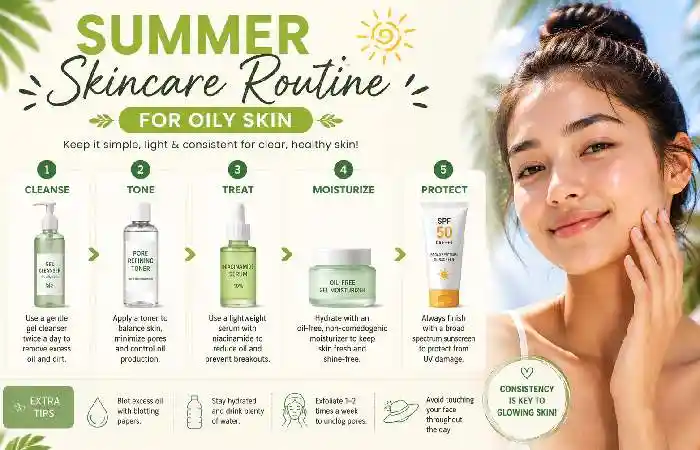
The summer is typically the most difficult season for oily skin since it’s a double whammy of sebum and sweat. It is therefore most important during the summer months to prevent the situation from getting out of control, without disturbing the barrier of the skin.
Using gentle cleansers for oily skin can help remove excess oil without stripping moisture during different seasons.
Morning routine
- Gentle gel cleanser
- Pick a low-pH gel or foam which takes away the water from sweat and overnight oil, but does not dry the skin out too much to leave it squeaky-clean.
- If you‘re acne-prone, using a salicylic acid cleanser might be a good option, but do not use them too much by using multiple exfoliating products simultaneously.
- Niacinamide serum (optional)
- 2-5% niacinamide for help with oil appearance and support barrier.
- Higher numbers are not always better and could make someone angry.
- Lightweight moisturizer
Use a non-comedogenic gel-cream or lotion.
Replace heavy occlusive moisturizers with Glycerine or Panthenol/ Hyaluronic Acids.
- Sunscreen SPF 30+ or SPF 50
If you‘re heading outdoors, give preference to sweat- and water-resistant formulas.
Sunscreens with gel, fluid, or flat/matte finish are generally lighter on oily skins.
Managing the mid-day sweat
- Blot your face using blotting papers, oil-control papers or clean tissues.
- Apply the sunscreen again as it recommends and whenever needed, particularly after excessive sweating.
- Don’t wipe your face over and over with the unclean towel and sleeve as the friction can aggravate acne.
Night-time protocol
If you wore make up or sun cream, cleanse skin really well. Water based first cleanse then mild cleanser would do.
Treatment step if needed:
- Leave-on preparations containing salicylic acid (a few nights a week), or
- If you are already using and it is suitable, you should start with a retinoid/adapalene.
- Light moisturizer to reduce irritation and support the barrier.
Summer routine checklist:
- Gel cleanser
- Optional niacinamide serum
- Lightweight gel-cream moisturizer
- Sweat-resistant SPF 30+/50
- Blotting papers or clean tissue
- Optional salicylic acid or retinoid at night
Many people also enhance their skincare with DIY and natural remedies for oily skin during seasonal transitions.
Monsoon Skincare Tips for Oily Skin
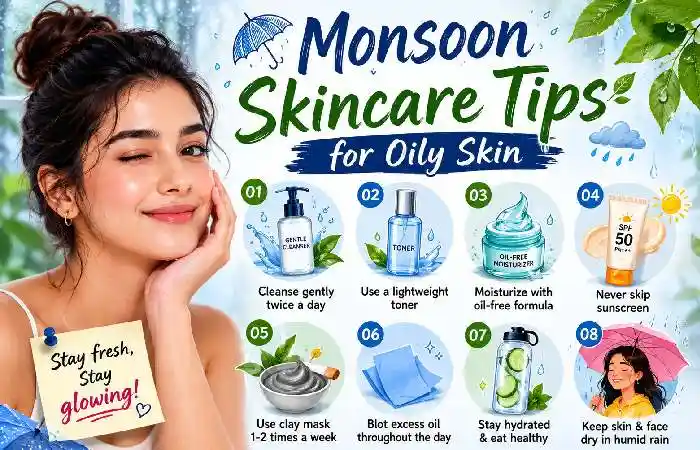
In the majority of humid climate, during the monsoon season an issue has been becoming a phenomenon; skin remain damp and wet for hours. An occlusion effect due to masks, helmets, scarves, clothing; the increased humidity results in a sensation of moist skin and trapping oils during the transpirative process.
Before updating your skincare routine, consult trusted skin care buying guides to choose products suited to each season.
What to change during monsoon
| Problem | Practical adjustment |
| Constant humidity | Use fewer layers and stick to lightweight textures. |
| Mask/helmet friction | Keep the skin moisturized but not greasy; change masks regularly. |
| Sweating of Sweat glands | Wash yourself after intense sweating, don’t sleep with perspiration and sunscreen. |
| Cloudy skies | Keep wearing the sunblock every day – the UV light gets there, even through window panes! |
Basic monsoon program
Morning
- Gentle cleanser
- If necessary, a light weight hydrating serum (glycerine/pantothenol/hyaluronic acid)
- Non-comedogenic moisturizer (very thin layer if humidity is extreme)
- Sunscreen SPF 30+
Evening
- Cleanse after returning home and after heavy sweating.
- Use salicylic acid or another acne treatment only as tolerated.
- Moisturize lightly.
Monsoon hygiene practices to adopt
- Wash a clean face towel every morning if you towel-dry your face.
- Change pillowcases at least once a week if you are a profuse sweater.
- Wash liners, hats and reusable masks as appropriate and regularly.
- Wash your hands and avoid touching your face.
Learning about effective ingredients for oily skin helps you adapt your skincare routine as the climate changes.
Winter Routine for Oily Skin
For many of us, Winter‘s a bit of a tease. Though we still tend to reach for our oils, our skins can become much drier, most obviously by being whipped dry by cold, wind, and centrally heated interiors. All of this means a face that looks oily but feels tight and flaky: irritated and shiny.
1. Gentle non-stripping cleanser
If you wake up feeling tightness of your skin then use a very mild cleanser or rinse with tepid water if this is part of your regular routine.
2. Hydrating serum
Glycerin, hyaluronic acid, panthenol or beta glucan is able to hold water.
3. Gel-cream or lotion moisturizer
Those with oily skins require, during winter, a little more emollience, but light and not grossly greasy balm.
4. Sunscreen SPF 30+
UV exposure is year round, and some winter activities increase reflected UV exposure.
Nighttime routine
- Gentle cleansing.
- Keep retinoids in if already tolerated, and scale back frequency if the irritation becomes excessive.
- Moisturize on slightly damp skin for enhanced hydration retention.
How Humidity Affects Oily Skin
Humidify: In one of the greatest seasonal variations oil skin can encounter for humidity. For this is related to the rate of evaporation of sweat and the behavior of products on the skin.
Behavior caused by high humidity usually“is an increase in the surface fluffing of human hairs, fatty tissues, and fibers, with a decrease in the serous membrane layers”.
- Perspiration ( Sweat ) will evaporate more gradually.
- Sunscreen and skin care can be heavier.
- Shine gets worse as oil and sweat combine on the surface.
- These increase the irritation of any friction: masks, helmets, collars or hats;
- Surfaces can be oily and swollen from heat so the pores seem more obvious.
Daily use of suitable sunscreens for oily skin is essential regardless of the season.
What usually happens in low humidity
- Loss of water from the skin is increased.
- The surface may be tight or rough regardless of oil flows.
- Retinoids and acids irritation may increase.
- Flaking may also occur as a secondary to shine.
Humidity adjustment rule
More humidity = fewer layers, thinner textures. Less humidity = more barrier support, slightly thicker hydration. Keep actives the same if they are working, just change frequency according to irritation and seasonal tolerance.
If seasonal changes trigger breakouts, following dedicated acne care for oily skin can help keep blemishes under control.
Best Products for Sweaty Oily Skin
Concentrate on product attributes that don‘t miss the mark when sweat makes an appearance, instead of simply looking at brand names.
| Product category | Look for | Often avoid if you’re very sweaty/oily |
| Cleanser | A mild low pH gel or foaming cleanser; could also use a salicylic acid if susceptible to breakouts. | ‘Harsh Scrubs and ‘Squeaky Clean’ Formulas with Harsh Sulfates’ |
| Moisturizer | Gel-cream, lotion, not blocking pores, Glycerine/panthenol/hyaluronic acid | Rich, fatty, occlusive formulas in the heat |
| Sunscreen | SPF 30+/50, water- or sweat-resistant, lightweight fluid/gel/matte finish | Very heavy cream sunscreens that slide with sweat |
| Oil control | Blotting paper, tissue, possibly powder if you can stand it. | Frequent vigorous rubbing or alcohol rich toners |
| Acne treatment | Salicylic acid, adapalene/retinoid (if tolerated/indicated) | Over-layering intense exfoliants during humid months |
A practical shopping checklist
- If you have sensitive skin then unscented or very low fragranced sunscreen would be your best option.
- Non-comedogenic labeling is of use but not always definitive, skin texture and sensitivity can be better indicators.
- When using in outdoor sports or for commutes, it is likely sweat resistance will be more important than having a “nice” texture.
- If you get “fungal acne–like” bumps, seek professional evaluation rather than self-diagnosing from social media.
Selecting appropriate skin care products for oily skin ensures your seasonal routine remains effective.
Sample seasonal routines at a glance
| Season | AM | PM |
| Summer | Gel cleanser → optional niacinamide → gel moisturizer → sweat-resistant SPF | Thorough cleanse → salicylic acid or retinoid if tolerated → light moisturizer |
| Monsoon | Gentle cleanser → optional hydrating serum → thin moisturizer → SPF | Cleanse after sweating → acne treatment as tolerated → light moisturizer |
| Winter | Extremely gentle Cleanser Moisturizing serum gel-cream/lotion Moisturizer SPF | Mild wash. Retinoid if can tolerate. Moisturizer on dampish skin. |
Quick “debugging” guide
| Symptom | Likely issue | Try |
| Even with moisturizer, I’m oily by noon. | Thick AM layers + humidity | Reduce layering, swap to gel textures and retain water/sweat resistant properties for sunscreen. |
| Taut when cleansing, glossy later. | Over-cleansing / dryness | Try a more mild cleanser and keep moisturizing it often. |
| Mask or helmet area break outs. | Obstruction + sweat + friction | Replace masks/liners frequently, wash when sweaty, keep products light. |
| Winter flakes on nose or around mouth. | Barrier dehydration | Exfoliate less frequently, introduce a hydrating serum, use a somewhat thicker moisturizer. |
| Sunscreen feels like it slides off | Formula not suited to sweating | Pick water/sweat proof SPF. Reapply every hour especially if sweating a lot. |
When to visit a dermatologist?
Though season adjustments do help a lot of people, see a professional evaluation if you experience: moderate to severe acne with painful cysts or scarring.
- Long-lasting redness, burning, or peeling.
- Rashes that get irritated or more itchy in the heat or humidity.
- Rapid significant variations in oil production
- Cases of decubitus sores that do not show signs of getting better 8–12 weeks after known treatment has been administered.
Main takeaways;
- Summers- gel textures, sweat proof SPF, cleanse the skin after sweat.
- Monsoons- light routine, hygiene, do not forget SPF on cloudy day too.
- Winters- provide support to skin and its barrier despite oily skin.
- Humidity makes all the difference:. At high humidity expect less layers and lighter textures; at low humidity, expect more barrier support
- For sweaty/oily skin: select low-pH cleansing products, non-comedogenic gel-cream type moisturizers, sweat-resistant sunscreens and avoid remedies which will strip away the oil.
A simple, consistent seasonal routine that adjusts texture, frequency, and sunscreens can outperform the latest in aggressive “oil-control” lines. Finding the ideal seasonal oily skin care routine is about finding one you keep with comfortably through hot, humid, rainy, and cold winter days without irritating your skin barrier.
A consistent oily skin care routine provides the foundation for healthy skin throughout the year.