

Ingredients for Oily Skin – What Works and What to Avoid?
 Khizrana Begum
Beauty & Lifestyle Writer
Khizrana Begum writes clear and reader-friendly content covering beauty, lifestyle and related topics.
Read Full Bio of Author →
Khizrana Begum
Beauty & Lifestyle Writer
Khizrana Begum writes clear and reader-friendly content covering beauty, lifestyle and related topics.
Read Full Bio of Author →
 Sameena Begum
Health, Technology & Digital Content Reviewer
Sameena Begum reviews content for clarity, accuracy and overall reader usefulness.
Read Full Bio of Reviewer →
Sameena Begum
Health, Technology & Digital Content Reviewer
Sameena Begum reviews content for clarity, accuracy and overall reader usefulness.
Read Full Bio of Reviewer →
Ingredients for Oily Skin – The pursuit of oily skin is really like an uphill battle. Half way through the day and it looks as if you have coated your face in grease, the size of your pores is obvious and pimples are appearing more than you would prefer. Oily skin should not attack; instead it is a skin type to embrace, but with the correct products, right formulation, and the routine that fosters balance and not depletes skin. Before selecting active ingredients, consult detailed skin care buying guides to make informed choices.
❝
This article is a part of
Skin Care Products for Oily Skin Guide
What Is Oily Skin?

Oily skin is a type of skin that the sebaceous glands secrete too much sebum. Sebum is the oil naturally produced that conditions and protects the skin. Too much of it is not good for the skin. Too much of the oil leads to greasiness and pores being clogged which can lead to blackheads and whiteheads, as well as acne.
It’s not about removing all traces of oil. It’s about regulating production of oil and keeping pores free of blockages, while not compromising the integrity of your skin barrier.
Understanding skincare ingredients is important, but building an effective routine also requires choosing the right skin care products for oily skin based on your specific concerns and goals.
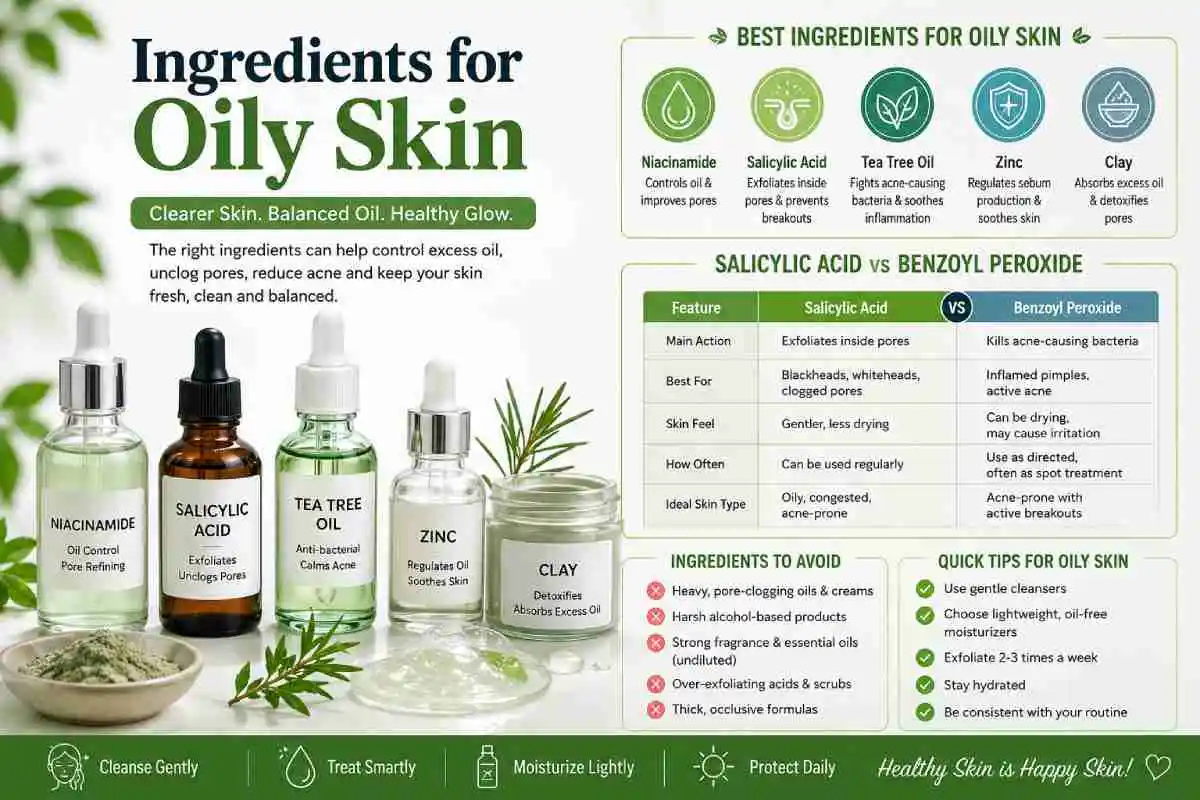
Best Ingredients for Oily Skin Explained
The ideal ingredients for an oily skin-type are those that control sebum production, unblock the pores and that soothe inflammation while being able to hydrate without any excess richness.
| Ingredient | Main Benefit | Best For | Texture/Feel |
| Niacinamide | Regulates oil, enhances pores, fortifies barrier | The daily usage, non uniform surfaces and the large size pores. | Lightweight |
| Salicylic Acid | It also exfoliates the pores and minimises acne and blackheads. | Breakout-prone, congested skin | Light, clarifying |
| Benzoyl Peroxide | Specifically targets the acne producing bacteria | Active breakouts with inflammation | Drying if overused |
| Tea Tree Oil | Natural antibacterial support | Mild acne, oily breakout-prone skin | Best in diluted formulas |
| Hyaluronic Acid | Hydrates without heaviness | Dehydrated oily skin | Water-like |
| Clay | Absorbs excess oil | Oily T-zone, occasional deep cleansing | Matte finish |
| Zinc | Helps reduce excess sebum | Sensitive oily skin | Soothing |
| Green Tea Extract | Calms skin and reduces oiliness | Redness, irritation, acne-prone skin | Gentle |
They should use frequently and in a high enough concentration. Those with oily skin should generally stick to lighter products and non-comedogenic gel moisturizers.
Many beneficial ingredients, such as salicylic acid and tea tree extract, are commonly found in cleansers for oily skin designed to remove excess sebum and unclog pores.
Niacinamide Benefits for Oily Skin
It is not surprising that niacinamide is one of oily skin’s favourite ingredients. This form of vitamin B3 works to balance the skin in so many ways, keeping oily skin in check without a thick or gooey finish.
Ingredients like hyaluronic acid, niacinamide, and ceramides are frequently used in moisturizers for oily skin to provide hydration without increasing shine.
Why Niacinamide Works So Well?
Niacinamide can help reduce the overproduction of sebum, which can in turn also help get rid of that all-day shine that most oily skinned people seem to suffer with. It is able to increase the barrier function of the skin and can therefore be helpful in preventing sensitivity from damaging products.
Key Benefits
| Benefit | How It Helps |
| Oil control | Helps reduce excess sebum |
| Pore appearance | Makes pores look less visible over time |
| Barrier support | Strengthens skin and improves resilience |
| Soothing effect | Helps calm redness and irritation |
| Better texture | Improves roughness and uneven skin tone |
Niacinamide is excellent for people with sensitive and oily skin. Because it’s a more gentle ingredient, it can typically introduce to both morning and evening routine easily. It layers nicely with salicylic acid, hyaluronic acid and gentle moisturizer.
As a general rule of thumb if you have oily yet sensitive skin, niacinamide is one of the gentlest ingredients to begin with.
Many modern sunscreens for oily skin include lightweight, non-comedogenic ingredients that help protect the skin without causing breakouts.
Salicylic Acid vs Benzoyl Peroxide
They are usually listed together as both benefit acne prone skin but have slightly different modes of action.
Comparison Table
| Feature | Salicylic Acid | Benzoyl Peroxide |
| Main action | Exfoliates inside pores | Kills acne-causing bacteria |
| Best for | Blackheads, whiteheads, clogged pores | Red inflamed pimples |
| Skin feel | Usually lighter and gentler | Can be drying and irritating |
| Frequency | Can often be used more regularly | Often used as a spot treatment or carefully in routine |
| Ideal skin type | Oily, congested, acne-prone | Acne-prone with active breakouts |
Which One Should You Choose?
If pores and blackheads and coarse skin texture are your primary concern, then it would be best to start with salicylic acid as it works inside the pore to clear it out.
If your acne is red and angry and current, then benzoyl peroxide would be most helpful as it directly kills the bacteria that cause acne.
Understanding acne-fighting ingredients can improve your approach to acne care for oily skin.
You have oily skin, then many people have found success with a salicylic acid cleanser or serum and a benzoyl peroxide only used on active breakouts. These two ingredients can also use together, you just have to be sure not to overly dry out your skin.
Tea Tree Oil for Acne and Oily Skin
One of the most commonly used natural ingredients for oily and acne prone skin. It is anti-bacterial and anti-inflammatory which means it is beneficial for clearing out breakouts. Knowing which ingredients work best helps you build an effective oily skin care routine.
How It Helps
Tea tree oil can actually kill the bacteria that create acne on the skin and may have some effect on mild inflammation. An all natural alternative that can help decrease the acne bacteria.
Important Note
The essential oil tea tree can never apply directly on the skin undiluted. It’s an essential oil, so pure essential oils can sting and burn the skin-it would be even worse if you have skin that’s already sensitive, red or impaired.
Best Use
Find a cleanser, a spot treatment or a gel that uses tea tree oil, but is properly formulated. This will give you the benefits without irritating.
Tea Tree Oil Pros and Cons
| Pros | Cons |
| Natural antibacterial support | Can irritate sensitive skin |
| May help mild breakouts | Not ideal for very inflamed acne |
| Works well in lightweight formulas | Must be diluted properly |
| Useful for oily skin | Overuse may cause dryness |
Tea tree oil is another useful complementary ingredient but if your acne is more than mild to moderate you should continue to use treatments which have a proven track record. Reading ingredient labels makes it easier to choose the right skin care products for oily skin.
Ingredients to Avoid If You Have Oily Skin
Oily skin doesn’t automatically mean you should exclude all oils and creamy products but there are certain ingredients and textures you can benefit from to make things better. The common mistakes that many people make when it comes to oily skin types are using too many heavy or greasy products, and using a cleanser that is too harsh.
| Ingredient or Type | Why to Avoid |
| Heavy mineral oil-based creams | May feel greasy and clog pores on some skin types |
| Thick comedogenic oils | Can contribute to congestion |
| Harsh alcohol-heavy products | It can also dry skin out leading to increased oil production |
| Powerful scent | Could sting and aggravate break-outs |
| Excessive use of acids | Can damage the barrier and increase sensitivity |
| Thick occlusive layers | May feel suffocating on oily skin |
To conclude don’t use strong detergents-especially ones that leave your skin squeaky clean-they strip your skin barrier, and the skin compensates by creating oil. Opt for mild cleansing, light hydration and regular treatment. Different climates may require ingredient adjustments through seasonal skin care.
Smart Ingredient Pairings for Oily Skin
When oily skin concern, you will notice a quicker response of ingredients when they formulate intelligently rather than haphazardly.
| Skin Concern | Best Ingredient Pairing |
| Excess shine | Niacinamide + lightweight moisturizer |
| Blackheads | Salicylic acid + gel cleanser |
| Active pimples | Benzoyl peroxide + soothing moisturizer |
| Sensitivity with oiliness | Niacinamide + hyaluronic acid |
| Breakouts with redness | Tea tree extract + calming ingredients |
Such a combination works to bring skin into balance. Over-treatment can aggravate an oily complexion, causing it to become parched and prone to more eruptions.
Many botanical ingredients are discussed in DIY and natural remedies for oily skin.
Final Thoughts
Finally, don’t forget, oily skin ingredients don’t have to be dry and stripping but simply need to leave your skin clean, clear and comfortable. Niacinamide can balance oil production and can even help pore look smaller, salicylic acid for blackheads and congestion, benzoyl peroxide to tackle active spots and tea tree oil for oily/spotty skin if used sparingly. Avoid very rich, cloggy, stripping or irritating ingredients.