
Healthy Exercise Habits: A Simple Guide to Staying Active and Fit
 Khizrana Begum
Beauty & Lifestyle Writer
Khizrana Begum writes clear and reader-friendly content covering beauty, lifestyle and related topics.
Read Full Bio of Author →
Khizrana Begum
Beauty & Lifestyle Writer
Khizrana Begum writes clear and reader-friendly content covering beauty, lifestyle and related topics.
Read Full Bio of Author →
 Sameena Begum
Health, Technology & Digital Content Reviewer
Sameena Begum reviews content for clarity, accuracy and overall reader usefulness.
Read Full Bio of Reviewer →
Sameena Begum
Health, Technology & Digital Content Reviewer
Sameena Begum reviews content for clarity, accuracy and overall reader usefulness.
Read Full Bio of Reviewer →
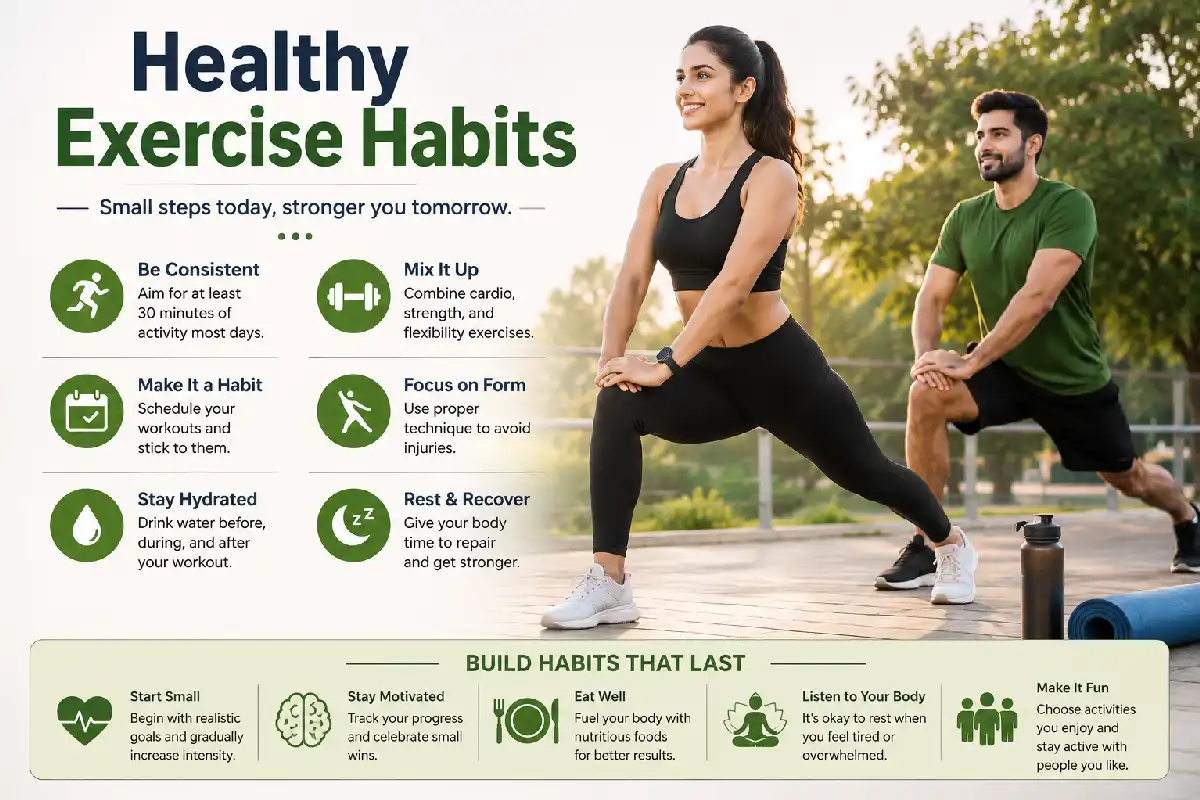
Healthy Exercise Habits: Exercise does not require spending long hours at the gym each day or being subjected to rigorous training. A good workout habit consists of the ability of a person to move his body, to have fun, as well as some time to rest.
Whatever it is that you can stick to, that’s the routine best for you! Walk, cycle, strength train, do yoga, swim, just do home exercises-whatever, as long as you stick with it.
❝
This article is a part of
Healthy Habits Guide
Why Daily Movement Matters
Everyday physical movement is essential for mind and body. We are addressing periods in time when a structured exercise session can not be scheduled. You can cut back on your sitting time, however, by finding opportunities to incorporate movement into your environment, such as using the stairs, walking, and reaching all around the house.
Regular exercise is an important part of building healthy daily routines and supporting overall well-being. Explore our complete healthy habits guide for practical lifestyle ideas.
Routine Physical activity:
Boost cardiovascular health
- Promote normal, healthy muscles and bones
- Enhance range of motion & flexibility
- Help keep a healthy body weight
- Increase energy
- Alleviate everyday stress
- Promote normal, healthy sleep quality
- Promote normal health & concentration
- Promote ease of daily living
There is no need for strenuous workouts every day. It can involve a complete exercise one day, a long walk or some easy stretches another day.
Combining regular physical activity with balanced nutrition can help support an active and healthy lifestyle. Explore our healthy eating habits guide for helpful tips.
How Much Movement Is Enough?
A good method is varying exercises during the week.
| Type of Activity | Examples | Main Benefit |
| Aerobic activity | Walking, cycling, swimming | Supports heart and lung fitness |
| Strength training | Squats, resistance bands, weights | Builds muscle and strength |
| Flexibility work | Stretching, yoga | Supports mobility |
| Balance exercises | Single-leg stands, tai chi | Helps improve stability |
| Light movement | Walking, household tasks | Reduces prolonged sitting |
It’s all about not getting too hung up on “all or nothing” when it comes to exercise. Even if it is just a small amount of movement, it still counts.
Building a Sustainable Workout Routine
Physical activity can complement other healthy routines that support emotional well-being and a balanced lifestyle. Explore our healthy habits for mental health for practical guidance.
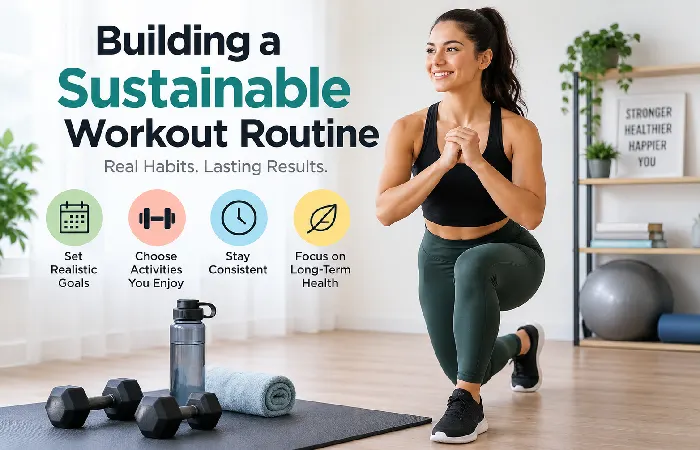
Starting with a workout that is too strenuous is a major workout pitfall. You’ll feel like you can exercise the week through, but too many workouts can be excruciating for your muscles, leading to fatigue or a lack of enthusiasm.
Rather work up to it slowly.
1. Start With Realistic Goals
Focus more on what is sustainable rather than what seems impressive.
As an example, if you’re completely sedentary; 20-30 mins of walking 3-5 times a week may be far more maintainable then attempting 2 high intensity work-outs each day.
2. Mix Different Types of Exercise
Balancing routine can cover cardiovascular exercises, strength training, mobility and recovery
For example:
| Day | Example Activity |
| Monday | Strength workout |
| Tuesday | Brisk walking |
| Wednesday | Mobility or yoga |
| Thursday | Strength workout |
| Friday | Walking or cycling |
| Saturday | Recreational activity |
| Sunday | Rest or gentle movement |
There could be a totally different structure! The goal here is to come up with a structure that works for you!
3. Increase Gradually
Don’t jump your workout session by hours or significantly in intensity/frequency from week to week. If you feel an exercise suddenly gotten so hard, then lessen it by a bit or rest longer. Workouts should be challenging, yet not make you tired.
4. Choose Activities You Enjoy
It’s easier to stick to exercise if it doesn’t feel like you are being punished.
Regular movement and consistent exercise habits can be useful parts of a sustainable approach to weight management. Explore our healthy habits for weight management for helpful ideas.
Try different activities:
- Dancing
- Hiking
- Swimming
- Jogging
- Cycling
- Yoga
- Strength training
- Sports
- Walking with friends
Pleasure can be a great motivator-
Staying Active Throughout the Day
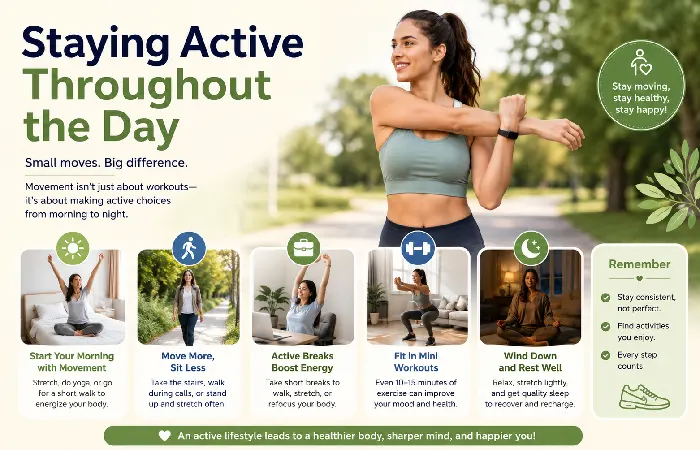
Exercise is just one element of being active. While a 30-minute gym session is great, you will significantly benefit even if the rest of the day is spent seated with a few short bursts of movement thrown in.
Think about movement in a more natural way.
Simple Ways to Move More
- Go on short walks at work.
- Take the stairs where possible.
- Take walks while speaking on the telephone.
- Get up frequently if you sit at a desk.
- Walk further when you park your car where possible.
- Get out to stretch while on short breaks.
- Go for a walk after eating a meal.
- Do your domestic tasks actively.
- Get outdoors for a short while leisure activity.
- Set reminders to not sit at a desk for too long.
Every bit of free time doesn’t need to involve a set exercise. You just need to try to integrate activity into your daily life.
Desk-Friendly Movement
Sitting much of the day at a desk, why not try this easy movement cycle:
Encouraging children to stay active through age-appropriate movement and play can help them develop positive routines. Explore our healthy habits for kids for practical tips.
Sit → stand → walk → stretch → return to work.
Even if it’s only a minute or two between bouts of sitting there’s still some physical action in your day to break things up.
Recovery and Rest Days
Rest is never time wasted, it is crucial for good training.
Exercise is essentially a stress that damages your body, but recovery allow it to recover and prepare to the next workout.
If you present any of these symptoms, you should recover a bit more:
- Muscles still ache as much
- Always feeling unusually tired
- Workout didn’t work as well as it could have
- Sleep is really a bit difficult
- Lack of desire
- Seem to be getting unusually irritable, even more so than usual.
- Each exercise is harder than it previously has been to do.
What to Do on Rest Days?
A rest day does not always need to be laying in bed for the whole day. You can engage in light exercise such as, depending on how you feel::
- Easy walking
- Light stretching
- Gentle yoga
- Mobility exercises
- Relaxation activities
Exactly how much recovery needed varies according to: intensity of your workout, fitness level of your fitness level, sleep, nutrition, your age, and your situation.
Sleep and Exercise Recovery
Resting will assist you with physical and mental recovery to get you ready for your next workout. Focus on a stable and regularly maintained sleep schedule, as it is not something you can disregard when your workout schedule heats up. Constant tiredness should be treated with more rest and good sleep, rather than increasing the volume.
Making exercise a consistent part of your routine becomes easier when you understand how healthy habits are formed and maintained. Explore our guide to how healthy habits work for useful insights.
Common Fitness Mistakes
Everyone, even the fitness-minded, is prone to creating habits that undermine their workouts or make them difficult to stick with.
| Common Mistake | Why It Can Be a Problem | Better Approach |
| Doing too much too soon | Can increase fatigue and injury risk | Progress gradually |
| Skipping warm-ups | May leave your body unprepared | Start with easy movement |
| Ignoring recovery | Can contribute to excessive fatigue | Schedule rest and lighter days |
| Focusing only on cardio | Leaves strength and mobility undertrained | Use a balanced routine |
| Chasing perfection | Makes missed workouts feel like failure | Focus on consistency |
| Poor exercise technique | Can reduce effectiveness and increase injury risk | Learn proper form |
| Comparing yourself with others | Can create unrealistic expectations | Track your own progress |
| Exercising despite significant pain | May worsen an underlying problem | Stop and seek appropriate advice |
| Changing routines constantly | Makes progress difficult to track | Stick with a routine long enough to assess it |
Don’t Ignore Pain
This doesn’t mean the discomfort of normal exercise is the same as injury pain: fatigue and minor muscle aches can happen after you start doing new things but severe, worsening or constant and acute pain warrant investigation.
If you have suffered an injury, have a medical problem, or have serious symptoms; you may need to seek advice from appropriate healthcare professional before altering your exercise.
How to Make Healthy Exercise Habits Stick
Establishing a habit requires removing unnecessary barriers from the equation. Try these tips:
- Make it convenient: Find a gym, park, walking path or at-home option that naturally slots into your schedule.
- Make it routine: Exercising at the same time will also help build movement into a habit.
- Track your success: Log your runs, time spent walking, strength gained or just your consistency with movement.
- Set realistic expectations: Don’t let a missed workout be a complete setback.
- Take smaller steps: Rather than declaring, “I need to get in shape,” set realistic goals, like walking 20 minutes each day, or performing two strength sessions during the week.
- Have a backup plan: If you don’t have time to squeeze in your workout, go for a quick walk or do a 10-minute mobility session instead. It has to be able to withstand your chaotic life.
FAQs
1. Is it healthy to exercise every day?
It is possible depending on the type of activity and its intensity. Daily activity is good, but your daily schedule should incorporate not just strenous activity but lighter activities and enough rest.
2. How long should a workout be?
What actually works when you exercise is that there’s no single “right” length of time for your workout. Even shorter workouts are perfectly viable and effective. The specific length of time your workouts need to be is largely determined by your fitness objectives, how experienced and fit you are, how much time you have available, and indeed, whatever exercise you are performing.
3. Can walking count as exercise?
Certainly. A brisk walk is a readily available cardio exercise and is perfect for beginners starting out with routine exercise.
4. Should I exercise when I am sore?
Slight muscle soreness is okay. If you feel that moving around a bit would be comfortable, don’t try to intensely train the muscles which feel very sore and painful.
5. Do I need a gym to stay fit?
No, things like walking, bodyweight exercises, resistance bands,cycling, dancing, yoga and other many many things you can do not at the gym.
6. What is the most important exercise habit?
Consistency: A manageable program you stick to for months is better than an insanely tough one that you quit after days.
7. How can beginners avoid exercise burnout?
Go slow and steady, Mix up exercises and activities, schedule rest and recovery, be realistic with what you want to achieve, and do not try and transform yourself from zero to hero on a Tuesday morning.
Final Thoughts
When building healthy fitness habits, its not about seeing how hard you can go each day its about making movement sustainable in your life.
Choose things you enjoy; slowly add to your load; continue moving; emphasize recovery; don’t be afraid of easier days. Ultimately, the workout schedule that you can stick to is the best one for you.