


Healthy Habits for Weight Management: Build a Sustainable Healthy Lifestyle
 Khizrana Begum
Beauty & Lifestyle Writer
Khizrana Begum writes clear and reader-friendly content covering beauty, lifestyle and related topics.
Read Full Bio of Author →
Khizrana Begum
Beauty & Lifestyle Writer
Khizrana Begum writes clear and reader-friendly content covering beauty, lifestyle and related topics.
Read Full Bio of Author →
 Sameena Begum
Health, Technology & Digital Content Reviewer
Sameena Begum reviews content for clarity, accuracy and overall reader usefulness.
Read Full Bio of Reviewer →
Sameena Begum
Health, Technology & Digital Content Reviewer
Sameena Begum reviews content for clarity, accuracy and overall reader usefulness.
Read Full Bio of Reviewer →
Healthy Habits for Weight Management: The key to weight management is to remember that it is forever and try to look at how you can stick to certain changes for the weeks, months and years ahead. While cutting calories dramatically and restricting foods may offer quick results you will likely fail to stick to this kind of diet.
A healthy way to eating, exercise, enough sleep, relaxation techniques and realistic goals will get you the desired health benefit.
Weight management is also about doing much more than having a particular number as your main goal. It is about working toward lifestyle changes and healthy habits that will keep your energetic, fit, correctly fed, and your overall feel to a high level, enabling you to keep weight at a manageable and healthy range.
❝
This article is a part of
Healthy Habits Guide
Healthy Lifestyle vs Dieting

Many people get confused between having a healthy lifestyle and ‘doing a diet.’ A diet is generally aimed at quick and easy ways of losing weight often through strict rules or by eating less food. But a lifestyle, can contain natural habits to make you feel well.
| Healthy Lifestyle | Short-Term Dieting |
| Focuses on long-term habits | Often focuses on quick results |
| Includes a variety of foods | May eliminate entire food groups |
| Allows flexibility | Can involve strict food rules |
| Encourages regular activity | Exercise may be used only to burn calories |
| Supports overall health | May focus mainly on the scale |
| Easier to maintain long term | Can be difficult to sustain |
Try to lose the ‘good’ or ‘bad’ perception for foods and learn to integrate these in your diet. Occasional treats will not have an effect on the bigger picture, it will rather be the long-term pattern of your consumption that really matters.
A sustainable approach also gets rid of unnecessary guilt. Just get back to your plan at the next time that you can, don’t cut back even further than intended to “make up for it.”
Eating Habits That Support Weight Goals
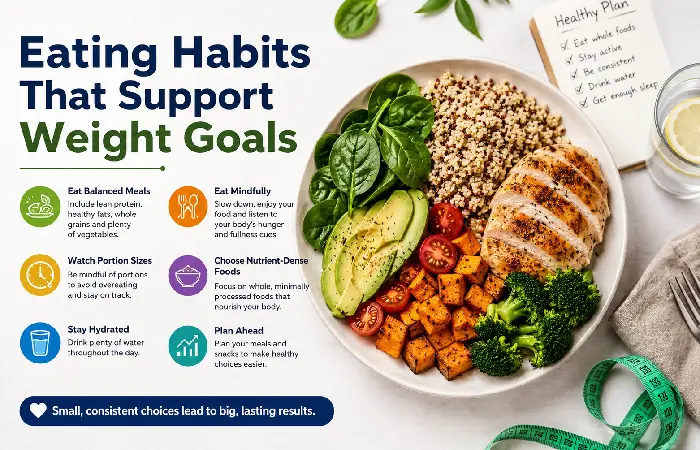
Healthy weight management is easier to approach when it is supported by consistent daily routines and balanced lifestyle choices. Explore our complete healthy habits guide for practical ideas.
You can simplify the process of weight management simply by altering your usual eating practices, without the need to precisely count all of your calories. Begin to create well-rounded and complete meals. Foods in these meals are most valuable when it includes food items that were once considered as being packed with nutrients, fiber and protein.
Build Balanced Meals
A balanced and nutritious meal has fruits or vegetables, a source of protein, and whole grain or another other high-fiber carbohydrate and and a moderate of fat source.
| Food Group | Examples | Why It Helps |
| Protein | Eggs, fish, beans, lentils, yogurt | Supports muscle and fullness |
| Vegetables | Spinach, carrots, broccoli, tomatoes | Provides fiber and micronutrients |
| Fruits | Apples, berries, oranges, bananas | Provides fiber and nutrients |
| Whole grains | Oats, brown rice, whole-grain bread | Provides fiber and sustained energy |
| Healthy fats | Nuts, seeds, avocado, olive oil | Adds flavor and supports nutrient absorption |
Practice Mindful Eating
Chew and eat more slowly. Pay attention to your feelings of hunger and fullness and ask yourself what these things means to your body. Eating in front of the TV, computer or while talking on the phone makes it easy to miss your body’s signals that it’s had enough.
- Simple actions like:
- When able, eat meals at a table
- Chew more slowly when eating
- Sip water throughout the day
- Eat if and only when hunger is triggered (not the automatic response)
- Eat sensible meal sizes
- Avoid casual nibbling/grazing throughout the day
Your favorite foods do not necessarily need to be totally banned. Learning what serving size is right and how often to enjoy them, is usually a more effective practice than a long list of no-no’s.
Exercise Habits for Weight Management
Physical activity also has other benefits asides just burning calories that will make a difference to managing weight. A routine of regular movement can help your cardiovascular system, strength, flexibility and improve your mood and energy during the day. The optimum mix of fitness activity for adults and muscle-strengthening exercise. Most importantly, pick things you truly like, consistency beats finding the ideal program.
Balanced nutrition and consistent eating habits can play an important role in maintaining a sustainable approach to weight management. Explore our healthy eating habits guide for helpful tips.
| Type of Activity | Examples | Potential Benefits |
| Walking | Brisk walking, hiking | Cardiovascular fitness and daily movement |
| Aerobic exercise | Cycling, swimming, dancing | Improves endurance |
| Strength training | Weights, resistance bands, bodyweight exercises | Builds and maintains muscle |
| Flexibility work | Stretching, yoga | Supports mobility |
| Everyday movement | Stairs, household tasks, active breaks | Increases overall activity |
If your currently exercising for nothing, then this could be a really good way to begin to increase your daily movement output. A walk outside every day, simple workout on the home exercise mat, or more movement through out your work day would suffice as a great way to get going.
As training can become increasingly significant on strength training principles alone, as having increased amounts of muscle at that weight becomes imperative for weight loss!
Tracking Progress Effectively
Monitoring your success would tell you what’s working but shouldn’t be your only form of measurement from the scale
Body weights fluctuate from day to day due to your hydration level, how much food you’ve eaten, the amount of sodium you’ve consumed, hormonal differences and if you’ve defecated. Using long term data would be more informative.
Taking care of mental well-being can complement healthy lifestyle changes and support a more balanced approach to everyday habits. Explore our healthy habits for mental health for practical guidance.
| Progress Measure | What to Monitor |
| Body weight | Long-term trend rather than individual readings |
| Waist measurement | Changes in body measurements |
| Fitness | Walking, strength, endurance, or stamina |
| Energy | How energetic you feel during the day |
| Food habits | Meal patterns and portion awareness |
| Sleep | Consistency and quality |
| Mood | Stress, motivation, and overall well-being |
That’s all you need, a simple habit tracker. Log workouts, foods eaten, sleep, water consumption and other behaviors you wish to change.
Don’t get to bogged down in tracking. If weighing oneself daily does cause that amount of grief, start tracking weights on a weekly scale, or focus more on behavioral goals.
Teaching children healthy routines early can help them develop positive habits around nutrition, activity, and overall wellness. Explore our healthy habits for kids for useful ideas.
Avoiding Common Mistakes
Weight-management plans can fall through due to restrictive or unrealistic goals and methods. Avoid potential errors by creating achievable habits.
1. Setting Unrealistic Goals
This kind of expectation can make you get easily disappointed. Establish small behavior changes: incorporate more veggies in your meals, walk regularly, cook at home.
2. Skipping Meals to “Save Calories”
Can also make you feel very hungry later, and lead to problems with eating more balanced diet. Maintaining regular meals may be easier.
3. Eliminating Favorite Foods
If you eliminate all foods that you love and want, you may increase cravings and feel that it is not sustainable.
4. Relying Only on Exercise
Exercise is vital, but weight is a sum of one’s food, activity, sleep, stress, etc., patterns.
5. Focusing Only on the Scale
All important changes are not recorded by a scale. Better fit, stronger, energized, sleep and nutrition is good to see.
6. Expecting Perfection
Skipping a workout or overeating one day does not mean it has ruined it all! One meal, one day will not define your lifestyle in the long-run.
FAQs
Is dieting necessary for weight management?
Not necessarily. Long-term and healthy weight maintenance tends to include eating well with exercise on the side, not with dieting of an extreme nature. If weight loss is suitable for you, there can be a slight more sustainable reduction in body weight with ease.
What is the best exercise for weight management?
It depends on what type of activity you love to do. It will be easy to keep this activity a routine if you love it! Walking, cycling, swimming, dancing, strength training all can count for an active exercise:
How often should I exercise?
Aim for routine weekly activity comprising of both cardiovascular and muscular training. When coming from very low activity, progress more slowly rather than a huge initial increase
Should I count calories?
Tracking calories may work for some people, and not others. But taking an interest in portion sizes, the type and quantity of foods consumed, satiety, and hunger may be enough.
Can I eat snacks while managing my weight?
Yep. Choose satisfying snacks when you have hunger pangs and remember protein/fiber/both containing options: yogurt with fruit, veggies with humous or a small hand-full of nuts.
Understanding how healthy habits develop can make it easier to create routines that support long-term lifestyle goals. Explore our guide to how healthy habits work for more information.
How long does healthy weight management take?
There is no definitive timeline. Some factors at play here involve current weight, diet, movement, sleep, underlying health issues, medication, and genetics. Building healthy habits is much more important that adhering to a rigid timeframe
Regular physical activity can complement balanced nutrition and other daily habits when working toward healthy weight management. Explore our healthy exercise habits guide for practical ideas.
Final Thoughts
Achieving a healthy weight balance isn’t about perfection or following another in the long string of diets that promises to make you healthy but eventually feels futile. The only habits which count are those that are doable, that you can consistently do: consume balanced meals, be active, track real progress in a way that benefits you, get adequate sleep and allow some wiggle room.
Remember, health maintenance is now and will forever be an on-going thing, not a 90 day project. Small habits, once repeated often enough, are powerful.