

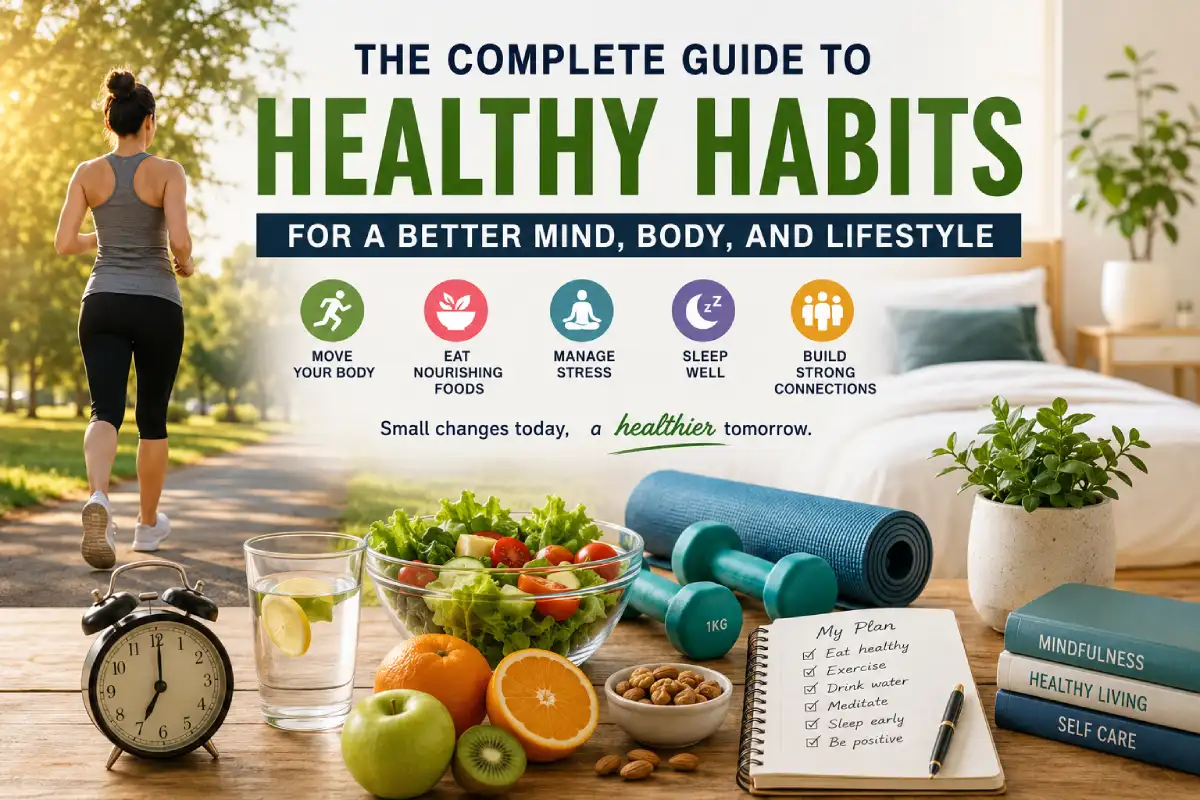
The Complete Guide to Healthy Habits for a Better Mind, Body, and Lifestyle
 Khizrana Begum
Beauty & Lifestyle Writer
Khizrana Begum writes clear and reader-friendly content covering beauty, lifestyle and related topics.
Read Full Bio of Author →
Khizrana Begum
Beauty & Lifestyle Writer
Khizrana Begum writes clear and reader-friendly content covering beauty, lifestyle and related topics.
Read Full Bio of Author →
 Sameena Begum
Health, Technology & Digital Content Reviewer
Sameena Begum reviews content for clarity, accuracy and overall reader usefulness.
Read Full Bio of Reviewer →
Sameena Begum
Health, Technology & Digital Content Reviewer
Sameena Begum reviews content for clarity, accuracy and overall reader usefulness.
Read Full Bio of Reviewer →
The first step toward a more wholesome lifestyle probably doesn’t feel particularly heroic. Most likely it will look a lot like the everyday – reaching for a glass of water to awaken, a short walk after lunch, fewer scrolls through more apps before falling back asleep, one additional attempt to actually cook something at dinner, or an intentional pocket of five minutes for pure breathing. Viewed individually, they’re hardly anything:
But repeated day after day, they build on one another and can affect your mood, your thoughts, how you work, how you sleep, and how you engage with the rest of the world.
That’s the magic of healthy habits — they move your good intentions into everyday action. This comprehensive resource explores practical, healthy habits to nourish your mind, body, emotions, work ethic, relationships, and overall lifestyle. The idea isn’t to aim for impossible perfection. A sustainable structure should align with your actual life—crazy schedules, stress-filled weeks, holidays, travel, and days where none of your plans go anywhere near unfolding as anticipated.
Healthy eating habits are an important foundation for maintaining energy, supporting overall wellness, and making balanced choices each day. Explore our healthy eating habits guide for practical tips.
❝
This article is a part of
Healthy Habits Guide
What Are Healthy Habits?

Healthy habits, when referred to here, will consist of regular and repeated behaviors that are beneficial to our physical, psychological, and even spiritual health and happiness on a daily level. When we mean practice, we are referring not to an isolated event or action, but to actions that become increasingly easy and routine to perform, so we are no longer consciously aware of or thinking about doing them.
Healthy habits can be surprisingly ordinary:
- Eating nutritious meals regularly
- Drinking enough fluids
- Moving your body throughout the day
- Getting adequate sleep
- Maintaining personal hygiene
- Spending time outdoors
- Managing stress
- Staying socially connected
- Taking breaks from screens
- Making time for hobbies
- Practicing gratitude or reflection
- Seeking help when you need it
A critical fact that is always missed: ‘Healthy’ is NOT extremism.
Taking care of your mental well-being is an essential part of developing a healthier lifestyle. Explore our healthy habits for mental health for practical ideas and guidance.
Your eating style cannot and need not be perfect. Nor must you hit the gym every single day for 2 hours! Nor must your mornings be 2 pages of a perfect ritual of a ‘morning routine’. Any kind of routine based on perfection is actually impossible to follow. The best routines are achieved through repetition.
Healthy Habits vs. Healthy Goals
A goal is something that you wish to do. A habit is something you do frequently.
For example:
Goal: Shed 5 kilograms
Habit: Daily 30-minute walk most days.
Or:
Goal: Feel relaxed
Habit: Get offline for 10 minutes before bed.
The destination is determined by the plans – the journey, by habit.
Why Healthy Habits Matter

All the small things we do on a day-to-day basis add up. A few extra hours of sleep one night won’t make or break you, but weeks and years of sleep will impact you in ways few things can. One skipped training session? That won’t make or break your life, but the consistent habit of going to the couch after a few tough days will have an effect.
We can all conceptualize habit as a vote for the life you want to build.
Ordering a salad for lunch is one vote to build a body that can thrive. Going to bed at a decent time is a vote for recovery and growth. Calling a friend is a vote to nurture healthy relationships. Choosing a brief walk instead of my desk is a vote to create a body capable of walking later in life.
Maintaining a healthy weight can be supported by consistent daily habits, balanced nutrition, and regular activity. Explore our healthy habits for weight management for useful tips.
None of these choices has to be perfect.
Physical Benefits
Healthy routines can support:
- Cardiovascular health
- Healthy body composition
- Strength and mobility
- Energy levels
- Digestive health
- Immune function
- Bone health
- Physical independence as you age
Mental Benefits
The activities and patterns of your life closely relate to how you feel on the inside. It is possible that with enough rest, physical activity, support, diet, and time alone, this has already assisted your mental state.
Lifestyle Benefits
Good habits can also simplify the day-to-day. When sleep, food, exercise, planning, and personal tasks have an established format, the amount of mental energy expended considering the subsequent activity decreases.
A routine isn’t about managing every single moment of the day.
A routine is about making things that have to be done easy to remember.
The Science Behind Habit Formation
The process of habit creation is commonly explained using this very simple loop:
Cue → Behavior → Reward
Children can benefit from developing healthy routines early, including nutritious eating, active play, and good daily habits. Explore our healthy habits for kids for practical ideas.
Cue – Something that cues an action or behavior to occur. Behavior – The response or action itself. Reward – Positive reinforcers are desirable incentives for continuing or repeating behaviors.
For example:
Cue: Finish breakfast
Behavior: Walking for 10 minutes
Reward: Listening to favorite podcast
Eventually, they can become conditioned.
Another useful concept is habit stacking.
What Is Habit Stacking?
A habit stack involves linking a new habit to a current habit:
The cue is the existing habit.
Instead of saying ‘ I need to start stretching ‘,
I’ll build this habit: ‘ As soon as I finish brushing my teeth in the morning,
I will stretch for 5 mins ‘.
Why Small Habits Work
A small starting size lowers the resistance.
>So you want to exercise.
So the idea of working out for 90 minutes each day sounds good but not realistic.
So you could try making a smaller initial goal:
“I will go for a 10-minute walk after dinner.” Once that sticks, make it longer.
The best habit is not always the biggest one.
This is the only repeatable one.
How to Build Healthy Habits That Last
Getting started on a good habit is less about increasing your motivation levels and more about changing your surroundings.
1. Start With One Change
Do not start your Monday morning redesigning your whole world.
Understanding how healthy habits work can make it easier to turn positive lifestyle choices into consistent routines. Explore our guide to how healthy habits work for helpful information.
Pick just one habit that would have an impact, and run with that.
For example:
- Drink water regularly.
- Walk after lunch.
- Go to sleep 30 minutes early.
- Eat without pulling out your phone. Get 10 minutes to sort tomorrow out and prioritize your day.
2. Make the Habit Specific
I want to exercise more.
Action: Each Monday, Wednesday, Friday, and Saturday, I will do a twenty-minute post-meal run. In this case, it is easier to establish a certain number of habits, since your criteria for success can be predetermined by you.
3. Reduce Friction
Make healthy easy.
Keep trainers near the door.
Have healthy snacks available before hunger sets in.
Don’t let your mobile phone be within reach of the bed. The system is directing you, subtly but actively.
4. Track Progress Without Becoming Obsessed
You could have a simple calendar, checklist, or notes app to help you keep track of your habits.
Also, one missed session does not negate the habits you have formed prior.
Consistency is not about never skipping a session; it’s about going back to that session as consistently as possible.
Daily Healthy Habits for a Better Life
Good health is not usually the result of one giant step, but of small steps adding up to something significant.
| Area | Simple Daily Habit |
| Hydration | Have a lot of water every day |
| Movement | Don’t just sit around: Take a walk! |
| Nutrition | Load up on nutritious whole foods. |
| Sleep | Maintain a consistent sleep routine. |
| Mental health | Take intentional breaks |
| Relationships | Connect with someone you care about |
| Productivity | Choose a few important priorities. |
| Recovery | Make time for rest |
| Personal growth | Read, learn, or practice a skill. |
I don’t need to cover it all every day; think of it as ordering a meal!
Healthy Morning Habits
The way you begin your day seems to determine the rhythm of the rest.
That doesn’t mean I have an elaborate routine involving getting up at 5 AM.
Regular exercise is an important part of an active lifestyle and can complement other healthy daily habits. Explore our healthy exercise habits guide for practical ideas.
Healthy mornings can be wonderfully simple!
Drink Water
After sleeping, a feeling of thirst commonly occurs many times. Drinking water first upon arising is considered a simple way to re-hydrate one self.
Get Some Natural Light
The natural light received during the daytime may influence the adjustment and control of the internal body clocks controlling wake and sleep timing during subsequent days.
Open the blinds up.
Step out onto a balcony.
Take a short stroll outside.
Avoid Immediately Reaching for Your Phone
Notifications are sending messages, news, social media, emails, even work straight to your head, before it’s even ready for all that… Spend 15 or even 30 minutes without checking…
Move Your Body
Morning movement does not need to be intense.
Try:
- Gentle stretching
- A short walk
- Mobility exercises
- Yoga
- Light bodyweight exercises
Eat a Balanced Breakfast if It Suits You
If you find you want an optimum start to your day with a satisfying, healthy, and wholesome Breakfast (a combination of the protein that you can obtain, mixed along with healthier carbs in the form of fibre-filled meals, vegetables, fruit, and even a little fat could be fantastic for you.
Everyone is going to find something that makes a “perfect breakfast for them.
Healthy Evening Habits
Evenings aren’t a time for productivity but more for transition
Your body and mind need an indication that the heavy lifting part of your day is nearly over.
Create a Wind-Down Period
Spend the last part of your evening doing quieter activities:
- Reading
- Stretching
- Taking a warm shower
- Journaling
- Preparing clothes for tomorrow
- Listening to relaxing music
Reduce Screen Stimulation
With bright screens, emotive media and constant notifications, it’s becoming harder to simply mentally switch off. You don’t necessarily need to avoid screens altogether; even developing a pre-sleep screen-free block of time for yourself can encourage stronger sleep habits.
Prepare for Tomorrow
Give yourself five minutes, and use that time to really figure out where it is you actually need to be directing yourself for the next 24 hours. Don’t sit and stew about how you’re never going to fall asleep within your own mind.
Healthy Eating Habits
Healthy eating. No magical food. Only a balanced diet so our body gets all the needed nutrients and energy.
What Is Balanced Eating?
Proper eating habits mean consuming nutrient- and protein-rich foods on time, regularly. Apart from that, it comprises fiber, healthy items, fat, and carbs as well.
A practical plate might include:
- Vegetables or salad
- A source of protein
- Whole grains or another carbohydrate source
- Healthy fats
- Fruit when appropriate
Some good food examples include those which are naturally present in fruit and veg, beans, lentils, nuts, seeds, grains, eggs, milk or dairy type products, fish as well as all protein type food.
Eat More Mindfully
Mindful Eating means paying attention to the food you are eating and how you eat it – not eating thoughtlessly or absentmindedly. Try putting down the phone when you are eating. Chew slower.
Note the flavours and textures.
Pay attention to whether you feel that you are truly hungry or feel hungry.
Do Not Turn Food Into a Moral Test
It doesn’t have to be food good or bad. Healthy eating has space for fun. Eating birthday cake does not mean that your health will not be healthy.
Eating a bowl of vegetables can, too.
It depends on the point of view of seeing it, as well as the size.
Healthy Exercise Habits
If there is one habit you would ever cultivate that could bring greater reward to your life, it is exercise. However, exercise does not have to be a grueling training regimen. Any movement in which energy is exerted is considered physical activity; exercise is planned physical activity to improve or maintain physical fitness.
Useful forms of movement include:
- Walking
- Cycling
- Swimming
- Dancing
- Running
- Strength training
- Yoga
- Sports
- Mobility work
Combine Different Types of Movement
A balanced routine can include:
| Type | Examples | Main Purpose |
| Aerobic | Walking, cycling, swimming | Cardiovascular fitness |
| Strength | Resistance exercises, weights | Muscle and strength |
| Mobility | Stretching, mobility drills | Range of motion |
| Balance | Single-leg exercises, certain yoga movements | Stability |
On most days of the week, adults should try to incorporate exercise and consider strengthening. The health professional will be able to assist them in choosing what form of exercise would be best for a condition, an injury, or a way of activity.
Make Exercise Enjoyable
The workout you do consistently is the ideal workout for you. Obviously, you are not going to become a runner just to be a runner.
Dance. Run. Walk. Swim. Jump on the trampoline. Play tennis. Badminton. Play with kids. Lift weights. Bicycle.
Exercise is a sustainable relationship that I am choosing to stay in; not a brutal session to which I am submitting.
Healthy Sleep Habits
Sleep is not wasted time.
This helps both the mind and the body rejuvenate. Effective sleep hygiene is a process used to create the behaviors and environmental and behavioral conditions that ensure better sleep.
Helpful sleep habits include:
- Set a consistent wake-up time and bedtime.
- Establish a relaxing bedtime ritual.
- Make sure your bedroom helps you sleep.
- Avoid caffeine late in the evening.
- Don’t make sure you get into doing late-night workouts.
- Go to bed for a longer period.
You probably require between 7 and 9 hours of sleep. Maybe it applies to your case, or perhaps entirely different.
.Healthy Habits for Mental Well-Being
Mental well-being isn’t being happy all the time. There will be a mixture of loss, fear, surprise, disappointment, frustration, grief, worry, boredom, and pleasure. Generally speaking, it comes down to how a person can cope, function, and get on with the normal aspects of life and relationships. Many habits can build this up.
Spend Time Outdoors
There’s nothing like a walk around the park, or some time spent in nature, to allow you a break from your screen and life indoors.
Practice Mental Pauses
No need for hour-long sessions on a cushion! Try the two-minute version – just breathe and observe what’s there.
Protect Your Attention
Constant notifications can fragment concentration.
Turn off unnecessary alerts. Give important tasks your full attention when possible.
Make Time for Enjoyment
There’s nothing silly in hobbies! Any form of interest – novels, cooking, gardening, gaming, playing with numbers, anything that involves taking pleasure and rejuvenation should not be neglected!
Ask for Support
The most wonderful thing you will ever do for your own physical self is to know and decide when you should be asking for help. This particular idea will benefit you even more if depression, stress, or unhappiness can be taking over and it becomes too difficult to keep going.
Healthy Habits for Emotional Wellness
Emotional health means that one can be aware of, interpret and respond to one’s emotions in adaptive ways.
It means that you do not remain a stoic with no feelings, but that there are ways one might manage one’s emotions more effectively.
Name What You Feel
Instead of saying, “I feel terrible,” try identifying the emotion:
- Frustrated
- Lonely
- Worried
- Disappointed
- Overwhelmed
- Excited
Naming emotions can make them easier to understand.
Pause Before Reacting
Whatever the situation that bothers you, take a pause.
Take a breath. Walk away if necessary. Respond when you are calmer.
Keep Perspective
A bad afternoon is not necessarily a bad life.
One error is not what can define your capacity.
A single failed result does not define who you are or who you will be.
A useful form of emotional behavior is to begin to detach the incident from the experience.
Healthy Habits for Productivity
Productivity is not striving to do more every single second.
Productivity is doing the important stuff in an efficient and effective manner, without completely wearing out all your energy, mental focus, physical being, and resiliency.
When you get out of bed, just think: to-do list.
What will you try to achieve out of those things: three things?
Then ask:
“What actually needs my attention today?”
Use Focus Periods
Work for a defined period without unnecessary distractions. Then take a short break.
Stop Treating Rest as Laziness
A brain that never gets a break eventually becomes less effective.
Rest can improve your ability to return to work with clearer attention.
Create Boundaries
Separate your work life from your play life, if at all possible.
After an exhausting day of tedious, difficult chores it amazes people of how stressful the time always appears to be
Healthy Habits for Strong Relationships
A basic human need is connection.
Healthy love isn’t about the flashy grand gestures. Most of the time, it’s the accumulation of normal moments that carry it forward.
Listen Properly
Hearing isn’t about waiting your turn to speak.
Put down the phone. Pay attention. Ask questions.
Express Appreciation
Tell people when you appreciate them.
A simple “I really value what you did” can carry more weight than we realize.
Make Time
Stay engaged with your relationships – a quick chat on the telephone, grab lunch, go for a walk with them, ring them once a week.
Respect Boundaries
Healthy relationships have boundaries.
Respect those of the other person and establish your own.
Common Unhealthy Habits to Break
The habits, however insidious they may be, slowly drain you of energy, and it takes quite some time for you to notice this.
Common examples include:
- Constantly checking notifications
- Sleeping at inconsistent hours
- Sitting for long periods without movement
- Skipping meals and then overeating later
- Relying heavily on highly processed foods
- Avoiding important responsibilities until the last minute
- Comparing yourself constantly with people online
- Neglecting friendships
- Working without adequate breaks
- Ignoring persistent physical or emotional concerns
It’s harder to break a habit than start one because the habit can already become more established due to its relationship with times, places, moods, people, or parts of the day.
Replace Rather Than Simply Remove
The case where I always reach for my phone out of boredom.
Instead of: “I am not going to reach for my phone,” I said it as:
“When I’m bored, I will get up and stretch, or read a book for 5 mins first.”
Changing one habit gives my brain a new action.
How to Stay Consistent with Healthy Habits
Most plans start with a blast of motivation, even a heavy dose of (unrealistic) optimism, but then you’re in real life and:
there’s stress from work, someone gets ill, there’s travel, lack of sleep, and the answer is certainly not to give it all up.
Use the Minimum Version
Create a smaller version of the habit for difficult days.
For example:
- Full habit: 45-minute workout
- Minimum habit: 10-minute walk
Or:
- Full habit: Cook a nutritious dinner
- Minimum habit: Prepare a simple balanced meal
The minimum version protects continuity.
Follow the “Never Give Up Twice” Principle
Missing one day happens.
Try not to let one missed day become a missed week.
Expect Imperfection
A healthy lifestyle needs to outlast the difficult days.
You’re building a lifestyle, not a 30-day program.
Creating a Personalized Healthy Habits Plan
One size fits all doesn’t exist.
A college student may need a different daily plan than a parent.
An employee may need a different daily plan than an athlete.
The entrepreneur is different from the retired person.
Step 1: Identify Your Priorities
Ask yourself:
- Do I need more energy?
- Do I want to improve my sleep?
- Am I sitting too much?
- Are my meals irregular?
- Am I engaging in sufficient stress management?
- Am I scheduling quality time with my favorite people?
- Am I using healthy boundaries around work or screen time?
Step 2: Choose Three Habits
Do not begin with 15.
You should commit to three life-changing habits.
For example:
Morning – have a glass of water, do 10 minutes of outdoor time.
Afternoon – take 5-minute stretch breaks, move.
Evening – no devices within 30 minutes of bedtime.
Step 3: Decide When and Where
Combine the habit with a triggering event.
“I will walk for 10 minutes after my dinner.”
This makes it a lot easier to keep in mind than “I should walk more”.
Step 4: Make It Easy
Make the healthy life easy. Keep snacks and prep meals. Put workout outfits where you will see them.
Set alerts or alarms.
Declutter your visible field.
Step 5: Review Weekly
- What worked?
- What felt difficult?
- What kept getting in the way?
- What can I make easier?
- What should I change next week?
It makes habit-making a perpetual experiment, instead of a pass-or-fail test.
A Simple Healthy Lifestyle Blueprint
If you desire to begin in practice, then:
| Time | Healthy Habit |
| Morning | Water, natural light, gentle movement |
| Breakfast | Nutritious meal if desired |
| Work/Study | Focus periods with regular breaks |
| Lunch | Balanced meal |
| Afternoon | Short movement break |
| Evening | Exercise or recreational activity |
| Dinner | Enjoy a balanced meal mindfully. |
| Night | Reduce stimulation and prepare for sleep. |
| Bedtime | Consistent sleep routine |
One of the most magical parts of a system like this is how it’s adaptable. It depends on your tradition, your daily schedule, profession, family ties, your affinity, and your unique interests- just too many criteria to even start.
Frequently Asked Questions About Healthy Habits
What is the most important healthy habit?
There isn’t one habit to break. In this life, there are also exercise, consuming good food, adequate sleep, managing your stress, and developing relationships. If you’re new to habits, then take one that you’ll be able to make.
How long does it take to develop a healthy habit?
There is no magic number. The time needed will differ based on the behavior, you, your environment, and your repetition. It’s more helpful to think in terms of repetition and lowering barriers than counting the number of days that pass.
Can I build several healthy habits at once?
You sure can, but often it’s easier to start small. After you’ve solidified one or two behaviours, trying another one may seem more manageable.
What if I miss a day?
The next one: continue.
Missing one day or two days in the diet plan is ok. You cannot let yourself down by thinking the whole diet plan has failed just because of two days.
Do healthy habits need to be difficult?
Nope- it’s perfectly fine for that habit to be a five-minute walk! As far as things to disagree about go: there is absolutely nothing wrong with water bottles, future-proof clothes, or the 7 pm bedtime.
Final Thoughts:
Being healthy doesn’t require any competition. You don’t have to get up earlier than the sun or get the dessert out of your house every morning, train and meditate in every single meal, or follow a detailed routine to get healthier than anything else! The healthiest lifestyle tends to be most consistent on normal days.
Begin: Make a drink.
Have something on your food or a snack. Pick up the call of a special individual. Close the screen on the laptop following ending working hours. Make sure to switch off the cellphone and that you get quality sleep.