

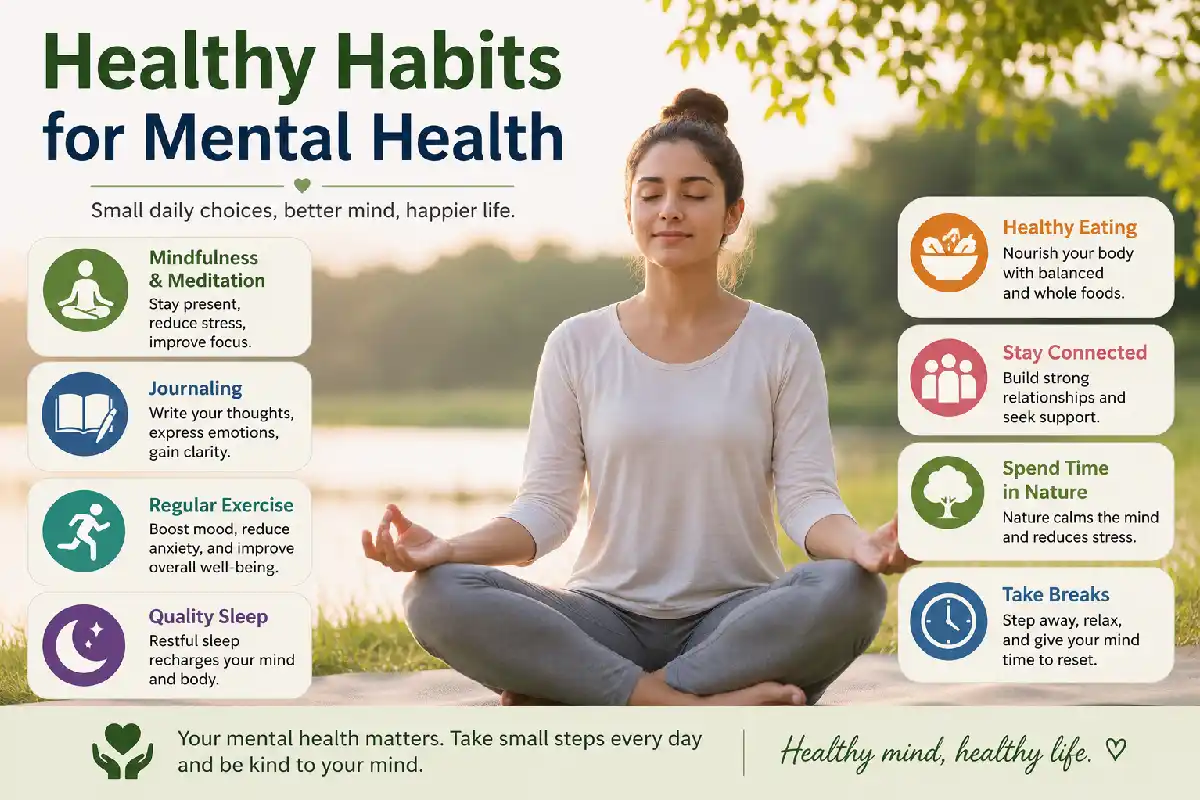
Healthy Habits for Mental Health: Simple Daily Practices for Better Well-Being
 Khizrana Begum
Beauty & Lifestyle Writer
Khizrana Begum writes clear and reader-friendly content covering beauty, lifestyle and related topics.
Read Full Bio of Author →
Khizrana Begum
Beauty & Lifestyle Writer
Khizrana Begum writes clear and reader-friendly content covering beauty, lifestyle and related topics.
Read Full Bio of Author →
 Sameena Begum
Health, Technology & Digital Content Reviewer
Sameena Begum reviews content for clarity, accuracy and overall reader usefulness.
Read Full Bio of Reviewer →
Sameena Begum
Health, Technology & Digital Content Reviewer
Sameena Begum reviews content for clarity, accuracy and overall reader usefulness.
Read Full Bio of Reviewer →
Healthy Habits for Mental Health: It is not just having occasional “self care days” that influences our state of mind. Rather, the little things we are doing every day-our sleep habits, our stress management techniques, how we move, and process our emotions, and the people around us – that actually impact how we feel over the long term. This doesn’t really translate to having a “perfect healthy mental state”routine; Rather it is what works for you and is something that you can realistically do each day.
It is consistency rather than perfection that is the key. A few minutes a day here and there can do just as much for you. If that is through mindfulness, journaling, exercise or just alone quiet time; These few minutes add up to significant, beneficial habits.
❝
This article is a part of
Healthy Habits Guide
How Do Habits Affect Mental Health?
Some of healthy choices you make – what you eats, how you move and relax – throughout the day can make a significant contribution to improving your attitude, enhance concentration, relieve stress, and regulate your emotions. The surest way to integrate your Healthy Lifestyle into your life and turn them into the way you do, is to incorporate into established daily habits that lend stability, structure, and proactive ways to deal with life’s stresses. Consider: sleeping eight hours can allow you get through frustrating situation with ease; exercising can help you diffuse stress and lift your mood. Connecting with loved and supportive individuals can ease away feel of isolation.
Supporting mental well-being is an important part of building a balanced and sustainable lifestyle. Explore our complete healthy habits guide for practical ideas.
| Healthy Habit | Potential Mental Health Benefit |
| Consistent sleep schedule | Supports mood and concentration |
| Regular physical activity | Helps manage stress and supports emotional well-being |
| Balanced meals | Provides energy for daily activities |
| Mindfulness | Encourages present-moment awareness |
| Journaling | Helps organize thoughts and emotions |
| Social connection | Reduces isolation and encourages support |
| Time outdoors | Provides a break from daily demands |
| Relaxation practices | Helps reduce physical and mental tension |
Professional treatment needs to be supported with healthy lifestyle habits-that’s key. But, it should not be used as the exclusive answer-not instead of medication, talk therapy or other medical advice a provider recommends.
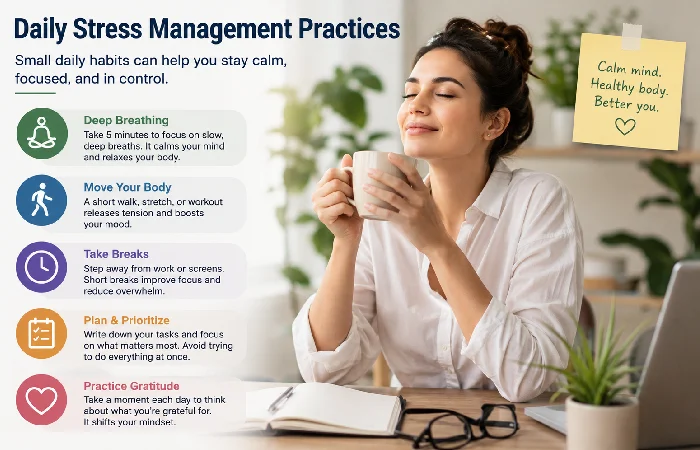
Daily Stress Management Practices
Nutritious food choices and consistent eating routines can complement other habits that support overall well-being. Explore our healthy eating habits guide for helpful tips.
Stress can be normal in life. Every human being feels stress in some time, but when stress continues to put pressure, you’ll be unable to relax your senses, think, focus, and enjoy the daily activities. Practicing a few stress management habits could help you to control any kind of pressure on your life.
It is not necessary that you have a unique system for stress management.
Start by practicing two or three small Habits to make them part of your day.
Try These Simple Stress-Relief Habits
Try taking some micro-breaks: If you spend long hours studying and working, consider standing up to stretch and move around. Some brisk walking can also be an effective option. Even stretching or moving in place can be useful, especially as far as your physical health is concerned.
Do several rounds of breath awareness You may use these focused breaths to handle situations where things feel overwhelming.
To breathe in, you may use the nose and release your breath via the mouth or nose. The breathing can be done 2-3 times for great benefits. Engage In Blood-Rushing Physical Movements You will be better suited to combat this if you take a walk, jog, run, or swim. If there is any other workout that you find interesting, that’s an excellent option, too.
This can go a long way toward releasing tension from the body and mind.
Limit your digital screen time. If you discover that your activities on various screen devices are a major source of stress, take steps to limit the time you spend using it. The following are some strategies.
Healthy daily routines can support sustainable approaches to managing weight alongside balanced nutrition and regular activity. Explore our healthy habits for weight management for practical guidance.
When dealing with numerous duties or assignments to finish, break your overall duties list into much simpler tasks that feel less stressful and are easier to do.
Make sleep a priority Get enough sleep at the same time each night – consistent sleep and sleep cycles work best. Incorporating an evening routine that you enjoy could help you wind down each day.
| Stress Management Practice | How to Make It Easier |
| Breathing exercises | Practice for 2–5 minutes |
| Walking | Take a short walk during a break |
| Stretching | Stretch after sitting for long periods |
| Digital breaks | Turn off nonessential notifications |
| Planning | Choose 3 important tasks each morning |
| Relaxation | Create a quiet evening routine |
The most productive stress-management habit will probably be the one that you can practice.
Mindfulness and Meditation
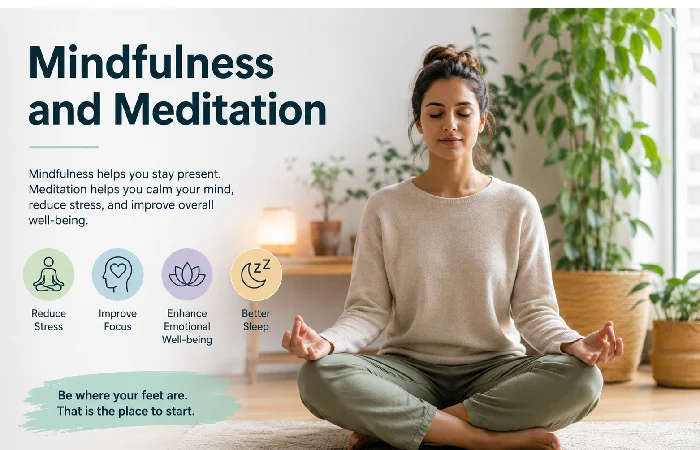
What exactly is mindfulness and meditation?
Mindfulness is to acknowledge and experience ( without judging ) each moment of time . Meditation is one practice of mindfulness .
Mindfulness meditation does not have to take a half an hour of sitting in a Lotus Position .
Helping children develop positive routines can support both their physical and emotional well-being as they grow. Explore our healthy habits for kids for useful ideas.
Just a couple of minutes here and there will serve to make you more aware of yourself and the world around you.
A Simple Mindfulness Exercise
And now i will walk you through a brief meditation to loosen yourself before that big week is upon you. Find an comfortable position sitting or lying down, shoulders relaxed. And shoulders still trying to sit up tall, but no strain anywhere.
Then bring your attention to your normal breath… just observe your natural inhale and exhale.
Let your mind wander to another area, if it has, just bring it back to your breath. Just continue to tune in to your breath for another few moments….
Your mind isn’t designed to stop. Wandering is something all human beings do. All it does is takes your attention when you see it start to wander, bring it back to the present moment, and then you’re off again. Other types of mindful practices include: mind walking, mindful eating, body scan, or sounds focusing meditation.
Journaling for Mental Wellness
A journal is a useful and confidential outlet to explore your inner self. The mere act of putting your feelings into writing can often pinpoint recurring issues, come to some understanding, and help work through situations where they otherwise seem absurd when bottled inside. There are multiple forms of journaling; you can either freestyle if it’s easy and natural for you to write freely or you can use prompts if that is of assistance.
Understanding how habits form can make it easier to develop routines that support emotional well-being and a healthier lifestyle. Explore our guide to how healthy habits work for more information.
Journaling Prompts to Try
- How am I feeling today?
- What stresses me most today?
- What went right today?
- What’s one thing I have in my control?
- What am I longing in my life?
- What small thing can I do for myself tomorrow?
- What do I feel gratitude for today?
Your day begins with morning, which would be a good time for your writing of journaling and plans for that day.
Night can serve for reflection over the day’s activities. Even five minutes can serve as part of your journaling practice.
| Journaling Style | Best For |
| Free writing | Getting thoughts out without structure |
| Gratitude journal | Focusing on positive experiences |
| Mood tracking | Identifying emotional patterns |
| Stress journal | Exploring triggers and responses |
| Goal journal | Tracking progress and intentions |
| Reflection journal | Learning from daily experiences |
If writing increases your intensity about worries; Take a break and consider sharing your story. With a mental health care provider.
Building Emotional Resilience
What is emotional resilience. Resilience in this case is our ability to get through the worst times that come. It is not about walling everything off and saying oh its not that bad really.
Regular physical activity can be a valuable part of a balanced lifestyle and may complement other healthy routines that support well-being. Explore our healthy exercise habits guide for practical ideas.
Resilience involves a skill we build with “healthy” feelings to recognize emotions and learn how to proceed through them.
It’s not that we develop resilience all at once but over time through daily actions and processes.
Ways to Build Emotional Resilience
Validate your feelings: It’s okay to feel sad, angry, anxious, or disappointed. Before suppressing feelings, pay attention to what’s present.
Identify what you can influence: Problematic situations typically have many uncontrollable variables, but you can identify the ones you can change to make things feel more doable.
Connect with others: Share your experience with a close friend, family member, mentor or therapist for insight, encouragement and accountability.
Extract lessons: Instead of seeing every slip up as a total crash, ask what you learned that you can take with you.
Keep routines in place: The power of sleep, movement, a balanced diet, downtime and enjoyable leisure time can form a base of stability and emotional resilience.
Be kind to yourself: Talk to yourself with the same understandingness and generosity you’d show someone you love.
| Resilience-Building Habit | Example |
| Self-compassion | Replace harsh self-talk with realistic encouragement |
| Social support | Talk with someone you trust |
| Problem-solving | Break a difficult problem into smaller steps |
| Healthy routines | Keep regular sleep and activity patterns |
| Emotional awareness | Name and acknowledge your feelings |
| Positive reflection | Recognize progress and lessons learned |
Just remember that resilience doesn’t mean you need to do everything on your own. In fact, finding professional help is a positive step to take if problems or feelings continue to stick around, are strong, or a lot to deal with on your own.
FAQs
What are the best healthy habits for mental health?
There is no one habit that is the ultimate solution for everyone. Some daily practices that the majority seem to benefit from to help keep you mentally healthy include: Consistent sleep Regular physical activity social interactionmindfulness Journallingmanaging stress Daily routines
How long does it take for healthy habits to improve mental health?
Depending on your habits! What brings comfort, structure or a brief respite instantly differs. Some habits bring longer term gratification.
Can journaling improve mental wellness?
Some journaling for people and their thoughts, emotions, feelings and patterns. The most important thing about Journaling – is when this takes a place without any pressure. It is important that the experience is helpful instead of feeling like one more task that has to do.
Is meditation necessary for good mental health?
No. Meditation is one tool; you don’t have to use it. Walking, other physical activities, art forms, breathing practices, socializing and other relaxing methods are all good alternatives if meditating is not to your liking.
What should I do if healthy habits aren’t enough?
In addition to establishing healthy behaviors, you can further foster your own mental and emotional well being by talking to a trained mental health professional. Certain situations that involve feelings like distress, despair, sadness, hopelessness, and anxiety could be so overwhelming that you need some form of professional help.
Final Thoughts
Healthy Habits for Well-Being: The Key is to Start small You don’t have to overhaul your life to improve your mental health! Choose 1-2 healthy habits to build around – such as trying to get a set bedtime, walking outdoors for a few minutes every day, engaging in 5 minutes of mindfulness meditation or writing a few journal entries. Once these habits become a normal part of your routine, you can continue adding more. You’ll be amazed how quickly consistent, small steps add up to significant progress in your journey toward greater mental and emotional wellness.