

Healthy Habits for Kids: Simple Ways to Build a Healthier Childhood
 Khizrana Begum
Beauty & Lifestyle Writer
Khizrana Begum writes clear and reader-friendly content covering beauty, lifestyle and related topics.
Read Full Bio of Author →
Khizrana Begum
Beauty & Lifestyle Writer
Khizrana Begum writes clear and reader-friendly content covering beauty, lifestyle and related topics.
Read Full Bio of Author →
 Sameena Begum
Health, Technology & Digital Content Reviewer
Sameena Begum reviews content for clarity, accuracy and overall reader usefulness.
Read Full Bio of Reviewer →
Sameena Begum
Health, Technology & Digital Content Reviewer
Sameena Begum reviews content for clarity, accuracy and overall reader usefulness.
Read Full Bio of Reviewer →
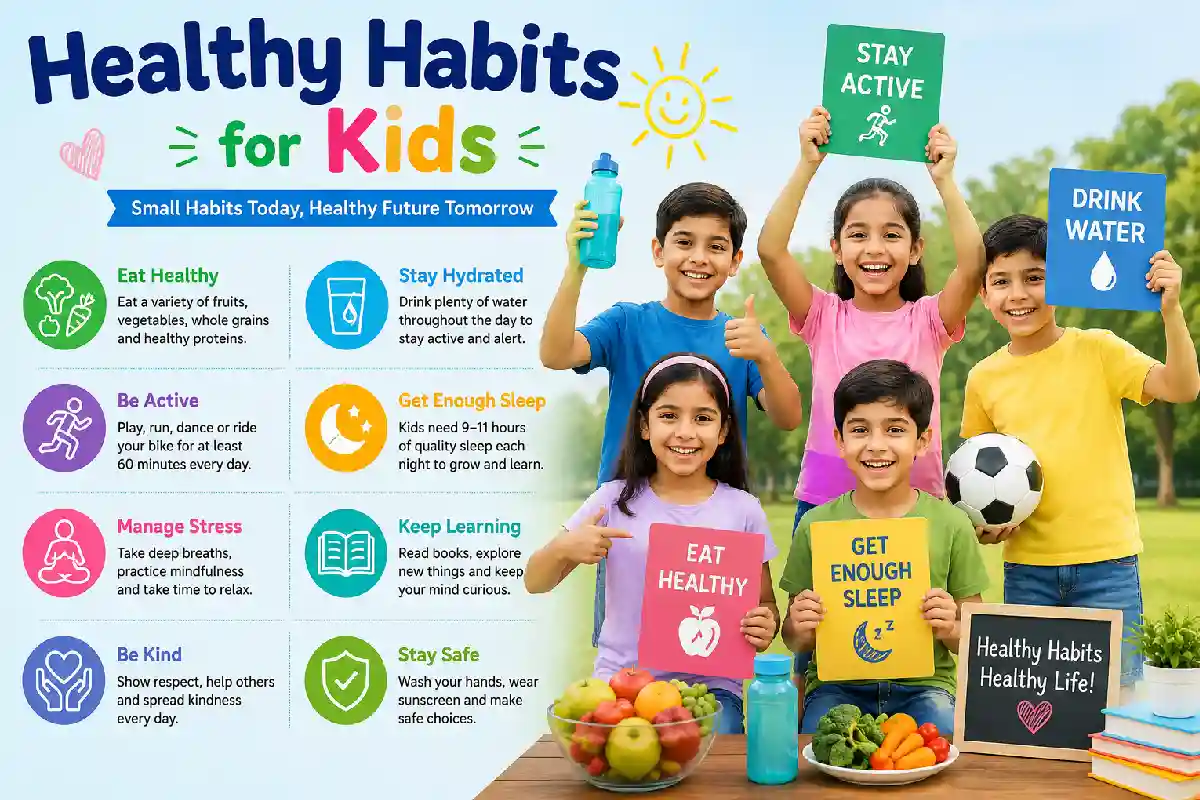
Healthy Habits for Kids: Building good habits within children is simplest when addressed from an early age. While children are always looking to adults to influence their behavior, daily life-like at mealtimes, during exercise time, and even while sleeping, practicing personal hygiene, or limit of screen time-plays a significant role in the physical well-being for the childhood span.
However, parents or caregivers do not necessarily need to establish strict schedules to raise healthy children, rather to assist them in understanding their bodies.
❝
This article is a part of
Healthy Habits Guide
Teaching Healthy Habits Early
Having children lead healthy habits and make them a regular part of daily life so it appears “normal” to the child. Do not spend a lot of time talking about and lecturing children.
Instead, involve them, make healthy choices practical and easy.
For example, let the child assist with the preparation of dinner, they could have the option of one or two healthy snack options, have the child participate in family walks in the evening.
Giving a child a manageable responsibility can allow them to feel good, gain a sense of responsibility, as well as take responsibility for themselves and their bodies.
Helping children build positive routines early can create a strong foundation for healthy living and overall well-being. Explore our complete healthy habits guide for practical ideas.
Healthy Habits Kids Can Learn Early
| Healthy Habit | Simple Way to Teach It |
| Eating nutritious foods | Include fruits and vegetables in everyday meals |
| Drinking water | Keep a water bottle easily available |
| Staying active | Encourage outdoor games and active family time |
| Getting enough sleep | Follow a consistent bedtime |
| Good hygiene | Teach regular handwashing and tooth brushing |
| Limiting screen time | Create screen-free periods during the day |
| Managing emotions | Encourage children to talk about their feelings |
You don’t have to be “perfect”. The occasional piece of candy, day off from exercise, or early night won’t kill us all. If you are consistent then good for you.
Healthy Eating for Children
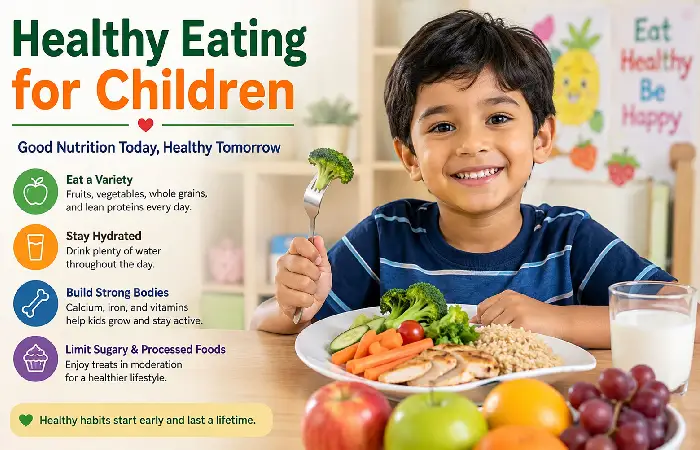
Nutritious meals and balanced eating habits are important parts of supporting children’s growth and everyday energy. Explore our healthy eating habits guide for helpful tips.
Providing kids with well-balanced foods gives kids the stamina that they need to grow, play, play and active. It’s better to consider healthy foods for kids as part of the overall eating experience, instead of a restrictive one. It’s better to offer fruits, vegetables, whole grains, protein and calcium sources all through out the day.
Building a Balanced Children’s Meal
| Food Group | Examples |
| Fruits | Apples, bananas, oranges, berries |
| Vegetables | Carrots, spinach, peas, broccoli |
| Whole grains | Oats, brown rice, whole-grain bread |
| Protein | Eggs, beans, lentils, fish, chicken |
| Dairy/alternatives | Milk, yogurt, cheese, fortified alternatives |
| Healthy fats | Nuts, seeds, avocado, nut butters |
Ideally, water should be the primary drink. Foods and drinks high in sugar may deliver significant amounts of sugar that do not benefit the diet in terms of nutrients.
Try not to use food as either a reward or as punishment. A good relationship to food can be built when foods are appropriately available to the child and can be made according to own will with the time.
Tips for Healthier Eating
- Eat as a family when feasible.
- Offer a variety of fruits and vegetables regularly.
- Keep healthy foods easily accessible and at kid’s level.
- Promote high fluid consumption.
- Give kids some decision-making power, even to an age-appropriate level, about their meal.
- Never force a kid to clear the plate.
- Make healthy food visually appealing and easily accessible.
Physical Activity for Kids
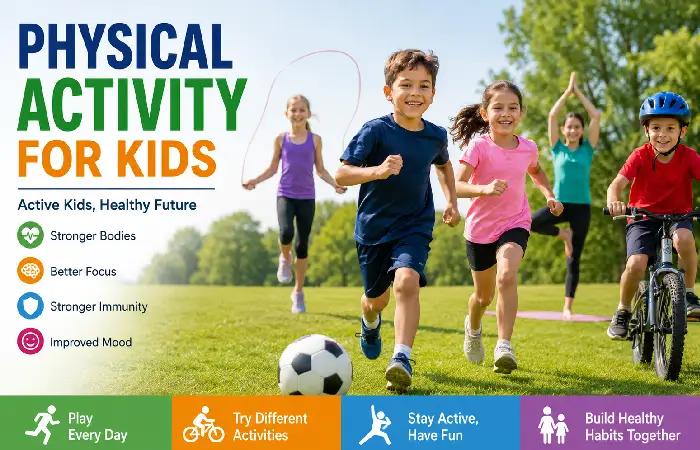
Children do need to be active for it to contribute to growth and development. The physical activity we do can contribute to our fitness, and support healthy muscle, bone, development of coordination, fitness and our overall well being.
There is no set definition to when exercise takes place. Children undertaking activities, which involve moving round, such as swimming, running, cycling, playing, jumping, running, or dancing, as well as playing games, can all go under the definition of taking physical activity, rather than just formal exercise routines
Fun Ways to Keep Kids Active
| Activity | What Kids Can Do |
| Outdoor play | Run, jump, climb, or play tag |
| Sports | Football, basketball, swimming, cricket |
| Dancing | Dance to favorite songs |
| Cycling | Ride a bicycle with appropriate safety equipment |
| Family walks | Walk together after dinner |
| Active games | Hide-and-seek, hopscotch, or relay races |
Any activity a child likes tends to work. If exercise feels more like a game and less like a punishment, children are likely to do it consistently.
An example can also be set by parents. Because children are always looking to us and often like to imitate we do in the household physical exercise can be made easy.
Healthy Sleep Routines
Good sleep is also integral to childhood. Youngsters require adequate sleep for growth, attention, daily functioning, mood and learning. Sleeping requirements also depend on the age and children ought to be using age-appropriate guidelines and recommendations set by pediatric health organizations.
A predictable routine for sleeping aids a child to unwind and prepare for a night sleep:
Simple Bedtime Routine
- Eat dinner and carry on evening activities.
- Have a shower or bath as suitable.
- Brush teeth and prepare for bed.
- Clear stimulating games and gadgets out of the bedroom.
- Read a story or engage in quiet conversation.
- Be put in bed at a regular time.
Stick to the sleep-inducing environment of coolness, darkness and quiet. Have set times to bed and wake up 7 days a week, this will prevent day and night confusion. If there is consistent significant trouble with falling and/or staying asleep; several awakenings at night, loud and persistent snoring, and a constantly overtired appearance, parents should discuss the issues with their pediatrician or healthcare provider.
Limiting Screen Time
Screen time is a major part of many childhoods, but over exposure can lead to deficits in physical play, sleep, family interactions and many other factors crucial to childhood development. Most significantly, in place of simple arbitrary rules, such as total number of hours consumed, responsible families can establish reasonable rules as to when the child is using it, where they are, and also how.
Supporting children’s emotional well-being is just as important as encouraging healthy physical routines. Explore our healthy habits for mental health for practical guidance.
Healthy Screen-Time Boundaries
| Rule | Example |
| Screen-free meals | No phones or tablets during family meals |
| Screen-free bedtime | Put devices away before bedtime |
| Screen-free bedroom | Keep recreational devices outside the bedroom |
| Scheduled breaks | Encourage children to get up and move regularly |
| Family activities | Balance screen use with play and conversation |
| Age-appropriate content | Choose suitable educational or entertainment content |
The screen time could even be a space where digital rules are modeled and taught, rather than having electronics forbidden. Discuss things like, online safety, what is OK to view, how to keep privacy and how to behave respectably online with children. The main role should be a behavioral model. It will be more difficult to establish screen rules to a child if the parents are not putting away their cell phone at meals, or while they are having a conversation.
Teaching balanced lifestyle habits can help children develop a healthy understanding of nutrition, activity, and everyday routines. Explore our healthy habits for weight management for useful information.
Creating a Healthy Daily Routine
It’s quite simple for an infant to adapt to a normal life with a normal routine. A normal daily routine helps children feel comfortable with what’s going to happen to them.
| Part of Day | Healthy Habit |
| Morning | Wake up, wash, eat breakfast, get ready |
| School/daytime | Learn, socialize, eat balanced meals |
| Afternoon | Outdoor play or physical activity |
| Evening | Family meal and relaxing activities |
| Before bed | Hygiene, reading, limited screens |
| Night | Consistent bedtime and adequate sleep |
Need flexibility Family commitments, school and holidays plus individual needs..
FAQs
What are the most important healthy habits for kids?
The most essential ones that come to mind is: eating properly and healthfully; exercise; sleep; cleanliness and hygiene; adequate hydration/water intake; setting boundaries with screen usage and having healthy methods to cope.
How can I get my child to eat healthier?
Begin offering nutrient-rich foods frequently, without meals becoming a fight. Get children involved in selecting groceries or helping to prepare meal, offering multiple healthy choices.
How much physical activity should children get?
Kids need regular bouts of physical activity distributed throughout the day. The exact amounts and type of activity vary significantly with age, so parents should refer to age-based guidelines.
Understanding how healthy habits develop can help parents and caregivers create routines that children can follow consistently. Explore our guide to how healthy habits work for helpful insights.
Should children have screen-time limits?
Absolutely. Setting limits appropriate for your children, will also support a good balance between screen time for leisure, sleep, physical activity, schoolwork, family time, etc.
How can I establish a better bedtime routine?
Maintain reasonably steady bedtimes and wake-up times. Develop a wind-down routine including hygiene, quiet play, reading, and limited screen time prior to sleep.
Should parents be strict about healthy habits?
Good habits come in all varieties as long as they become a consistent routine yet can be a fluid guideline. A structured life works for all kids; overly rigid habits are actually painful for children to integrate. Modeling healthy living and promoting a home in which children feel comfortable makes for sustainable habits.
Regular physical activity and active play are important parts of a healthy routine for growing children. Explore our healthy exercise habits guide for practical ideas.
Final Thoughts
Not all good childhood health behaviors need a complex structure of daily routines and firm rules. However, by modeling good nutrition, physical activity, safe sleeping practices, sound screen habits and sound routines (eating, napping etc) in childhood. We can integrate those small behaviors into adulthood without conscious effort.
Making good health, instead of good functioning a more prominent and acceptable standard family practice, is probably the way children will most benefit.