
Healthy Habits at Work: Simple Ways to Stay Healthy and Productive
 Khizrana Begum
Beauty & Lifestyle Writer
Khizrana Begum writes clear and reader-friendly content covering beauty, lifestyle and related topics.
Read Full Bio of Author →
Khizrana Begum
Beauty & Lifestyle Writer
Khizrana Begum writes clear and reader-friendly content covering beauty, lifestyle and related topics.
Read Full Bio of Author →
 Sameena Begum
Health, Technology & Digital Content Reviewer
Sameena Begum reviews content for clarity, accuracy and overall reader usefulness.
Read Full Bio of Reviewer →
Sameena Begum
Health, Technology & Digital Content Reviewer
Sameena Begum reviews content for clarity, accuracy and overall reader usefulness.
Read Full Bio of Reviewer →
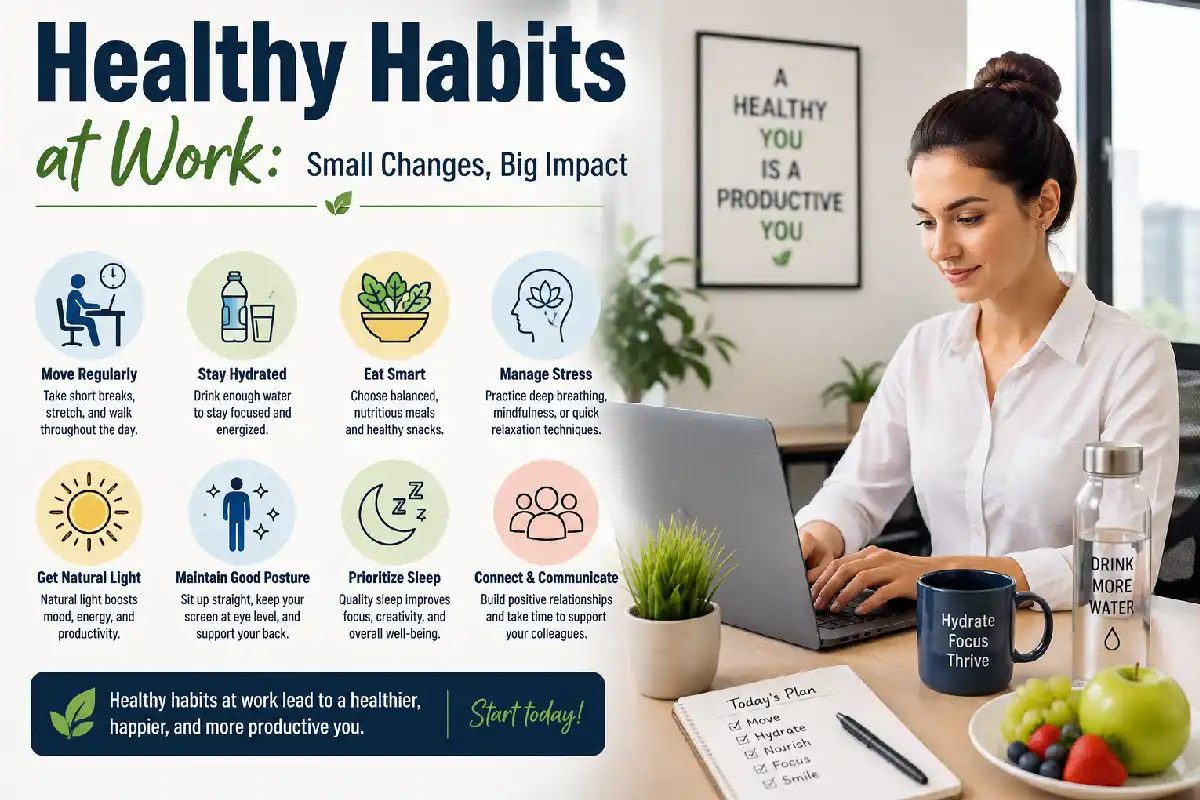
Healthy Habits at Work: Work consumes a great many hours out of our day, thus the habits we cultivate within those hours can truly make or break your energy levels, focus and overall well being. Long periods of sitting, skipping meal times, deadlines and constantly checking e-mails, are subtle but progressive factors in impacting the same negatively.
The best news? It does not require a major overhaul of your lifestyle to counter this. Incorporating a couple of healthy habits into your work day should provide benefits that extend much beyond helping you feel a bit more at ease, focused and more in control during your workday.
❝
This article is a part of
Healthy Habits Guide
Staying Healthy at Your Desk
A lot of desk jobs involve a lot of sitting and sitting for hours in the same position and discomfort of the chair, amount of screen time and lack of movement may result in stiffness in your body and strain on your eyes which will make you feel tired overall.
Firstly, make sure that your workstation setup allows you to perform all tasks with the least amount of effort from your body.
Understanding how healthy habits work can make it easier to turn positive choices into consistent daily routines. Explore our complete healthy habits guide for practical ideas.
| Desk Habit | Why It Helps |
| Sit with your back supported | Encourages better posture |
| Keep your screen near eye level | Reduces unnecessary neck strain |
| Keep feet flat on the floor | Provides better stability |
| Relax your shoulders | Helps reduce upper-body tension |
| Keep frequently used items nearby | Limits repetitive reaching |
| Change position regularly | Prevents prolonged static sitting |
Get up and move around a few times during the day and stay off your feet. It doesn’t hurt to sit down for long durations and get up out of the chair for a couple of minutes here and there.
Also, don’t neglect your eyes. If you are spending hours in front of the computer, let your eyes drift to and from anything further away. The glare, font size, etc., can be more taxing than you realize.
Healthy habits around food can become easier to maintain when you understand how consistent routines and balanced choices fit into everyday life. Explore our healthy eating habits guide for helpful tips.
Managing Workplace Stress
When you have upcoming deadlines, a bunch of meetings in your calendar, a constantly overflowing inbox and conflicting work duties it is incredibly likely that you will feel stressed. Obviously you can’t avoid every situation that will result in feeling stressed but you can control how you respond to it. One basic practice which will make a huge impact in stressful workload is establishing priorities and categorizing items as urgent versus non-urgent things to do; doing them “in tandem”, all the time, for every single situation only compound stress.
Simple Ways to Manage Work Stress
In the morning when you first get to work, take a moment and focus on one task to accomplish.
Break up big tasks into little ones.
Refrain from “multitasking.”
Building healthy routines can also support emotional well-being and encourage a more balanced approach to daily life. Explore our healthy habits for mental health for practical guidance.
Remember to take quick breath breaks/stretching breaks.
Let people know your workload cannot be handled.
Have a “somewhat” organized workspace.
Schedule in the opportunity to work on things that really stress out intellectually to include some breaks, if necessary or feasible. The shorter break is better than continuing to trudge on work if you have lost the mental capacity to do such things. Work can cause chronic stress at a very high level in response to an organizational and/or job environment that has negative effects on work relationships, social interactions, emotions, and the performance of your work, if there seems to persist at a constant or escalating pace then one should seek medical attention or other help from organizational resources.
Healthy Break Habits
Breaks should be restorative, not lost time. They can even enhance work by restoring focus and energy-as long as you make them effective. However instead of relaxing at your desk looking through social media during each break, use them to stretch, have some water or to distance yourself from the computer.
Consistent lifestyle habits can play an important role in maintaining a sustainable approach to weight management. Explore our healthy habits for weight management for useful ideas.
| Break Idea | Approximate Time | Benefit |
| Walk around the office | 5–10 minutes | Adds movement |
| Stretch gently | 3–5 minutes | Relieves stiffness |
| Drink water | 2 minutes | Supports hydration |
| Step outside | 5–10 minutes | Provides a mental reset |
| Practice slow breathing | 2–5 minutes | Encourages relaxation |
| Talk with a coworker | 5–10 minutes | Provides social connection |
Never wait until you feel completely drained to take a break; short, frequent breaks will actually give your already overwhelming workday a much needed breathing room.
Improving Focus and Productivity
Children can develop positive routines by practicing healthy behaviors consistently from an early age. Explore our healthy habits for kids for practical guidance.
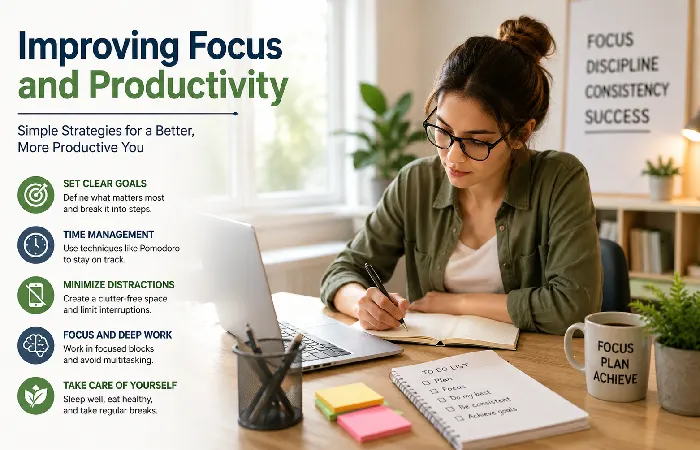
Work ethic doesn’t simply mean work work work. Most people’s attention span actually gets better when their brains have enough downtime.
Begin by finding what you consider to be one or two main things. Get that done before others dig you out from their small requests, if this is at all possible.
Habits That Can Improve Focus
Structure your day. Take a few minutes at the start to identify what needs to be done first. Minimize distractions.
- Turn off unused alerts.
- Closing extra tabs can take up mental processing space.
- Break down your tasks. Allow yourself at least a twenty-minute block to get into something before switching over to texts.
- Optimize your space.
- Cluttered surroundings lead to scattered thought.
- Take your breaks. Step away from your screen as if taking break. Conserve your energy.
Save intense tasks when you usually are the more energized. Here’s an example.
| Less Helpful Habit | Healthier Alternative |
| Checking email constantly | Check messages at planned intervals |
| Working through every break | Take short movement breaks |
| Multitasking constantly | Focus on one priority |
| Skipping lunch | Eat a balanced meal |
| Sitting all day | Add regular movement |
| Staying late every day | Set reasonable work boundaries |
Work-Life Balance Tips
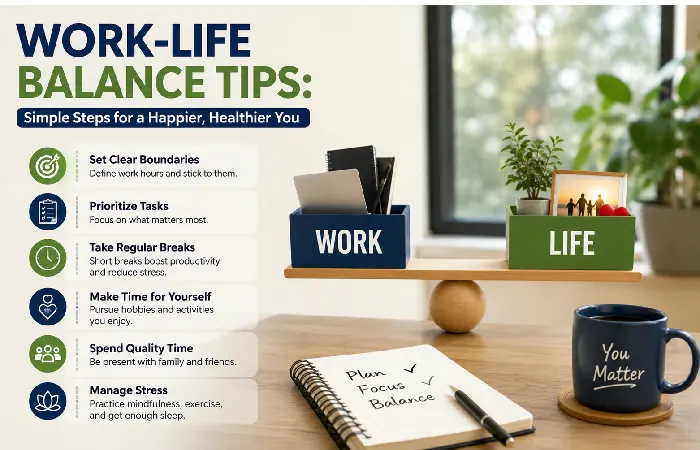
Good health habits at work shouldn’t stop the minute the day ends. In fact, setting clear boundaries around when work is and is not taking place can allow you to make time for sleep, relationships, other pursuits, activity, and even calm. This could be particularly useful if you work from home, since your “workplace” might be just a room away from where you lounge.
Regular exercise can become easier to maintain when physical activity is incorporated into a consistent daily routine. Explore our healthy exercise habits guide for helpful tips.
Practical Work-Life Balance Strategies
Here’s what we propose:
- Establish a realistic time frame to switch off. If you can, just don’t let work creep into every available evening hour.
2. Develop a ritual to transition between work and home. This could be a brief walk, workout, shower or change into comfortable clothing.
3. Turn off distracting notifications. Not every notification will and and need your attention on it straight away.
4. Take the downtime that you’ve made. Restoration is essential in sustaining the ability to do the same work effectively again tomorrow.
5. Guard your sleep. Adequate and reliable sleep will maintain energy and focus.
6. Schedule in other important activities that you enjoy. Having a life should always feel like there’s time for things and people other than your workplace.
7. Develop boundary-setting skills. Being able to say no to tasks that are less critical to your role can safeguard valuable time and energy.
And by balance, we don’t have to divide all our days by two (one for personal, one for work life). There are days that will obviously require more from you. Balance is created over time through new, sustainable behaviors.
A Simple Healthy Workday Routine
All of these can be worked into a routine which doesn’t involve to much upheaval.
| Part of Day | Healthy Habit |
| Start of work | Choose your main priorities |
| Morning | Drink water and maintain good posture |
| Mid-morning | Take a short movement break |
| Lunch | Eat away from your screen when possible |
| Afternoon | Stretch, walk, or step away briefly |
| Late afternoon | Finish priority tasks and review tomorrow |
| End of work | Shut down work and transition to personal time |
Consistency over perfection. If you slip and skip a workout or a stressful day occurs, your habits are not ruined.
FAQs
What are the most important healthy habits at work?
Among the habits that can serve you best are those of regular movement, being physically comfortable in a workspace, proper hydration, and consuming a balanced diet. Others would involve stress management and healthy boundaries. Taking restorative breaks is crucial.
How often should I take breaks from my desk?
It’s not the same schedule as what fits everyone else. Realistically, the ideal set-up is short movement breaks and eye rests every short while, not staring at a screen for several hours at a time.
How can I reduce stress at work?
Focus on key tasks, split larger jobs down into stages, try and limit the number of tasks you multitask, have short breaks, inform others of how busy you are, utilize breathing exercise when needed.
How can I stay focused during a busy workday?
Focus on only a couple of priorities, have minimal notifications, work in bursts of intense effort, make sure your desk area is tidy and take short breaks every time your attention begins to waver.
How can I maintain work-life balance?
Define realistic work limits; establish a true ending point for each workday; safeguard your time; reduce nonwork hour notifications and make time for sleep, your relationships, exercise, and the activities you enjoy.
Are healthy work habits important for productivity?
Yes, attending to foundational needs-like adequate exercise and movement, nutrition, sleep, stress management, and break time-can contribute to a foundation for an sustainable energy level and attentiveness, ultimately enabling you to remain effective over time.
Final Thoughts
Creating productive, healthy work habits doesn’t necessitate a massive overhaul. It’s as simple as making one or two manageable changes, like decluttering your workstation, increasing your activity, actually taking breaks, organizing your tasks, and protecting your work-time.
The aim isn’t a perfectly structured and regimented day. Instead, we are working towards designing a system which enhances your overall health but also ensures your work is completed. In truth, small, sustained habits make for more positive impact in life than infrequent dramatic interventions.