

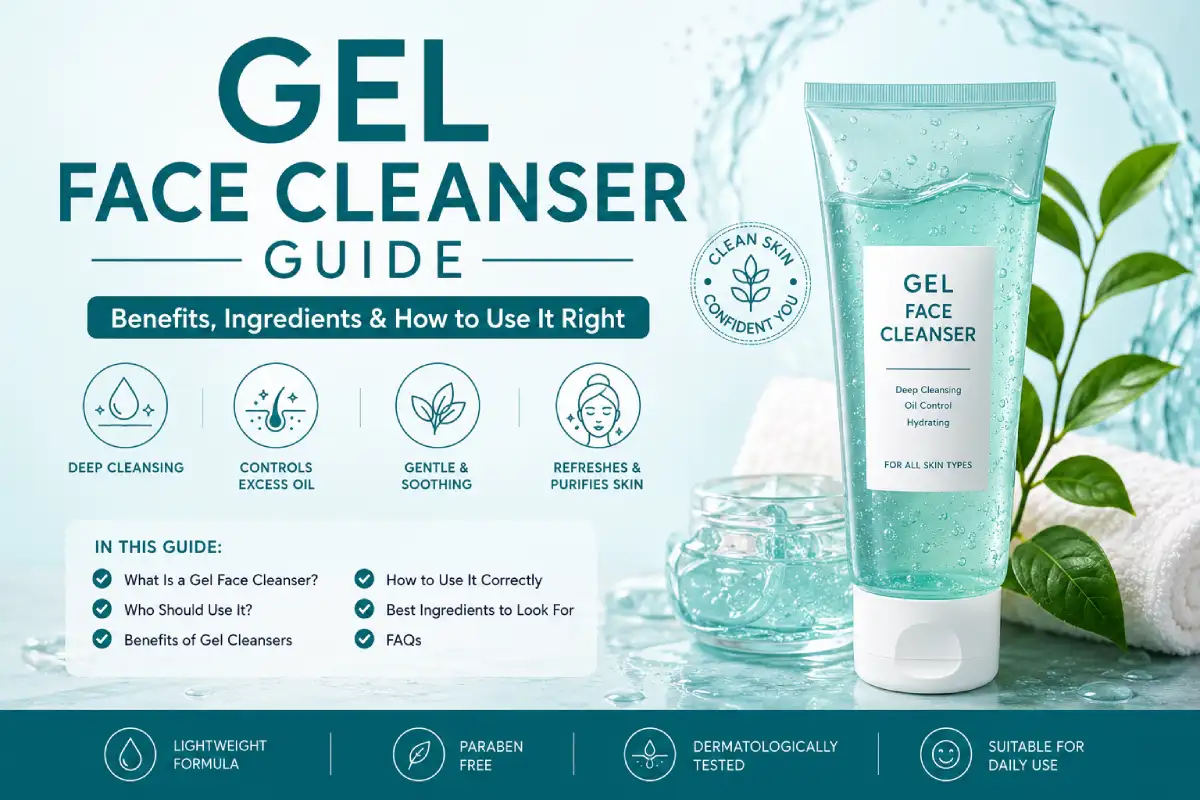
Gel Face Cleanser Guide: Benefits, Ingredients & How to Use
 Khizrana Begum
Beauty & Lifestyle Writer
Khizrana Begum writes clear and reader-friendly content covering beauty, lifestyle and related topics.
Read Full Bio of Author →
Khizrana Begum
Beauty & Lifestyle Writer
Khizrana Begum writes clear and reader-friendly content covering beauty, lifestyle and related topics.
Read Full Bio of Author →
 Sameena Begum
Health, Technology & Digital Content Reviewer
Sameena Begum reviews content for clarity, accuracy and overall reader usefulness.
Read Full Bio of Reviewer →
Sameena Begum
Health, Technology & Digital Content Reviewer
Sameena Begum reviews content for clarity, accuracy and overall reader usefulness.
Read Full Bio of Reviewer →
My perfect skincare routine won’t ever be a ten-step system, as that honestly wouldn’t get used. In fact, the easier it is, the more likely I am to stick to it. Cleansing, for instance, can’t be skipped because the product I use to clean my skin will take away dirt, grease, sweat, and literally any products applied, such as foundation or sunscreen.
The gel face cleanser is probably the most popular variety, as they generally feel refreshing, lightweight, and gentle on the skin, and can be suitable for oily, combination, problem, and normal skin types, depending on the ingredients.
However, no single gel cleanser formulation will work for every user, since cleaning agents and ingredients (along with fragrance and other active ingredients) can significantly alter how a product performs.
This Guide to Gel Face Cleansers looks at what gel face cleansers are, who can use them, the uses and benefits, and how to use your gel facial cleanser and what you need to look out for.
❝
This article is a part of
Cleansing Guide
What Is a Gel Face Cleanser?

A gel cleanser is just what it sounds like- a water-based facial wash that’s gelatinous in texture. If you compare it to cream cleansers, it typically appears to be on the lighter side in weight and usually has little to medium suds. So it is quite literally a product that, when applied to your skin with water, lifts away the impurities. However-that’s the gist of things, but not an adequate way to describe its purpose when discussing facial skincare-its principal purpose is quite simple: clean skin without a ton of excess gunk, grime, and product residue.
Choosing the right cleanser depends on your skin type, concerns, and daily skincare needs. For a broader overview of cleanser types and how to build a consistent routine, explore our complete face cleanser guide.
Surfactants—those active ingredients in cleansers — help dissolve unwanted oil, dirt, and product on the skin surface, allowing you to wash them away with water. In conclusion, your face is clean, not “pulled tight” or otherwise in a painful condition after applying gel cleanser. That said, “squeaky clean’ isn’t better’ – your dermatologist is more likely to want you to adopt a gentler cleansing style.
Gel Cleanser vs. Other Cleanser Types
| Cleanser type | Typical texture | Often suitable for | Main characteristic |
| Gel cleanser | Light, gel-like | Oily, combination, normal skin | Fresh and lightweight |
| Cream cleanser | Rich and creamy | Dry or sensitive skin | More moisturizing feel |
| Foam cleanser | Foamy | Oily or combination skin | Removes surface oil effectively |
| Oil cleanser | Oil-based | Makeup/sunscreen removal | Dissolves oil-based residue |
| Micellar cleanser | Watery | Sensitive or convenient cleansing | Gentle, low-rinse option |
They are a guideline, and nothing should really be strictly adhered to; much more depends on what the skin thinks about the actual ingredient regardless of the description.
Who Should Use Gel Cleansers?

If you are dealing with frequent breakouts, selecting a cleanser that fits acne-prone skin can be an important part of your skincare routine. Explore our face cleanser guide for acne-prone skin for more targeted cleansing advice.
Anyone who finds that too thick or cream cleanser not very pleasant can easily use one based on gel – it can have a comfortable feeling at a summer time or under the strong humidity.
1. Oily Skin
Skin types that tend to quickly get a dewy sheen might be able to handle a gel cleanser. These should strip away surface oil without that heavy feel that you get from some more creamy cleansers. That said, skin is going to need that skin barrier for protection. So overdoing it with a really drying cleanser to strip off all of the oil won’t make for a pleasant experience.
2. Combination Skin
This skin type has some oily and some more normal or dry areas. A sensitive gel cleanser would be a nice in-between ground. Try to get something with enough effectiveness to clean the T-zone without leaving you feeling stripped on the outer areas.
3. Acne-Prone Skin
A common ingredient on the mind of many people suffering from acne is a cleanser with salicylic acid. What it works with is salicylic acid; it’s a beta-hydroxy acid, meaning it can penetrate skin pores and dissolve the grime and oils that contribute to blackheads and acne.
However, harsh skin scrubs will not do well for acne-prone skin. According to the American Academy of Dermatology, you should wash your skin without excessive scrubbing; otherwise, it could lead to pimples flaring up again and make the situation worse.
4. Normal Skin
Many different types of gentle cleansers will be tolerated by normal skin. If you’re cleaning every day, a simple hydratising gel cleanser may do,
5. People Living in Hot or Humid Climates
A refreshing clean can feel absolutely divine, particularly if oiliness and sweating have been an ongoing issue throughout the day. If you have been exercising, even exercising post gym routine would feel good as a clean.
What About Dry or Very Sensitive Skin?
So this can get a little tricky:
Not every cleanser has the same texture or finish. If you prefer a richer cleansing experience, our cream face cleanser guide explains what to consider when choosing a cream-based formula.
Gel does not necessarily equal dry. This is because it may contain humectants such as glycerin, hyaluronic acid, or aloe, and skin-benefiting extracts too. If your skin is particularly dry and/or sensitive and you are suffering from eczema and/or rosacea, you’d likely be happier with a cream or lotion formula Cleanser that is also fragrance-free, the way the AAD advises for dry and sensitive skin.
Benefits of Gel Cleansers
A good gel cleanser can provide several everyday skincare benefits.
Removes Excess Oil
Oil is naturally produced by the skin to serve as part of the outer barrier of protection. Too much surface oil mixed with sweat, makeup, sunscreen, sunscreen residue, and particles of the environment will collect on top of the oil and will eventually need to be rinsed away. A good cleaner effectively cleans this surface oil mixture away.
Cleans Without a Heavy Residue
A lot of people love the way gel cleaners do rinse off nice and fresh, which may come in handy if you aren’t comfortable with how creamy or oil-based the other types can be.
Can Support Acne-Prone Skin
The right kind of acne-focused ingredient in a gel cleanser, such as salicylic acid ( which can penetrate the oil in the pores), can also do wonders in managing those pores. Keep in mind that cleaning the pore ( not stripping the skin ) is on one’s road to clear skin.
For those who prefer a cleanser that creates a lather during washing, explore our foaming face cleanser guide to learn more about this type of formula and how it can fit into a skincare routine.
Remember that while cleansers can help to manage acne, moderate to severe, cystic, and persistent acne may require a prescription from a doctor.
Helps Prepare Skin for the Rest of Your Routine
Cleansing sweeps away the debris sitting on the surface of your skin. Therefore, your moisturizer or treatments are applied to a clean canvas. And you don’t necessarily have to apply a million actives afterward. Your simple routine can really get the job done.
Feels Refreshing
Sometimes it’s even down to the feel.A light and invigorating gel may feel welcome after a long and busy day, after a workout, or just after having had the pleasure of being sticky with sweat and smog.
How to Use Them Correctly
The method is no less critical than the actual cleanser.
Step 1: Wash Your Hands
Always wash your face before touching it because the dirt and oil you will transfer doesn’t do much anything for your skin.
Step 2: Wet Your Face
No hot water or boiling water. Lukewarm clean water is the way to go; it could even irritate/strip your acne/sensitive skin if too hot.
Step 3: Apply a Small Amount
There’s no need for a massive amount of cleanser. You don’t want to use so much that you can’t comfortably spread it out to cover your entire face.
Step 4: Massage Gently
Take a pea-sized drop of cleanser onto the tips of your fingers and massage your face in a circular motion. There really is no need to vigorously cleanse the skin, as many dermatologists and I advise against this anyway!
Step 5: Rinse Thoroughly
Rinse in warm water, making sure you get the product fully removed from under the nose and jaw and hairline.
Step 6: Pat Dry
Instead of rubbing your face, blot it with a clean, soft cloth.
If you regularly wear makeup or sunscreen, using more than one cleansing step may be an option worth considering. Our double cleansing guide explains how this method works and how it can be incorporated into an evening routine.
Step 7: Moisturize
Moisturiser to damp skin- this adds an extra layer of hydration to ensure the skin remains hydrated after washing. If the skin is acne-prone and capable of wearing a moisturiser (while not on a breakout), it is advised to use a non-comedogenic moisturiser.
How Often Should You Use a Gel Cleanser?
For some people, one wash in the morning and one at night is all that will be necessary. Those who perspire heavily may benefit from a wash after perspiring. The AAD advises gentle washing twice a day or after sweating in the case of acne sufferers.
There can be too much washing.
| Skin situation | Practical cleansing approach |
| Normal skin | Morning and evening |
| Oily skin | Usually morning and evening |
| Combination skin | Morning and evening |
| Acne-prone skin | Up to twice daily and after sweating |
| Dry skin | Use a gentle cleanser as needed. |
| Sensitive skin | Keep cleansing gentle and avoid irritating formulas. |
Best Ingredients to Look For
Cleansers can say whatever they want as far as how good it cleanses, but really all you need to know is on the ingredient list.
Glycerin
Glycerin: The ingredient glycerin is a humectant, which means that its job is to draw moisture to one’s skin. Is certainly and normally considered one of many substances to use with hydrating products.
Hyaluronic Acid
Humectants also frequently include hyaluronic acid. In a cleanser, this can provide a softer feel without being too drying.
Aloe Vera
Aloe vera is often found in lighter creams for its properties that calm and soothe the skin. It can make its place on some soaps meant for normal cleansing that do not strip the face.
Salicylic Acid
Salicylic acid is great if you suffer from oily or acne-prone skin. It can get deep into pores that are oily and clear out the gunk from the pores. That said, if you have sensitive skin, or if you’re already using many exfoliants, then using an exfoliating acid could be too irritating. Introduce active ingredients slowly
Some people find that their skin becomes uncomfortable or irritated with harsh cleansing products. If you need a gentler approach, explore our face cleanser guide for sensitive skin for helpful tips on choosing a suitable formula.
Niacinamide
This B3 vitamin comes in handy in skincare formulas to reinforce and shield the barrier of the skin, improve overall unevenness, and balance oiliness.
The results will be what can be expected of a rinse-off formula. Skincare cleaners will always be cleaning agents as opposed to products which sit on the skin to do there work.
Fragrance-Free Formulas
Fragrance-free – Best if you have sensitive skin You want it to appear in the “AAD Recommended Fragrance-free Brands” listed for dry and sensitive skin, since “fragrance-free actually means no fragrances were added.”
Ingredients and Features to Consider by Skin Type
| Skin type | Useful features | Things to watch |
| Oily | Lightweight gel, gentle cleansing agents, salicylic acid | Over-cleansing, harsh alcohols |
| Combination | Gentle gel, balanced cleansing | Very drying formulas |
| Acne-prone | Non-comedogenic, gentle formula, salicylic acid | Scrubs and excessive exfoliation |
| Dry | Hydrating ingredients, fragrance-free formula | Strong detergents and very hot water |
| Sensitive | Minimal, fragrance-free formula | Fragrance and irritating actives |
| Normal | Gentle, balanced cleanser | Unnecessarily harsh ingredients |
FAQs
Is a gel face cleanser good for oily skin?
Yes. Lightweight gel cleanser can help in the case of oily skin, as its texture helps in cleansing surface oil and can also help get rid of excess sebum, but as it does not contain heavy emollients like oil cleansers, it will leave little residue and will be effective without compromising skin in terms of cleansing performance.
Can I use a gel cleanser every day?
Yes, if it’s the right kind for your skin. You can wash it at least twice and usually at most twice per day with a gentle cleanser. If you experience any dryness or irritation from the cleanser then wash a less or use a milder formula.
Is gel cleanser good for acne?
It can be! While a mild cleansing gel may help lift excess oil and debris from the skin, formulations that utilize salicylic acid may even assist in helping to clean pores. However, for stubborn or very sensitive skin, a cleanser is often not sufficient.
Can dry skin use a gel cleanser?
Yes, as long as you do it wisely. For mild dry skin, a moisturizing and unscented gel may be OK. However, for ultra-dry, sensitive skin, a cream or another kind of delicate cleanser may do.
Should I wash my face after using a gel cleanser?
Many modern cleaners, gel cleansers tend to be a ‘rinse off’ cleansing formula. Massage this directly into wet skin; the excess cleanser should be removed by rinsing your face off using plenty of lukewarm water, then pat the skin with a clean dry towel.
Final Thoughts
When selecting a face cleanser, don’t focus on the strongest formula on the shelf. Ideally, the cleanser will lift the daily grime away without leaving your skin feeling uncomfortable or imbalanced.
A gel face cleanser is a suitable all-day use choice for an oily or combination skin type or those with normal or some acne-prone skin. Glycerin, hyaluronic acid, ceramides, aloe vera and –in some formulas – salicylic acid help each cleanser serve specific skin type functions.