

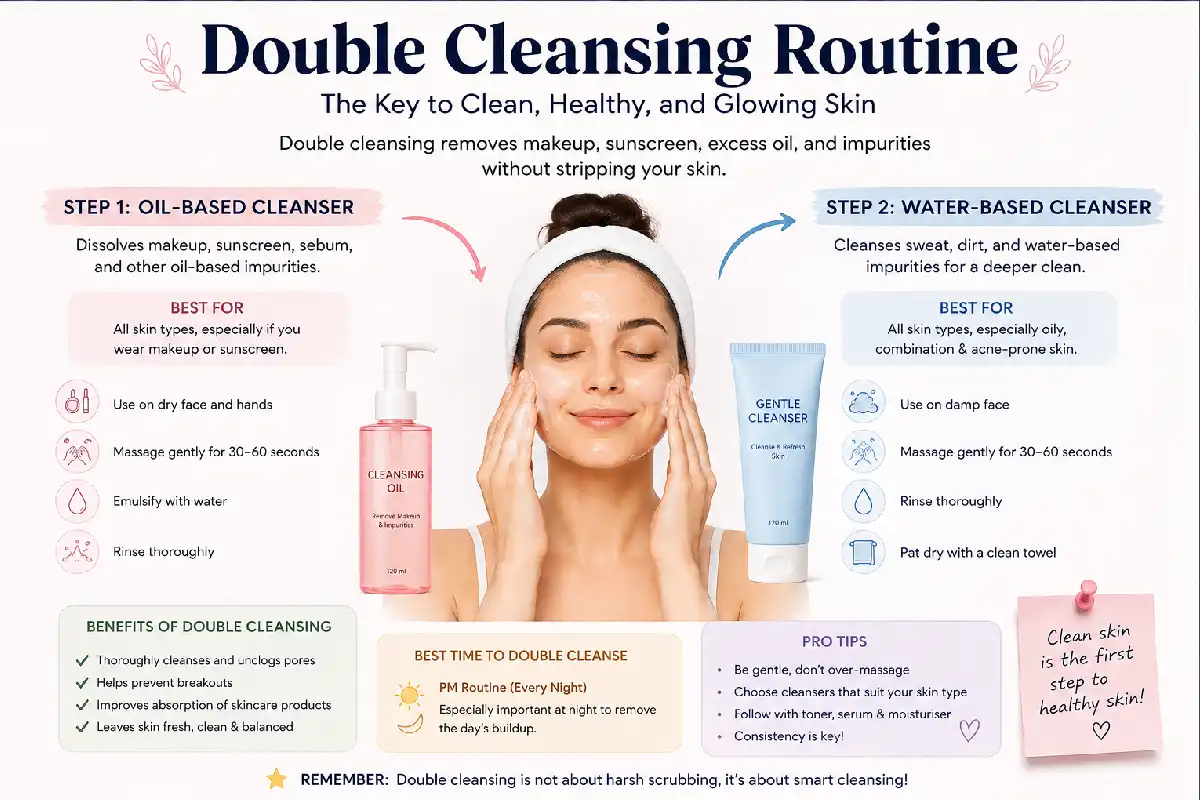
Double Cleansing Routine: A Complete Guide to Clean, Healthy-Looking Skin
 Khizrana Begum
Beauty & Lifestyle Writer
Khizrana Begum writes clear and reader-friendly content covering beauty, lifestyle and related topics.
Read Full Bio of Author →
Khizrana Begum
Beauty & Lifestyle Writer
Khizrana Begum writes clear and reader-friendly content covering beauty, lifestyle and related topics.
Read Full Bio of Author →
 Sameena Begum
Health, Technology & Digital Content Reviewer
Sameena Begum reviews content for clarity, accuracy and overall reader usefulness.
Read Full Bio of Reviewer →
Sameena Begum
Health, Technology & Digital Content Reviewer
Sameena Begum reviews content for clarity, accuracy and overall reader usefulness.
Read Full Bio of Reviewer →
Double Cleansing Routine: Washing and cleansing are key factors toward maintaining a clean complexion. The amount of pollution, sunblock, sweat, oil, and makeup your skin collects throughout the day should have all been removed and properly washed away. Though, there are still opportunities throughout your day that you may require more than one level of cleaning to get rid of debris that may remain on the skin. This is particularly essential if you tend to wear long-lasting cosmetics and/or water resistance lotion.
Double cleaning can help with this.
Double cleansing means using two different kinds of washes: first one helps break up oil-based products like makeup, sunscreen and sebum, and the second, typically water-based helps wash off the sweat and remaining dirt. However, double cleansing is not essential for all.
❝
This article is a part of
Cleansing Guide
What is Double Cleansing?
What to do post-double cleansing Double cleansing means performing your cleansing steps twice which generally means using your chosen oil-based cleanser (oil, balm or micellar waters) for step one and a water-based wash later. Oil helps to break up things oil isn’t supposed to handle like makeup, oils, sunscreen and pollutants on your face that won’t just run off with water, paving the way for step two. Step two and a wash with your water-based cleanser works to take away any water-based grime like sweat, dirt, and more in your face.
Choosing the right cleanser is an important part of building a consistent skincare routine. For an overview of different cleanser types, ingredients, and cleansing practices, explore our complete face cleanser guide.
Together these steps can give a deep and clean feeling without too much scrubbing!
How to Double Cleanse?
A basic double cleansing routine can be performed in the following order:
| Step | Product | Main Purpose |
| 1 | Oil cleanser or cleansing balm | Dissolves makeup, sunscreen, and excess oil |
| 2 | Water-based cleanser | Removes sweat, dirt, and remaining residue |
| 3 | Moisturizer | Helps support the skin barrier |
| 4 | Optional skincare | Serums or treatments can follow cleansing |
Start with dry hands (and skin if you don’t use an oil cleanser for an oil cleansing method). Apply to the entire face andMassage into and all over, focusing on where makeup/sunscreen builds. Drizzle water all while massaging your skin until white and milky. Rinse with lukewarm water.
If you are prone to breakouts, your cleansing routine may need to be adapted to your specific skin concerns. Our face cleanser guide for acne-prone skin provides more targeted guidance.
Wash with an gentle water-based cleanser after this. Massage it around with your fingertips, as opposed to scrub it away with a washcloth. Rinse and pat dry the face.
Generally double cleansing is best done at nighttime since you’re taking products & oil accumulated throughout the day.
Gel cleansers can be a lightweight option for people who prefer a fresh cleansing texture. Explore our Benefits of Double Cleansing
If your skin tends to feel dry or tight after cleansing, you may prefer a richer formula. Our cream face cleanser guide explains what to consider when choosing a cream-based cleanser. With the right techniques and products double cleansing does have a bunch of benefits, and of course the result depends entirely on your skin type! A lot of makeup is designed to last for a long time and may not come off just with normal face washing. An oil cleanser or cleansing balm can more effectively break down your foundation, concealer, mascara, and other products. And the good news is you won’t need to scrub and exfoliate so aggressively and potentially damage your skin. Although, everyday application of sunscreen is vital in a skincare ritual, yet few products come with the feature of water-resistance, or they cling to the skin tighter. Thus, this first cleansing step helps to dissolve sunscreen, before the water-based one washes away remna An oil-based cleaner will also help dissolve some of the buildup of excess sebum and other oil-soluble contaminants. This, in turn might be something people feel at the end of the day as skin becomes ‘greasy’. After cleaning up your face with a cleanser, it is easy to do the next skin products ( Moisturiser, Serum etc.) on clean skin. When taking the makeup and daily residue and sunblock off on your face, a morning and night routine can be convenient and relaxing. Your cleanser may contain ingredients which will help to break down heavy makeup instead of using friction. Generally it’s better to have a delicate wash than a good scrub. So, who could find the double cleansing system useful? Anyone with consistent makeup habits – or a persistent reliance on leave-on masks, products and also waterproof, heavy lotions, and sunscreens, should consider it worthwhile.
Helps Remove Makeup
Removes Sunscreen More Thoroughly
Helps Remove Excess Sebum
This will not strip the skin clean as some natural oil needs to be retained by skin to form part of its barrier system.Provides a Clean Base for Evening Skincare
May Reduce the Need for Harsh Scrubbing
Can Be Useful After Heavy Product Use
| Potential Benefit | Why It May Help |
| Makeup removal | Helps dissolve long-wearing cosmetic products |
| Sunscreen removal | Loosens oil-soluble sunscreen residue |
| Sebum removal | Helps dissolve excess surface oil |
| Gentle cleansing | May reduce the need for aggressive rubbing |
| Evening routine | Provides a clean starting point for nighttime skincare |
Oil Cleanser vs Water-Based Cleanser

For those who prefer a cleanser that creates a lather, our foaming face cleanser guide covers the key considerations when choosing a foaming formula.
The two cleansers used in double cleansing may also have different effects. Here we have provided some tips so that the difference is recognizable.
Oil Cleansers
Oil cleansers are specifically created for removing oils. Usually used as the first step of the double-cleansing routine.
The ingredient would include cleansing oils, emulsifier, which will enable the product and oil to mix and rinse away, as well as other additives.
The cleansing balms function similar with the oil cleansers. Normally the oil balms are having a more solid texture which melts when they were massaged onto the skin.
Water-Based Cleansers
Water-based cleansers get rid of impurities that can be dissolved in water on your skin such as sweat, oils and environmental residues. These cleansers are usually available in gel, foam, cream or lotion. A good second cleanser should take all the dirt from the skin but not strip dry and pull out every drop of moisture.
Which One Should You Use First?
The oil based cleanser will be used first, then the water based cleanser will follow.
| Feature | Oil-Based Cleanser | Water-Based Cleanser |
| Best used | First | Second |
| Main focus | Oil-based residue | Sweat, dirt, and remaining residue |
| Common textures | Oil, balm | Gel, foam, cream, lotion |
| Makeup removal | Often effective | Depends on formula |
| Sunscreen removal | Often useful | Removes remaining residue |
| Skin feel | Soft or emollient | Fresh and cleansed |
And it really isn’t important, by the way, that one product cleans skin perfectly. They have distinct jobs to do.
Who Should Double Cleanse?
Double cleansing is particularly a handy technique for those who often apply makeup, sunscreen or products that linger for an extended period of time.
People Who Wear Makeup
Whether it’s foundation, concealer, longwear lipstick, or anything else you wear, it is broken down effectively by oil cleanser before you start the second phase.
People Who Use Water-Resistant Sunscreen
Water-resistant sunscreen might not easily remove with one easy step. Perhaps at the end of the day, double cleansing would work fine in removing the excess sunscreen.
People With Oily or Combination Skin
There is some satisfaction some who have oily or combination skin like to get from a double evening cleanse. It’s not as simple as, all oily skin requires a double cleansing at night. If the cleaning leaves the skin tight, flaky, burning, painful, etc then it’s possibly too harsh for the skin.
People With Dry or Sensitive Skin
For those with dry or sensitive skin, double cleansing is possible if they don’t mind, and it’s critical to know your products. Delicate and fragrance-free alternatives could be a good choice. Double Cleansing is Not Necessary Every Night Depending on your usage, you might not have to double cleanse each night if you aren’t using makeup or a thick layer of sunscreen.
Who May Not Need It?
If you do not wear a lot of make-up and the few products which you do apply daily can be removed with just one clean product, then you may find that one step will do you well. “The point of a cleanse is to help to de-clutter the skin without the need to strip down that healthy skin barrier” explains cosmetics scientist Lucy.
Common Mistakes
Double cleansing doesn’t have to be painful, though several mistakes may lead to increased irritation during your cleaning ritual:
Double cleansing may not be suitable for everyone, particularly if your skin is easily irritated by frequent cleansing. If you have sensitive skin, explore our face cleanser guide for sensitive skin for advice on choosing a gentler approach.
Applying Harsh Cleansers
The mixture of 2 harsh chemicals that would clean skin will probably clean some of the healthy oils too and leave the skin feeling tightness and dryness.
Opt for more gentle formulations (especially for the second step)
Rubbing too harshly
The most obvious tip to a better cleanse would be not to scrub your face so hard. It requires nothing more than being placed under lukewarm water and having the product work its magic without the help of a washcloth.
Washing in overly hot water.
Although washing your face with steaming hot water in the shower feels heavenly, it’s far too harsh on the skin, to the point where it’s extremely dehydrating. Just use lukewarm!
Double cleansing too much
The effectiveness of double cleansing comes from removing layers of dirt, product, etc. Instead of doing it on your skin twice or even three times a day (that would be pointless), it is recommended to double cleanse on the nights you wear makeup, use heavy sunscreen or if you notice significant product accumulation.
Forgetting the neck
Remember that while most people remember to put on their sunscreen and makeup to protect their face, they rarely tend to them on their neck as well. While you don’t have to clean your neck with this procedure necessarily, just a little attention to it when you’re doing your second cleanse is not a bad idea.
Forgetting your moisturizer
Especially since most active ingredients can be stripping to your skin, a good, gentle moisturizer is a must when double cleansing at night to add the hydration and moisture that your skin lost from cleansing.
Choosing products based on skin type alone
Product recommendations vary greatly when based on individual skin types alone, because what is mild and gentle to one persons skin may be irritating to another.
Use what works on your skin rather than trying something simply because it’s recommended for YOUR skin type.
How often should you double cleanse?
Generally speaking most people need this type of cleansing method at night rather than in the morning.
Morning cleansing usually does not involve removing make-up, long-wear sunscreen, pollution, etc. And according to your skin and overnight treatment products, simple water or mild, gentle cleansing may suffice in the morning.
You should consider double cleansing during the nights you have applied makeup, water resistant sunscreen, and products with ingredients like heavy makeup.
| Situation | Double Cleansing? |
| Heavy makeup | Often useful |
| Water-resistant sunscreen | Often useful |
| No makeup and minimal products | May not be necessary |
| Very dry skin | Use cautiously |
| Sensitive or easily irritated skin | Use gentle products and monitor tolerance |
| After a normal day with light products | Depends on your cleanser and skin |
Everyone doesn’t have to double cleanse every single night. The skincare must be personalized.
Tips for a Better Double Cleansing Routine
Remember not to be too harsh and apply consistently. Use clean hands, don’t rub too much, and be sure to wash your products completely off! If the feeling of an oil cleanser not washing off fully irks you, try a more easily emulsified and wash-off oil cleanser and then, choose a second step that leaves you skin feeling calm and not taut like your skin has been stretched like a trampoline.
If your skin feels dry, flakey, itchy, or irritated, it’s likely time to back off the double cleansing, and consider gentler products to use. Also consider making changes one product at a time and introducing products one at a time so you are able to tell what your skin responds to.
FAQs
Is double cleansing necessary every day?
No, you don’t need to double cleanse. It’s often recommended to use the practice at nighttime to remove makeup, stubborn water-resistant sunscreen, or accumulation of makeup/products. If a single mild cleanse works perfectly on your skin, you do not need a second clean wash.
Can I double cleanse if I have oily skin?
Yes, for oilier skin types double cleansing will work well – just do try not to pick something which is going to be harsh. Your skin won’t thank you for leaving feeling dry, sensitive or overstripped. A popular trend is using the one oil and then following up with a good quality cleansing.
Does a dry skin type need to use oil cleanser?
Indeed.
Oil cleansing can be beneficial in removing residue of makeup and sunscreen from your skin without the necessity for intense friction. Use a fairly mild formula of oil cleanse, just in case. Use a light cleanse thereafter to help eliminate any remained residues.
Should I double cleanse in the morning?
Double cleansing is normally of most benefit in the evening. Most of the makeup, suncare and environmental accumulation only needs to be washed from the face in the evening and a lighter cleansing can usually see you through to the evening.
Can double cleansing cause dry skin?
This can happen if the products are too harsh, if you’re cleansing too much, or if you’re rubbing your skin too roughly. If you get out of the shower or the sink with your skin feeling tight or “squeaky” clean, you’re probably using the wrong products and/or cleansing way too often.
Does double cleansing remove blackheads?
While double cleansing can get rid of any excess oil left on the surface of the skin and wash away any makeup, sunscreen, and buildup from the day, it can’t necessarily promise that you will be free of blackheads. If you find that your pores are still clogged, you might need to use other skincare ingredients that will address this issue.
Can I use micellar water instead of an oil cleanser?
Yes. Based on the composition and your skin type’s needs micellar water may be your first cleansing step. If you do use it then follow the product instructions and rinse it off with a soft water-based cleanser later, if necessary.
What should I apply after double cleansing?
You can follow cleansing with your normal night products. For a minimalist routine use a hydrating serum followed by moisturizer. If you include an active use it wisely and don’t overdo your skin with many treatments.
Final Thoughts
Double cleansing can be an effective component of an evening skincare routine, especially for those who wear makeup, use water resistant sunscreens, or get a large amount of product accumulation and environmental grime in their skin during the day.
The steps involved are extremely simple: an oil based cleanser or appropriate first step cleanser is followed by a gentle water based cleansing wash. The goal here is to create a deep clean without completely stripping the skin or being irritating.
Double cleansing does not entail using a ridiculous number of products on your face. Ideally, you want to create the optimum clean without leaving your face in a stressed and irritated state. If one product cleanses and feels good, why put yourself through more hassle by applying a second one? Work what you’ve already got, get soft-gloved products – don’t exfoliate with an exfoliant!