

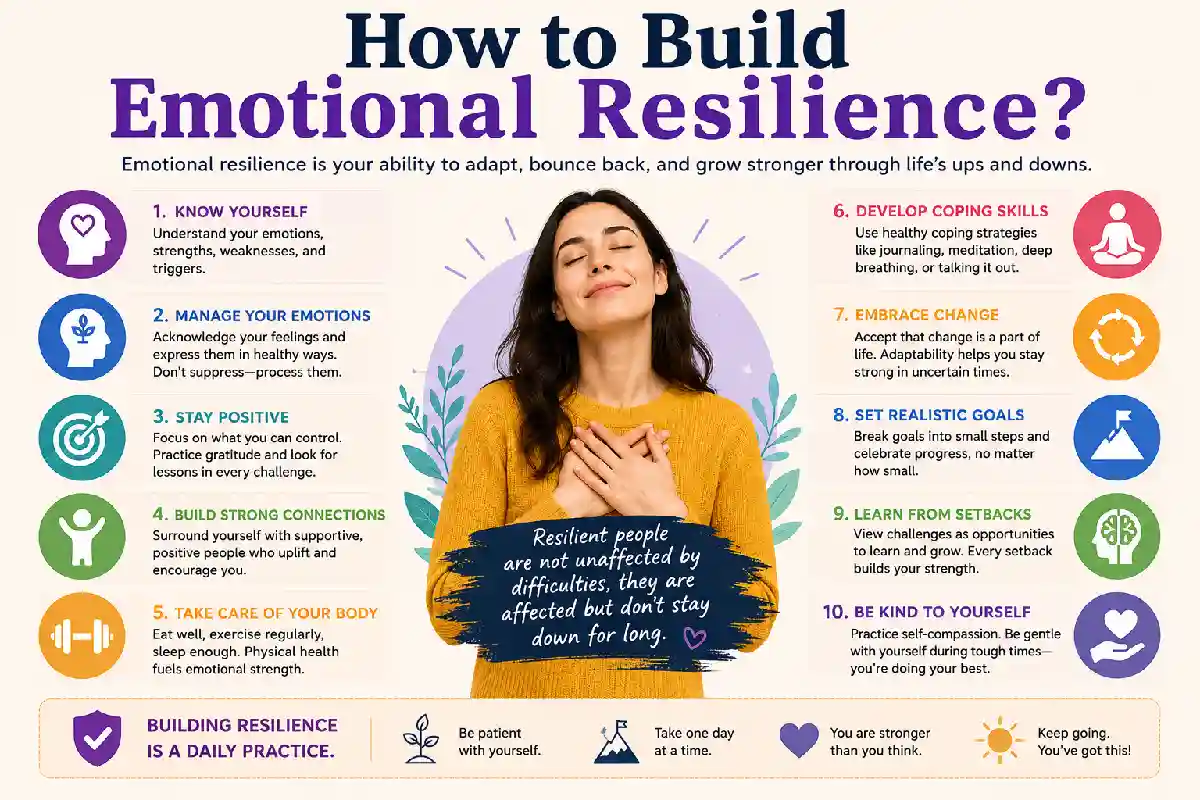
How to Build Emotional Resilience? : Guide to Becoming Stronger Through Life’s Challenges
 Khizrana Begum
Beauty & Lifestyle Writer
Khizrana Begum writes clear and reader-friendly content covering beauty, lifestyle and related topics.
Read Full Bio of Author →
Khizrana Begum
Beauty & Lifestyle Writer
Khizrana Begum writes clear and reader-friendly content covering beauty, lifestyle and related topics.
Read Full Bio of Author →
 Sameena Begum
Health, Technology & Digital Content Reviewer
Sameena Begum reviews content for clarity, accuracy and overall reader usefulness.
Read Full Bio of Reviewer →
Sameena Begum
Health, Technology & Digital Content Reviewer
Sameena Begum reviews content for clarity, accuracy and overall reader usefulness.
Read Full Bio of Reviewer →
How to Build Emotional Resilience? – Rarely are things like you want them or expect them to be. You’ll encounter relationship issues, family issues, problems at work, cash difficulties, or some other form of strife even at your most well-meaning times. Since you can’t control other people or circumstances around you, what you do have the power to manage are your reactions. This is probably the single best quality you could learn in life – the strength to keep our chin up, no matter what happens, and just keep walking forward.
Emotional resilience is not to bury or deny how you feel, it’s to welcome all those feelings in to build strength and build resilience.
❝
This article is a part of
Mental Wellness Guide
What Is Emotional Resilience?
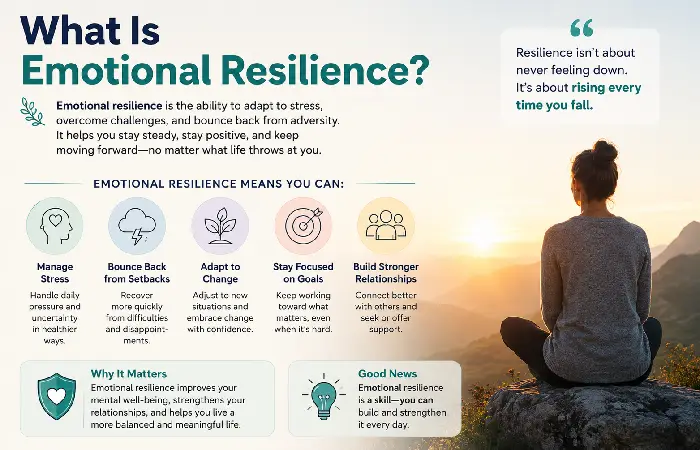
Emotional resilience is to be able to do well when you face adversities such as trauma, tragedy, threats, significant stresses etc. Emotional resilience comes from one’s capability to spring back from these difficulties and stress.
Emotionally resilient individuals are not without pain but their distress are in better managed. Resilience may be defined as the tree’s ability of an oak to stand up to a storm because it bends but it doesn’t break.
Building resilience is an important part of maintaining overall mental and emotional health, helping you adapt to challenges with greater confidence.
Key Characteristics of Emotionally Resilient People
| Characteristic | Description |
| Self-Awareness | Understanding emotions and reactions |
| Adaptability | Adjusting to change effectively |
| Optimism | Maintaining hope during difficulties |
| Emotional Regulation | Managing feelings in healthy ways |
| Confidence | Believing in personal abilities |
| Problem-Solving | Searching for answers, not problems |
| Perseverance | pushing past impediments |
They assist individuals in overcome adversity and also shield their psychological and psychological well being.
Why Resilience Matters?
Resilience means keeping yourself happy and bouncing back from hardship. In the modern world where life has become more and more complicated, challenging and filled with stresses, physical as well as mental fitness through a good health have become necessary and to some extent people are becoming conscious of these facts. A positive attribute or like an arm-guard can guard individuals against undue strains of demands placed on them which can cause and affect one’s health.
Learning effective stress management techniques can strengthen resilience by reducing the impact of everyday pressures.
Benefits of Emotional Resilience
| Benefit | Impact |
| Reduced Stress | Better management of difficult situations |
| Improved Mental Health | Lower risk of anxiety and depression |
| Stronger Relationships | Better communication and conflict resolution |
| Increased Confidence | Greater belief in personal capabilities |
| Increased Efficiency | Increased focus and decisiveness |
| Fast Acting Relief | Bounce back ability after negative experiences |
Why Resilience Is Essential
Even the smallest of jobs can seem impossible when one has not built up his/her own sense of inner resilience. And even the most horrible situation can appear to turn out as an opportunity when one develops resilience.
Practicing mindfulness helps you stay present, regulate emotions, and develop a more resilient mindset.
Resilient people tend to:
- Handle criticism constructively
- Recover from failures more quickly
- Maintain healthier relationships
- Stay motivated during difficult periods
- Make better decisions under pressure
- Experience greater life satisfaction
While building resilience won’t take away your stress, it will change how you respond to stress
Understanding the Foundations of Emotional Strength
You’ll discover to make your life much better by learning to recognize resilience.
A consistent self-care routine supports emotional resilience by promoting healthy habits and regular recovery from daily stress.
The Three Pillars of Resilience
| Pillar | Explanation |
| Mental Strength | Ability to manage thoughts effectively |
| Emotional Balance | Regulating emotions during stress |
| Social Support | Lean on relationships |
When these cornerstones are in place, people are more readily able to traverse the twists and turns of life
Developing a Growth Mindset
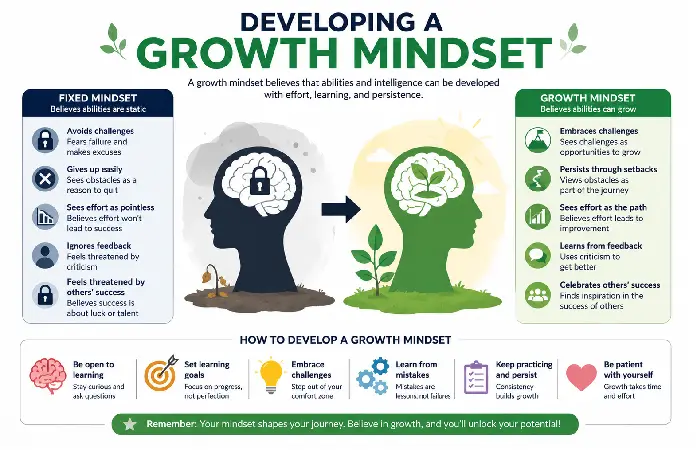
One of the strongest ways of develop resilience is to develop a growth mindset.
Mindsets There are two types of mindsets which are growth mind set & fixed mind set that our intelligence, abilities talents and characteristics are something that can be increased by learning, perseverance and hard work.
Getting enough quality sleep for mental health improves emotional regulation and gives you the energy needed to handle difficult situations.
Fixed mind set individuals view their failures in the past as the be all and end all and the. People with growth minds set up learn from failure failure get on with failure failures.
Fixed Mindset vs Growth Mindset
| Fixed Mindset | Growth Mindset |
| “I can’t do this.” | “I can’t do this yet.” |
| Avoids challenges | Embraces challenges |
| Fears failure | Learns from failure |
| Gives up easily | Persists through obstacles |
| Seeks approval | Seeks improvement |
How to Develop a Growth Mindset?
- Reframe Challenges
Instead of “Why is this happening to me?”, try asking, “What can I learn from this experience?” These 16 words can make the biggest difference to the way you see your trials, and yourself.
- Embrace Learning
Every failure comes with an innate lesson. Let process conquer perfection.
- Celebrate Small Wins
Appreciation on minor success will bring down confidence level in order to generate new habits.
- Replace Negative Self-Talk
Transform your limiting statements into enabling statements.
| Negative Thought | Resilient Alternative |
| I always fail | I’m learning and improving |
| This is impossible | This is challenging but manageable |
| I’m not good enough | I am capable of growth |
Gradually these changes to our outlook fortify emotional strength.
Developing strong emotional intelligence skills can enhance resilience by helping you understand, manage, and respond to emotions more effectively.
Coping With Setbacks
You cannot avoid being knocked down sometimes. Failure happens. Unanticipated events can cause you to feel despair or disappointment. How people manage these things is all that sets them apart.
Common Life Setbacks
- Job loss
- Financial difficulties
- Relationship challenges
- Health concerns
- Academic struggles
- Personal failures
Healthy Ways to Cope
Acknowledge Your Emotions
Actually, the suppression of emotion increases power of emotion. Let us experience emotion without judge.
Ask yourself:
- What do I feel right now?
- Why do I feel this?
- What help do I require?
Self-awareness is the first step in getting past this
Focus on What You Can Control
Focus your energy on those things you have some influence over when you find yourself in troubled times
Circle of Control Table
| Within Your Control | Outside Your Control |
| Attitude | Other people’s opinions |
| Actions | Past mistakes |
| Habits | Unexpected events |
| Reactions | Economic conditions |
| Effort | Others’ behavior |
Focusing on the areas you have influence over will generally lower stress, and the sense of being more in control will likely follow also.
Practice Self-Compassion
The way you talk to your friend. The same way you would to yourself.
Research consistently confirms that, the greater our capacity for self-compassion, the more willing and able we are to tolerate emotional suffering, and, as a result, we are more successful in creating and maintaining mental health.
Create an Action Plan
Large tasks seem more manageable when divided into small steps
Example:
| Problem | Small Action Step |
| Job loss | Update resume |
| Financial stress | Create monthly budget |
| Relationship issue | Schedule a conversation |
| Health concern | Book medical appointment |
Taking small actions creates movement and a feeling of being in control again.
Building Healthy Support Systems
No one is an island for building resilience. The importance of connections for emotional well-being. A good network of friends and family gives comfort and reassurance and a different outlook on a problem.
Why Social Support Matters
People with strong social connections often:
- Experience lower stress levels
- Recover faster from setbacks
- Have improved mental health
- Feel greater emotional security
- Live longer and healthier lives
Types of Support Systems
| Support Type | Examples |
| Emotional Support | Friends, family, partners |
| Professional Support | Therapists, counselors, coaches |
| Community Support | Support groups, clubs, organizations |
| Workplace Support | Mentors, colleagues, managers |
Signs of a Healthy Support Network
- Mutual respect
- Trust and honesty
- Encouragement
- Emotional safety
- Positive communication
Fostering major relationships is absolutely the one best way you are able to create future leverage as well as potential within your relationships.
Daily Resilience Habits
Resilience isn’t built on grand gestures. It’s cultivated in the small rituals. It’s in the small, constant effort that large resilience is built.
1. Practice Gratitude
To be better in life focusing on positive things will help the people and thus will lead to emotional better development.
Simple Gratitude Exercise
Each evening, write down:
- Three things that went well
- One lesson learned
- One thing you look forward to tomorrow
It’s also conditioning your brain to see possibilities rather than challenges.
2. Maintain Physical Health
They are inter-dependent – the physical & emotional.
Healthy Lifestyle Factors
| Habit | Benefit |
| Regular Exercise | Reduces stress hormones |
| Quality Sleep | Improves emotional regulation |
| Balanced Nutrition | Supports brain function |
| Hydration | Enhances mood and concentration |
Exercising a least 20 -30 minutes a day improves the immune system too.
3. Practice Mindfulness
And this awareness means being living the now without holding onto the past or worry about the future.
Mindfulness Benefits
- Reduced anxiety
- Improved focus
- Better emotional regulation
- Increased self-awareness
Simple practices include:
- Deep breathing
- Meditation
- Walking mindfully
- Body scan exercises
4. Develop Problem-Solving Skills
Strong-minded people take steps.
Problem-Solving Framework
| Step | Action |
| Identify | Define the problem |
| Analyze | Understand causes |
| Brainstorm | Generate solutions |
| Choose | Select best option |
| Act | Implement solution |
| Review | Evaluate results |
This could potentially reduce the feeling of being helpless.
5. Build Emotional Awareness
A sense of feelings recognized early before it can consume the person
Keep a journal to track:
- Daily emotions
- Stress triggers
- Personal strengths
- Progress made
Journaling is a fantastic avenue for releasing and figuring out healthier alternatives.
6. Practice Positive Self-Talk
Strength of Emotional endurance depends on how we talk to ourselves
Examples of Positive Self-Talk
| Negative Thought | Positive Alternative |
| I can’t handle this | I will take one step at a time |
| Everything is going wrong | Some things are difficult, but not everything |
| I failed | I learned something valuable |
Even with such small adjustments in its configuration, they result in tremendous and far-reaching impact.
7. Stay Purpose-Driven
It is having something to hold onto in the hard times for individuals that can be a real game changer.
Purpose can come from:
- Family
- Career goals
- Community service
- Personal growth
- Spiritual beliefs
The power of a significant purpose that can inspire you through the tough times.
Quick Resilience Building Checklist
| Daily Habit | Completed? |
| Practice gratitude | □ |
| Exercise or move body | □ |
| Get quality sleep | □ |
| Connect with someone | □ |
| Use positive self-talk | □ |
| Reflect on lessons learned | □ |
| Practice mindfulness | □ |
Practicing this list reliably will greatly build and increase emotional resilience in the long run.
Conclusion
Emotional endurance is one of the greatest gifts that you can offer to yourself to experience more growth in life. When you grow in emotional toughness it does not mean that life would not come with suffering, stress and trials; it means that you would be ready to handle any event or trial. You can increase resilience by having a more positive mindset, how you react to certain situations, support system and routine. Do not attempt to have it all done in a day and build a good support and routine.