

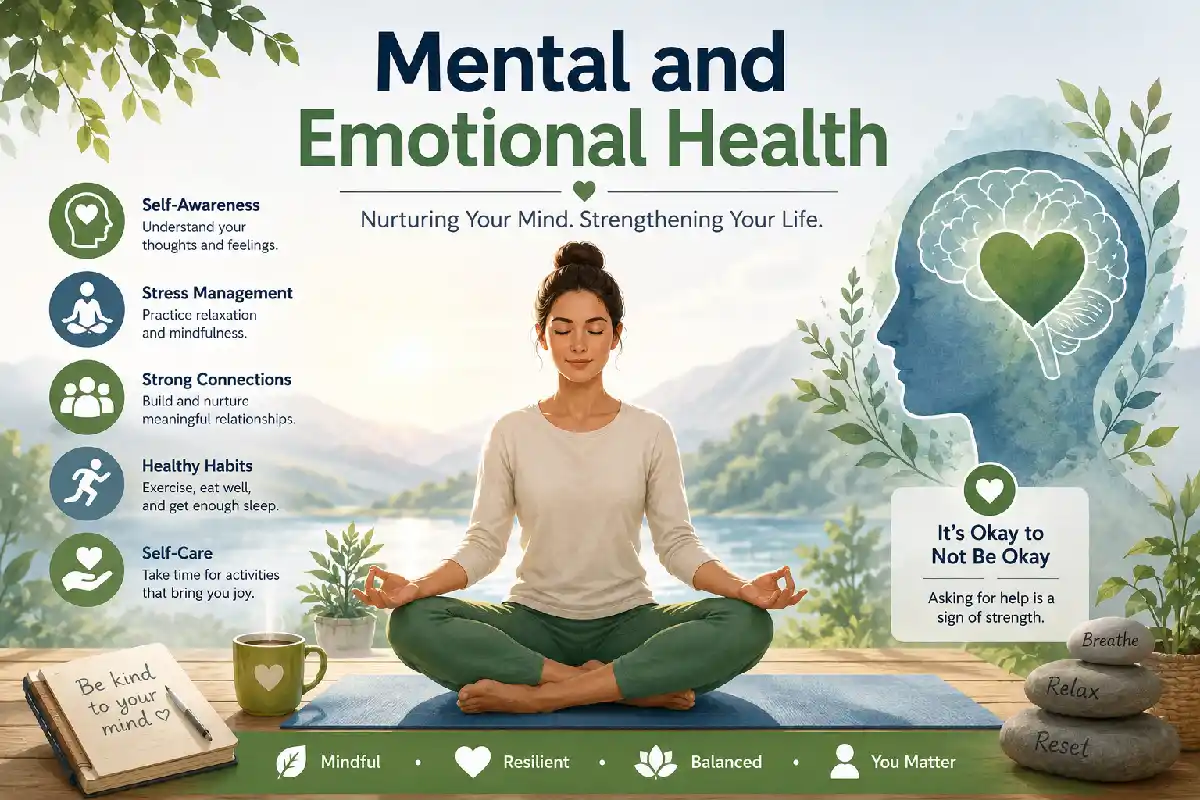
Mental and Emotional Health Tips for Everyday Life
 Khizrana Begum
Beauty & Lifestyle Writer
Khizrana Begum writes clear and reader-friendly content covering beauty, lifestyle and related topics.
Read Full Bio of Author →
Khizrana Begum
Beauty & Lifestyle Writer
Khizrana Begum writes clear and reader-friendly content covering beauty, lifestyle and related topics.
Read Full Bio of Author →
 Sameena Begum
Health, Technology & Digital Content Reviewer
Sameena Begum reviews content for clarity, accuracy and overall reader usefulness.
Read Full Bio of Reviewer →
Sameena Begum
Health, Technology & Digital Content Reviewer
Sameena Begum reviews content for clarity, accuracy and overall reader usefulness.
Read Full Bio of Reviewer →
Mental and emotional health have never been just a thing, they have been a way of life and are really the very definition of our ability to love, to work, to sleep, to withstand hardship, and to repair ourselves. When we give these facets the attention they require, our lives don’t necessarily become painless all day long, but we all feel a lot more connected, alive, grounded, and resilient. And it all has to be in massive, grand, and impossibly perfected gestures.
Each simple choice creates building blocks over time to bring emotional strength. Healthiest sense of strength does not mean never having difficulty, but the willingness to carry on truthfully, compassionately, and with companionship.
Physical health is much more discussed these days than our mental or emotional health, but the two are inextricably linked. Mental exhaustion can cause physical symptoms and stress in the body will likely impact mental state too. Carrying emotional pain can lead to an inability to get the job done. Yet the most basic habits, healthy support systems and coping mechanisms will have significant long-term positive impact.
This article, will demystify Mental and Emotional Health in simple, human terms – including explaining what the terms are and what they mean, their importance, when you know when you’re thriving and when you might be under strain and what you can actually do on a day-to-day basis to cultivate greater mental and emotional health.
❝
This article is a part of
Mental Wellness Guide
Mental and Emotional Health at a Glance
| Area | Mental Health | Emotional Health | How They Work Together |
| Main focus | Ideas, emotions, performance, or even emotional or psychological health. | Knowing what it feels like and learning to handle emotions | They both influence behavior and how a person adapts to life. |
| Examples | Concentration, memory, decisions making, anxiety, depression | Coping With Anger Sadness joy grief and empathy | A sound mind helps processing emotions and a sound emotions help the mind to think clearly |
| Common signs of wellness | Concentrate , calm the thoughts, resolve it in balanced form | Self awareness, emotionally regulated, adaptable, emotionally expressive healthy | Manage stress, be a better person and better partner, trust yourself more |
| When struggling | Constant worry, low motivation, negative thinking, confusion | Emotional outbursts, numbness, mood swings, overwhelm | Stress can affect both at the same time |
| Support tools | Therapy, rest, routines, movement, medical care when needed | Journaling, communication, reflection, boundaries, emotional support | Most wellness plans support both areas together |
What Is Mental and Emotional Health?
How well can you learn and focus? It also includes psychological functioning in response to ordinary stress, learning, thought, concentration, memory, judgment and decision making. It includes our psychological, emotional and social well-being: how we think, feel, act and cope with life’s ups and downs. Emotions are what we feel inside when we encounter a situation that causes us distress and causes us to react either through action or inaction.
Learning effective stress management techniques can help you stay calm, improve focus, and protect your overall mental well-being.
The two are closely linked, but they are not exactly the same.
An expert in analytical thinking might struggle to share their emotions and vice versa with somebody who expressed their emotions easily might be prone to high levels of anxiety or be stuck in a state of constant mind chatter. This goes to say that both are linked. If an individual is feeling anxious thoughts can begin to unravel, in an individual is overcome by emotion then they can’t truly focus, and when an individual is relaxed, in touch with others, and calm then typically making decisions is a straightforward process.
A helpful way to think about it is this:
Mental help with you: Let them come through you.
Emotional health with you: Let them flow through you.
All help you through life.
Building emotional resilience makes it easier to recover from setbacks and adapt to life’s everyday challenges.
A strong mental health not necessarily means you will feel cheerful all the while. That just means you are able to get through bad times without becoming too weak that you lose yourself completely. It indicates being able to feel that you’re depressed without being mired in the funk, feeling that you’re angry without making destructive choices, and experiencing stress without letting this dictate whole day.
Why Mental and Emotional Health Matters?
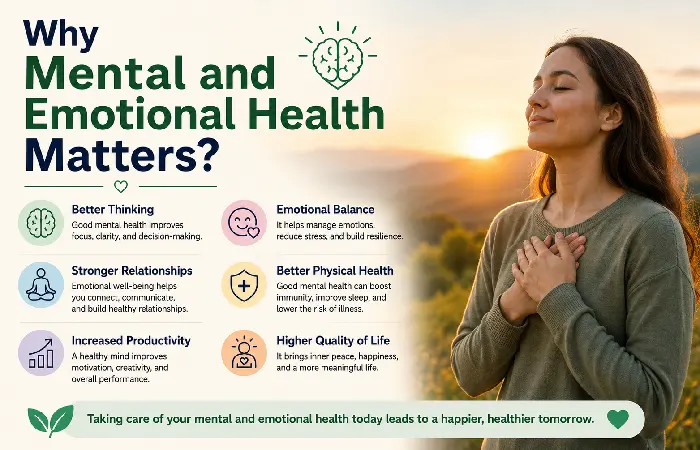
Mental and emotional health matter because they affect nearly everything.
They are reflected in your sleep patterns, your ways of communicating and connecting with others, your problem solving ability and your reactions to stress and change. And the person who is psychologically sound typically exhibits more patience, patience, participation and reliability. The person in turmoil may be capable, but their journey through life is generally more difficult and more draining.
Practicing mindfulness can improve self-awareness, reduce anxiety, and help you stay present throughout the day.
Here is why it matters so much:
| Area of Life | How Mental and Emotional Health Affect It |
| Work and study | Better focus, memory, planning, and motivation |
| Relationships | More empathy, communication, trust, and patience |
| Physical health | Lower stress response, better sleep, improved self-care |
| Decision-making | Clearer thinking and less impulsivity |
| Self-esteem | More self-respect, confidence, and self-acceptance |
| Daily energy | Less mental exhaustion and emotional overwhelm |
In addition, mental health, also related to mental wellness and well-being of course impacts our resilience. However, this may surprise some. Resilience has less to do with putting on an brave face and never breaking, but much to do with picking yourself up when something does in fact happen, stress takes place or when something just does not go well.
Creating a consistent self-care routine supports better emotional balance, lowers stress, and promotes long-term mental wellness.
When something happens that is disappointing, brings grief, put us to pressure or triggers conflict; you may still break but do not become demolished as you possess both the mechanisms or resources to get it right and the skill to do so in order to get back up again.
Moreover, a higher quality of living is guaranteed with optimal mental and emotional health, making life less daunting with more opportunities to find joy, deepen relationships as well as facilitate growth, learning and knowledge gaining even when things just don’t go to plan for once!
Signs of Good Mental and Emotional Well-Being
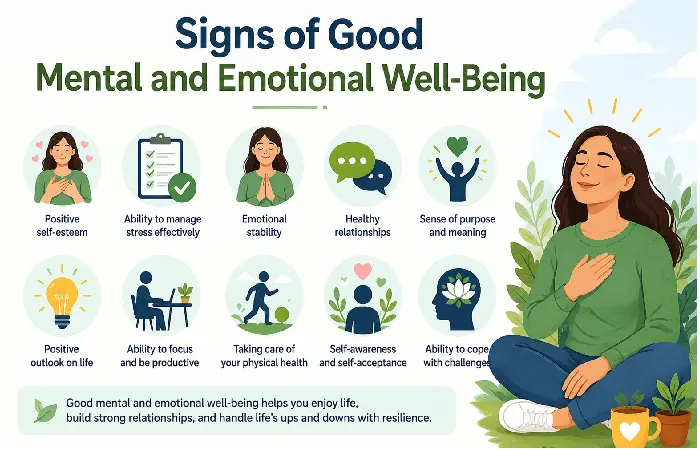
Good mental and emotional health does not mean constant positivity. It means balance, flexibility, and the ability to respond to life in a healthy way.
Some signs include:
- You can concentrate most of the time.
- You can come back after difficult events (even if that’s hard to do!).
- You know what you are feeling without being controlled by feelings.
- You ask for help when you want.
- You have someone (someone’s!) to connect to.
- You can enjoy things and feel present in them.
- You can make decisions without constant panic.
- You can tolerate stress without becoming overwhelmed all the time.
Comparison Table: Healthy vs Struggling Signs
| Area | Signs of Healthy Well-Being | Signs Something May Be Off |
| Thoughts | Straightforward reasoning, sensible mindset | Persistent concern or anxiety racing thought patterns negativity toward self |
| Emotions | Agile, mindful, controlled | Numbness, frequent mood swings, emotional overwhelm |
| Behavior | Stable routines, healthy coping | Self avoidance, fleeing, sudden outbursts |
| Relationships | openness , trust , limits | Separation, drama, appeasing people, doubt |
| Energy | Steady enough for daily life | Extreme fatigue, restlessness, burnout |
| Recovery | Can bounce back from stress | Takes too long to recover or cannot recover at all |
Keep in mind, however, we all have tough days in life. One depressed day is hardly a sign that a person is experiencing mental illness. Our concern is sparked when the distress is persistent, severe or begins interfering significantly with the individual’s daily life.
Common Factors That Affect Mental Health
Your overall Mental health is influenced by a wide array of circumstances and factors. It isnt attributed by a single event nor it indicates any weakness. Rather, it is formulated by an intrinsic integration of biology, surroundings, exposure, habits and surroundings.
Getting enough quality sleep for mental health is essential for emotional regulation, concentration, and overall cognitive performance.
Common factors include:
- Genetics and brain chemistry
For many individuals, the predisposed capacity for anxiety, depression, mood instability, or even trouble focusing can have a biological component. Brain chemistry can account for certain dispositions but is seldom all-encompassing.
- Stress and pressure
A built-up series of pressures at work, in school, regarding finances, from our family, and to manage our romantic ties can be spiritually draining over a considerable duration.
- Trauma and painful experiences
If there has been childhood abuse, loss, neglect, accidents or trauma these can have lasting emotional and mental consequences.
- Sleep problems
Lack of good quality sleep could lead you to experience the following: decreased concentration decreased focus increase irritability decrease in ability to manage stress
- Physical illness
Changes in hormones, persistent disease, inflammation and chronic pain can all influence mental well being greatly.
- Social connection
Your bonds nurture your mind; stress in connections damages it.
- Lifestyle habits
How your brain and body feel also depends on factors like nutrition, motion, water consumption, how much screen time, and substance use.
- Life transitions
Moving, divorce, job changes, marriages, parenting, retirement, and loss of a loved one cause feelings.
Table: Factors and Their Possible Impact
| Factor | Possible Effect on Mental Health |
| Chronic stress | Burnout, anxiety, irritability |
| Trauma | Hypervigilance, fear, emotional shutdown |
| Poor sleep | Low mood, brain fog, emotional sensitivity |
| Isolation | Loneliness, hopelessness, low self-worth |
| Physical illness | Fatigue, stress, frustration, sadness |
| Unhealthy coping | Dependence, avoidance, emotional instability |
| Strong support | Better resilience, emotional safety, confidence |
Mental health is not static. Over time, it can become better with treatment, with support and with positive actions. That one aspect about it brings with the most optimistic news.
Developing emotional intelligence skills can strengthen relationships, improve communication, and enhance your personal and professional life.
Understanding Emotional Wellness
Emotional wellness entails an individual being able to identify, understand as well as handle emotions in an appropriate manner. It does not entail not to feel or act based on our emotions. It means having a healthy relationship with your emotional life.
A person with emotional wellness can say, “I feel hurt,” instead of only acting hurt. They can say, “I am angry,” instead of exploding, and notice sadness without becoming consumed by it. They can feel joy without waiting for it to disappear.
Emotional wellness includes:
- Self-awareness
- Emotional regulation
- Healthy expression
- Empathy
- Flexibility
- Self-compassion
- Healthy boundaries
Many people were never taught how to deal with feelings. They were told to “be strong,” “stop crying,” or “get over it.” But emotions are not enemies. They are signals. They tell us when we need rest, support, safety, change, or healing.
For example:
- Fear could be telling you something feels unsafe.
- Anger could be telling you a boundary was violated.
- Sadness could be telling you there’s a loss.
- Shame could be telling you that you need compassion, not criticism.
- The goal is not to eliminate emotions.
- The goal is to understand them and respond wisely.
A simple emotional wellness cycle
| Step | What It Means |
| Notice | Recognize the emotion without denying it |
| Name | Put a clear label on what you feel |
| Understand | Ask what triggered it and what it is asking for |
| Respond | Choose a healthy action instead of reacting blindly |
| Recover | Give yourself time to settle and reset |
This cycle sounds basic, but it could possibly change the whole approach a person experiences daily.
Daily Habits That Support Mental Health
We often make big change from very small shifts of habit. Mental health care isn’t just for when things are at their worst, but to form steady habits for times of normal life.
Daily habits that make a real difference:
- Keep a consistent sleep schedule
This mental health tool that might be most effective also probably is the least respected. If you slept enough you will be able to deal with stressors, stay alert, and manage emotions and the mood.
- Move your body regularly
You’ll get all the health rewards even if it’s pretty easy-walking, dancing, stretching and light strength-training are moderate options that can boost mood, stress and anxiety.
- Eat in a balanced way
Even our own brain can get the staves to feast your body with regularly prepared meals packed with plenty of protein fiber essential fat and liquid and you’ll keep both your body and soul in a high state of bliss.
.4. Limit constant digital noise
Why our brain needs food even if we’re full! The brain needs steady flow of protein, fibre, the ‘good fat’ and fluids to keep the spirit high and brain charged.
- Create small routines
Having a simple routine every morning/evening can offer a greater sense of safety and predictability. Sometimes useful in the height of uncertainty.
- Stay connected
Even simply two main constructive social interactions per week-with a partner, colleagues or neighbours-can counteract isolation.
- Practice self-reflection
You embark on the real heavy lifting, the real emotional processing by mediating, writing, praying, thinking, breathing.
- Reduce unhealthy coping
Some examples of temporary fixes, which actually make things worse over time, include: drinking alcohol, binge shopping, stress eating, over working, avoidance.
Table: Helpful Daily Habits and Their Benefits
| Habit | Benefit |
| Regular sleep | Better mood, focus, and recovery |
| Daily movement | Lower stress and improved energy |
| Balanced meals | More stable emotions and concentration |
| Hydration | Less fatigue and brain fog |
| Screen boundaries | Reduced overwhelm and comparison |
| Social contact | Lower loneliness and stronger support |
| Journaling | Better emotional clarity |
| Breathing exercises | Faster stress recovery |
No single habit fixes everything. But together, they create a more stable foundation.
The Connection Between Physical and Mental Health
Mind and body are interlinked. Your physical and mental health is directly related and your body and mind are in constant contact. One does not need to remain separate while the other endures torment or difficulty.
Symptoms of stress include headache, upset stomach, muscle pains in the neck and other parts of the body, tension and back pains, breathlessness, fatigue, headache, headache attacks, headache pain in general and insomnia.
There is the converse case whereby physiological causes would create worries in your mind, such as panic, irritability and despair. The less the physical symptoms are, the better the body can resist mental stress.
Common ways the body affects the mind:
- Poor sleep can make you grumpier.
- Chronic pain can feel discouraging, and exhausting, or even hopeless.
- Hormonal changes that could affect your mood. Deficiencies in diet could prevent concentration and make it hard for someone to feel motivated. Your lifestyle could be the blame
- A lack of activity and exercise can leave someone depleted of energy.
Common ways the mind affects the body:
- A quick heartbeat, sweating and feeling ill can indicate a state of anxiety.
- Symptoms of depression include difficulty moving around, fatigue and changes in eating habits.
- Your muscles might tense and a headache may start after experiencing stress.
- Your sleep and your digestion will probably suffer if you’re undergoing distress.
Table: Mind-Body Connection Examples
| Situation | Mental Effect | Physical Effect |
| Work stress | Worry, overwhelm | Muscle stiffness Poor sleeping |
| Grief | Sadness, not feeling any thing at all | The effects on appetite |
| Anxiety | Anxiety/ nervousness | Heart pounding, upset stomach |
| Depression | Demotivation despondency | No energy. Lethargic movement. |
| Poor sleep | Brain Fog, Cranky | Lingering exhaustion, headaches. |
Looking after your body means you will also be looking after your brain. They work together.
Managing Stress and Emotional Challenges
Stress is a perfectly normal and healthy phenomenon. The issues surrounding stress aren’t about its existence but rather when the process never ends or never gets properly regulated or healed with enough time and support.
We’ll feel sad, disappointment, grief, anger, fear, or lonliness, uncertainty or rejected . This may well be our natural feelings however we can learn strategies and how to survive, and come through them with ease.
Practical ways to manage stress:
- Break problems into smaller steps
Problems seemed like a little easier when I have something small to do.
- Use grounding techniques
5 things you can see. 4 things you can feel. 3 things you can hear. 2 things you can smell. 1 thing you can taste. Useful during moments of anxiety.
- Speak to yourself more gently
Self criticism amplifies the stress hormones, compassionate self-talk gives a moment to recuperate
- Protect your energy
You don’t have to say yes to everything. Boundaries are not a negative thing. They are a healthy boundary.
- Don’t underestimate brief moments of calm
Even five minutes of rest is enough to give your nervous system a chance to reboot.
- Talk to someone safe
Sometimes relief begins with being heard without judgment.
- Focus on what is controllable
Not everything can be fixed at once, but some things can be influenced. Start there.
Table: Stress Response vs Healthy Response
| Stress Trigger | Unhelpful Response | Healthier Response |
| Conflict | Accuse, run and hide or shut down | pause listen clarify |
| Overwhelm | Panic, putting off an activity. | Focus on, slice activities |
| Rejection | Self-deprecation; self-mortification | Mindfulness and Self-Compassion |
| Uncertainty | Disaster thinking | Don’t get stuck in the moment, take notes |
| Loneliness | Withdrawal | Reach out, connect |
Managing stress isn’t the same thing as not caring. It is a matter of being a lesser victim of it.
Building Emotional Resilience
Resilience is being able to rebound from difficulties. It is not about never falling or faltering. It is about developing the internal and external resources so you have the capacity to rise above it all and get your forward motion back.
Resilience can be built. This is something that we are not just born with – 1-2% the number of.
Emotional resilience: The importance of hard feelings.
- Allow yourself to feel whatever hard feelings you need to.
When you try to avoid a pain, often it just grows. Be aware of it and allow it to pass.
- Strengthen self-trust
Make small promises to yourself. Over a period of time you gain confidence.
- Learn from difficult experiences
While every experience isn’t meant to teach you something… a lesson will most likely still come out of it.
- Stay connected to others
Resilience is fostered by feeling loved. We recover from a bad day better not just by the love of God, but in a truly felt deep loving relating.
- Practice flexible thinking
Don’t go to the worst case, go to multiple case.
- Keep a sense of purpose
Purpose gives direction during hard seasons.
- Celebrate progress
As we see how far we’ve come, not just where the finish line remains, our resilience strengthens.
Table: Traits of Resilient People
| Trait | What It Looks Like in Real Life |
| Self-awareness | Knows personal triggers and limits |
| Flexibility | Adapts when plans change |
| Hope | Believes change is possible |
| Support-seeking | Asks for help without shame |
| Patience | Understands healing takes time |
| Self-compassion | Treats themselves with kindness after mistakes |
Resilience does not mean never breaking. It means learning how to mend.
When to Seek Professional Support
Maybe the best way to cope doesn’t always work, it means that seeking additional support may be required and seeking support from a trained therapist, counsellor, Psychologist, Doctor, or Psychiatrist can provide this extra help.
It may be time to seek support if:
- Most of the time, I feel sad, anxious, mad or numb.
- Sleep, my appetite or my energy level changed much
- You are withdrawing from people and activities.
- It’s hard to function, let alone perform at your job or school.
- Your coping behaviours are harmful.
- You feel helpless and hopeless and have a tendency to remain stuck.
- You’re going to the emergency room because of a panic attack or having intrusive thoughts or extremely wide emotional swings.
- You are in a lot of pain because something traumatic happened to you recently (or many years ago) and the effects are ongoing.
- You have an alcohol/drug or other addictive problem used to manage extreme pain.
Table: When Support May Help
| Experience | What It Might Mean |
| Constant anxiety | Ongoing stress or anxiety-related concern |
| Ongoing sadness | Could have symptoms of depression or grief that would need further support. |
| Emotional numbness | Burnout Trauma or Overwhelm |
| Severe mood swings | Need for professional evaluation |
| Social withdrawal | Depression, fear, exhaustion, or isolation |
| Loss of function | Stress is interfering with normal life |
Reaching out for help earlier may be better than struggling until things are more serious, similar to how you would ask for a second opinion about recurring physical pain for an ache or the like.
This makes just as much sense with regards to the ongoing pain that you are experiencing, which is emotional rather than physical.
In cases of risk of immediate injury or the risk of harm to yourself or others, please seek immediate help via an emergency route.
How to Care for Mental and Emotional Health Every Day
Developing a strong mental health routine don’t have to be complex at all; the mental health practices just need to be real and steady.
Here is a simple daily framework:
Morning
- Wake up at roughly the same time.
- Avoid rushing if possible.
- Drink water.
- Take a few slow breaths.
- Set one intention for the day.
During the day
- Take short movement breaks.
- Eat regularly.
- Notice stress before it builds.
- Keep one or two priorities clear.
- Stay in touch with at least one supportive person.
Evening
- Reduce overstimulation.
- Reflect on the day without harsh judgment.
- Unplug from screens when possible.
- Prepare for rest.
- Aim for a calming bedtime routine.
This kind of structure creates emotional safety. It tells the brain, “I am cared for. I am not in constant emergency mode.”
A Gentle Reminder About Progress
It’s not about perfection. Sometimes your days will be orderly and productive. Sometimes your days will be scattered and exhausted. That’s okay — it’s also okay and good and a sign of progress, just maybe in tiny, hidden steps toward larger, more visible ones.
Someone can be better without being fully well, healing without being “fully healed” and brave and still need support.
That is not a contradiction. That is real life.
FAQs Frequently Asked Questions
Mental health and emotional health are different; why?
Behavior and emotions combined the mind’s ability to think, reason, all thought process, psychological functions, are collectively known as mental health.
Emotional health consists in the capacity to recognize and to manage emotions – being clear as to what is going on and what to do about it. There is a fine distinction between emotional and mental health.
Can someone have good mental health but poor emotional health?
Yes . It’s definitely possible for the person to be completely able to cope / function & to be totally lucid & clear about their situation but still really struggling with emotional coping and expression, with other areas of their life seeming to be perfectly fine .
What are the most common signs of poor mental or emotional health?
These are other symptoms of depression: sleep disorders or problems with appetite attention problems and poor memory difficulty completing things having a sense of feeling blank and empty. Having an inability to make the decision, for instance whether to take public trans or not having the ability to complete the every day task.
What daily habits help mental health the most?
Here are some things that may support more than you’d ever anticipate: a stable sleep habit, consistent movement of our physical bodies, whole foods, abundant liquid, relationship and connection, cutting down on our screen time, and simple habits/rituals.
How does stress affect emotional health?
Stress can make you capable of expressing emotion’s magnitude, containing unpleasant emotions, and spending mind effort. It can make you feel depressed or upset or bad, stressed, or shutdown indefinitely.
Is emotional resilience something you are born with?
Although it’s beneficial having people born with talent, reliance, Coping strategies, reflection and routines can guide and help individuals learning to develop resilience.
When should someone talk to a professional?
You would need help of a expert should any other measures above for a period lasting more than few weeks, affecting daily activities, work or social life and causing distress.
Can physical health really affect mental health?
Absolutely yes – sleep, eating, disease, pain, hormones, movement – really anything that affects us affects our brain. They are no different you know.
Final Thoughts
Mental and physical health is so woven into the fabric of our lives that they are not separate from our life. Mental health influences the ways that you know yourself; the ways that you love others and how other people love you; the ways that you offer service and expression to your work; and the ways that you recharge your batteries to navigate setbacks and difficulties. If this area of mental wellness give attention, your life can start feel not just simpler, but richer and more under your guidance, more rewarding, more purposeful.