

Emotional Intelligence Skills for Better Well-Being
 Khizrana Begum
Beauty & Lifestyle Writer
Khizrana Begum writes clear and reader-friendly content covering beauty, lifestyle and related topics.
Read Full Bio of Author →
Khizrana Begum
Beauty & Lifestyle Writer
Khizrana Begum writes clear and reader-friendly content covering beauty, lifestyle and related topics.
Read Full Bio of Author →
 Sameena Begum
Health, Technology & Digital Content Reviewer
Sameena Begum reviews content for clarity, accuracy and overall reader usefulness.
Read Full Bio of Reviewer →
Sameena Begum
Health, Technology & Digital Content Reviewer
Sameena Begum reviews content for clarity, accuracy and overall reader usefulness.
Read Full Bio of Reviewer →
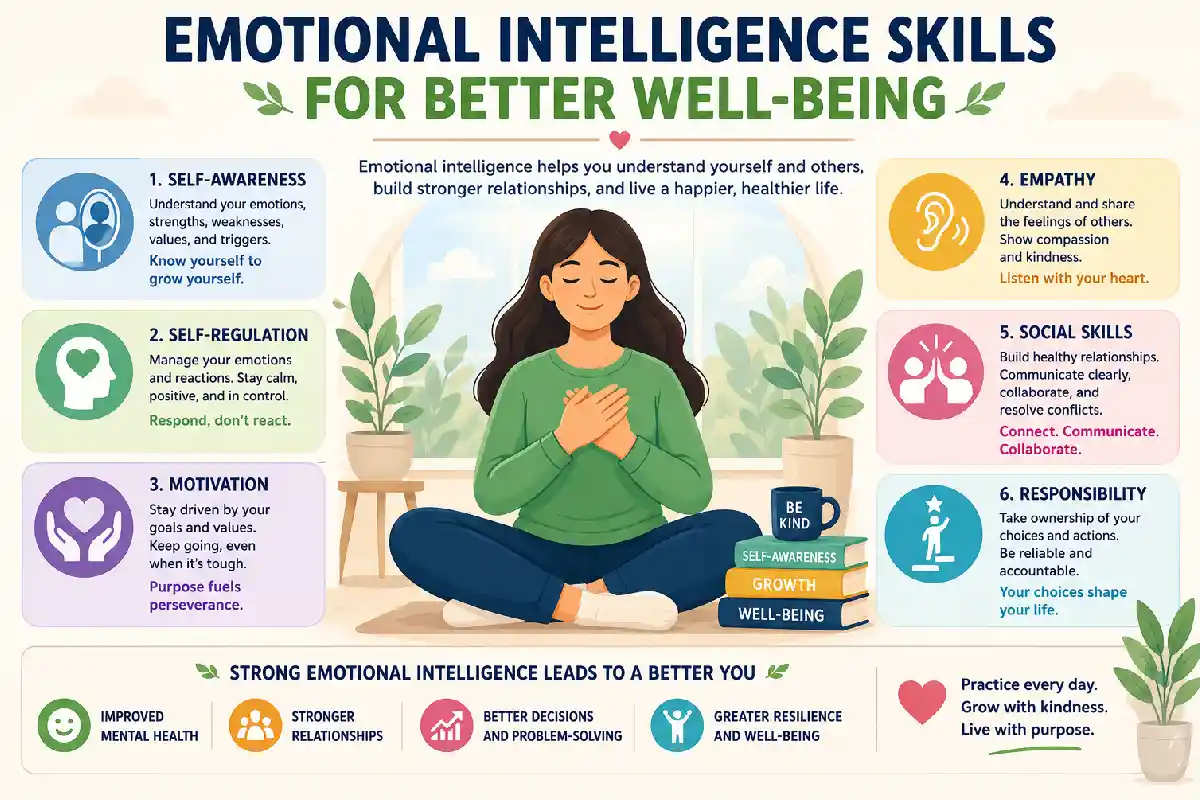
Emotional Intelligence Skills to Improve Well-Being are going to be one of the most relevant life skills in 2026. Whether it‘s about under control stress and anger, about developing stress management techniques, about building better relationships, about learning how to communicate properly or about being a better leader, emotional intelligence (EQ) is going to be vital for life-wise mental and emotional health.
Different from IQ, emotional intelligence is something that can be worked on and improved upon with practice. Studies from major psychology research institutions have demonstrated time and again that the higher the emotional intelligence, the stronger one‘s mental health, relationships, job performance and ability to cope with stress.
That‘s a lot to cover but throughout this guide I want to tell you what emotional intelligence is and teach you about the key skills, exercises you can do on a daily basis, common mistakes to look out for and some basic tools that will help your emotional intelligence development.
❝
This article is a part of
Mental Wellness Guide
What Is Emotional Intelligence?
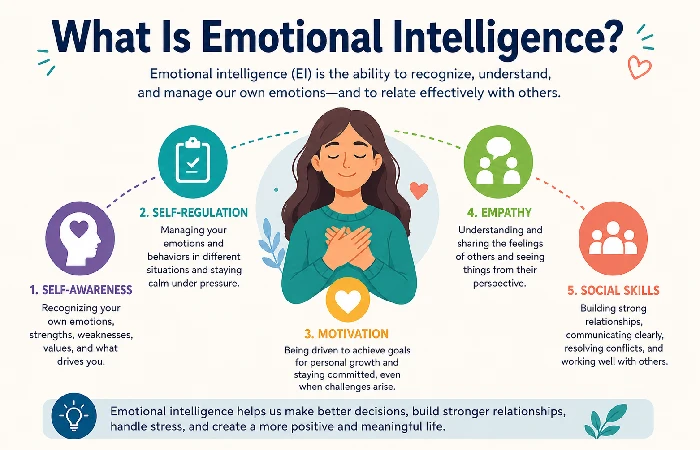
Emotional intelligence (EI) also termed emotional quotient (EQ) gauges your capacity to identify, comprehend, control, and communicate your feelings; at the same time, it assesses your sensitivity to and skill in going through and responding to the feelings of others. Not to be confused with intelligence quotient (IQ), which assesses one‘s thinking skills, EI relates specifically to competence in emotional areas.
Psychologist Daniel Goleman popularized emotional intelligence through five key components:
- Self-awareness
- Self-regulation
- Motivation
- Empathy
- Social skills
People with high emotional intelligence generally:
- Handle stress better
- Make thoughtful decisions
- Build stronger relationships
- Resolve conflicts calmly
- Adapt to change more effectively
Emotional Intelligence vs IQ
| Feature | Emotional Intelligence | IQ |
| Measures | Emotional abilities | Cognitive abilities |
| Can Improve? | Yes | Limited |
| Helps Relationships | Excellent | Moderate |
| Helps Mental Well-being | Very High | Moderate |
| Workplace Success | High | High |
| Stress Management | Excellent | Limited |
Resource
| Organization | Research |
| American Psychological Association | https://www.apa.org |
| World Health Organization | https://www.who.int |
Self-Awareness Skills
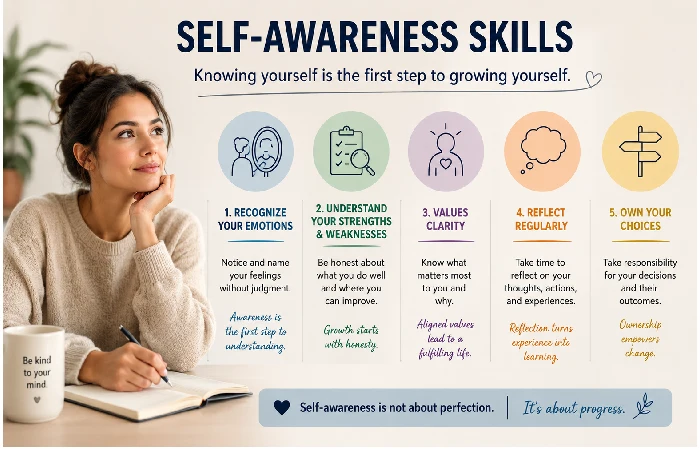
Self-awareness is the key skill to have in developing Emotional Intelligence. It is the clarity that you are aware of your own feelings and emotions, and for the realization that these are, and by what means they impacts on decisions and actions.
Developing strong mental and emotional health lays the foundation for improving emotional intelligence and building healthier relationships.
Self-awareness enables individuals to handle stress, communicate well, and even make a sound decision because they know what exactly causes them to react on certain situations.
It involves recognizing:
- emotions
- triggers
- strengths
- weaknesses
- personal values
However, if we are not aware of ourselves, our emotional responses tend to become involuntary.
Daily Self-Awareness Exercises
| Exercise | Time Needed | Benefit |
| Journaling | 10 min | Identify emotions |
| Mood tracking | 5 min | Recognize patterns |
| Meditation | 10–20 min | Improve awareness |
| Reflection after conversations | 5 min | Better communication |
| Gratitude writing | 5 min | Positive mindset |
Signs of Strong Self-Awareness
- Accepts feedback
- Knows emotional triggers
- Understands personal values
- Makes thoughtful decisions
- Learns from mistakes
Self-Regulation Techniques
Self- regulation refers to your own ability to control one-third of your emotions, thoughts or behaviors in an adaptive way when you are under stress and/or aroused. With an awareness of your emotional state, self- regulation allows you to control, hold back, and react to these states.
Learning effective stress management techniques can help you stay calm under pressure and make better emotional decisions.
Healthy self-regulation includes:
- Pausing before reacting
- Breathing exercises
- Positive self-talk
- Reframing negative thoughts
- Taking short breaks during stress
Emotional Regulation Comparison
| Situation | Reactive Response | Emotionally Intelligent Response |
| Criticism | Become defensive | Ask clarifying questions |
| Stress | Panic | Prioritize tasks |
| Conflict | Raise voice | Stay calm |
| Failure | Self-blame | Learn and improve |
| Delays | Frustration | Practice patience |
Empathy and Relationships
Empathy is defined as the ability to understand the thoughts, behaviors and emotional behavior of another individual. It is one of the most crucial factors of EI in that it can be used for building trust, for taking care of relationships and for better communication. Empathy isn‘t just about being able to sense the other‘s feelings but reflected in acts of respect and care.
Building emotional resilience enables you to handle setbacks with confidence while strengthening your emotional intelligence over time.
Strong empathy leads to:
- Better friendships
- Healthier marriages
- Improved teamwork
- Better customer service
- More effective leadership
Ways to Practice Empathy
- Listen without interrupting
- Ask open-ended questions
- Validate emotions
- Observe body language
- Avoid assumptions
Relationship Benefits of High EQ
| High Emotional Intelligence | Low Emotional Intelligence |
| Better communication | Frequent misunderstandings |
| Greater trust | More conflict |
| Strong teamwork | Poor collaboration |
| Healthier boundaries | Emotional burnout |
| Higher satisfaction | Increased stress |
Communication Skills
Communication is one of the most important skills for a greater well-being. In order to communicate successfully, one should have the ability to state your thoughts, feelings, ideas clearly and have a genuine interest in the perspective of other people.
Practicing mindfulness improves self-awareness, which is one of the core components of emotional intelligence.
We can see that people who are better at communicating have more gratifying relationships, superior competence in conflict management and more enjoyable encounters.
Emotionally intelligent communicators:
- Listen actively
- Stay calm during disagreements
- Express emotions respectfully
- Give constructive feedback
- Ask thoughtful questions
Active Listening Checklist
- Maintain eye contact
- Avoid interrupting
- Repeat key points
- Ask follow-up questions
- Acknowledge emotions
- Respond thoughtfully
Improving Emotional Intelligence Daily
There isn‘t an easy route to grow your emotional intelligence; it is a skill that you can learn, through practice. Just simple exercises like writing a thank you note or remembering to breathe a couple of deep breaths before walking in to a high-pressure meeting can go a long way towards great self-awareness and stress management.
A consistent self-care routine supports emotional regulation and helps you maintain the mental clarity needed for healthier interactions.
You will soon discover that establishing thoughtful routines in your life will help you to help your overall mental health and your resilience skills along with your interpersonal skills.
Daily EQ Improvement Plan
| Habit | Frequency |
| Meditation | Daily |
| Journal emotions | Daily |
| Read psychology books | Weekly |
| Ask for feedback | Weekly |
| Practice gratitude | Daily |
| Reflect before sleeping | Daily |
| Improve listening | Every conversation |
Emotional Intelligence Growth Framework
| Stage | Focus |
| Beginner | Awareness |
| Intermediate | Regulation |
| Advanced | Empathy |
| Expert | Leadership & coaching |
Frequently Asked Questions
Is emotional intelligence as or more relevant than IQ?
Both are important, but EI usually influences relationship, group work, leadership and the long run more.
Can you be learned?
Yes. Your emotional intelligence, unlike your intellectual intelligence, is trainable over time with effort, practice, and feedback.
Generally how long does it take to increase hot emotional intelligence?
Most people see results within a few weeks from starting habits such as journaling, mindfulness, active listening, etc. but more meaningful improvements may take a few months.
Prioritizing quality sleep for mental health enhances focus, emotional control, and decision-making, all of which contribute to stronger emotional intelligence skills.
What is the first modification novice should learn?
Self-awareness, First of all. The better you understand your own feelings, the more easily you will be able to learn how to control them and relate better.
Useful or not? A question of whether the apps are useful or not.
They can also support habit formation by guiding users through exercises in mindfulness, monitoring your mood or keeping a journal, and only work well when combined with in vivo practice.
Conclusion
Building Emotional Intelligence Skills for Enhancing Personal Well-being is a valuable journey which can have positive impact on all aspect of life such as mental health, intimate relationship, careers and leadership. Because of higher level of awareness of yourself, your emotions you will be able to control them, be more empathetic in caring yourself and other and communicate effectively.We suggest you begin with just one or two habits that you try daily. Track and be aware of how you‘re doing, and try to be receptive to feedback. With regular practice, time and patience, they will make a difference in your quality of life.