


Blush: A Complete Guide to Shades, Types, and Application
Last Updated: September 18, 2026
Blush is one of those makeup products that can totally transform your face in just a few easy sweeps. Foundation and concealer can even out your skin, but blush is what adds that perfect flush of color back into the skin, giving you a healthy glow and that added dimension to your face.
Deciding on the right blush: so many options, so little time. There’s a traditional powder formula, newer cream and liquid blushes … and the list goes on. The key is not just selecting a pretty color, but instead, considering your skin tone and undertone, as well as your face shape, skin type, and desired finish.
What Is Blush?
Blush is makeup you wear on your cheeks for some color and life. Blushes can be pink, peach, coral, rose, mauve, berry, and even red shades. Do you have a little blush on your cheeks after walking for a few minutes or even after doing a quick workout?
That‘s what blush will do in a more charming, refined way.
It can also add dimension to a makeup look. Foundation can sometimes make the face appear a little flat – that is, to lack contrast in skin tone – because it covers the various shades that your skin naturally displays. Blush can help restore that vibrance.
Types
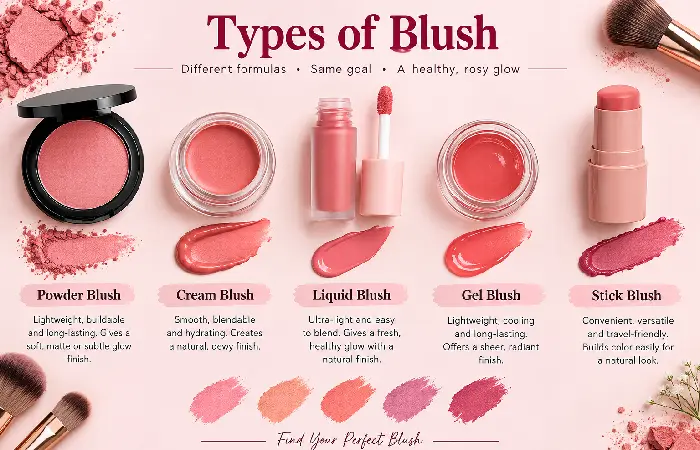
Blush formulas today are a huge surprise. All formula types deliver different effects when applied to the skin, and with the right texture, application can become far easier.
| Type of Blush | Texture | Suitable For | Typical Finish |
| Powder blush | Dry, silky powder | Oily and combination skin | Matte to luminous |
| Cream blush | Soft and creamy | Normal and dry skin | Dewy, natural |
| Liquid blush | Lightweight fluid | Most skin types | Fresh, skin-like |
| Gel blush | Light gel texture | Oily or combination skin | Sheer, fresh |
| Stick blush | Solid cream | Most skin types | Natural to dewy |
| Baked blush | Smooth baked powder | Most skin types | Soft, often luminous |
Powder blush is probably the best known. It is very easy to blend with a brush and especially effective when applying to powder-set makeup.
Cream blush blends more into the skin than sitting really obvious on the surface and thus can be particularly desirable for dry or aging skin.
Liquid blush is usually highly blendable but can also be strongly pigmented. Starting with a tiny dot is often enough.
Stick blush is ideal if you want your makeup to be compact and easy to put on. If you want it to apply easily to the skin, then apply it with your fingers, a sponge, or a brush.
How to Choose a Blush Shade?
Selecting the appropriate blush color. Considering one‘s skin tone and undertone are the two most important things to look at when selecting the perfect shade of blush. Your skin tone is the normal shade (color)of your skin. It can be extremely light or extremely dark. Your undertones are the hues beneath your skin.
To keep the deepest skin tone punchy and fresh, continue the Lip Flattering colors from Light Peach, Peach Pink & Rose.
Coral, peach, apricot, and warm pink-based shades for medium-coloured skin, and darker, tanned, or more coloured skin shades of berry, plum, brick, and terracotta for darker skin.
| Skin Tone | Blush Shades to Explore |
| Fair | Soft pink, peach, light rose |
| Light | Pink, peach, warm rose |
| Medium | Coral, apricot, mauve, rose. |
| Tan | Terracotta, deep coral, warm berry |
| Deep | Berry, plum, brick red, rich coral |
Warm undertones might go for peach, coral, apricot, and warm terracotta hues. Pink, rose, mauve, and berry are best suited for cool undertones. Neutral undertones have the most freedom of options and can go for either side of the family.
Remember, these are simply guidelines for where to start, but not rules. An especially interesting blush shade might not always be under an exact color family.
How to Apply?
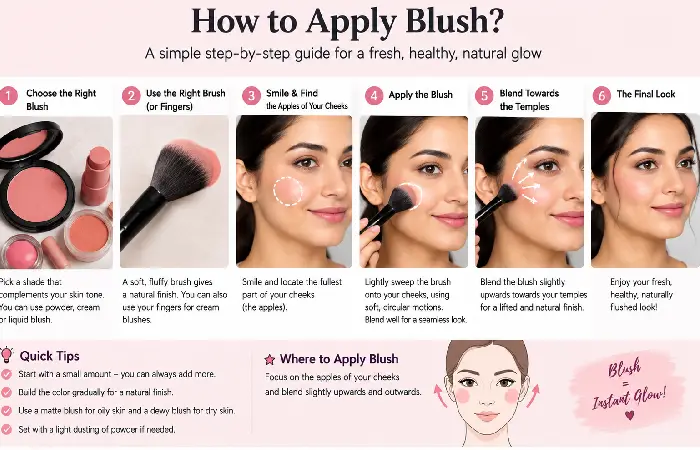
Blusher should be applied softly and blended out. Keep it simple for now, as natural and simple is the best look. If using a powder, load your powder blush brush with color and tap off.
Layer 1: Apply one very fine and transparent coat; return to the 8A for extra coats if needed.
How To Use Cream Blush: As with the powders, dab it onto your skin using your fingers, a dense blush brush, or your wet sponge. Tap a small dot of the blusher gently onto your cheekbones and blend at your will using your fingers or sponge.
Liquid blushes are quite the handful to manage, so use in mild dabs.
Blend all the edges carefully so that blush gradually disappears away from the edges; never create a mask-like line.
Remember: if in doubt, wear less, blend it better, examine your face in daylight, and add more if necessary.
Blush Placement by Face Shape
Blush placement can subtly influence how facial proportions appear. There is no compulsory placement for any face shape, but a few techniques can help create different visual effects.
| Face Shape | Suggested Placement | Visual Effect |
| Round | Upper cheeks toward temples | Creates a lifted appearance |
| Oval | Apples of cheeks toward temples | Maintains natural balance |
| Square | Softly across the cheek area | Softens angular appearance |
| Heart | Cheeks blended gently outward | Balances the upper face |
| Long/Oblong | More horizontally across cheeks | Adds visual width |
Looking for a lifted makeup contour? Sweep blush a touch higher on the cheeks and blend the color out toward the temples. For a fresh, youthful glow, keep a small wash of color swept through the apples of the cheeks.
Avoiding categorizing your face shape as much as possible by understanding your own bone structure is more important.
Cream Blush vs Powder Blush
The two main formulations are cream and powder blush, and the appearance is very different. A cream blush has a smooth, satin finish, and you still see the same skin softness. It might be more minimal because the effect is going to blend in, so you will perceive it as though the color is actually emanating from your skin, not on top of it. Powder blush is much more easily blended and perhaps more appropriate if you have oily skin or you are in a warm climate.
| Feature | Cream Blush | Powder Blush |
| Texture | Creamy | Dry powder |
| Finish | Natural to dewy | Matte to luminous |
| Application | Fingers, sponge or brush | Makeup brush |
| Best suited to | Normal and dry skin | Combination and oily skin |
| Buildability | Easy | Very easy |
| Beginner friendly | Yes | Yes |
Both formulas aren’t necessarily better on its own.
Use Cream blush for a fresher-faced, glowy finish, or if powder blush exacerbates dryness, or if you want a more delicate application. Use Powder blush if you want a more traditional finish, a smidgen of oil control, or easier blending! (Or why not both! Apply a sheer layer of cream blush and layer on a coordinating powder blush for extra impact and longevity.)
Final Thoughts
Blush can actually be a surprisingly big step in your makeup routine. Blush has to bring the warmth back to your skin, add shape and dimension to your face and – most importantly – make your face look fresh and alive. The best blusher is the one that suits your skin, your makeup, your style and personality! Experiment with powder, cream, liquid, and stick blushes, practice applying it in different areas of your face, and as soon as you discover a color and texture that complements your skin tone, using blush will be one of the quickest and most instantaneously addictive things you can do.