


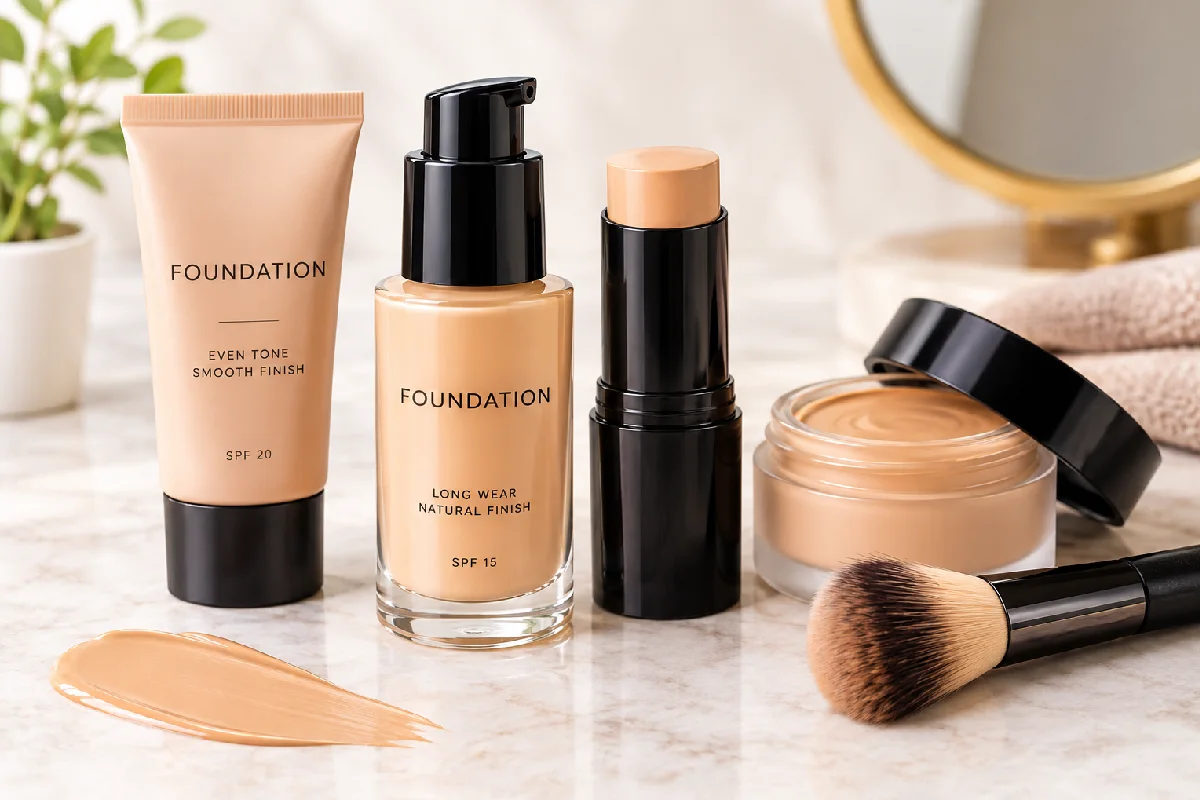
Foundation: A Complete Guide to Choosing and Applying the Right Makeup
Last Updated: September 18, 2026
Foundation is one of those cosmetics that can really help elevate your entire finished look. The right formula can make your skin look more uniform, hide small imperfections, and set a base to go along with concealer, blush, bronzer, and more.
But foundation is about so much more than color. Its formula, finish, coverage, undertone, skin type, and applicator all play a role in how it’s going to sit on your skin. And what looks beautiful on another person may feel thick, cakey, patchy, and dry on yours.
1. What Is Foundation Makeup?
A base product helps to even out your complexion. Your base product typically comes after your skin-care and primer, before anything else like concealer, blush, and bronzer. The level of coverage you get from your base product can range from ultra-light to full depending on your formula, but a newer base product can also contain formulas for controlling shine, hydration, and SPF protection, and shouldn’t always be a substitute for an SPF product.
A good base product, in general, should work in synergy with your skin, as it shouldn’t sit heavily on top of the skin and you want it to even out your complexion without completely masking your natural features.
Foundation at a glance
| Feature | What it means |
| Coverage | The amount of dark areas or imperfections that the makeup can conceal visually |
| Finish | How the foundation appears on your skin (matte, natural, satin, dewy, etc.) |
| Undertone | The subtle warm, cool, or neutral tone beneath your skin colour |
| Formula | Liquid, serum, cream, powder, stick, etc. |
| Longevity | How well the product maintains its appearance throughout the day |
2. Types of Foundation
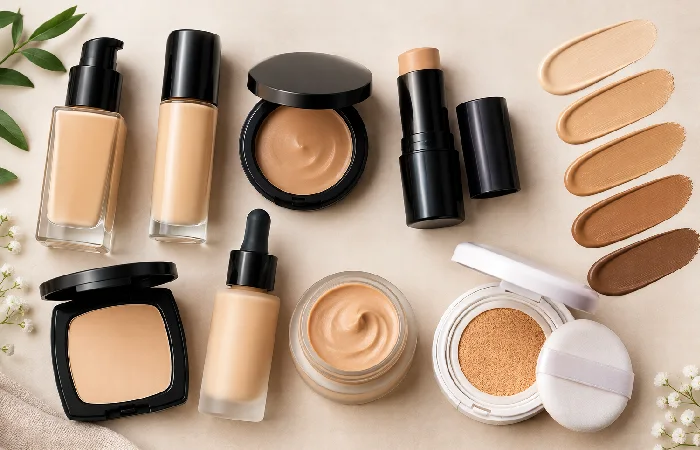
Types of foundation also come in various formats and have a slightly different feel. Liquid foundation is probably the most flexible option. It comes in sheer, medium, and full coverage options, and you can get a whole range of finishes – from matte to dewy.
- Cream foundation tends to be slightly creamier in consistency, so it is a good choice if you prefer a slightly heavier finish of foundation and a soft feel to the skin if you have normal or dry skin.
- Powder foundation has the advantage that it is very quick and easy to apply, and is popular with those who like to wear powder on their skin or who need to control shine.
- Stick foundation is an easy-to-hold product, which is also easy to blend with a brush or sponge, and is ideal if you like to get some precise application.
- Serum foundation usually has a thinner, more liquid consistency, and is preferred by those who want to wear less product on the skin.
| Foundation type | Typical feel | Often preferred for |
| Liquid | Flexible | Most skin types |
| Cream | Richer | Normal to dry skin |
| Powder | Lightweight | Normal to oily skin |
| Stick | Creamy and portable | Quick application |
| Serum | Thin and lightweight | Natural-looking makeup |
3. How to Choose the Right Foundation?
Start with the finish you want to wear daily. If you’re not into the shine, maybe a matte or soft-matte finish, which will have a slightly more natural look on the skin. If your complexion is looking a little dull, maybe a glowy finish will breathe some life back into the complexion.
Coverage is another important decision. Sheer coverage allows more natural skin to show through. Medium coverage offers more evening out while still looking relatively natural. Full coverage is designed for a more complete makeup base.
Be careful not to pick the heaviest coverage. A lighter formula is often more natural-looking and takes less to apply for day-to-day use.
Think about how long you want to wear it. It might not be worth having a more durable foundation if you’re only going out for a short time.
4. How to Find Your Foundation Shade?
Finding the right shade is often easier when you separate skin depth from undertone.
Skin depth refers to how light or deep your complexion appears. Undertone refers to the subtle color underneath the surface.
Common undertones include:
- Warm: golden, yellow, or peach-like
- Cool: pink, rosy, or bluish
- Neutral: a balance between warm and cool
- Olive: a muted greenish or golden-neutral appearance
Your foundation may have the right depth but still look wrong if it’s not the right undertone. For a better comparison, try the shades on your jawline (not your hand). Wait a few seconds to make your final decision-formulas sit a bit differently after they dry. Natural light can be helpful for comparing.
5. Foundation for Different Skin Types
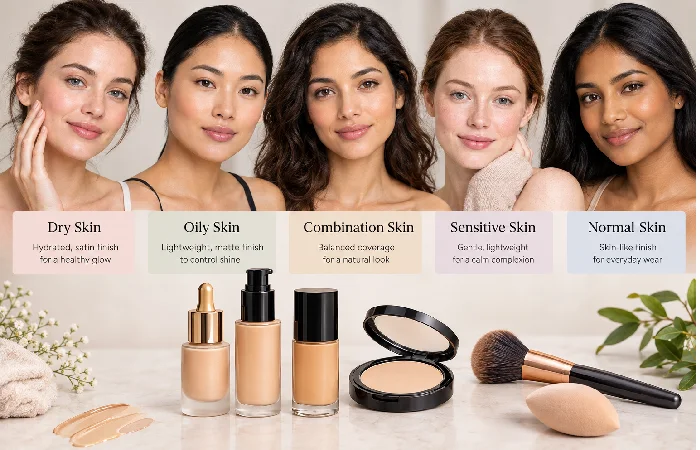
Your skin type can influence how foundation behaves throughout the day.
Dry skin
Look for formulas with a comfortable, moisturizing feel and avoid applying too much powder over areas that already appear dry.
Oily skin
Lightweight, oil-controlling, or soft-matte formulas may work well. Applying thin layers can help prevent the base from feeling overly heavy.
Combination skin
You might need to balance out various parts of your face. Use a light foundation with focused powder if necessary only in places where the shine is excessive.
Sensitive skin
Keep it straightforward, and if you are aware that other cosmetic components irritate your skin, read the ingredients.
| Skin type | Finish to consider | Application tip |
| Dry | Natural or radiant | Prep skin well |
| Oily | Matte or soft matte | Use thin layers |
| Combination | Natural or satin | Powder only where needed |
| Normal | Most finishes | Choose based on preference |
| Sensitive | Simple, comfortable formula | Patch-test unfamiliar products |
6. How to Apply Foundation?
Foundation application doesn’t have to be complicated. Clean and moisturized skin, so your products will sit well and give them a chance to sink in. Use the tiniest amount of primer if you’re wearing any, and wait a moment.
Apply very small dots of foundation to your face. Apply the thinnest layer where you want the most coverage – cheeks, nose, chin and then blend out. Using your fingers, a sponge or a brush is your choice.
Fingers give you a little more speed and a little more dewiness; a damp sponge helps you get a softer blend; a brush will give you a more precise look.
The main thing is to build the coverage gradually. Two or three light layers are often easier to work with than one thick layer.
Finally, check for harsh lines around your jawline and hairline and be sure to blend.
7. Sunglasses for Different Face Shapes
Sunglasses, apart from foundation, are still a significant part of a balanced overall beauty routine. The shape of the frame can change how the proportions of your face seem.
Round face
Angular or rectangular frames can introduce visual structure.
Square face
Rounder or oval frames can provide contrast against stronger facial angles.
Oval face
Many frame styles can work well because oval faces tend to have relatively balanced proportions.
Heart-shaped face
Medium frames that are well balanced help give a wider look to a narrower forehead and narrower jaw. As always, these are style tips, not rules, so comfort and personal choice should come first.
8. Choosing Sunglasses for Different Outfits
Sunglasses can also be selected according to the clothing and occasion.
| Outfit | Sunglasses style to consider |
| Casual jeans and T-shirt | Classic rectangular or aviator-inspired frames |
| Summer dress | Oversized or rounded frames |
| Office outfit | Clean, understated frames |
| Sportswear | Lightweight sporty frames |
| Traditional outfit | Elegant, simple frames |
The easiest approach is to treat sunglasses as an accessory rather than trying to make them match every detail of an outfit. A simple neutral frame can work across many looks.
9. Common Foundation Mistakes
Foundations can be uneven even if you’re spending a small fortune. Here are some of the mistakes you should avoid…
1)Choosing the wrong color: Bright white, dark, pink, or yellow foundation can make your face look like it’s floating above your body.
2) Applying Too Much: More is not always more with foundations.
A heavy-handed approach can bring out every crease and bump.
3) Not Preparing the Skin: Applying foundation over dry, unmoisturized skin can make your face look patchy.
4) Skipping the Neck: Stop dead on your jawline, and the differences are apparent.
5) Using Too Much Powder: Yes, powder can set shine. The moment you start applying the product in thick layers is when your face will look flat and old.
6) Not Blending Carefully: Make sure to blend around your nose, jawline, hairline, and brows to avoid visible lines.
Final Thoughts
Foundation is meant to be part of a seamless transition from face to neck. The smoother the transition, the more of a natural finish you will achieve. The wrong foundation on the wrong skin can have all kinds of issues, such as you won’t be able to get the coverage you want, last as long as you want, get the finish you want, or just plain look good! It is probably the easiest thing to get right once you know your categories and how to choose the right foundation.