


Face Primer: A Complete Guide to Choosing and Using Makeup Primer
Last Updated: September 18, 2026
Face primer can be one of the products that will give your makeup an easier, more even wear and feel better when you have it on. It’s a sort of thin layer of padding between your skin and your makeup.
But primer isn’t a one-size-fits-all item. Some are designed to control oil, some to moisturize, some to reduce the appearance of pores, and others to give you a fresh glow. What you need is commonly determined by your skin type, your desired look, and the kind of finish that the product gives.
What Is Makeup Primer?
Primer: Makeup primer is a makeup product you put on your face after your skincare routine and before your makeup foundation or other makeup.
What does primer do?
To provide a sleek, even surface so your foundation has a nice place to hold onto and will slide over your skin easily. Think of primer as a makeup primer, which will help your foundation to glide over your skin rather than cling to some dry patches or onto some heavier patches.
Primers are available in cream, gel, lotion, balm, and liquid styles. There are completely transparent versions as well as those with a bit of pigment, to address specific complexion concerns.
| Primer type | Main purpose | Typical finish |
| Hydrating | Adds moisture and comfort | Natural/dewy |
| Mattifying | Helps reduce shine | Matte |
| Blurring | Softens the appearance of pores | Smooth |
| Illuminating | Adds radiance | Glowy |
| Color-correcting | Helps visually balance discoloration | Depends on formula |
| Gripping | Helps makeup adhere to the skin | Natural |
Why Use Primer?
A face primer is simply meant to prime your skin for foundation. Depending on how your foundation is used, it can create texture, grip onto dry patches, or vanish throughout the day. Primer will help your foundation apply seamlessly.
Reasons to use primer include:
- Smoothens your base: Primer can make your foundation easier to apply.
- Extends makeup wear: Certain primers can help keep makeup on longer.
- Control oil: Shine-control primers might work well for oily areas.
- Hydrate: Hydrating primers can be better for dry skin and can help make makeup feel more comfortable.
- Visually minimizes the appearance of pores: Blurring primers can reduce the appearance of open pores.
- Creates radiance: Radiance-boosting primers can give dull-looking skin a dewy finish.
- Primer is not going to be a permanent fix to the texture of your skin – it is for cosmetic and temporary use only, so don’t expect primer to replace a skincare product.
Types of Face Primers
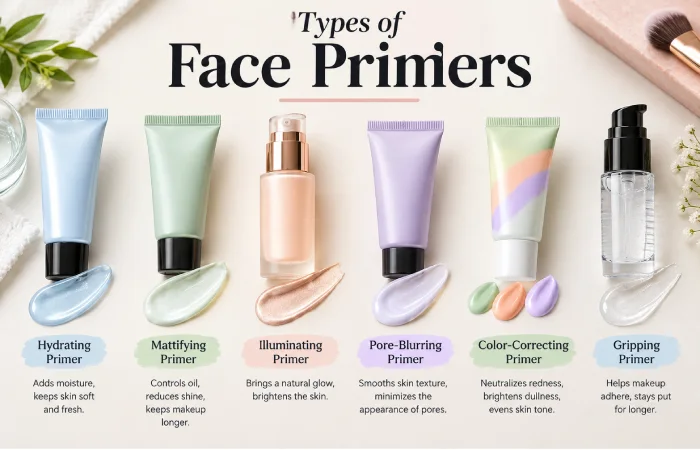
There are, of course, a variety of face primers, and they address different makeup issues.
Hydrating Primer
A hydrating primer can include ingredients to keep the skin feeling like a soft, hydrated pillow. It can be quite a nice primer when your foundation looks a little dry, patchy.
Mattifying Primer
Eliminating shine: Mattifying primer works best for those who feel the need to diminish the shine factor. These types of formulas are a good call, particularly in areas like the forehead, chin, and nose which, more often than not, tend to get oily.
Pore-Blurring Primer
Describe a pore-blurring primer? A smoothing primer with a soft-focus effect. Does not literally vanish the pores but will help diminish their appearance on the skin under makeup.
Illuminating Primer
Illuminating primers have light-reflecting particles or other ingredients that make the skin glow. They are preferable when you want a fresher, glowing makeup.
Color-Correcting Primer
These primers contain subtle colors intended to visually balance certain types of discoloration. For example, green is commonly used to visually neutralize the appearance of redness, while peach or orange tones may be used for certain areas of dark discoloration depending on skin tone.
Primer for Different Skin Types
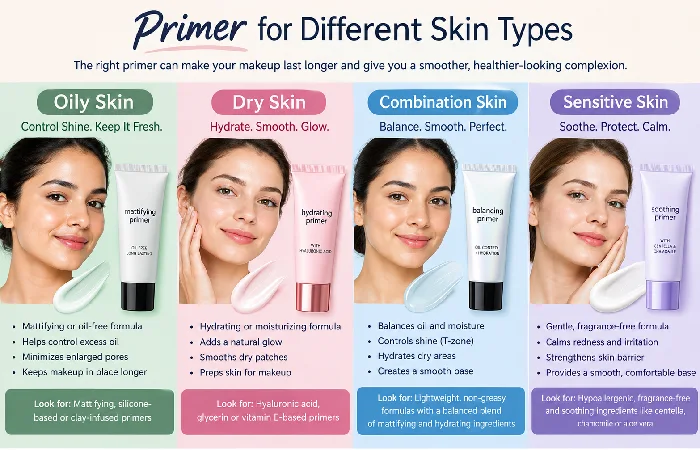
Choosing primer according to your skin type can make a noticeable difference in how your makeup looks.
| Skin type | Primer to consider | What to look for |
| Oily | Mattifying | Oil-control, lightweight texture |
| Dry | Hydrating | Moisturizing, comfortable finish |
| Combination | Balancing | Different formulas for different zones |
| Normal | Smoothing or illuminating | Desired makeup finish |
| Sensitive | Simple, gentle formula | Fewer potential irritants |
For those with combination skin, you are not required to use the same primer in all areas of your face. Use a mattifying primer for the T-Zone and a hydrating primer for the drier areas.
How to Apply Makeup Primer?
Applying too much primer is one of the easiest ways to make makeup look heavy. A small amount is usually enough.
1: Clean your face. Begin with clean skin so you will have a clean place to apply the foundation. Step
2: Apply your skincare. Use your normal moisturizer and sunscreen for the day.
- Apply a primer. Take a tiny bit of primer and then lightly apply it where you want it most.
You can apply primer with your fingers, by using your makeup sponge, or your makeup brush, depending on what the primer is.
- Wait a bit. There is waiting a bit for the primer to set in your face before you start with the foundation.
- Apply your foundation. Pat with a sponge or a brush lightly over your skin above the primer.
Primer vs Moisturizer
Primer and moisturizer may look similar, but they serve different purposes.
Moisturizer is primarily a skincare product. It helps support the skin’s moisture balance and can improve how comfortable the skin feels.
Primer is primarily a makeup-preparation product. It is designed to influence how makeup applies, looks, and wears.
They can be used together. A typical routine might look like:
Cleanser → Moisturizer → Sunscreen → Primer → Foundation → Other makeup
Primer should not automatically replace moisturizer, especially if your skin needs additional hydration.
How to Choose the Right Primer?
Figure out the cause – What is it you hate most about your makeup? If your foundation feels oily within a few hours, it could be good to choose a mattifying primer. If your foundation highlights flakes, it could be time to consider switching to a moisturizer.
>If your skin blocks your pores or has texture, a blurring or smoothing primer will give you much better results.
Match it to your finish – For super matte skin, you don’t need much more than a mattifying primer; for dewy, light skin, maybe a luminous primer is what’s needed. Know your ingredients – If you already know you may be sensitive to an ingredient, it can always be worth checking the ingredients before you buy. Keeping up with patch testing your makeup before use can also be helpful.
Final Thoughts
Face primer isn’t necessary for everyone, but it is worth having if you want to achieve a more even application or certain effects. Apply it minimally to have a flawless work surface; choose a priming product adapted to your skin. After knowing what the goal of each primer is, you will be able to choose the one you need, and your makeup will last much longer.