

Restorative Yoga for Stress Relief: A Complete Guide to Deep Relaxation
 Khizrana Begum
Beauty & Lifestyle Writer
Khizrana Begum writes clear and reader-friendly content covering beauty, lifestyle and related topics.
Read Full Bio of Author →
Khizrana Begum
Beauty & Lifestyle Writer
Khizrana Begum writes clear and reader-friendly content covering beauty, lifestyle and related topics.
Read Full Bio of Author →
 Sameena Begum
Health, Technology & Digital Content Reviewer
Sameena Begum reviews content for clarity, accuracy and overall reader usefulness.
Read Full Bio of Reviewer →
Sameena Begum
Health, Technology & Digital Content Reviewer
Sameena Begum reviews content for clarity, accuracy and overall reader usefulness.
Read Full Bio of Reviewer →
Restorative Yoga for Stress Relief – Today, life moves fast. From our work lives to our social lives, family lives and even the demands of social media, it’s no wonder that we never seem to keep up with ourselves. In times when stress becomes too intense, it starts to creep into all aspects of our lives – affecting us both physically and mentally.
Perhaps one of the simplest, most straightforward ways of plugging back into yourself is through stress relief restorative yoga. Instead of a hard-core workout session, restorative yoga is about teaching us how to find stillness and rest, and in doing so allowing our nervous system to relax and our bodies to relax into the weight of relaxation.
❝
This article is a part of
Stress Management Guide
What is Restorative Yoga?
Restorative Yoga A slow and restful all-levels gentle style that guides your body into a deeply relaxing state. Instead of stretching your muscles powerfully, building muscles or receiving a great physical workout, you perform several supported, restful poses that you hold for up to five minutes each.
Explore our complete guide to yoga for stress relief to discover practices that promote relaxation and emotional balance.
The goal is simple:
- Relax the body completely
- Calm the nervous system
- Encourage mindful breathing
- Reduce mental fatigue
- Improve emotional balance
Blankets, bolsters, blocks, and/or cushions are available to prop up your body completely so there’s no work required by your muscles. Instead of the constant motion of power yoga or vinyasa flow, the power of stillness rules!
Why Does Stress Affect Both Body and Mind?
As soon as we come across anything to our upset, we switch on fight-or-flight response system of our bodies
Gentle yoga poses for stress relief pair perfectly with restorative sessions to release muscle tension.
Common symptoms include:
- Tight shoulders
- Neck pain
- Headaches
- Shallow breathing
- Racing thoughts
- Fatigue
- Poor sleep
- Digestive discomfort
If this doesn’t shift over time this may lead to Chronic inflammation, levels of stress in our body, lower immunity, and a feeling of low wellbeing. Using props in restorative yoga helps us shift out of our ‘alert state’ and allow our body to sink down into a deeper level of rest and digest, allowing us to restore and rejuvenate
Benefits for Mental Wellness
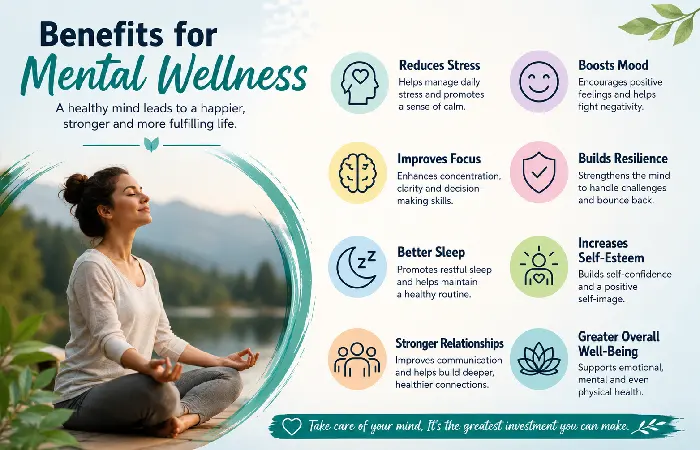
Complement your practice with these yoga exercises for stress relief to improve flexibility and reduce anxiety.
There’s one huge benefit to restorative yoga that attracts a lot of individuals: emotional balance.
1. Reduces Stress Hormones
Using breathing exercises, restorative poses to reduce our body’s primary stress hormone, cortisol.
Result
- Less anxiety
- Greater emotional stability
- Better concentration
2. Improves Sleep Quality
Many people cannot fall asleep in their lives, because they can keep on thinking in the dark even if they have went into sleep. The nervous system is settled down to make room for more restful, deep sleep
activity.
Benefits include:
- Falling asleep faster
- Fewer nighttime awakenings
- Feeling refreshed in the morning
3. Supports Emotional Healing
In a restorative yoga space, we have time to pause and take it all in, all of the feelings without judgment.
If you’re just getting started, follow this beginner’s guide to yoga for stress relief before trying restorative sessions.
Many practitioners report:
- Feeling calmer
- Improved patience
- Better emotional resilience
- Increased self-awareness
4. Encourages Mindfulness
While the pose is held still for 3 to 5 minutes, focus automatically goes to the inward process.
You begin noticing:
- Your breathing
- Muscle tension
- Thoughts
- Emotional patterns
This awareness forms the foundation of mindfulness.
5. Helps Reduce Anxiety
Proper deep breathing with full physical support is used to trigger the parasympathetic nervous system.
You can also include a morning yoga routine for stress relief to begin each day feeling refreshed and focused.
This can lead to:
- Slower heart rate
- Lower blood pressure
- Reduced muscle tension
- A calmer mind
6. Relieves Physical Tension
Stress often settles in the:
- Neck
- Shoulders
- Lower back
- Jaw
- Hips
Restorative poses gently release these tight areas without forcing stretches.
Mental Wellness Benefits at a Glance
| Benefit | How It Helps |
| Lower stress | Reduces cortisol levels |
| Better sleep | Calms the nervous system |
| Improved mood | Encourages relaxation |
| Emotional balance | Supports mindfulness |
| Reduced anxiety | Slows heart rate |
| Better focus | Clears mental clutter |
| Increased energy | Promotes deep rest |
Restorative Yoga vs Other Yoga Styles
| Yoga Style | Intensity | Main Goal | Best For |
| Restorative Yoga | Very Low | Relaxation | Stress relief |
| Yin Yoga | Low | Deep tissue stretching | Flexibility |
| Hatha Yoga | Moderate | Balance | Beginners |
| Vinyasa Yoga | Moderate-High | Fitness & Flow | Active individuals |
| Power Yoga | High | Strength | Athletic practice |
Essential Restorative Poses
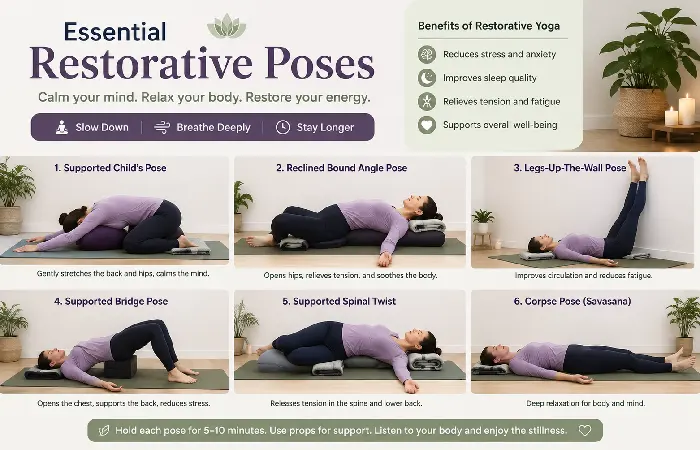
Complete your wellness routine with yoga for better sleep and stress relief to unwind before bedtime.
Simple enough pose, these beginner-friendly poses are almost effortless while giving the best results when relaxing.
1. Child’s Pose (Balasana)
This yoga pose is going to leave you feeling on top of the world.
Benefits:
- Relaxes the back
- Releases shoulder tension
- Calms the mind
Hold for 5–10 minutes with a bolster under your chest.
2. Legs-Up-the-Wall Pose (Viparita Karani)
Great pose for when you’ve been sitting or standing a lot.
Benefits:
- Improves circulation
- Relieves tired legs
- Reduces swelling
- Encourages deep relaxation
Hold for 10–15 minutes.
3. Reclining Bound Angle Pose (Supta Baddha Konasana)
Add cushions at your knees for the ride .
Benefits include:
- Opens the hips gently
- Encourages slow breathing
- Relaxes abdominal muscles
4. Supported Bridge Pose
Slide a yoga block or pillow under your hips
Benefits:
- Opens the chest
- Improves breathing
- Relieves lower back tension
5. Supported Forward Fold
Rest your head on a stack of pillows and fold yourself forward.
Benefits:
- Calms the nervous system
- Relaxes the spine
- Reduces mental fatigue
6. Supported Twist
Let gentle spinal twists soothe away the tension in your back.
Benefits:
- Improves spinal mobility
- Supports digestion
- Encourages relaxation
7. Savasana (Corpse Pose)
Often considered the most important restorative pose.
Stay completely still while focusing on natural breathing.
Benefits:
- Deep relaxation
- Mental clarity
- Reduced stress
- Full-body recovery
Remain for 10–20 minutes.
Restorative Pose Comparison
| Pose | Hold Time | Main Benefit | Difficulty |
| Child’s Pose | 5–10 min | Relaxation | Easy |
| Legs-Up-the-Wall | 10–15 min | Circulation | Easy |
| Reclining Bound Angle | 8–15 min | Hip opening | Easy |
| Supported Bridge | 5–10 min | Chest opening | Easy |
| Supported Twist | 5–8 min | Spine relaxation | Easy |
| Forward Fold | 5–10 min | Mental calm | Easy |
| Savasana | 10–20 min | Complete recovery | Very Easy |
Props You May Need
Restorative yoga relies heavily on comfort. Props reduce muscular effort and allow longer holds.
| Prop | Purpose |
| Yoga Bolster | Supports the spine and hips |
| Yoga Blocks | Adds height and stability |
| Blankets | Cushion joints and keep warm |
| Cushions | Replace bolsters at home |
| Yoga Strap | Supports gentle stretches |
| Eye Pillow | Blocks light and promotes relaxation |
| Wall | Assists balance and support |
Don’t Have Yoga Props?
Household items work just as well.
You can use:
- Pillows
- Folded blankets
- Towels
- Sofa cushions
- Books
- Bed pillows
The goal is comfort—not expensive equipment.
A Simple 20-Minute Restorative Yoga Routine
| Time | Pose |
| 3 minutes | Gentle breathing |
| 5 minutes | Child’s Pose |
| 5 minutes | Legs-Up-the-Wall |
| 4 minutes | Reclining Bound Angle |
| 3 minutes | Savasana |
This routine fits easily into a busy day and can be practiced in the morning or before bedtime.
Practice Tips
By following just few simple practices can help in your restorative yoga session get better.
Choose a Quiet Space
Reduce distractions by practicing in a peaceful room.
Wear Comfortable Clothing
Loose, breathable clothing helps you relax more fully.
Focus on Slow Breathing
Try inhaling for four counts and exhaling for six counts.
Longer exhalations encourage deeper relaxation.
Don’t Force Any Stretch
Restorative yoga is never about pushing limits.
Just remember, if a pose isn’t working for you, it can either be supported in more ways or modified.
Stay Warm
As the body relaxes, temperature may drop slightly.
Use a blanket if needed.
Turn Off Notifications
Turn your phone to silence for an undisturbed calm
Practice Consistently
Even 15 or 20 minutes 3 or 4 times a week can take a lot of you in the long run.
Common Mistakes to Avoid
| Mistake | Better Approach |
| Holding tension | Relax completely |
| Rushing poses | Stay several minutes |
| Ignoring discomfort | Use more props |
| Comparing yourself | Focus on your own body |
| Holding your breath | Maintain slow breathing |
| Practicing after heavy meals | Wait 1–2 hours |
Who Can Benefit from Restorative Yoga?
Restorative yoga is suitable for many people, including:
- Office workers
- Students
- Seniors
- Beginners
- Caregivers
- Busy parents
- People experiencing everyday stress
- Individuals recovering from physical fatigue (with medical guidance if needed)
If you are injured, pregnant or have any long term medical condition and would like to join new practice you can speak with a doctor or an experienced yoga instructor
Tips for Building a Sustainable Practice
| Habit | Benefit |
| Practice at the same time each day | Builds consistency |
| Use calming music if desired | Creates a relaxing atmosphere |
| Dim the lights | Encourages rest |
| Keep sessions simple | Makes it easier to maintain |
| Finish with gratitude | Supports emotional wellbeing |
Final Thoughts
Restorative yoga offers us the lesson that healing isn’t always achieved through the more… it’s achieved through the more quiet and allowing of us. Using supported and slow poses, and deliberate breath, restorative yoga is a practical approach to reducing stress, deepening sleep, relieving physical tension, and developing emotional equilibrium. No need for flexibility, a lot of space or equipment, only silence and pillows in order to have 20 minutes for a purposeful break.
Frequently Asked Questions
Is restorative yoga good for stress relief?
Yeah. The idea of restorative yoga is actually to trigger your body’s relaxation response, and to get you to destress, settle down the nervous system, to just release all that tension. With those supported poses and the breathwork.
How often should I practice restorative yoga?
The results from a daily, regular, brief practice are nothing short of astonishing– 2 to 5 20 to 30-minute practices are extremely impactful.
Can beginners practice restorative yoga?
Yes! Restorative yoga can be performed by anyone of any yoga experience level, since it’s about being comfortable. Its poses are usually supported by props and quite accessible.
Is restorative yoga the same as meditation?
Not really. Restorative yoga consists of quiet poses where you’re supported and meditation is generally centered on your mental awareness. Yet restorative yoga tends to produce a meditational state since it cultivates still, breathing awareness.
Can restorative yoga help with sleep?
Many people feel that taking some restorative yoga in the evening aids them in clearing the mind, releasing the body, and dissociating from the rest of the day and have a more soothing and nervous system-soothing experience.
What is the best time to practice restorative yoga?
Practising the night before can ease you into a restful sleep. And the morning practice helps you be able to use all of your mental capacity to do what you need to do with your day