

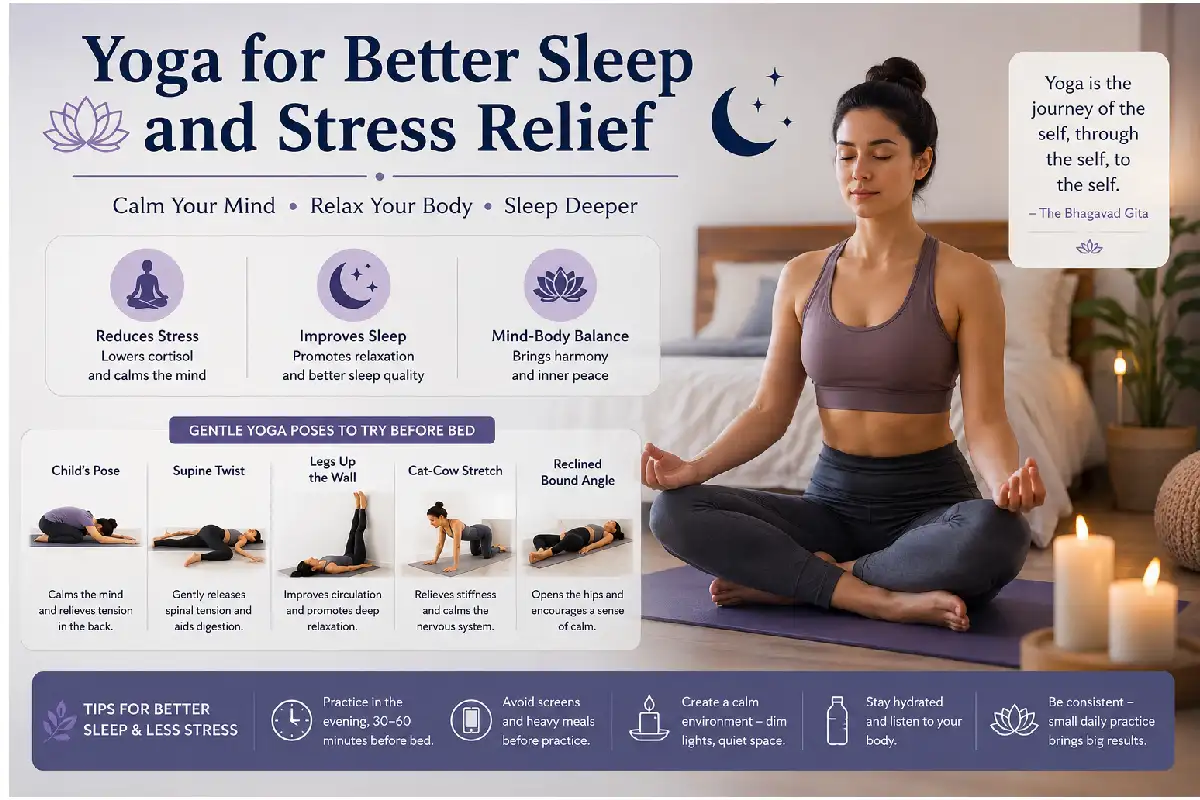
Yoga for Better Sleep and Stress Relief – A Complete Guide
 Khizrana Begum
Beauty & Lifestyle Writer
Khizrana Begum writes clear and reader-friendly content covering beauty, lifestyle and related topics.
Read Full Bio of Author →
Khizrana Begum
Beauty & Lifestyle Writer
Khizrana Begum writes clear and reader-friendly content covering beauty, lifestyle and related topics.
Read Full Bio of Author →
 Sameena Begum
Health, Technology & Digital Content Reviewer
Sameena Begum reviews content for clarity, accuracy and overall reader usefulness.
Read Full Bio of Reviewer →
Sameena Begum
Health, Technology & Digital Content Reviewer
Sameena Begum reviews content for clarity, accuracy and overall reader usefulness.
Read Full Bio of Reviewer →
Yoga for Better Sleep and Stress Relief – Modern living can be stressful – late nights at the office, never-ending phone notifications, mounting financial concerns, or a brain that just won’t switch off. It’s not unusual for us to spend hours just rolling in our beds before finally falling into a sleep we’ll never remember waking from, groggy and exhausted. The good news is, there’s a natural way that people have been using to alleviate stress and prepare for sleep for thousands of years -yoga!
There is no “best yoga” or “yoga flexibility.” yoga involves breath, meditation, and a smooth intentional movement to relax body and mind. Just 15 to 20 minutes of gentle yoga before bed is sufficient to reduce stress, release muscle tightness, relax your system, and ensure you fall into a restful sleep. Here’s where to begin with this article to demonstrate the effect of stress on your sleep, and how to perform bedtime yoga for best results – the most relaxing evening sequence of yoga poses, mindful breathing, good evening routines, and simple sleep habits.
❝
This article is a part of
Stress Management Guide
Why is Yoga Effective for Better Sleep?
The power of yoga helps activate your parasympathetic nervous system-also known as your “rest and digest” nervous system. It decreases your heart rate and blood pressure, and produces less cortisol-the main stress hormone in the body.
Explore our complete guide to yoga for stress relief to discover practices that help reduce stress and improve sleep quality.
Benefits of Yoga Before Sleep
| Benefit | How It Helps |
| Reduces stress | Lowers cortisol levels |
| Relaxes muscles | Releases physical tension |
| Calms racing thoughts | Improves mental clarity |
| Improves breathing | Encourages relaxation |
| Supports deeper sleep | Helps you stay asleep longer |
| Enhances mood | Increases serotonin and GABA activity |
How yoga helps you sleep instead of taking sleeping pills yoga doesn’t make you dependent like some pills which induces you to sleep.
How Stress Affects Sleep?
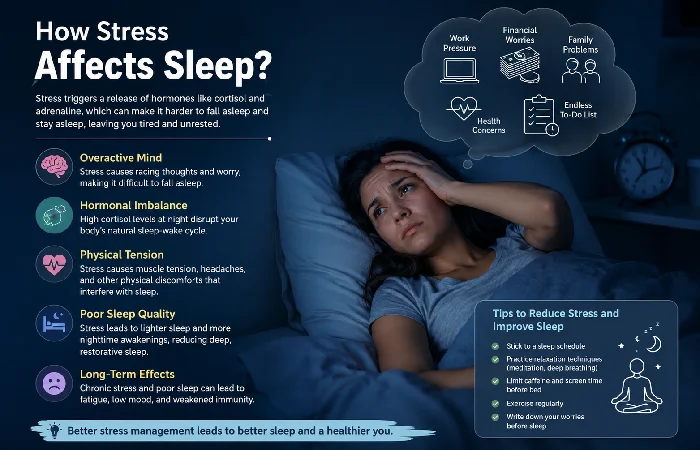
Practicing gentle yoga poses for stress relief before bed can help relax your body and prepare you for restful sleep.
Stress and sleep are linked. The mind and the sleeping process share an exceptionally deep relationship. Stress tells your body’s “The brain to act as if it should confront a danger instead of recuperate: fight or flight mode”.
Heart rate
- Blood pressure
- Muscle tension
- Mental alertness
- Cortisol production
Even Though it’s useful in an emergency situation, the long-term stresses will not allow your brain to switch off at night, even when it should.
Common Symptoms of Stress-Related Sleep Problems
| Physical Symptoms | Mental Symptoms |
| Tight shoulders | Racing thoughts |
| Headaches | Anxiety |
| Muscle tension | Overthinking |
| Fatigue | Difficulty relaxing |
| Restlessness | Irritability |
Over time, chronic sleep deprivation may cause stress levels to become even higher, starting a negative loop which becomes quite hard to stop.
Add these yoga exercises for stress relief to your evening routine to release tension after a busy day.
Yoga Before Bed
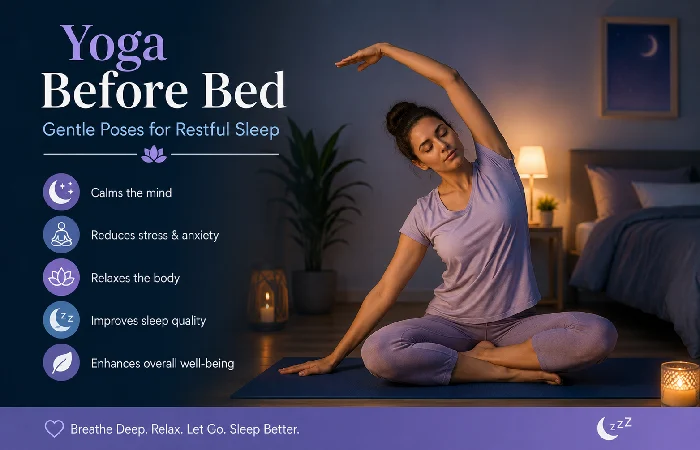
Yoga exercises before going to sleep do not need to be vigorous. In contrast, slow movements, light exercises are the most appropriate, they convey the signal to your nervous system: safe to rest.
Why Does Evening Yoga Work?
Evening yoga helps:
- Release tension accumulated throughout the day
- Slow mental activity
- Stretch stiff muscles
- Improve breathing
- Lower stress hormones
- Prepare your body for sleep
Best Time to Practice
| Timing | Benefits |
| 60 minutes before bed | Ideal relaxation |
| 30 minutes before bed | Good for calming the mind |
| Immediately before bed | Gentle stretching only |
Avoid vigorous types of Yoga like Power Yoga and Hot Yoga prior to your bedtime as it will give you a temporary surge of energy.
Relaxing Yoga Sequence
Bedtime Yoga for Beginners (15 – 20 minutes) Here’s the perfect bedtime yoga routine to help you to unwind and drift into sleep in just 15 to 20 minutes.
1. Child’s Pose (Balasana)
Duration: 2 minutes
If you’re new to yoga, start with this beginner’s guide to yoga for stress relief to build confidence before bedtime practice.
Benefits:
- Relaxes the spine
- Releases lower back tension
- Calms the nervous system
- Encourages slow breathing
2. Cat-Cow Stretch
Duration: 2 minutes
Benefits:
- Improves spinal mobility
- Reduces neck stiffness
- Releases back tension
- Synchronizes movement with breath
3. Seated Forward Fold
Duration: 2 minutes
Benefits:
- Stretches hamstrings
- Relaxes the nervous system
- Reduces anxiety
- Encourages mindfulness
4. Legs-Up-The-Wall Pose (Viparita Karani)
Duration: 5–10 minutes
This is one of the best yoga poses for bedtime.
Benefits include:
- Improves circulation
- Relieves tired legs
- Reduces swelling
- Slows the heart rate
- Promotes deep relaxation
5. Reclining Butterfly Pose
Duration: 3 minutes
Benefits:
- Opens hips gently
- Releases emotional tension
- Encourages deep breathing
- Relaxes pelvic muscles
6. Corpse Pose (Savasana)
Duration: 5–10 minutes
This last relaxation pose is so your body can soak in all the goodness you have just put it through.
Focus only on breathing naturally.
Complete Bedtime Yoga Routine
| Yoga Pose | Time | Primary Benefit |
| Child’s Pose | 2 min | Stress relief |
| Cat-Cow | 2 min | Spine relaxation |
| Forward Fold | 2 min | Mental calm |
| Legs-Up-the-Wall | 5–10 min | Better circulation |
| Reclining Butterfly | 3 min | Deep relaxation |
| Savasana | 5–10 min | Better sleep |
Breathing for Better Sleep
Why not try a bit of Pranayama for to put the speed of the mind into slow motion and banish that hurry to go off to sleep fast.
1. 4-7-8 Breathing
This commonly-used breathing technique eases your nervous system.
Beginning your day with a morning yoga routine for stress relief can also improve your sleep by reducing daily stress.
Steps:
- Inhale for 4 seconds
- Hold for 7 seconds
- Exhale slowly for 8 seconds
- Repeat 4–8 rounds
Benefits:
- Lowers heart rate
- Reduces anxiety
- Helps you fall asleep faster
2. Diaphragmatic Breathing
Also called belly breathing.
Practice:
- Place one hand on your chest.
- Place the other on your stomach.
- Breathe deeply so only your stomach rises.
- Exhale slowly.
This encourages complete relaxation.
3. Alternate Nostril Breathing
This exercise gives both halves of your nervous system a rest, restoring your body into balance.
Pair your bedtime routine with restorative yoga for stress relief to encourage deep relaxation and better sleep.
Benefits include:
- Better concentration
- Lower stress
- Improved emotional balance
- Reduced mental clutter
Breathing Techniques Comparison
| Technique | Best For | Duration |
| 4-7-8 Breathing | Falling asleep | 5 minutes |
| Belly Breathing | Relaxation | 5–10 minutes |
| Alternate Nostril | Anxiety reduction | 5 minutes |
Evening Wellness Habits
Yoga practices are much more rewarding when coupled with proper evening routines.
Healthy Evening Habits
- Finish dinner 2–3 hours before bedtime
- Keep lights dim after sunset
- Reduce screen exposure
- Drink herbal tea if desired
- Read a physical book
- Journal your thoughts
- Practice gratitude
- Listen to calming music
- Stretch gently
- Meditate for five minutes
Evening Routine Example
| Time | Activity |
| 7:00 PM | Light dinner |
| 8:00 PM | Short walk |
| 8:30 PM | Reduce screen time |
| 9:00 PM | Gentle yoga |
| 9:20 PM | Breathing exercises |
| 9:30 PM | Read a book |
| 10:00 PM | Sleep |
This helps train your body when to begin to calm itself.
Sleep Hygiene Tips
Sleep hygiene: A tiny few things you can do. The little things are usually the biggest things and the easiest to ignore.
Create a Comfortable Sleep Environment
Your bedroom should feel calm, cool, and inviting.
Aim for:
- Cool room temperature
- Comfortable mattress
- Supportive pillow
- Dark curtains
- Minimal noise
Limit Blue Light Exposure
Phones, tablets, tv’s, computers all emit blue light which will keep the melatonin production from happening. Try to get away from the screen a couple of hours prior to going to sleep.
Maintain a Consistent Sleep Schedule
Go to bed and wake up at the same time—even on weekends.
Your internal body clock responds well to consistency.
Avoid Heavy Meals Before Bed
Eating large meals immediately before sleeping may cause:
- Indigestion
- Acid reflux
- Restlessness
Choose lighter dinners whenever possible.
Reduce Caffeine Intake
Avoid caffeine after mid-afternoon if you’re sensitive to it.
Common sources include:
- Coffee
- Tea
- Energy drinks
- Chocolate
- Soft drinks
Sleep Hygiene Checklist
| Habit | Recommended |
| Fixed bedtime | ✔ |
| Dark bedroom | ✔ |
| Cool room | ✔ |
| No screens before bed | ✔ |
| Daily yoga | ✔ |
| Evening breathing | ✔ |
| Comfortable mattress | ✔ |
| Avoid late caffeine | ✔ |
Yoga vs Other Relaxation Methods
| Method | Stress Relief | Sleep Improvement | Equipment Needed |
| Yoga | Excellent | Excellent | Yoga mat |
| Meditation | Excellent | Very Good | None |
| Reading | Moderate | Good | Book |
| Warm Bath | Good | Good | Bathtub |
| Music Therapy | Moderate | Moderate | Music player |
This also indicates yoga to be an overall form of workout, taking off your mental and physical stress together.
Tips for Beginners
If you’re new to yoga, keep these simple suggestions in mind:
- Start with short sessions.
- Focus on slow breathing rather than perfect poses.
- Use pillows or blankets for support.
- Avoid comparing yourself with others.
- Listen to the limits of your body.
- Practice regularly rather than striving for perfection.
- Spend a few minutes on rest at the end of every practice.
The goal isn’t flexibility—it’s creating a peaceful transition into sleep.
Common Mistakes to Avoid
| Mistake | Better Approach |
| Doing intense workouts before bed | Choose gentle yoga |
| Holding your breath | Maintain slow, steady breathing |
| Practicing on a full stomach | Wait 2–3 hours after dinner |
| Using bright lights | Keep lighting soft |
| Expecting instant results | Stay consistent for several weeks |
Final Thoughts
One of the biggest factors in our physical health, emotional health, and full-body wellness is getting sufficient sleep. It’s usually the first thing that begins to slide during stressful periods of time, and the least stressful, most natural way to relax and prepare your mind and body to sleep well is yoga.
Through gentle restorative yoga poses, breath work, good nighttime habits, and other supportive practices, you can create a simple, peaceful routine that will lull your body and mind to deeper rest- without the use of medications. Prior experience in yoga is not necessary, and it’s never the advanced practices that will lead you to sleep; rather, simply having a space of quiet and a few slow, simple movements that aren’t thinking-heavy.