


Morning Yoga for Stress Relief: A Simple Daily Practice to Calm Your Mind
 Khizrana Begum
Beauty & Lifestyle Writer
Khizrana Begum writes clear and reader-friendly content covering beauty, lifestyle and related topics.
Read Full Bio of Author →
Khizrana Begum
Beauty & Lifestyle Writer
Khizrana Begum writes clear and reader-friendly content covering beauty, lifestyle and related topics.
Read Full Bio of Author →
 Sameena Begum
Health, Technology & Digital Content Reviewer
Sameena Begum reviews content for clarity, accuracy and overall reader usefulness.
Read Full Bio of Reviewer →
Sameena Begum
Health, Technology & Digital Content Reviewer
Sameena Begum reviews content for clarity, accuracy and overall reader usefulness.
Read Full Bio of Reviewer →
Morning Yoga for Stress Relief – Just having one simple thing that’s a no-brain-er each morning will take much of your everyday stress away. A 15-20 minute yoga practice is one of the best things that you can do to start your day calm and energetic, instead of frantic and on edge. Instead of reaching for the coffee or immediately jumping into emails and work calls, your morning yoga practice begins the process of unlearning fight-or-flight and can get your body’s natural state of relaxation online.
No matter your experience level with yoga, you can establish a daily morning practice that instills mental peace.
In this morning yoga guide, I’ll go over why morning yoga reduces stress, easy beginner stretches for morning, morning breathing techniques, a refreshing morning flow, and tips for making yoga a morning habit.
❝
This article is a part of
Stress Management Guide
Why Morning Yoga Reduces Stress?
I believe that the morning is one of the most critical times to start calming down your body’s nervous system before life’s tasks can get started! A few minutes of morning movement boosts circulation, helps relieve muscles that are getting stiff, and can get your parasympathetic nervous system engaged.
Explore our complete guide to yoga for stress relief to build a daily routine that supports a calmer mind.
1 . The gentle pace of morning yoga is a wonderful way to counter any higher-impact training that may be over stimulating, but your morning yoga poses are the perfect way to add mobility, improve balance, enhance focus and boost mindfulness via your breath.
The Morning Yoga Connection to Emotional Health.
| Benefit | How It Helps |
| Reduces cortisol | Lowers the body’s stress hormone |
| Improves mood | Encourages endorphin release |
| Increases flexibility | Reduces muscle stiffness |
| Enhances focus | Improves concentration |
| Boosts circulation | Increases oxygen delivery |
| Improves posture | Relieves tension in the neck and back |
| Supports sleep | Better mornings often lead to better nights |
Why Yoga In The Morning?
Perhaps the obvious physical benefits of a morning yoga practice to many of you are: Flexibility But, here’s why morning yoga will benefit not just your mind, your heart, your body and even aspects of your life that you might not have even conceived of until now.
Benefits of Morning Yoga
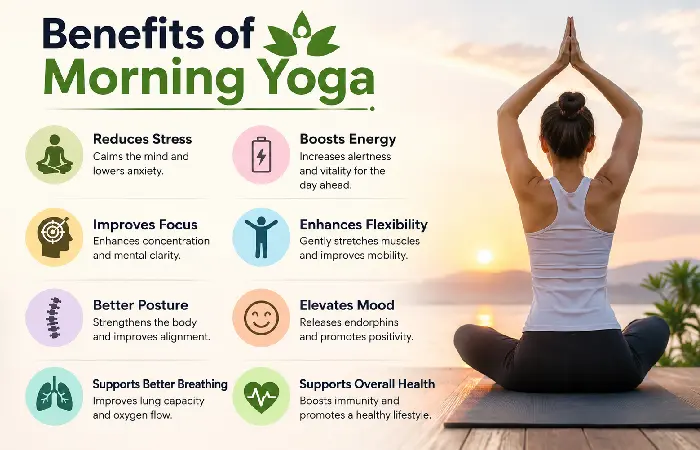
Start your morning with these yoga poses for stress relief to ease tension and improve flexibility.
1. Fewer Chances of feeling Overwhelmed – Because you’ll focus on breathing deeply and be in poses, these practices are perfect for helping to relax your system at a nerve-wracking and overwhelming time.
2. Wakes you up on its own – Instead of chugging coffee as you’re running out the door each morning, why not learn to wake your system up with yoga?
Your poses and breathing are both great ways to get oxygen and blood to the rest of your body.
3. Clearer Mind – Just doing the practice alone before your busy day starts can help organize your brain.
4.Increases flexibility – Our body becomes tight in the night, so few gentle movement helps release tension in your joints and encourage better blood flow into the body.
5. Good Posture – For those who are chained to the desks in office for hours, a few minutes of morning yoga can trigger the muscles on the back, shoulders and core.
6. Balances emotions through mindfulness – Through the practice of yoga one develops a better awareness which makes you react and not respond.
Add simple yoga exercises for stress relief to increase energy and reduce daily stress.
7. Richer Breath – Working with conscious breath awareness can result in better richer breathing and enhance oxygenation to the organs.
Mental versus Physical Benefits
| Physical Benefits | Mental Benefits |
| Better flexibility | Less anxiety |
| Improved balance | Better concentration |
| Stronger muscles | Emotional stability |
| Better posture | Improved confidence |
| Increased circulation | Better mood |
| Reduced stiffness | Reduced stress |
Gentle Morning Stretches
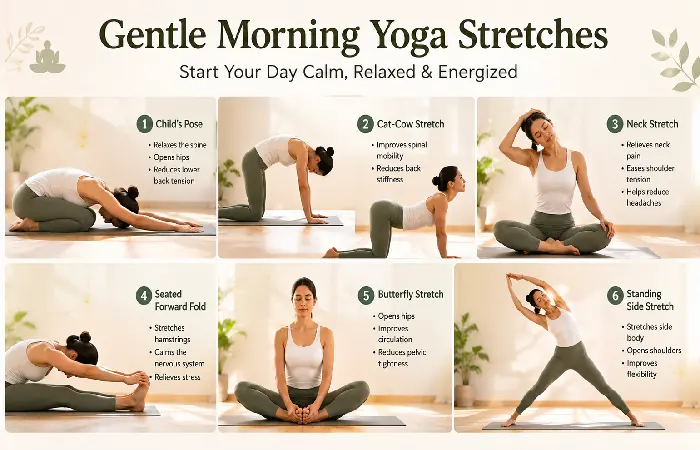
If you’re new to yoga, begin with this beginner’s guide to yoga for stress relief before establishing a morning routine.
Calming morning poses Gentle stretches to prepare for the day ahead Stiff all morning? Try this calming yoga poses for morning energy.
1. Child’s Pose
Benefits
- Relaxes the spine
- Opens hips
- Reduces lower back tension
Pause for 30 to 60 seconds, breathing steadily.
2. Cat-Cow Pose
Move fluidly through the arch and round phases of this pose. The benefits of Cat-Cow include:
- Better spinal mobility
- Reduced back stiffness
- Improved posture
Repeat for 8–10 breaths.
3. Neck Stretch
Gently tilt your head toward each shoulder.
This helps reduce:
- Neck pain
- Shoulder tension
- Headaches caused by stress
4. Seated Forward Fold
Gently stretch your hamstrings and back muscles – do not push the stretch too hard. The advantages are:
Balance your active practice with restorative yoga for stress relief to encourage relaxation and recovery.
- Calms the nervous system
- Improves flexibility
- Relieves stress
5. Butterfly Stretch
Sit with the soles of your feet together.
Benefits:
- Opens hips
- Improves circulation
- Reduces pelvic tightness
6. Standing Side Stretch
Reach one arm overhead while leaning gently.
This stretches:
- Side body
- Shoulders
- Rib cage
Stretching Routine
| Stretch | Duration |
| Child’s Pose | 1 minute |
| Cat-Cow | 1 minute |
| Neck Stretch | 1 minute |
| Forward Fold | 1 minute |
| Butterfly Pose | 1 minute |
| Side Stretch | 1 minute |
Total: Approximately 6 minutes.
Breathing Exercises
Breath-work-Style 2 01 Breathing Exercises pranayama – The controlling of the breath regulates your entire system.
Continue your wellness routine in the evening with yoga for better sleep and stress relief for a restful night.
1. Diaphragmatic Breathing
Inward breath into belly- like lung using your diaphragmatic muscle then up into the chest Guidelines
- Relax in a sitting position.
- Rest a hand on the abdomen.
- With the nasal cavity Inward-breath from
- Breath slowly out of the mouth.
Repeat this 5 min.
2. Box Breathing
A favorite among athletes and professionals.
Pattern:
- Inhale for 4 seconds
- Hold for 4 seconds
- Exhale for 4 seconds
- Hold for 4 seconds
Repeat for 5 minutes.
3. Alternate Nostril Breathing
This traditional yoga breathing exercise balances the nervous system.
Benefits include:
- Reduced anxiety
- Improved focus
- Mental clarity
Practice for 3–5 minutes.
4. Equal Breathing
Simply inhale and exhale for the same length.
Example:
- Inhale for 5 seconds
- Exhale for 5 seconds
Continue for several minutes.
Comparing Breathing Exercises
| Exercise | Best For | Time |
| Belly breathing | Relaxation | 5 min |
| Box breathing | Stress reduction | 5 min |
| Alternate nostril | Mental clarity | 5 min |
| Equal breathing | Daily mindfulness | 3–5 min |
Energizing Yoga Flow
If you’re feeling nice and warm after any of the preceding movements, try these flow: Mountaing Pose Your feet are planted squarely on the floor.
Benefits:
- Improves posture
- Encourages mindful breathing
- Builds stability
Sun Salutation
One of the best morning yoga sequences.
It combines:
- Forward fold
- Plank
- Cobra
- Downward Dog
- Standing stretch
Repeat 3–5 rounds.
Warrior I
Strengthens:
- Legs
- Core
- Balance
Also boosts confidence and focus.
Warrior II
Excellent for building endurance while opening the hips and shoulders.
Downward-Facing Dog
Benefits:
- Lengthens the spine
- Strengthens shoulders
- Improves circulation
Hold for 5–8 breaths.
Cobra Pose
A gentle backbend that:
- Opens the chest
- Improves posture
- Reduces upper back tension
Tree Pose
A balancing posture that improves:
- Focus
- Stability
- Body awareness
Suggested Morning Flow
| Pose | Time |
| Mountain Pose | 1 minute |
| Sun Salutations | 5 minutes |
| Warrior I | 2 minutes |
| Warrior II | 2 minutes |
| Downward Dog | 2 minutes |
| Cobra Pose | 1 minute |
| Tree Pose | 2 minutes |
| Final Relaxation | 3 minutes |
Total: Approximately 18–20 minutes.
Creating a Morning Routine
Morning is the best time to be practicing yoga; this not only can put you in a positive state of mind for the rest of the day but can boost your metabolism and energy levels throughout the day as well. If you’re struggling with finding time to create a morning routine, here are some ways you can start your own morning yoga routine in no time. You don’t have to take hours either all that it take’s is consistant effort.
Step 1: Wake up slightly earlier
Set your alarm just twenty minutes before your usual wake-up time.
Step 2: Hydrate
Get a glass of water before your morning yoga and perform the yoga with the water.
Step 3: Select a space
Practice somewhere with:
- Fresh air
- Comfortable temperature
- Minimal distractions
Step 4: Wear Comfortable Clothing
Loose, breathable clothing allows easier movement.
Step 5: Practice Mindfully
Avoid rushing through poses.
Focus on:
- Slow breathing
- Smooth transitions
- Relaxation
Step 6: Finish with Meditation
Spend 3–5 minutes sitting quietly.
Observe your breathing without judgment.
Sample Morning Routine
| Time | Activity |
| 6:30 AM | Wake up |
| 6:35 AM | Drink water |
| 6:40 AM | Gentle stretching |
| 6:50 AM | Yoga flow |
| 7:05 AM | Breathing exercises |
| 7:10 AM | Meditation |
| 7:15 AM | Healthy breakfast |
Staying Consistent
A few realistic goals and a little flexibility can go a long way in making yoga a lasting habit. Begin with a manageable time 10 minutes per day is still effective for your body over time. Set a Consistent Time Train your body to look forward to movement every morning. Focus on a realistic goal
A few realistic goals:
- Three days per week initially
- Increase gradually to five or six days
Track Your Progress
Keep a simple journal noting:
- Energy levels
- Stress levels
- Mood
- Flexibility
Celebrate Small Wins
Notice improvements such as:
- Feeling calmer
- Better sleep
- Reduced stiffness
- Increased confidence
Common Obstacles and Solutions
| Challenge | Solution |
| No time | Practice 10 minutes |
| Low motivation | Prepare your mat the night before |
| Feeling stiff | Begin with gentle stretches |
| Busy mornings | Wake up 15 minutes earlier |
| Missing sessions | Restart without guilt |
Common Mistakes to Avoid
- Skipping your warm-up.
- Holding your breath during poses.
- Comparing yourself with others.
- Practicing immediately after a heavy meal.
- Ignoring pain or discomfort.
- Being inconsistent.
- Rushing through movements.
Tips for Beginners
- Focus on proper breathing before advanced poses.
- Use yoga blocks or cushions if needed.
- Move slowly and avoid forcing stretches.
- Stay hydrated throughout the day.
- End every practice with a few minutes of relaxation.
- Remember that progress comes from consistency rather than perfection.
Frequent questions:
Should I practice yoga in the morning or evening class?
You’ll feel energized for your day from your morning yoga and better concentrated, whereas you’ll relax from the evening yoga class before sleeping. That’s a personal decision and based on your routine and desired benefits of practice.
What time should I dedicate to morning yoga?
For most people you will get both mental and physical benefits from morning yoga practices of 15-30 minutes each morning.
Is morning yoga good for beginners?
Absolutely. Simple breath work and beginner pose/stretch would be perfect for your morning yoga practice.
Should I eat before a morning yoga class?
Generally the best thing to do is either attend with an empty stomach, or have a small snack before if you’re hungry. If you choose to eat be sure that you eat at least 1 to 2 hours before attending practice.
How long will it take before I start to see the effects of morning yoga?
Some individuals begin to notice an immediate difference in their focus and energy levels after the very first session, however most will feel effects on their flexibility, stress reduction, and posture more noticeably between 3-6 weeks of a regular practice.
Summary
As the sun comes up to greet the world, we get an opportunity to do the same with our bodies, minds, and spirits, and there is perhaps no greater tool to start this with than a dedicated practice of morning yoga for stress relief and more, to allow you to be the best you can be for the day ahead and for life more broadly.