

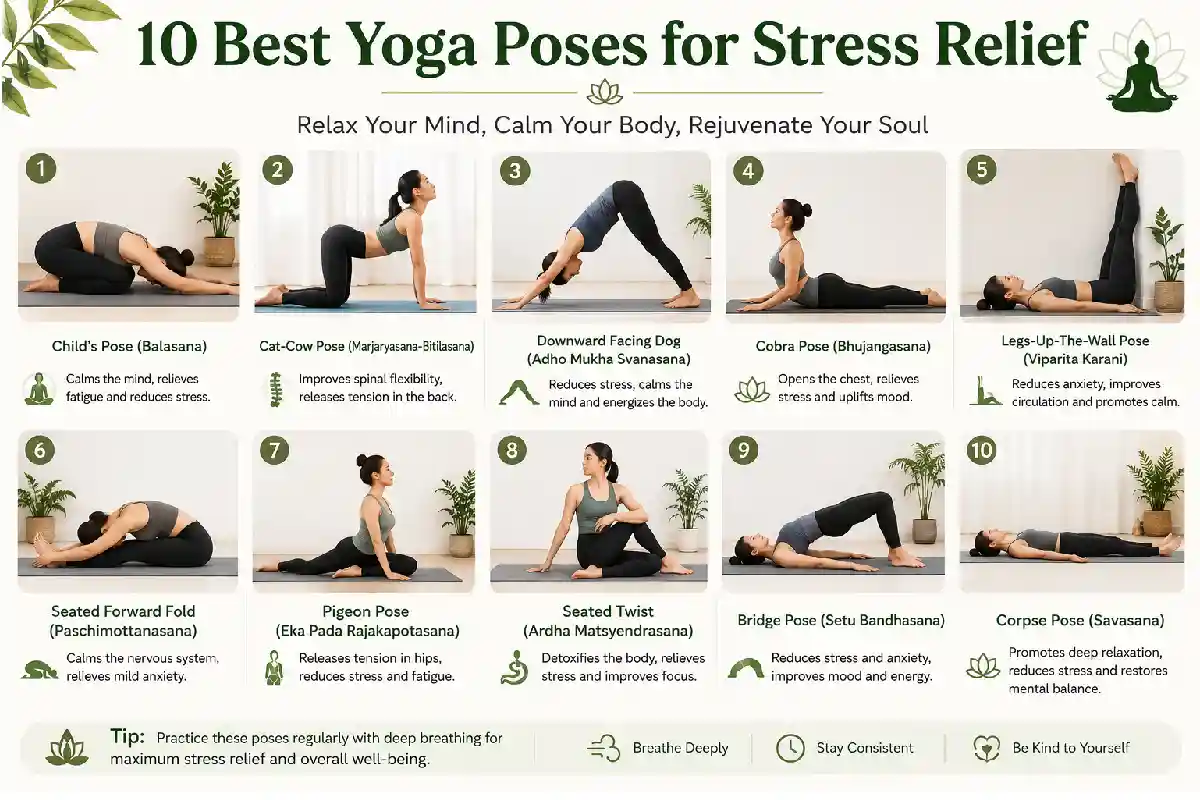
10 Best Yoga Poses for Stress Relief – A Complete Guide
 Khizrana Begum
Beauty & Lifestyle Writer
Khizrana Begum writes clear and reader-friendly content covering beauty, lifestyle and related topics.
Read Full Bio of Author →
Khizrana Begum
Beauty & Lifestyle Writer
Khizrana Begum writes clear and reader-friendly content covering beauty, lifestyle and related topics.
Read Full Bio of Author →
 Sameena Begum
Health, Technology & Digital Content Reviewer
Sameena Begum reviews content for clarity, accuracy and overall reader usefulness.
Read Full Bio of Reviewer →
Sameena Begum
Health, Technology & Digital Content Reviewer
Sameena Begum reviews content for clarity, accuracy and overall reader usefulness.
Read Full Bio of Reviewer →
10 Best Yoga Poses for Stress Relief – The nervous tension can literally live in your body – the tension you carry in your shoulders, the quick, shallow breaths, the racing mind. But the most simple and purest of things can just be yoga to break up that tension and the imprint it creates. These are sequences that put in gentle motion, breathing, and a stillness that gives your nervous system a little reboot.
❝
This article is a part of
Stress Management Guide
Why Certain Yoga Poses Reduce Stress?
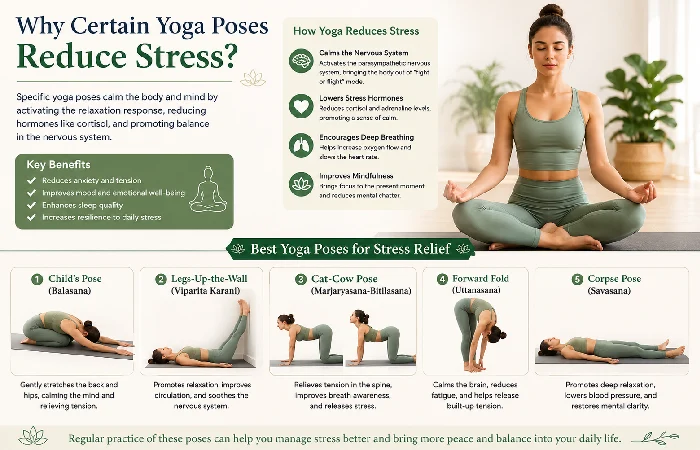
Explore our complete guide to yoga for stress relief to discover techniques for reducing stress and improving overall well-being.
Some yoga postures lower our stress response by kicking in the parasympathetic nervous system- the “rest and digest” system of our body. Forward folds (such as Child’s Pose) place light pressure on our abdomen, bringing our attention inward to soften our minds. Restoration positions (like Legs-Up-the-Wall) help blood flow to carry away excess cortisol and reduce overall levels.
Slow, deep breathing combined with moves like Cat-Cow release physical tension in our spines and encourage the brain to believe we are in safe circumstances.
Balancing poses like Tree Pose require us to direct all our focus to the action at hand, drawing it away from an overly busy, anxious mind. Twisting pose can “wring” the tension from the nervous system and the soft backbends open the chest to relieve the tension posture many people take on when stressed. When used in conjunction with movement and breath, these mind-body activities reduce your heart rate and provide relief.
Quick reference Top 10 poses in a flash
Quick Reference: 10 Poses at a Glance
| # | Pose (English) | Pose (Sanskrit) | Best For | Hold Time |
| 1 | Child’s Pose | Balasana | Grounding, calming the mind | 1–3 minutes |
| 2 | Cat-Cow Pose | Marjaryasana-Bitilasana | Releasing spinal tension | 1–2 minutes |
| 3 | Legs-Up-the-Wall Pose | Viparita Karani | Deep relaxation, circulation | 5–15 minutes |
| 4 | Seated Forward Bend | Paschimottanasana | Quieting an overactive mind | 1–3 minutes |
| 5 | Corpse Pose | Savasana | Full-body reset | 5–10 minutes |
| 6 | Standing Forward Fold | Uttanasana | Releasing head and neck tension | 1–2 minutes |
| 7 | Reclining Bound Angle Pose | Supta Baddha Konasana | Opening the chest, deep rest | 3–5 minutes |
| 8 | Easy Pose with Breathwork | Sukhasana | Centering, mindful breathing | 3–5 minutes |
| 9 | Bridge Pose | Setu Bandhasana | Releasing anxiety, opening the chest | 30–60 seconds |
| 10 | Extended Puppy Pose | Uttana Shishosana | Stretching the spine, calming | 1–2 minutes |
These five poses discussed are practiced at length below: They’re among the most accessible poses for novices to practice and produce some of the quickest stress relief. What Kind of Yoga Poses Ease Stress They aren’t all the same-some pose more of a chill vibe. Poses with long, slow holds that require forward folds, and some mild inversions turn on your body’s “rest-and-digest” parasympathetic nervous system that slows heart rate and stress.
Complement these poses with yoga exercises for stress relief to build strength, flexibility, and relaxation.
| Mechanism | What It Does | Poses That Use It |
| Forward folding | Compresses the abdomen, encourages introspection | Child’s Pose, Seated Forward Bend |
| Gentle inversion | Improves circulation, calms the mind | Legs-Up-the-Wall |
| Slow, rhythmic movement | Syncs breath with body, releases tension | Cat-Cow |
| Stillness and surrender | Triggers deep relaxation response | Corpse Pose |
These along with deep, diaphragmatic breathing help communicate to the brain it is safe to let go – even at the end of a rough day.
Child’s Pose
This pose helps release the tension you store in your hips and legs as a result of a stressful workday. This gentle yoga pose may also increase circulation, especially the movement of blood to your legs, relieve pressure and tension, and may be helpful with reducing anxiety levels.
If you’re just starting out, follow this beginner’s guide to yoga for stress relief to learn the basics safely.
Stress-relieving benefit As with many forward folds, forward folds can be calming for the nervous system and can help alleviate minor symptoms of anxiety and tiredness.
Cat-Cow Pose
Cat-Cow: This easy, fluid movement done in the hands-and-knees pose as you cycle through the movement of stretch, flat, arch, round, stretch again. Pose – this is warming to and lengthens the spine and relaxes the nervous system. This is normally done at the beginning of the session.
Legs-Up-the-Wall pose (Viparita Karani)
A very passive yoga pose. Lie down on the floor, on your back and prop your legs up the wall. Place your hips close to the base of the wall.
Practice these poses as part of a morning yoga routine for stress relief to begin your day with a calm, focused mind.
It helps blood flow the opposite way, and will reduce swelling in your legs. By calming the nervous system it will reduce blood flow to the heart.
Pair active poses with restorative yoga for stress relief to promote deeper relaxation and recovery.
It is a great pose to release stress, anxiety and help with insomnia, while it also slows your heart rate down.
Typically held for 5-15 minutes closed eyes with very slow deep breaths helps you ease into the pose.
Seated forward bend (Paschimottanasana)
Sit with your legs straight out in front of you and bend your body from your hips towards your feet, folding through your back, the backs of your legs, and your lower back. Forward folding naturally turn you inward and this pose can help to alleviate some low-grade anxiety, reduce headaches and exhaustion as well as aid digestion.
Corpse Pose
Cool down After your last class of the day, you might even practice this as a separate, effective stress-buster. How to do it: Lie on your back with your arms by your side and palms pointing upward.
Legs can be slightly bent and hip width apart. Close your eyes and let all tension slip away allowing the body to become heavy. Breathe easy in and out of your nose and let all your attention simply fall into breathing for 5 to 10 minutes.
End your practice with yoga for better sleep and stress relief to relax your body before bedtime.
Stress-Relief Plus: This is the most critical pose for integration-sinking into Savasana ensures that your whole system enjoys the physical and mental benefits of your yoga practice, helping you to feel peaceful and with less racing thoughts and an eased heart.
Tips for Beginners
| Tip | Why It Helps |
| Start with 5–10 minutes a day | Consistency matters more than duration when building a stress-relief habit |
| Focus on breath, not perfection | Deep, steady breathing amplifies the calming effect of every pose |
| Use props (blankets, blocks, walls) | Props make poses more accessible and help you relax fully into them |
| Practice in a quiet, low-light space | Reduces sensory distractions and supports relaxation |
| Don’t force flexibility | Stress relief comes from ease, not strain — work within a comfortable range |
| End with stillness | Even one minute of stillness (seated or lying down) helps lock in the benefits |
With regular practice, these poses can become a reliable tool for managing everyday stress — no experience or special equipment required.