
Breathing Exercises for Stress Relief: Simple Techniques to Calm Your Mind and Body Naturally
 Khizrana Begum
Beauty & Lifestyle Writer
Khizrana Begum writes clear and reader-friendly content covering beauty, lifestyle and related topics.
Read Full Bio of Author →
Khizrana Begum
Beauty & Lifestyle Writer
Khizrana Begum writes clear and reader-friendly content covering beauty, lifestyle and related topics.
Read Full Bio of Author →
 Sameena Begum
Health, Technology & Digital Content Reviewer
Sameena Begum reviews content for clarity, accuracy and overall reader usefulness.
Read Full Bio of Reviewer →
Sameena Begum
Health, Technology & Digital Content Reviewer
Sameena Begum reviews content for clarity, accuracy and overall reader usefulness.
Read Full Bio of Reviewer →
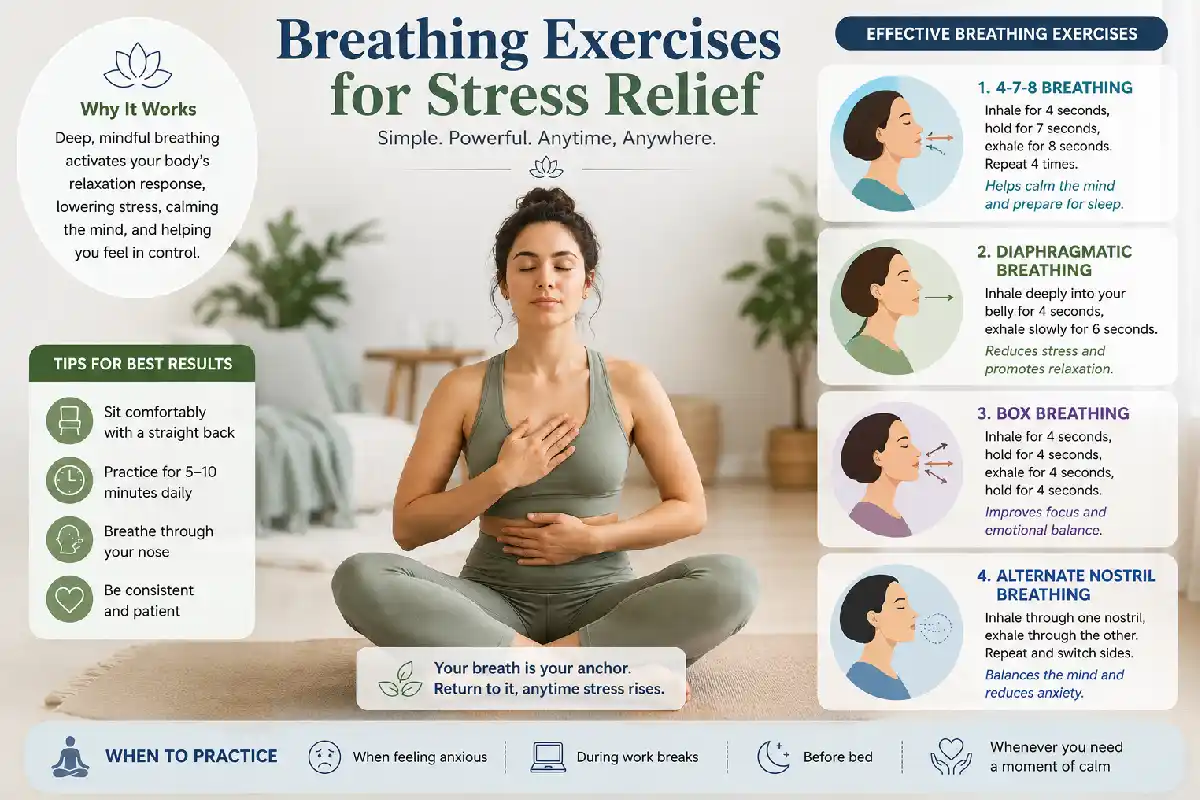
Breathing Exercises for Stress Relief: Most of us know how to relieve stress through different complicated ways but sometimes the easiest tool can be the answer. In this modern era, every one of us is surrounded by the workload, family issues, money related pressure, notifications of social media, etc that are taking our attention constantly leaving our mind feel tired and bodies physically tight and limited.
Controlled breathing exercises for anxiety If you practice with awareness, controlled breathing exercises has been proven to slow heart rates, reduce stress hormones in the body, improve focus, and enhance the feeling of relaxation. They’re free, simple, and have the stamp of medical approval to help settle your nervous system and restore emotional balance.
❝
This article is a part of
Stress Management Guide
Explore our complete guide to yoga for stress relief to build a consistent practice for managing daily stress.
What Are Breathing Exercises?
A type of exercise in which you use conscious efforts to control how you breath (depth, rate and rhythm) for health benefits breathing exercises stimulate the body’s ability to relax and communication to the brain and nerves.
Adding these yoga poses for stress relief to your exercise routine can improve flexibility and relaxation.
Instead of breathing shallowly and rapidly as you might if you’re feeling anxious this technique requires that you slowly and deliberately deep inhale
Key Benefits of Breathing Exercises
| Benefit | How It Helps |
| Reduces Stress | Activates the body’s relaxation response |
| Lowers Anxiety | Slows racing thoughts and calms the mind |
| Improves Sleep | Encourages relaxation before bedtime |
| Enhances Focus | Increases oxygen delivery to the brain |
| Supports Heart Health | Helps regulate blood pressure and heart rate |
| Boosts Emotional Control | Improves resilience during stressful situations |
Why Breathing Matters?
Most of the time we don’t even think about breathing; unless it speeds up to a shallow pant during times of anxiety and stress. It has actually got an important and inseparable connection to our nervous system and how we are feeling at any time of day. Our bodies jump into fight or flight mode with any sort of stress and the results are rapid shallow breaths, muscles tightening up and racing heartbeats.
If you’re new to yoga, begin with this beginner’s guide to yoga for stress relief before trying more advanced exercises.
Start your day with a morning yoga routine for stress relief to boost energy and reduce tension.
In the old days this was important as we may have needed to escape from an attack or danger.
Now, we simply stay caught in this state all day from everyday stresses.
Conscious breathing helps reverse this process.
How Does Stress Affect Breathing?
| Stress Response | Effect on Breathing |
| Anxiety | Rapid breathing |
| Panic | Hyperventilation |
| Mental Overload | Shallow chest breathing |
| Chronic Stress | Reduced oxygen efficiency |
| Tension | Tight chest and shoulders |
The slower your breath the more you send messages to your brain you’ve nothing to fear and that’s the hallmark of the activation of your parasympathetic (or ‘rest and digest system’).
Balance active movement with restorative yoga for stress relief to support recovery and relaxation.
What Happens During Deep Breathing?
- Heart rate slows down
- Blood pressure decreases
- Muscles relax
- Cortisol levels may reduce
- Focus improves
- Emotional balance increases
Which is one of the reasons the beginning minutes of most meditation, yoga, and mindfulness practices start with breath work.
The Science Behind Breathing and Stress Relief
Regulated breathing techniques have been shown to boost your mind and your physical well-being, research suggests. Controlled breathing influences your vagus nerve which plays a vital role in your parasympathetic nervous system. The vagus nerve stimulates your body’s relaxation response.
Complete your routine with yoga for better sleep and stress relief to help your body unwind at night.
Physiological Effects of Slow Breathing
| Body System | Positive Impact |
| Brain | Improved focus and emotional regulation |
| Heart | Better heart rate variability |
| Lungs | Enhanced oxygen exchange |
| Nervous System | Reduced stress response |
| Muscles | Lower tension levels |
| Sleep Cycle | Improved relaxation before sleep |
Just five minutes of concentrated, mindful breathing can make a difference.
Diaphragmatic Breathing
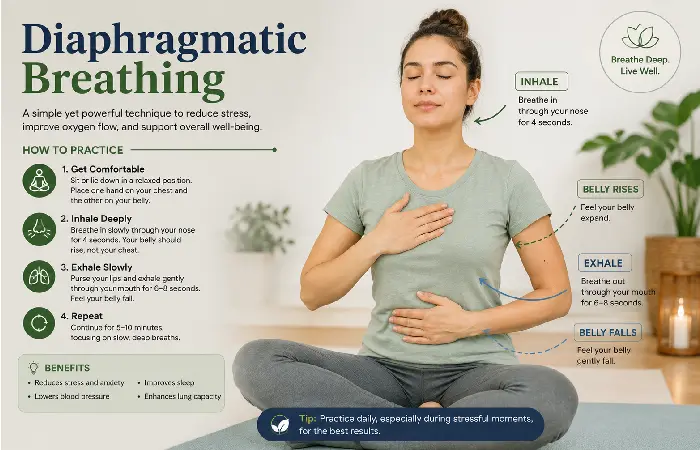
The technique of belly breathing or diaphragmatic breathing, listed amongst one of the top 10 relaxation techniques to get the upper hand of the menace of excessive tension and stress encourages deeper breathing over and above surface chest breathing involving the diaphragm.
Benefits of Diaphragmatic Breathing
- Reduces anxiety symptoms
- Improves oxygen intake
- Lowers heart rate
- Relaxes muscles
- Enhances mindfulness
How to Practice Diaphragmatic Breathing?
Step 1
Sit comfortably or lie on your back.
Step 2
Place one hand on your chest and the other on your abdomen.
Step 3
Inhale slowly through your nose for four seconds.
Step 4
Allow your belly to rise while keeping your chest relatively still.
Step 5
Exhale slowly through your mouth for six seconds.
Step 6
Repeat for 5–10 minutes.
Beginner Practice Schedule
| Week | Duration |
| Week 1 | 3 Minutes Daily |
| Week 2 | 5 Minutes Daily |
| Week 3 | 7 Minutes Daily |
| Week 4 | 10 Minutes Daily |
Best Time to Practice
- Morning
- Before meetings
- During work breaks
- Before bedtime
Diaphragmatic breathing can retraining your body to relax on default.
Box Breathing
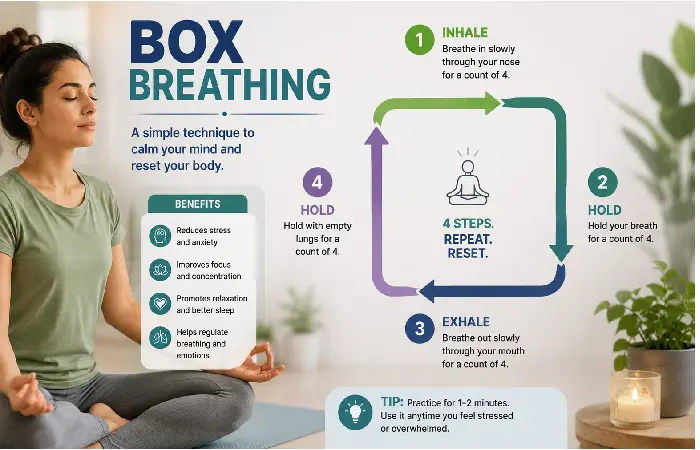
“Box breathing is an organized approach to breath used by military members, athletes, and people working in high stress industries.
The principle consists of equal numbers of counts when you’re inhaling, holding, exhaling and holding again.”
Why It Works
This predictable rhythm can stabilize your breath and decrease your feeling of being overloaded in your head.
Box Breathing Pattern
| Phase | Count |
| Inhale | 4 Seconds |
| Hold | 4 Seconds |
| Exhale | 4 Seconds |
| Hold | 4 Seconds |
Visualize tracing the four sides of a square as you breathe.
How to Practice Box Breathing?
- Sit comfortably.
- Inhale through your nose for four counts.
- Hold the breath for four counts.
- Exhale slowly for four counts.
- Hold again for four counts.
- Repeat for several cycles.
Benefits of Box Breathing
- Immediate stress reduction
- Improved concentration
- Better emotional control
- Increased mental clarity
- Reduced feelings of panic
When to Use Box Breathing?
| Situation | Benefit |
| Before Presentations | Calms nerves |
| During Work Stress | Restores focus |
| Before Exams | Reduces anxiety |
| Athletic Performance | Improves concentration |
| Difficult Conversations | Promotes emotional balance |
We sometimes have people report feeling a sense of calm at an internal level after just a few cycles of breath.
Alternate Nostril Breathing
Alternate nostril breathing This form of breath work is also referred to as Nadi Shodhana, and is Yoga.
You will breath through your nostrils in a specific order and pattern.
This yoga breath is thought to balance your energy flows, and also improve clarity of mind.
Benefits of Alternate Nostril Breathing
- Encourages relaxation
- Improves focus
- Supports mindfulness
- Reduces mental clutter
- Promotes emotional stability
Step-by-Step Guide
Step 1
Sit comfortably with your spine straight.
Step 2
Use your right thumb to close the right nostril.
Step 3
Inhale slowly through the left nostril.
Step 4
Close the left nostril using your ring finger.
Step 5
Release the right nostril and exhale.
Step 6
Inhale through the right nostril.
Step 7
Close the right nostril and exhale through the left.
This completes one cycle.
Recommended Practice
| Experience Level | Duration |
| Beginner | 3 Minutes |
| Intermediate | 5–7 Minutes |
| Advanced | 10–15 Minutes |
Best Uses
- Meditation preparation
- Stressful workdays
- Emotional overwhelm
- Morning mindfulness routines
Clients report they are usually more peaceful and grounded within just minutes.
4-7-8 Breathing Technique
4-7-8 breath has a reputation of aiding in relaxing the mind and making it easy for people to fall asleep at night.
The technique stems from age-old breathing principles with a slight tweak for making exhalations a little longer.
Breathing Pattern
| Action | Duration |
| Inhale | 4 Seconds |
| Hold | 7 Seconds |
| Exhale | 8 Seconds |
How to Practice?
Step 1
Rest your feet up and put your shoulders back
Step 2
Gently inhale through your nose for 4 count
S 3
Hold the breath for seven seconds.
Step 4
Inhale and exhale slowly and fully through your mouth for eight counts.
Step 5
Repeat for four cycles.
Why It Helps
It’s as simple as you let yourself just to release a sigh, to allow a relaxed response to kick in and take over the body and mind.
Benefits of 4-7-8 Breathing
- Helps reduce anxiety
- Encourages better sleep
- Calms racing thoughts
- Lowers stress levels
- Promotes emotional regulation
Ideal Times for Practice
| Time | Purpose |
| Before Sleep | Faster relaxation |
| During Anxiety | Emotional calming |
| After Work | Stress release |
| During Travel | Reduces nervousness |
A lot of individuals use this to assist them get unwind as a natural option just before going to sleep
Comparing Popular Breathing Exercises
| Technique | Difficulty | Best For | Duration |
| Diaphragmatic Breathing | Easy | Daily relaxation | 5–10 Minutes |
| Box Breathing | Easy | Focus and stress control | 2–5 Minutes |
| Alternate Nostril Breathing | Moderate | Mental balance | 5–10 Minutes |
| 4-7-8 Breathing | Easy | Sleep and anxiety relief | 2–5 Minutes |
Daily Practice Tips
Learning how to do the breath work is the easy part! The real magic occurs when you start doing the breathing exercises regularly.
Start Small
A lot of beginners go for hours straight and fail and lose motivation. Try a little every day.
Suggested Daily Schedule
| Time of Day | Exercise |
| Morning | Diaphragmatic Breathing |
| Midday | Box Breathing |
| Evening | Alternate Nostril Breathing |
| Before Sleep | 4-7-8 Breathing |
Create a Calm Environment
A silent space for you to not have others bother you is another need when meditating.
Helpful additions include:
- Soft lighting
- Comfortable seating
- Relaxing music
- Natural surroundings
Use Technology Wisely
For a little extra help staying in a routine, breathing apps and meditation timers will do the job.
Features to look for:
- Guided sessions
- Breathing animations
- Progress tracking
- Reminder notifications
Focus on Consistency
It’s far better to practice for five minutes each day than one hour per week.
Habit-Building Tips
| Strategy | Benefit |
| Set Reminders | Builds routine |
| Practice After Waking | Creates consistency |
| Pair with Meditation | Deepens relaxation |
| Track Progress | Increases motivation |
Listen to Your Body
Breathing exercises should feel comfortable.
If you experience:
- Dizziness
- Discomfort
- Breathlessness
Return to the normal breath. Move even more softly
Common Mistakes to Avoid
Breathing Too Fast
Relax with slow and even breaths.
Forcing Deep Breaths
Your breath should be free rather than tight.
Poor Posture
If your posture is correct your lungs are free to fully expand.
Inconsistent Practice
The more you use this one, the greater benefits.
Expecting Instant Results
Some immediate stress relief may occur but ongoing stress relief can begin to be managed as a pattern.
Combining Breathing Exercises with Other Stress-Relief Techniques
You will discover your breathing exercises work even more effective if used with good life style options.
Effective Combinations
| Practice | Benefit |
| Meditation | Greater mindfulness |
| Yoga | Improved flexibility and calm |
| Walking | Enhanced mood |
| Journaling | Emotional processing |
| Quality Sleep | Better recovery |
| Exercise | Reduced stress hormones |
And combined these habits will do a solid job helping you maintain positive mental health.
Conclusion
Breathwork for Stress Management you do it every day at no cost-this natural and innate body function is one of the easiest tools in your toolbox for immediate, potent stress relief. Feeling stressed out from a busy day, grappling with anxiety, being caught up in your emotions, or having trouble falling asleep? Breathwork to the rescue.
No experience, equipment or commitment is needed, and you can practice deep-breathing for relaxation (diaphragm and box breathing included) wherever you are whenever you are – minutes of it will cut through that stress, settle you into yourself and bring you to sleep and rest.
FAQ: Breathing Exercises for Stress Relief
How long should I practice breathing exercises each day?
Many of the experts will advise a few to ten minutes per day of work that produces tangible relief from your stress.
Which breathing technique is best for anxiety?
There are a few additional breathing strategies commonly practiced to combat anxiety: diaphragmatic breathing technique and 4-7-8 breathing technique.
.Can breathing exercises help with sleep?
Yes. The slow-breathing exercises might also relax your nervous system so you can go to sleep.
Are breathing exercises scientifically supported?
Many believe that a more conscious attention to breathing techniques helps you reduce tension, control emotional state, and gain better state of mind.
Can I practice breathing exercises at work?
That’s absolutely right – the breathing box exercise is one that often works extremely well to get work stress relief and find our attention & focus again.