

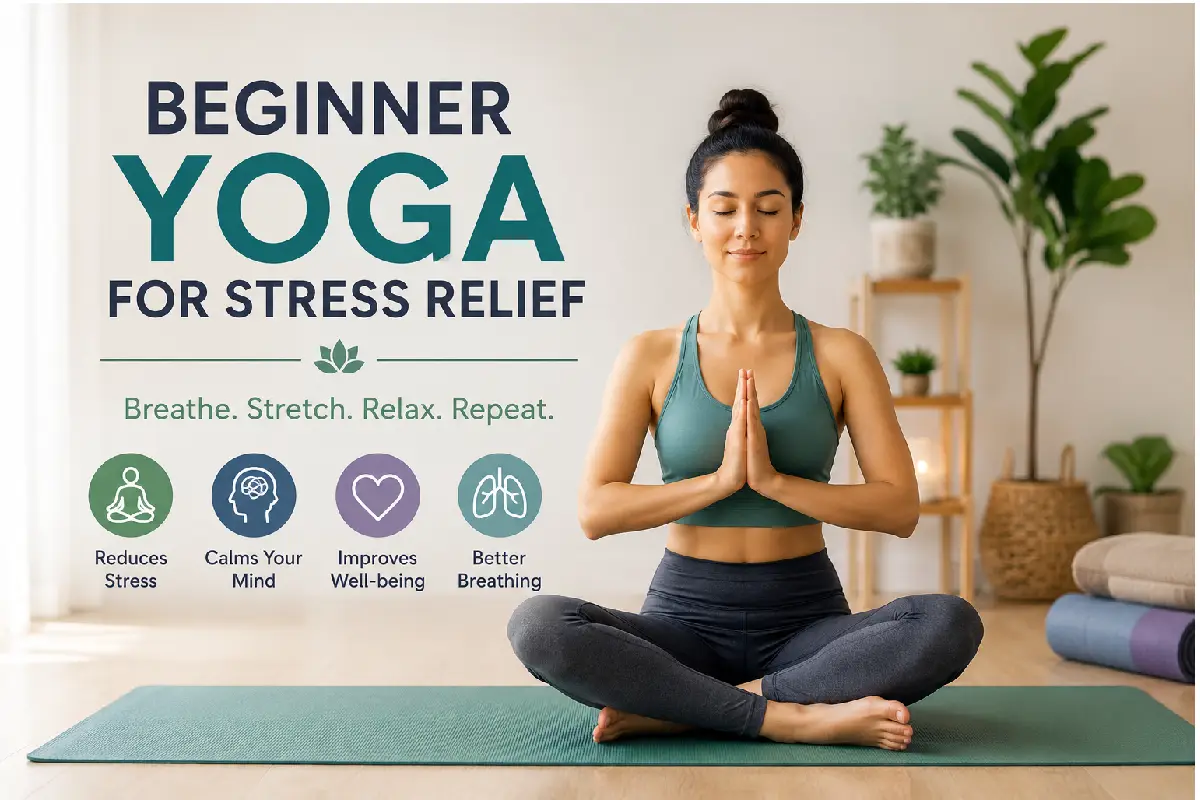
Beginner Yoga for Stress Relief: A Simple Guide to Relaxation and Better Well-Being
 Khizrana Begum
Beauty & Lifestyle Writer
Khizrana Begum writes clear and reader-friendly content covering beauty, lifestyle and related topics.
Read Full Bio of Author →
Khizrana Begum
Beauty & Lifestyle Writer
Khizrana Begum writes clear and reader-friendly content covering beauty, lifestyle and related topics.
Read Full Bio of Author →
 Sameena Begum
Health, Technology & Digital Content Reviewer
Sameena Begum reviews content for clarity, accuracy and overall reader usefulness.
Read Full Bio of Reviewer →
Sameena Begum
Health, Technology & Digital Content Reviewer
Sameena Begum reviews content for clarity, accuracy and overall reader usefulness.
Read Full Bio of Reviewer →
Beginner Yoga for Stress Relief – Yoga can significantly help alleviate both your mental and physical stress. Whether it is the pressures of your work life, family matters, or some form of financial crisis – or even just too much time in front of your computer – an unending list of stressors is enough to make you weary, exhausted, and emotionally spent. Luckily – The great news is – you don’t have to be flexible or a certified yogi for years to find stress relief through this wonderful practice.
Beginner yogis may also feel the stress reduction benefit of this form of practice if they start with a mindful approach in movements, breathing exercises and body awareness. Even if you only have about 10-20 minutes a day practising, it is an advantage for you to be able to relax your muscles, relieve the tension from them, improve your sleep, and cheer you up and lift your spirits for a sense of inner peace.
❝
This article is a part of
Stress Management Guide
Getting Started with Yoga
Let’s delve into how you can commence, the necessary tools that might be of help, a beginner flow routine to practice, traps you need to avoid, and crucial precautions for a long-lasting positive experience.
Start with our complete guide to yoga for stress relief to understand how regular practice supports mental and physical well-being.
Yoga – The Mechanism of Stress Relief Yoga is basically the union of breathing exercises, body movements, and awareness. When they are performed together, they encourage the relaxation reflex in our body, help reduce the effect of hormones associated with stress, and relieve the ill-feelings generated by the constant stress of everyday living.
With this form of yoga for stress reduction, beginners will benefit in a wide range of ways:
- Reduces stress hormones like cortisol
- Improves mood and emotional well-being
- Relieves neck, shoulder, and back tension
- Encourages deeper breathing
- Improves sleep quality
- Enhances flexibility and posture
- Increases focus and concentration
- Builds resilience to everyday stress
How Yoga Support Mental Health?
| Yoga Practice | Stress Relief Benefit |
| Deep breathing | Slows heart rate and calms the nervous system |
| Gentle stretching | Releases muscle tension |
| Mindfulness | Reduces anxious thoughts |
| Relaxation poses | Promote emotional calm |
| Regular practice | Builds long-term stress resilience |
New at Yoga: Getting something new started can look intimidating, especially for someone starting a new workout program with yoga, due to all of the unique positions you’ve been told you should master. Luckily, this mind-body work is beneficial for just about everyone, regardless of their size, age, and health status.
Learn simple yoga poses for stress relief that are safe and effective for beginners.
Your only focus in the first few days is to connect movement with your breath – no jumping around doing complex movements yet. Select a Cozy Space Where You can stretch, roll, and move without feeling cramped up.
Your yoga space should have:
- Good ventilation
- Enough room for a yoga mat
- Minimal distractions
- Comfortable temperature
- Soft lighting if possible
Wear something comfortable:
A piece of clothing that doesn’t restrict your movement. Like the example of
- Yoga leggings
- Athletic shorts
- Stretchable T-shirts
- Breathable tops
Wear loosely fitting clothes.
Practice At the Appropriate Time
Once you’re comfortable with the basics, try these yoga exercises for stress relief to build strength and flexibility.
Though you can practice anytime, some beginner practice sessions include:
| Time | Benefits |
| Morning | Boosts energy and mental clarity |
| Afternoon | Reduces work-related stress |
| Evening | Relaxes muscles and improves sleep |
Timing is not as important as consistency is…
Create a healthy habit by following a morning yoga routine for stress relief each day.
Practice Proper Breathing: Yoga has some very fundamental basics. And breathing is arguably the most important one.
Practice:
- Slow inhale through the nose
- Slow exhale through the nose
- Keep breathing naturally during poses
- Avoid holding your breath
When you learn to breathe properly, you will learn the right things that can signal your nervous system that it is safe, so that you can de-stress and feel better.
Begin Slowly
Don’t attempt advanced yoga poses immediately.
Begin with:
- 10–15 minute sessions
- Basic stretches
- Gentle balance poses
- Relaxation exercises
Increase length slowly as you become more comfortable.
Essential Equipment
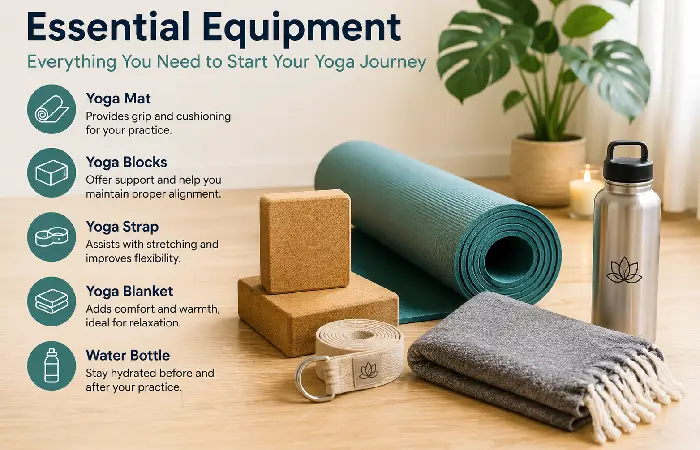
As your practice grows, include restorative yoga for stress relief to promote deep relaxation and recovery.
Some people think yoga requires a lot of costly accessories, but this isn’t the case! You really need only a few items. Yoga Essential Equipment
| Equipment | Purpose |
| Yoga mat | Prevents slipping and cushions joints |
| Yoga blocks | Help with flexibility |
| Yoga strap | Assists stretching |
| Cushion or bolster | Supports seated poses |
| Blanket | Adds comfort during relaxation |
Choosing the Right Yoga Mat
Look for:
- Non-slip surface
- Medium thickness (4–6 mm)
- Easy to clean
- Durable material
A quality mat improves stability and confidence.
Helpful Optional Accessories
These aren’t required but can improve comfort.
- Meditation cushion
- Foam roller
- Eye pillow
- Water bottle
- Small towel
Do Beginners Need Props?
Absolutely.
Yoga props make poses safer and more comfortable.
Examples include:
- Blocks for reaching the floor
- Strap for hamstring stretches
- Cushion for hip support
Using props isn’t “cheating”-it’s smart!
Easy Yoga Sequence
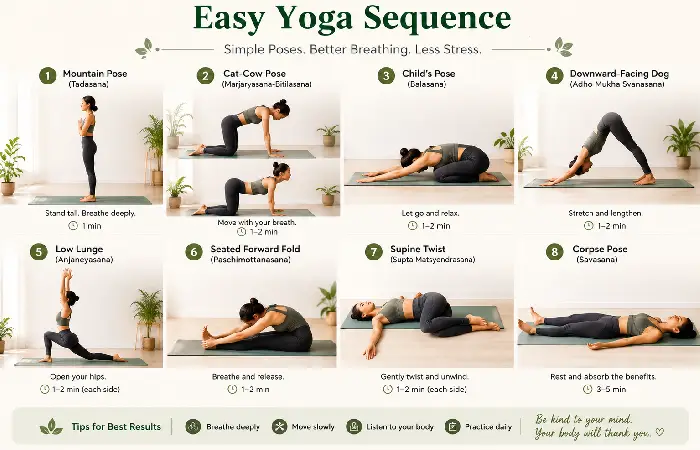
Finish your day with yoga for better sleep and stress relief to unwind before bedtime.
This sequence for beginners will take about 15-20 minutes. Work through this with slow movements and focus on breathing throughout.
Step 1: Easy Seated Breathing (2 Minutes)
Sit comfortably.
- Close your eyes
- Relax shoulders
- Breathe deeply
- Focus only on your breath
This prepares the mind.
Step 2: Cat-Cow Stretch (2 Minutes)
Benefits:
- Relieves spinal tension
- Improves mobility
- Releases stress
Instructions:
- Start on hands and knees.
- Inhale while arching your back.
- Exhale while rounding your spine.
- Repeat slowly.
Step 3: Child’s Pose (2 Minutes)
Benefits:
- Calms the mind
- Stretches lower back
- Encourages deep breathing
Stay relaxed.
Step 4: Downward Facing Dog (1 Minute)
Benefits:
- Lengthens spine
- Improves circulation
- Releases shoulder tension
Bend knees slightly if needed.
Step 5: Mountain Pose (1 Minute)
Stand tall.
Focus on:
- Balanced posture
- Slow breathing
- Relaxed shoulders
This teaches body awareness.
Step 6: Standing Forward Fold (2 Minutes)
Benefits:
- Releases neck tension
- Stretches hamstrings
- Relaxes the nervous system
Keep knees slightly bent if necessary.
Step 7: Warrior II (2 Minutes)
Benefits:
- Builds strength
- Improves confidence
- Enhances balance
Hold each side for several breaths.
Step 8: Tree Pose (2 Minutes)
Benefits:
- Improves concentration
- Enhances balance
- Encourages mindfulness
Continue to leave your foot planted somewhere along the ankle or calf – not on the knee.
Step 9: Supine Twist (2 Minutes). Lie flat on your back.
Benefits:
- Relaxes the spine
- Releases tension
- Improves flexibility
Switch sides slowly.
Step 10: Corpse Pose (5 Minutes)
The most important relaxation pose.
- Lie flat.
- Close your eyes.
- Focus only on breathing.
- Allow your body to completely relax.
Beginner Yoga Routine Summary
| Pose | Time |
| Seated breathing | 2 minutes |
| Cat-Cow | 2 minutes |
| Child’s Pose | 2 minutes |
| Downward Dog | 1 minute |
| Mountain Pose | 1 minute |
| Forward Fold | 2 minutes |
| Warrior II | 2 minutes |
| Tree Pose | 2 minutes |
| Supine Twist | 2 minutes |
| Corpse Pose | 5 minutes |
Total: 20 minutes
Common Beginner Mistakes
It’s normal for all students, especially beginners, to make mistakes in yoga. Awareness of those mistakes allows them to practice in the safest possible way and helps prevent them to avoid injuries or potential limitations later on the yoga journey.
1. Holding Your Breath
Many beginners stop breathing during difficult poses.
Instead:
- Keep slow, natural breathing.
- Let breathing guide movement.
2. Comparing Yourself to Others
- Yoga is personal.
- Your flexibility and progress will differ from everyone else’s.
- Focus on your own improvement.
3. Forcing Flexibility
- Never push into pain.
- Stretch only until you feel gentle tension.
- Pain is a warning sign.
4. Skipping Warm-Up
- Cold muscles are more prone to injury.
- Begin every session with gentle movement.
5. Practising Too Long
More isn’t always better.
Beginners should aim for:
- 15–20 minutes
- Three to five days weekly
Gradually increase as your body adapts.
6. Ignoring Alignment
Proper posture protects joints.
If practising from videos:
- Move slowly.
- Use mirrors if helpful.
- Practice near a wall for balance.
7. Rushing Through Poses
- Yoga isn’t a race.
- Stay in each pose for several breaths.
- Slow movement provides greater relaxation.
Common Mistakes at a Glance
| Mistake | Better Habit |
| Holding breath | Breathe slowly throughout |
| Forcing stretches | Respect your limits |
| Skipping relaxation | Finish with Corpse Pose |
| Comparing progress | Focus on your own journey |
| Practicing irregularly | Build consistency |
| Ignoring discomfort | Modify poses when needed |
Safety Tips
Yoga is generally safe, but beginners should follow basic precautions.
Listen to Your Body
- Mild stretching is normal.
- Sharp pain is not.
- Stop immediately if something hurts.
Warm Up First
Prepare muscles with:
- Shoulder rolls
- Neck stretches
- Gentle walking
- Cat-Cow
Stay Hydrated
Drink water:
- Before yoga
- After yoga
Avoid large meals immediately beforehand.
Use Props
Blocks, straps, and cushions improve:
- Stability
- Comfort
- Safety
Modify When Necessary
Everyone’s body is different.
Modify poses if you have:
- Knee pain
- Lower back pain
- Tight hips
- Limited flexibility
Speak with Your Healthcare Provider If You Have
- Recent surgery
- Pregnancy
- High blood pressure
- Severe arthritis
- Chronic back problems
- Heart disease
Safety Checklist
| Safety Tip | Why It Matters |
| Warm up first | Prevents injury |
| Breathe naturally | Keeps body relaxed |
| Use props | Improves alignment |
| Avoid pain | Protects joints and muscles |
| Practice on a stable surface | Reduces slips and falls |
| End with relaxation | Allows recovery |
Creating A Consistent Habit
Steady habits are your for life stress relief plan. A little every day beats an hour a week. Setting Reasonable Goals Instead of an hour of yoga every day, begin with:
- 10–20 minutes
- Three to five sessions weekly
Increase gradually.
Create a Schedule
Treat yoga like any important appointment.
Examples:
- Before breakfast
- After work
- Before bedtime
Keeping the same time each day helps build a habit.
Start Small
Even five minutes counts.
A short session is better than skipping practice entirely.
Track Your Progress
Record:
- Practice days
- Favorite poses
- Stress levels
- Sleep quality
- Energy levels
Seeing improvement can boost motivation.
Pair Yoga with Healthy Habits
Support your practice by:
- Eating balanced meals
- Staying hydrated
- Getting enough sleep
- Taking regular walking breaks
- Practising mindfulness or meditation
Be flexible. There are days when you will only be able to get 10 minutes in. That’s perfectly ok! Consistency > perfection.
Weekly Beginner Yoga Plan
| Day | Activity | Duration |
| Monday | Gentle yoga flow | 20 minutes |
| Tuesday | Stretching and breathing | 15 minutes |
| Wednesday | Rest or light walk | — |
| Thursday | Beginner yoga sequence | 20 minutes |
| Friday | Relaxation and meditation | 15 minutes |
| Saturday | Full-body yoga | 25 minutes |
| Sunday | Gentle stretching | 15 minutes |
Beginner Yoga Safety Tips
Of all exercise routines, Yoga is very well-known to be one of the best to stay secure. For you to receive optimum rewards from the practice, be sure that you implement and apply excellent practices to stay away from personal injuries. When beginning Yoga, pay more attention to being conscious of every single movement you undertake as opposed to being conscious of how flawless each pose seems.
Pay attention to the body
As with any workout regimen, Yoga must not lead to pain in your body.
Pain should be extremely sharp and agonising if anything at all. Stretches can feel good, even if the muscles are doing work a little, but in case you are getting excruciating discomfort, end immediately. To be aware of your body, it’s best to know when to stop doing things like:
- Moving at your own pace
- Modifying poses when needed
- Taking breaks whenever you feel tired
- Avoiding any movement that causes pain
Get yourself ready for practising
First thing is a warm up of muscles and joints, so you don’t do strains! The type of warm-up I prefer to do involves:
- Neck rolls
- Shoulder circles
- Wrist and ankle rotations
- Cat-Cow stretches
- Gentle side bends
- Deep breathing for 2–3 minutes
Perform your yoga poses on a safe flat surface
Make sure your yoga mat is made of a material with good grip, so that the joints are well supported, and your body is properly balanced.
Hold on through more complex poses. Hold your breath to support your core during tough positions.
Instead:
- Inhale through your nose.
- Exhale slowly through your nose.
- Coordinate your breath with each movement.
- Maintain smooth, steady breathing throughout your practice.
Don’t force flexibility!
Practice, repetition, and patience will develop your muscles’ flexibility – forcing muscles will cause injury. Do not stretch any further than your body allows! Note: Don’t extend your stretch beyond slight discomfort.
- Avoid bouncing during stretches.
- Use yoga blocks or straps if needed.
- Progress at your own pace.
Stay hydrated
Before and during your yoga practice, sip on some water so you feel replenished. Just don’t gulp down a ton of water; you might get pretty uncomfortable while twisting in it.
Wearing attire
Choose comfortable attire that will let you move easily. You’ll want clothes that have a nice amount of stretch, in addition to something that will allow your body to breathe. The last thing you want to do is wear something extremely baggy that can hold up to being turned into a twisted pretzel of flesh and material.
Do Not Do Yoga Right After You’ve Eaten.
Typically, you’ll want to wait at least 2 to 3 hours following a major meal before jumping into any of these poses. You might have something light like a snack or fruit or yoghurt about an hour prior to practice if you are hungry.
Props
Don’t be afraid to use props. Yoga props can help modify any pose and make them more comfortable for all levels.
Helpful props include:
- Yoga blocks
- Yoga straps
- Bolsters
- Cushions
- Folded blankets
Tools and Techniques for Prevention
This helps to promote alignment, thereby relieving excessive pressure on the area. Know When to See a Doctor If you suffer from any of the following conditions, consult your physician prior to beginning yoga.
- Recent surgery
- Severe back or neck problems
- Heart disease
- High blood pressure
- Osteoporosis
- Chronic joint pain
- Pregnancy or other medical conditions requiring exercise modifications
Yoga Safety Checklist
| Safety Tip | Why It Matters |
| Warm up first | Prepares muscles and joints |
| Practice on a yoga mat | Improves stability and prevents slipping |
| Breathe steadily | Supports relaxation and movement |
| Avoid pain | Reduces injury risk |
| Stay hydrated | Supports overall performance |
| Use props | Makes poses safer and more comfortable |
| End with relaxation | Helps the body recover and reduces stress |
Building a Consistent Routine
The greatest benefits of yoga come from practising regularly. A consistent routine helps reduce stress, improve flexibility, strengthen muscles, and create healthy habits that support both physical and mental well-being.
Start with Small Goals
Avoid trying to practice for an hour every day right away. Instead, begin with short sessions that fit easily into your schedule.
A realistic goal for beginners is:
- 10–20 minutes per session
- 3–5 days each week
Once this becomes a habit, you can gradually increase the duration or frequency.
Choose a Regular Practice Time
Practising at the same time each day helps turn yoga into a lasting habit.
Popular options include:
- Early morning to start the day calmly
- During a lunch break to relieve work stress
- Evening to unwind before bed
Pick the time that works best for your lifestyle and stick with it as consistently as possible.
Create a Comfortable Yoga Space
Designate a quiet area in your home where you can practice without distractions.
Your space should have:
- Enough room for a yoga mat
- Good ventilation
- Comfortable lighting
- Minimal noise
- Easy access to your yoga props
Having a dedicated space can make it easier to stay committed.
Follow a Weekly Plan
A structured schedule helps prevent missed sessions and keeps your practice balanced.
| Day | Activity | Duration |
| Monday | Beginner yoga flow | 20 minutes |
| Tuesday | Gentle stretching and breathing | 15 minutes |
| Wednesday | Rest or light walking | 20–30 minutes |
| Thursday | Full beginner yoga sequence | 20 minutes |
| Friday | Relaxation yoga and meditation | 15 minutes |
| Saturday | Strength and balance practice | 25 minutes |
| Sunday | Gentle recovery yoga | 15–20 minutes |
Track Your Progress
Keeping a simple journal can help you stay motivated.
Record things like:
- Practice dates
- Session length
- Favorite poses
- Stress levels before and after practice
- Improvements in flexibility, balance, or sleep
Even small improvements are signs of progress.
Be Flexible with Your Routine
Life can get busy, and missing a day is completely normal. If you don’t have time for a full session, even 5–10 minutes of stretching and breathing exercises can help maintain your habit.
Pair Yoga with Healthy Lifestyle Habits
Yoga works best when combined with other healthy practices, such as:
- Eating a balanced diet
- Staying hydrated
- Getting 7–9 hours of sleep
- Taking regular walking breaks
- Practising mindfulness or meditation
- Limiting excessive screen time before bed
Celebrate Small Milestones
Recognizing your progress keeps motivation high. Celebrate achievements like:
- Completing your first week of practice
- Holding a pose longer than before
- Feeling less stressed after sessions
- Improving balance and flexibility
- Making yoga a regular part of your routine
Final Thoughts
Beginning a yoga practice for stress relief doesn’t require advanced skills, expensive equipment, or hours of free time. By learning proper breathing, using simple poses, and practising consistently, you can reduce everyday stress, improve flexibility, and develop a healthier connection between your mind and body.
Start with short sessions, listen to your body, and focus on progress rather than perfection. Over time, these small daily practices can lead to noticeable improvements in your mood, sleep, posture, and overall well-being. Remember, the most effective yoga routine is the one you can enjoy and maintain consistently.
Building a consistent yoga routine doesn’t require perfection—it requires persistence. Practising for just 10–20 minutes a few times each week can significantly reduce stress, improve physical health, and support emotional well-being. Focus on steady progress, listen to your body, and enjoy the journey toward a calmer, healthier lifestyle.