


Hair Care Routine for Thin Hair: A Complete Guide for Volume and Healthy Hair
 Khizrana Begum
Beauty & Lifestyle Writer
Khizrana Begum writes clear and reader-friendly content covering beauty, lifestyle and related topics.
Read Full Bio of Author →
Khizrana Begum
Beauty & Lifestyle Writer
Khizrana Begum writes clear and reader-friendly content covering beauty, lifestyle and related topics.
Read Full Bio of Author →
 Sameena Begum
Health, Technology & Digital Content Reviewer
Sameena Begum reviews content for clarity, accuracy and overall reader usefulness.
Read Full Bio of Reviewer →
Sameena Begum
Health, Technology & Digital Content Reviewer
Sameena Begum reviews content for clarity, accuracy and overall reader usefulness.
Read Full Bio of Reviewer →
Hair Care Routine for Thin Hair: Flat-looking, lack of volume, oily-looking or easily weighted down is often experienced with fine and thin hair types. Having fine or thinning hair doesnt mean you cant achieve that full, healthy look. Complete hair care for fine/thin hair means simply to know and the follow the right methods to best for your hair types. Gentle cleansing, conditioning, scalp care, products that work, styles that create volume and don’t hurt your hair. In the meanwhile, hair care must take into account simple knowledge about the hair two distinct types, fine or thinning hair.
While ‘fine’ refers to the diameter size of the individual hair strand, ‘thin’ hair typically signifies that of decreasing density, or accelerated hair fall. Knowing the nature will aid in obtaining applicable products and strategies.
❝
This article is a part of
Hair Care Routine Guide
Understanding fine and thinning hair
Fine hair describes hair that has individual strand diameter that are significantly smaller than average medium and coarse hair types. Thin hair may also indicate a decreasing count of hair, or fewer than normal hair strands spread around one’s scalp. An individual with fine hair may also experience a decrease in their hair’s density along with their fine hair count, whereas others can still possess a fine texture in relation to its diametrical size, but has the expected number of hairs on their head.
| Hair characteristic | What it means | Common concern |
| Fine strands | Individual hairs have a small diameter | Hair can appear flat |
| Low density | Fewer hairs are present across the scalp | Scalp may be more visible |
| Oily roots | Sebum accumulates quickly | Hair loses volume |
| Fragile strands | Hair may break more easily | Split ends and breakage |
| Product buildup | Products remain on the hair or scalp | Hair looks dull and heavy |
What it can do isn’t actually thicken your individual hair strands in an overnight treatment regimen, but a decent routine actually provides the illusion of fullness and adds more weight and body while encouraging healthy scalp conditions to boost Hair-line appearance. Sudden drastic amount shedding, thinning hair spots or rapid split widening is a potential sign to see Your skin doctors or other appropriate care provider for specific Hair-loss evaluations;.
Thin hair benefits from a consistent routine that focuses on gentle cleansing, conditioning, and avoiding unnecessary buildup. For a broader approach to daily hair care, explore our complete hair care routine guide.
Volumizing Hair Care Products
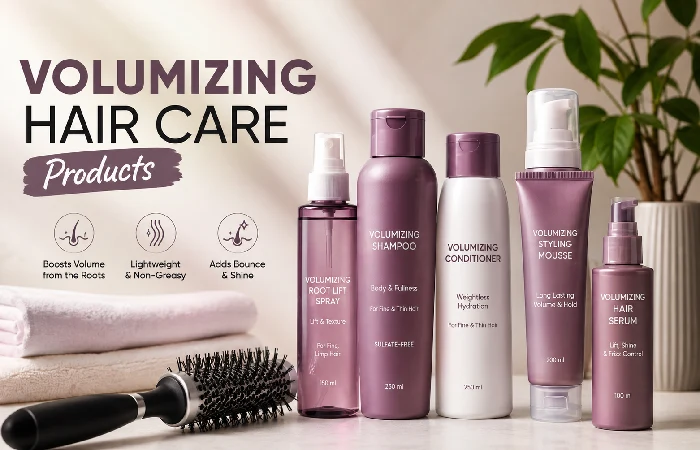
One of the most crucial components to take under consideration is opting for light-weight products for the upkeep of your fine hair. Those volumizing shampoos as well as condition are normally designed to rinse without leaving too much reside, they add fullness to the hair.
Opt for light products rather than heavy ones designed for intensely moisturizing strands unless you are sure your hair needs it due to dryness or damage. Ingredients such as proteins, light conditioning agents along with conditioning polymers might add fullness and smoothness to your individual hair strands.
Hair thickness and texture can vary between individuals, and men with fine or thinning strands may benefit from a tailored approach. Our hair care routine for men offers practical guidance for building simple hair-care habits.
Shampoo
Light-weight volumizing shampoo will assist cleanse your scalp of oils, sweat, & styling product remnants. Use no extra shampoo compared to what’s necessary & always clean the scalp rather than vigorously scrubbing the mid-lengths and ends.
Conditioner
Conditioner is important although thin hair still needs it to decrease strands friction in order to stop strand damage. A few drops is all that’s necessary and should only be applied on mid-lengths and ends.
Leave In Products
For any kind of leave-in products for fine hair select mists or sprays. Leave-in conditioning creams are far too thick for delicate hair-you’ll just give your hair the oily appearance.
Women with fine hair may need to consider styling habits, product weight, and how often they use heat tools. Explore our hair care routine for women for additional hair-care guidance.
| Product | Best approach for thin hair | What to avoid |
| Shampoo | Lightweight, volumizing formula | Excessively heavy formulas |
| Conditioner | Small amount on lengths | Applying heavily at roots |
| Leave-in conditioner | Fine mist or lightweight spray | Thick creams |
| Hair mousse | Lightweight volumizing mousse | Excessive amounts |
| Hair oil | Tiny amount on ends if needed | Saturating the roots |
| Dry shampoo | Occasional use for oil control | Heavy buildup from frequent use |
Read the Product Label
Volume, body, thickening – those labels can be great to know at least what the marketing agency is aiming for, but they’re no promises of specific product performance. Pay attention to how your hair actually feels, because when you feel there’s a coating, goop, greasiness, flatness, cut back on what you used or even apply a different formula.
Thin strands can be more susceptible to breakage, particularly when exposed to excessive heat, chemical treatments, or rough handling. If your hair is also dry or brittle, our hair care routine for damaged hair provides helpful tips for gentler hair care.
Washing Without Weighing Hair Down
What’s the magic number? Washing can add volume Whether your fine hair feels flat or is quickly oil-slicked, the number of times a week you should wash is highly personalized. Your scalp’s oil output; the level of your activity; the climate in your area; how you wear your hair (e.g., ponytails, updos); and any styling products you utilize all contribute to your individual wash number.
Focus on the Scalp
Wash through thoroughly using your scalp as the focus point of the shampoo – not your lengths and tips. Massage your scalp with your finger tips only (scratching with the nail will not have a good effect). Let the suds drift through your hair while rinsing.
Occasiontionally, the length of the hair and the need to tackle an extremely greasy scalp can also call for a double gentle wash of your hair.
Coloring can sometimes leave fine hair feeling dry or fragile, making proper maintenance especially important. If you regularly color your hair, explore our hair care routine for color-treated hair for practical care strategies.
Use Conditioner Strategically
Thin Hair – don’t let a thin hair take no more for you – this isn’t a reason for you to throw away the conditioner. Use a little bit. Remember the oils make my roots greasy at times so I would only leave it mid way or below the ears. What do you do for normal to simple washes?
- Completely wet hair in lukewarm water.
- Apply a little of your shampoo to the roots.
- Massage gently between the fingertips.
- Rinse off.
- Add lightweight conditioner to the lengths of hair and ends.
- Rinse off.
- Squeeze excess water gently.
- Dry without any rubbing.
Because too much use of hot water in addition to the misuse of a rough towel could feel dry and mechanical hurt. We rather give us gentle blotting, instead of rubbing ourselves with a rough towel and then using a microfiber towel.
Scalp Care for Fuller Hair

For those looking to maintain healthier-looking strands while reducing breakage, consistent hair-care habits are important. Our hair care routine for hair growth covers useful practices that can support your overall hair-care goals.
A beautiful head of hair springs from a beautiful and healthy scalp. It may not result in an added number of follicles on your head, but effective head care and maintaining a well-aired scalp will ensure you’re setting yourself up for success when dealing with hair treatment. A Cleanse a Regular Cleanse Removing sweat, oil, build-up, impurities and dead cells from scalp through daily washing is essential particularly with excess usage of dry shampoos and styling product.
Gentle Scalp Massage
Massaging your scalp with shampoo can feel very nice and allows you to spread all of the shampoo onto the scalp, work on the balls of your fingers so you do not pull on your scalp. Before washing, you can just try massaging your head for several minutes. Make sure the touch is light and that you don’t tug on the roots of the hair.
Avoid Excessive Oil Treatments
Although oils can help the ends feel softer, using them directly and in excess on an already easily-oiled scalp may cause hair to look flat. Thin hair does not necessarily mean “the more oil, the better”.
| Scalp habit | Recommended approach |
| Cleansing | Wash according to oil and buildup |
| Massage | Use gentle fingertip movements |
| Exfoliation | Avoid aggressive scrubbing |
| Oils | Use sparingly if appropriate |
| Dry shampoo | Use occasionally and cleanse regularly |
| Scratching | Avoid vigorous scratching |
When are you supposed to see a dermatologist When you notice excessive scratching of the head resulting to skin inflammation and lesions; shedding or unusual hair loss accompanied by red scaly, sores and itch; the professional assessment is in order.
Styling Tips for Volume
Styling methods can fake it and add volume without overloading your hair with product. One of the simpler of these styling techniques is blow drying the roots in an upward motion. Work the light volumizing mousse or spray through your hair, if desired, while applying. Blow dry your hair with a medium setting in the direction of the roots.
Change Your Part
If you stick with one part for days, that section of your hair may begin to lie too flat. Changing up where your part is by just an inch or two to each side is a fast way to boost the look of your hair.
Blow-Dry for Lift
Try lifting the roots with your fingertips or appropriate brush as you are drying. Make sure not to hold overly hot air extremely close to the scalp or linger on a particular area.
Choose a Suitable Haircut
Correctly cut hairstyle can give you some body. Severely long layers are so heavy that they often drag hair down. Depending on the length of your face shape you hair texture and weight a shorter/medium hair style in combination with the proper style and with very careful placement of layers gives the perception of a very movementy hair.
| Styling technique | Benefit |
| Root lifting | Creates visible height |
| Side part | Adds visual volume |
| Lightweight mousse | Provides body without excessive weight |
| Blow-drying roots | Helps create lift |
| Strategic haircut | Improves shape and fullness |
| Texturizing spray | Adds texture when used sparingly |
Keep from backcombing your hair overzealously again. Though backcombing adds volume temporarily, the mechanical stress that comes with it only leads to a tangled, broken hair texture.
Mistakes to Avoid
Thin hair can benefit less from a wealth of products and rough treatment- avoiding the following mistakes can keep the overall look and feel of hair intact.
Too much conditioner
One of the most basic conditioner rules is to not get any on your roots, but it will also weigh down fine hair, flattening strands. Use a minimal amount as a starting and layer more if necessary.
Applying oils to the roots
Oil can easily make fine hair look flat and greasy. If you’re a fan of hair oil, use a tiny amount to the ends for a bit more hydration, but keep them away from the roots.
Too much dry shampoo
while dry shampoo is a savior for oil absorption, don’t rely on it to skip washes- it has the ability to makehairlook coated and dull.
Too much heat styling
This might seem obvious, but too many rounds of high heat on the hair shaft can cause damage to the hair. On a less heat-focused note, avoid pulling your hair back too tightly because, like overdoing it with heat stylers, pulling on the hair is the biggest culprit of split ends, as it breaks up the proteins and lipids that make hair stronger.
Aggressive brushing
It is easy to split hair simply by brushing and especially when you’re doing so with soaking wet hair.
| Mistake | Why it can be a problem | Better approach |
| Too much conditioner | Can flatten fine strands | Use a small amount |
| Heavy root oils | Can make hair look greasy | Keep oil minimal |
| Excessive dry shampoo | Can cause buildup | Use occasionally |
| High heat | Can damage strands | Use moderate heat |
| Rough brushing | May increase breakage | Detangle gently |
| Tight hairstyles | Can stress hair | Choose looser styles |
Building a Simple Thin Hair Routine
Morning Refresh hair with a gentle rinse and no excessive brushing or rubbing. Add a root lifter for a little bounce and apply light heat to shape if desired. Wash Day Wash scalp with a light, clarifying shampoo.
Lightly apply conditioner to the mid-lengths and ends only. Rinse well and gently towel dry squeeze out excess water. Styling Apply a little bit of mouse, root lifter spray or other light styling product. Don’t apply all over the head just on problem areas. Weekly maintenance Keep an eye and hand on your hair, how is it feeling?
When is it feeling flat and dirty, this is when your routine is the most effective.
If hair is dull, flat or you have product buildup- you are probably washing and rinsing the wrong way. The best routine isn’t a schedule but what actually makes your hair look and feel the best!
FAQs
Is thin hair the same as fine hair?
No, Fine describes the size of hair,thin indicates density. It is Possible to havefine hair but a lot of them, or fine hair with thin density.
How often should I wash thin hair?
Wash as frequently as your scalp gets oily or accumulates buildup. Some people with fine hair wash daily, and others wash every few days; figure out what feels best for your scalp without over-drying it.
Can shampoo make thin hair thicker?
Shampoos have no long-term ability to alter inherent hair diameter or numbers. There are volumetric or thickening products that make the hair texture thicker.
Should I use conditioner on thin hair?
Yes Conditioner makes it more slick or smooth and less likely to frizz and tangle! Just use a very lightweight one on all over or in mid lengths if your roots get greasy quickly
Are hair oils good for thin hair?
Hair oils also potentially can assist in make your hair softness and decrease the appearance of dryness on the ends of your hair. Too much can weigh a fine mane and create it seem oily.
How can I make thin hair look fuller naturally?
Ensure hair is clean and products are light, alternate the part, get appropriate haircut and lift the root of hair when blow-drying, don’t build-up product, be delicate and do not tug.
Does scalp massage increase hair growth?
It is relaxing and may help you maintain good scalp habits. There are no guarantees. … This is a mild form of scalp stimulation and while it can be relaxing and may promote healthy scalp habits, it is not a cure all for hair loss and you should still see a dermatologist for severe hair loss.
What is the best haircut for thin hair?
Find the best hairstyle. There’s no single style to work for everybody. A trim will always add movement and can be a lot less dense then heavier styles to give you the illusion of thicker, fuller finer hair. A good stylist will suggest the perfect hairstyle to suit your hair density and face shape.
Final Thoughts
Ultimately, an effective hair care regimen for thin or fine hair hinges on lightweight products, delicate washing, targeted conditioning, healthy scalp practices, and volume-oriented styling techniques. You will not have to accumulate an extensive library of products to see significant benefits; using fewer products, the correct way, is often enough to avoid flatness and product buildup.
Prioritize keeping your scalp clear, fragile hair protected, excessive heat and pulling kept to a minimum and products with consistent textural benefits that are perfect for the specific needs of fine hair. When applied properly on a consistent basis with realistic expectations, thinning or fine hair can look healthier, be easier to style, and be significantly fuller looking.