


Hair Care Routine for Hair Growth: 7 Steps for Healthier Hair
 Khizrana Begum
Beauty & Lifestyle Writer
Khizrana Begum writes clear and reader-friendly content covering beauty, lifestyle and related topics.
Read Full Bio of Author →
Khizrana Begum
Beauty & Lifestyle Writer
Khizrana Begum writes clear and reader-friendly content covering beauty, lifestyle and related topics.
Read Full Bio of Author →
 Sameena Begum
Health, Technology & Digital Content Reviewer
Sameena Begum reviews content for clarity, accuracy and overall reader usefulness.
Read Full Bio of Reviewer →
Sameena Begum
Health, Technology & Digital Content Reviewer
Sameena Begum reviews content for clarity, accuracy and overall reader usefulness.
Read Full Bio of Reviewer →
Healthy Hair Growth – The Real Lowdown. Growing healthy hair has very little to do with finding a “magic” oil, serum, or shampoo. Hair actually grows from the inside out, depending on the state of your scalp, genetics, hormones, your overall diet, and what you do to your hair daily. Therefore, if you’re looking for a regimen that aids hair growth, it has just one aim: make your follicles’ environment as healthy as it possibly can be and minimize damage.
You won’t be changing your inherent hair-growth cycle drastically, but you can take care to preserve what hair you have and also minimize any potential loss.
How Hair Grows. There will also be a discussion on how to take care of your scalp, products that actually work, how to oil your hair correctly, helpful nutrients for hair growth, and also what to actually avoid (that we all do). Note: If you’re noticing extreme hair loss that comes all of a sudden and in patches, you must see a professional like a dermatologist.
❝
This article is a part of
Hair Care Routine Guide
How Hair Growth Works

It is useful to understand exactly what is going on under the hair before trying to find ways of building a regimen: Each hair grows out of a follicle found underneath the skin on the scalp; a follicle creates the part you see as hair. Hair doesn’t grow at the same pace the entire time, but rather the follicles go through different hair-growth cycles.
| Hair-growth phase | What happens |
| Anagen | The active growth phase |
| Catagen | A short transition phase |
| Telogen | A resting phase |
| Shedding | The old hair eventually falls out. |
The anagen phase is the period when cells inside the follicle actively produce hair. The length of this phase varies from person to person, which is one reason some people can grow very long hair while others struggle to reach the same length.
This also answers a key distinction between hair growth and hair retention.
Hair growth involves actually producing hair from the follicle. Hair retention simply means that you can retain the shaft long enough to perceive this growth as additional length.
For example, if your hair grows normally but the ends repeatedly split and break, you may feel that your hair “isn’t growing.” The problem may actually be breakage rather than the follicle itself.
Building healthier-looking hair starts with consistent daily care, from cleansing and conditioning to gentle handling and scalp care. For a complete overview of these fundamentals, explore our complete hair care routine guide.
Heredity, hormonal changes, diseases, poor diet, stress, medicines, and diseases of the scalp may also affect hair loss and shedding.
A Simple Daily Hair Care Routine for Hair Growth
You do not require any of those elaborate 10-step skincare regimens if you do not. Adherence is more crucial than a complex program.
Morning
- Gently comb or style your hair.
- Avoid hairstyles that pull strongly on the roots.
- Protect your hair from unnecessary heat.
- If your scalp is exposed to strong sunlight, consider appropriate scalp protection.
Wash days
- Shampoo mainly the scalp rather than aggressively scrubbing the lengths.
- Rinse thoroughly.
- Apply conditioner to the lengths and ends.
- Detangle gently.
- Pat or wrap the hair instead of rubbing it vigorously with a towel.
According to dermatologists, it is important to choose products based on hair type and whether the scalp is oily and dirty. Shampoo is basically for cleaning the scalp; conditioner has been designed to moisturize and untangle the hair.
Night
- Avoid sleeping with extremely wet hair.
- Loosen tight hairstyles.
- If your hair tangles easily, gently detangle it before sleeping.
- Avoid repeatedly twisting or pulling individual strands.
The most beneficial routine is one you’ll do on a regular basis. A basic, consistent routine is almost always better than a fancy routine you keep up for two weeks only.
Scalp Care for Faster Growth
Scalp is the base for all hair to grow. That is not to say that a rough scrubbing of your scalp along with constant oil treatment will cause your hair to grow faster. That just means that your scalp must be well cared for.
What is scalp care?
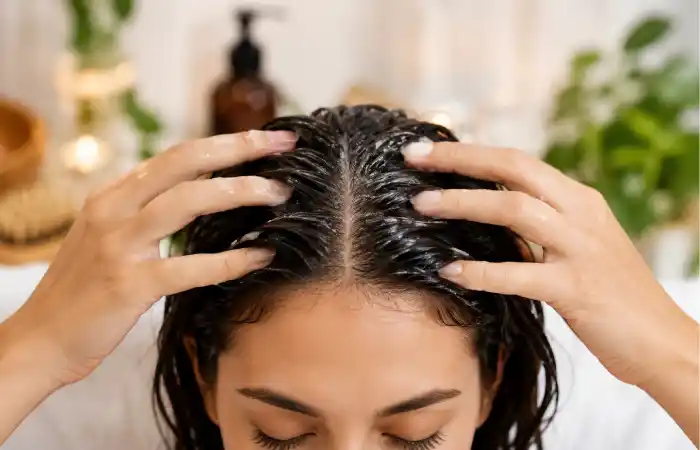
Scalp care basically consists of caring for the skin of the scalp to keep it healthy, comfortable, and not to provoke or irritate excessively, as well as choosing products that match your scalp. The first thing to determine whether you have an oily, dry, sensitive, flaky, or, fortunately, rather balanced scalp. If your scalp tends to get oily fast enough, it’s going to be messy if you let the product and oils from the scalp accumulate for too long by avoiding shampooing for an extended amount of time.
Men may have different grooming habits and hair-care concerns that can influence how they maintain their hair. For practical guidance tailored to men’s needs, explore our hair care routine for men.
Otherwise, scrubbing with dry or overworked, dry, and sensitive hair can also be painful & itchy to the scalp & hair.
According to the American Academy of Dermatology, shampoo should ideally be applied to the scalp, not the hair.
Gentle scalp massage
If there’s one thing that will make shampooing and oiling your scalp even more enjoyable, it’s getting a massage at the same time. Don’t scratch the scalp with your fingernails; rather, use the pads of your fingers during the massage.
Women may also need to adapt their hair-care routine based on styling habits, hair texture, and individual concerns. Our hair care routine for women provides additional guidance for maintaining healthy-looking hair.
Try:
- You then rest your fingers lightly on your scalp.
- With these fingers, you make small, circular movements.
- You can traverse your entire scalp, all the while making sure that the hairs on the
- scalp are not pulled over one another.
If you feel any burning, irritation, or pain, stop the practice.
A massage should feel comfortable—not like a workout for your scalp.
If you continue to suffer from itching, painful lesions, excessive scaling and redness, or hair loss of undetermined origin, have your scalp examined before attempting stronger and stronger home treatments.
Best Products for Hair Growth
There isn’t one ‘perfect’ product for hair growth. Which is most suited to you, if your main concerns are breakage, dryness, dandruff, thinning, or something else, is a decision you need to make considering these needs.
Excessive heat, chemical treatments, and rough handling can contribute to dryness and breakage, which may make it harder to maintain length. If your hair is already showing signs of stress, explore our hair care routine for damaged hair for gentler care strategies.
Most hair-growth routines consist of these basic types of products:
| Product type | Main purpose | How to use |
| Gentle shampoo | Cleans scalp and removes buildup | Apply mainly to scalp |
| Conditioner | Reduces dryness and tangling | Apply mainly to lengths |
| Leave-in conditioner | Helps manage dryness and breakage | Use on lengths as needed |
| Hair oil | Adds lubrication and softness | Use according to hair type |
| Heat protectant | Helps reduce heat-related damage | Apply before heat styling |
| Medicated treatment | Addresses specific scalp/hair conditions | Use according to medical advice |
Be Wary of “Hair Growth” Claims. Many people make the mistake of buying a product because it says “hair growth” on the label. A cosmetic product can make your hair feel softer, decrease breakage, or simply give hair shine while not actually stimulating any more follicles to grow more hair. If your hair loss is caused by an actual condition, that should be identified. A dermatologist will work to see if you are dealing with hormonal issues, heredity, illness, or a deficit from your diet.
Color-treated hair can require additional attention because repeated chemical processing may affect its condition and moisture. If you regularly color your hair, our hair care routine for color-treated hair offers useful tips for maintaining colored hair.
Hair Oiling Techniques
Hair Oiling: Benefits and Downsides. Traditionally an age-old custom widely used in the sub-continent of South Asia. Hair oiling can be a helpful approach to hair care, especially in improving your hair’s softness, smoothness, and reducing roughness that often develops due to hair drying. That said, you shouldn’t rely on hair oil as the ultimate remedy.
How to oil your hair properly
Choose a small amount of oil rather than soaking your hair.
- Separate your hair into different sections to get to all your strands.
- Take a drop and rub it on your scalp or length depending on your concern.
- Massage it with your fingertips.
- Run the rest of the oil along the length.
- Leave as much as you are comfortable with.
- Wash your hair using your normal shampoo.
Avoid aggressive massage. Pulling or rubbing the hair unnecessarily can increase breakage.
Which oils can you consider?
Some of the top oil products used as the basis for hair conditioning are coconut oil, argan oil, jojoba oil, and almond oil. However, generally the best cosmetic oil is one your own hair handles best. If you have an oily and/or breakout-prone scalp, you might be uncomfortable with applying the oil generously.
If you’re looking for easier manageability over an oily scalp with dryness or very dry hair, a light hand will come in handy.
If your hair is naturally fine or thin, reducing breakage and choosing lightweight products can be especially important when trying to maintain length. Explore our hair care routine for thin hair for practical tips tailored to finer strands.
As far as going over the top with hot oil treatments, take caution. Heat damage from extremely hot oil is warned against by AAD members who use such a procedure to treat hair loss for fear it may lead to more broken hair.
Nutrition That Supports Hair Growth
Hair doesn’t grow independently of the rest of your body. Your hair follicles are also dependent upon nutrition and calories in order to do the work.
And so, a balanced and healthy diet, one of the most underestimated tools for amazing hair growth.
Important nutrients
| Nutrient | Food sources |
| Protein | Eggs, fish, chicken, dairy, beans, lentils, soy |
| Iron | Lentils, beans, meat, leafy greens, fortified foods |
| Zinc | Meat, seafood, dairy, beans, nuts |
| Healthy fats | Nuts, seeds, fatty fish, avocado |
| Vitamin-rich foods | Fruits, vegetables, eggs, dairy, whole grains |
Specifics to note -protein. Much of your hair is made of a protein, Keratin. Some of the effects of severe calorie restrictions and some diets can lead to hair loss due to a severe calorie or protein restriction. Iron deficiency and some other deficiencies have also been linked to hair loss.
What about hair-growth supplements?
And this is where marketing can become tricky: Biotin supplements often boast that they work wonders on hair, skin, and nails; however, the NIH indicates there is little evidence for additional biotin actually helping hair in individuals who have not had deficiencies. The more isn’t always the better: In high doses, some nutrients can be toxic, and some supplements will also interfere with lab tests. Better to discover you have a real deficiency (with the guidance of your health practitioner) before downing supplements in hopes of rapid hair regrowth.
Habits That Slow Hair Growth
Sometimes the most effective change is removing habits that damage the hair.
1. Excessive heat
Flat irons, curling irons, or hot blowouts can lead to breaking of the hair. When you use hot instruments, lower the heat as much as possible, and don’t go over the same part of your hair twice.
2. Tight hairstyles
Always wearing them super tightly (and braids/buns/extensions) creates tension around the hair follicles over the years that can lead to traction alopecia. (That’s when the force on your hair causes hair loss)
3. Rough towel drying
Your wet hair is delicate! If you rub your hair excessively with a towel to get water out, you would get more damage mechanically. Just blot excess water out of your hair with a towel or with a soft T-shirt/cloth.
4. Excessive brushing
You don’t need to drag through the comb a thousand times throughout the day. In fact, excessive brushing is not good for your hair it can damage your mane and cause split ends.
5. Frequent chemical processing
Excessive dyeing, perms, relaxing treatments, or chemical straightening can have a severely damaging effect on the shaft of the hair. Those who are used to having their hair chemically altered should be aware of reducing damage as much as possible by spacing chemical treatments far apart and using a professional for all services.
6. Crash dieting
If your calories are extremely restrictive, it can actually harm the body’s capability to assist consistent hair regrowth. So any type of hair care regimen needs to continue past your cabinet as well. Sleep, food, decreased stress levels, and your health have a great deal to do with it too.
How Long Does It Take to See Hair Growth?
Hair grows slowly, so you have to be patient. Softness, manageability, or less breakage may show up relatively soon in your life when you change your habits. Actual differences in thickness or length will take longer.
Look in your hair from time to time and take a picture of it every other week or so (under similar lighting, so you can compare!)
Instead of every time you style it. If hair loss happens from something temporary, such as a spell of illness or a large crisis in your life, recovery may take a while as well. “Some hair loss linked with stress will naturally regrow once the stressors cease,” according to AAD.
A Practical Weekly Hair Growth Schedule
| Day | Routine |
| Monday | Gentle wash + conditioner |
| Tuesday | Gentle styling; minimize heat |
| Wednesday | Scalp check + light massage |
| Thursday | Wash if scalp needs it. |
| Friday | Conditioning or leave-in care |
| Saturday | Optional light oiling |
| Sunday | Rest from tight styling and heat. |
Once again, it is only a suggestion. Your washing schedule depends much more on the state of your scalp and the quality of your hair as opposed to the clock! A girl with an excessively oily scalp would need to wash her hair infinitely more often than someone with dry, curly, or Textured hair.
FAQs
1. What is the best hair care routine for hair growth?
An effective routine will combine regularly washing and conditioning the scalp, untangling delicately, feeding hair well, not overdoing heat, avoiding tight hairstyles, preserve hair ends. Major hair fall causes are to be found and addressed, rather than applying more and more cosmetics.
2. Does oil make hair grow faster?
Hair oil provides the hair with lubrication, making it softer and perhaps easier to manage. It is not an instant or sure way to increase follicle growth.
3. How often should I wash my hair?
No frequency fits everybody. Shampoo when hair gets oily/dirty – Wash your hair as often as you need, depending on the type you have, but dermatologists say it can be adjusted as you go.
4. Is scalp massage good for hair growth?
Scalp massage can be an enjoyable and relaxing component of a hair care routine. However, there is no replacement for medical treatment for hair loss. Avoid vigorously scrubbing or pulling at your scalp.
Final Thoughts
What A Really Good Hair-Care Programme Will Do To Help Give You More Hair In The Long-Term: Our best tip to take from this guide to good hair care and more hair growth: it’s not about immediate gratification; it’s about creating a salon for healthy, growth-friendly hair by keeping the hair you already have in great shape. Clean your scalp gently; deep condition; treat your wet hair gently; minimize the damaging effects of heat & chemicals; get pressure and stress out of your hair and scalp for now. The benefits will then take effect. Feed yourself well for great hair.