


Hair Care Routine for Damaged Hair: A Complete Guide to Repair, Strengthen, and Protect Your Hair
 Khizrana Begum
Beauty & Lifestyle Writer
Khizrana Begum writes clear and reader-friendly content covering beauty, lifestyle and related topics.
Read Full Bio of Author →
Khizrana Begum
Beauty & Lifestyle Writer
Khizrana Begum writes clear and reader-friendly content covering beauty, lifestyle and related topics.
Read Full Bio of Author →
 Sameena Begum
Health, Technology & Digital Content Reviewer
Sameena Begum reviews content for clarity, accuracy and overall reader usefulness.
Read Full Bio of Reviewer →
Sameena Begum
Health, Technology & Digital Content Reviewer
Sameena Begum reviews content for clarity, accuracy and overall reader usefulness.
Read Full Bio of Reviewer →
Damaged Hair: Getting damaged hair is the worst! What looked okay one month, then suddenly 3 months after chemical treatment, frequent heat styling, blow-drying, and rough brushing, becomes dry, tangled, and brittle, making your hair an everyday management challenge. On a positive note, however, with a little time, commitment, and a good Damaged Hair Repair Plan, you can repair damage and love the hair that’s left.
Split or truly broken hair will never magically re-unite, but you can save the rest of your length and see and feel results; hair will look and feel healthier and be more manageable and much less susceptible to future damage.
Doctors have put reducing heat treatment, handling wet hair carefully, deep conditioning, and avoiding chemicals in place as top concerns.
However, the key is not to smother your hair with a multitude of products; severely damaged hair will typically have the best results with a simple system of gentle cleaning, conditioning, slow combing, strengthening once or twice a week, and regular trims.
❝
This article is a part of
Hair Care Routine Guide
What Causes Hair Damage?
Damaged Hair Cuticles- Damage to the hair fibre or strand that occurs because you utilize chemical treatments, heat, and any such activity. Harsh Brushing, rubbing hair, as well as the sun or the Chlorine utilized, will result in hair damaging which the cuticle will certainly get worn out.
Common causes include:
- Frequent straightening or curling
- Repeated bleaching or coloring
- Chemical relaxing or perming
- Excessive blow-drying
- Rough towel drying
- Brushing or detangling too aggressively
- Very tight ponytails, buns, or braids
- Excessive exposure to sunlight
- Chlorinated swimming pools
- Washing with overly harsh products
Bleaching and other chemical treatments can particularly dry and damage hair because these processes strip and weaken protein structures in your hair. Sun exposure can also make your hair dry, rough, brittle, and increase the amount of split ends you have.
A Simple Hair Care Routine for Damaged Hair
A repair-focused routine should be gentle enough to follow consistently.
| Routine Step | What to Do | Main Purpose |
| Cleansing | Use a gentle shampoo mainly on the scalp | Removes dirt and buildup |
| Conditioning | Condition length and ends after wash | Adds slip for softness, reducing abrasion |
| Detangling | Use a wide-toothed comb; work through and through | It will also reduce breakage. |
| Leave-in care | Apply a leave-in conditioner or suitable serum | Helps manage frizz and tangles |
| Drying | Blot or wrap instead of rubbing | Reduces mechanical damage |
| Treatment | Alternate moisturizing and strengthening treatments | Supports softness and resilience |
| Styling | Choose loose, low-manipulation styles | Prevents unnecessary stress |
| Trimming | Remove visibly split ends | Stops damaged ends from remaining on the hair |
You can’t avoid a complicated fifteen-step regimen. More important than products on the bathroom shelf is to stick to something simple.
Signs of Hair Damage

Healthy hair starts with a consistent routine that matches your hair type and needs. For a broader overview of cleansing, conditioning, and daily maintenance, explore our complete hair care routine guide.
Once you learn exactly what damaged hair is like to touch as well as look like, your readiness to make some adjustments to your beauty habits should grow.
1. Dry, Rough Texture
Generally, healthy hair will feel very soft. If the hair is damaged, it might feel dry and coarse (straw-like), and the very ends of the hair would likely feel like this.
2. Excessive Frizz
Frizz is a versatile affliction; damaged cuticles may present as a rougher outer surface.
3. Split Ends
Split ends are defined as when the tip of a hair breaks. A conditioner or a serum can help an already split end of hair look a little better, but there is no way to actually fix split ends of hair.
4. Frequent Breakage
Seeing short hairs on your clothes, pillow, sink, or brush – your broken hairs – indicates too much splitting.
5. Loss of Shine
Once treated with chemicals/heat many times, your hair can become a bit lacklustre; this is due to the smoothness of the outer layer of your hair being compromised.
6. Excessive Tangling
Unusually tetchy hair often benefits from further treatment and a softer touch.
According to the American Academy of Dermatology, brittle and frazzled hair-a side effect of damage-is susceptible to breakage, which can result in frizz and a dull look.
Repairing Chemically Treated Hair
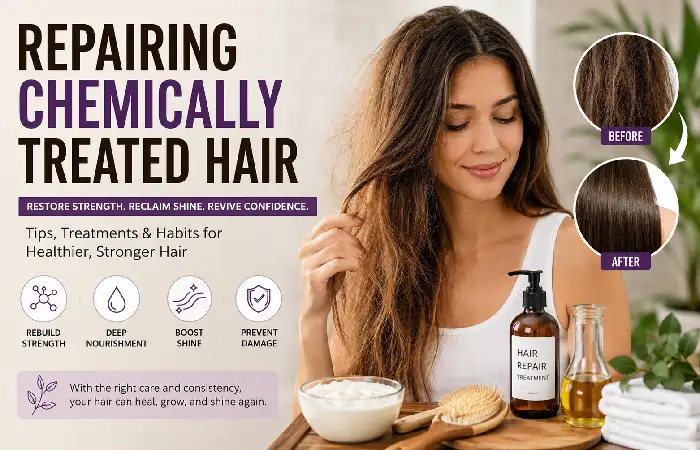
Men who experience dryness, breakage, or other hair concerns can benefit from adjusting their everyday grooming habits. Our hair care routine for men provides practical guidance for building a simple and consistent routine.
Patience, not aggressive “repair,” is what chemically compromised hair must have. You wouldn’t want to over-process something just repaired! “If you’ve permed, relaxed, bleached, or colored your hair several times, consider refraining from additional chemical services. Spacing the treatment with extra weeks in between can significantly diminish the added damage,” says AAD Dermatology.
Start With Gentle Washing
Rub the shampoo into your scalp and not into the entirety of the strands of hair, as the running water during the rinse will distribute the shampoo.
Always shampoo, then condition. Conditioner reduces the friction between strands of hair, making them easier to comb. If hair is particularly dry or tangles very easily, use a leave-in conditioner.
Avoid Immediate Reprocessing
If your hair’s been previously treated with a chemical relaxing agent or has recently been bleached or color-processed, double consider applying yet another chemical process, even if the color is not the ideal shade or texture of your hair, or your style doesn’t feel natural. Well-treated, healthy-looking hair cannot be compared to an over-styled, superficial look.
Protect the Ends
The tips of your hair have the oldest growth and therefore tend to suffer the worst. Concentrate conditioner, masks, or a light leave-in treatment for the areas that feel the most damaged.
Protein vs Moisture Treatments
- Protein and moisture treatments are one of the most confusing parts about damaged hair care.
- Moisture treatment refers to conditioning products designed to improve softness, flexibility, and manageability.
- Protein treatment is hair products containing ingredients that are designed to temporarily strengthen or condition compromised hair fibers.
- Neither should automatically replace the other.
| If Your Hair Feels… | Consider Prioritizing |
| Dry and rough | Moisturizing conditioner/mask |
| Frizzy and difficult to manage | Moisture + leave-in conditioning |
| Weak and prone to snapping | Occasional strengthening treatment |
| Chemically processed | Balanced moisture and strengthening care |
| Soft but limp after heavy conditioning | Reduce heavy products and reassess |
| Very brittle | Gentle care and professional assessment if severe |
Often, a healthy diet is still the very best strategy. If your hair tends to get dry, a good conditioner or cutting some heat damage is where to begin. Otherwise, try adding a strengthening masque that’s designed for your type of hair.
Don’t believe that more of a treatment product is better or that it will lead to results faster. Products that are too rich or thick will result in heavy, dull hair that will not behave.
Heat-Free Styling Options
Reducing the heat exposure is one of the easiest modifications to implement if your hair is already damaged. The AAD suggests air-drying hair whenever feasible and using the low setting when blow-drying is necessary. Additionally, decrease the use of hot tools.
Hair can become damaged from heat styling, coloring, chemical treatments, or environmental exposure, and women may have additional styling-related concerns. Explore our hair care routine for women for more guidance on maintaining healthier-looking hair.
Try these heat-free alternatives:
- Loose braids for soft waves
- Overnight twists
- Low, loose ponytails
- Claw-clip styles
- Loose buns
- Air-dried natural texture
- Foam or fabric rollers
- Headband waves
Steer clear of hairdos that cause tension along the roots. Constant pressure, whether it’s from the tension you create with ponytails, extensions, braids, and the like, is an ever-growing cause of hair breakage and hair loss.
If a heated tool is necessary, use one that has a heat-protection setting (and use a medium temp if possible) and try to go over the same section of hair only once.
Trimming Split Ends
Trimming will probably have its place in a regimen focused on dealing with damaged hair. You don’t actually want to use merchandise that claims it may completely glue split finish collectively – the reality? Although some conditioners and serums help make damaged split ends “disappear” cosmetically by smoothing them, reducing up cut off the split segment is the only real option to eliminate the problem.
And, importantly, you don’t need to drastically modify your mane!
A “trim” may do the job by taking off obvious damage even though it still permits you to keep length. If you can trim your ends and still have them splitting soon after, you likely need to look beyond shears. Keep excessive styling, harsh treatment, chemical processing, tugging, rubbing, and lack of nourishment in mind.
Long-Term Hair Repair Tips
Hair repair is really about damage management. Because the visible hair shaft is not living tissue, damaged portions cannot return completely to their original condition. Your goal is to protect new growth and prevent existing damage from becoming worse.
If your damaged hair has also been affected by frequent coloring, it is important to consider both its condition and color maintenance. Our hair care routine for color-treated hair offers practical tips for caring for colored hair.
1. Reduce Heat
Make air-drying your default whenever practical. Save straighteners and curling irons for occasions when you genuinely want the style.
- Condition Regularly
Use conditioner after shampooing. If your hair is very dry, add a deeper conditioning treatment according to how your hair responds.
- Detangle Carefully
Never yank through knots. Apply conditioner or detangler and work gradually from the ends upward.
- Be Gentle With Wet Hair
Hair when wet is more prone to breaking and to stretching out. You can ease up the friction by avoiding rubbing a towel on your hair and wrapping it loosely in a towel or just leave it to drip dry!
- Protect Hair From the Sun
They dry and damages your hair, alters the strength of the follicle, fades your colour, and creates brittle locks. A hat and a barrier, or a hat and a barrier on a hat, is a very simple solution, in case you will be in the sun for long hours.
- Be Careful With Swimming
Swimming in chlorinated pool water can be very drying to your hair and damaging to it, too. Washing and rinsing out the water right after swimming and then conditioning your hair is also a good tip.
Sample Weekly Routine for Damaged Hair
| Day | Routine |
| Monday | Gentle shampoo + conditioner + leave-in |
| Tuesday | Heat-free styling + gentle detangling |
| Wednesday | Rest day; avoid unnecessary manipulation |
| Thursday | Shampoo + conditioner |
| Friday | Loose, low-tension hairstyle |
| Saturday | Deep conditioning treatment if needed |
| Sunday | Minimal styling and careful detangling |
This routine can be modified depending on your particular scalp type, hair type, lifestyle, and the specific needs of your hair – after all, there isn’t always one definitive answer that applies to everybody’s situation.
FAQs
Can damaged hair become healthy again?
Damaged segments of the hair shaft can not be returned to their normal state fully. But damaged hair may look healthier, be less broken, feel a less harsh texture and a stylist’s haircut may remove split ends and halt the process of future damage.
How often should I use a hair mask?
Everyone can find the correct frequency. One will be able to begin with once a week and adapt according to his hair’s feel. If his hair becomes heavier or “oily,” reduce the amount of product and frequency.
Is oil good for damaged hair?
Some oils can improve softness, shine, and the appearance of dry or split ends. However, oil does not permanently repair a split end. It should be viewed as a conditioning or cosmetic step rather than a cure.
Should I stop using heat completely?
You do not necessarily have to eliminate heat forever, but reducing it is especially sensible when your hair is already fragile. When heat styling is necessary, use appropriate protection and the lowest practical temperature.
Is protein treatment better than a moisturizing treatment?
Neither is universally better. Damaged hair can benefit from both conditioning and appropriate strengthening care. Start with what your hair actually needs rather than following a rigid schedule.
Final Thoughts
The right hair care routine to prevent damage to damaged hair is not finding one miracle product. Rather, it is altering your entire hair care routine for damaged hair. In other words, change your habits that made the hair damaged in the first place.
Fine or thin hair can be particularly vulnerable to breakage when exposed to excessive heat or harsh styling. If you have finer strands, explore our hair care routine for thin hair for tips on keeping your routine lightweight and gentle.
You’ll want to shampoo gently, condition frequently, handle your wet hair delicately, ease up on the hot styles and chemicals, provide your strands with protection from sun and swimming chlorine, and ensure the dead-ends meet their match with a trip to the stylist for a trim. And when all is said and done, your hair just really requires time and recovery
Once you begin addressing dryness and breakage, maintaining consistent hair-care habits can help you work toward healthier-looking, stronger hair. Explore our hair care routine for hair growth for additional care strategies.