

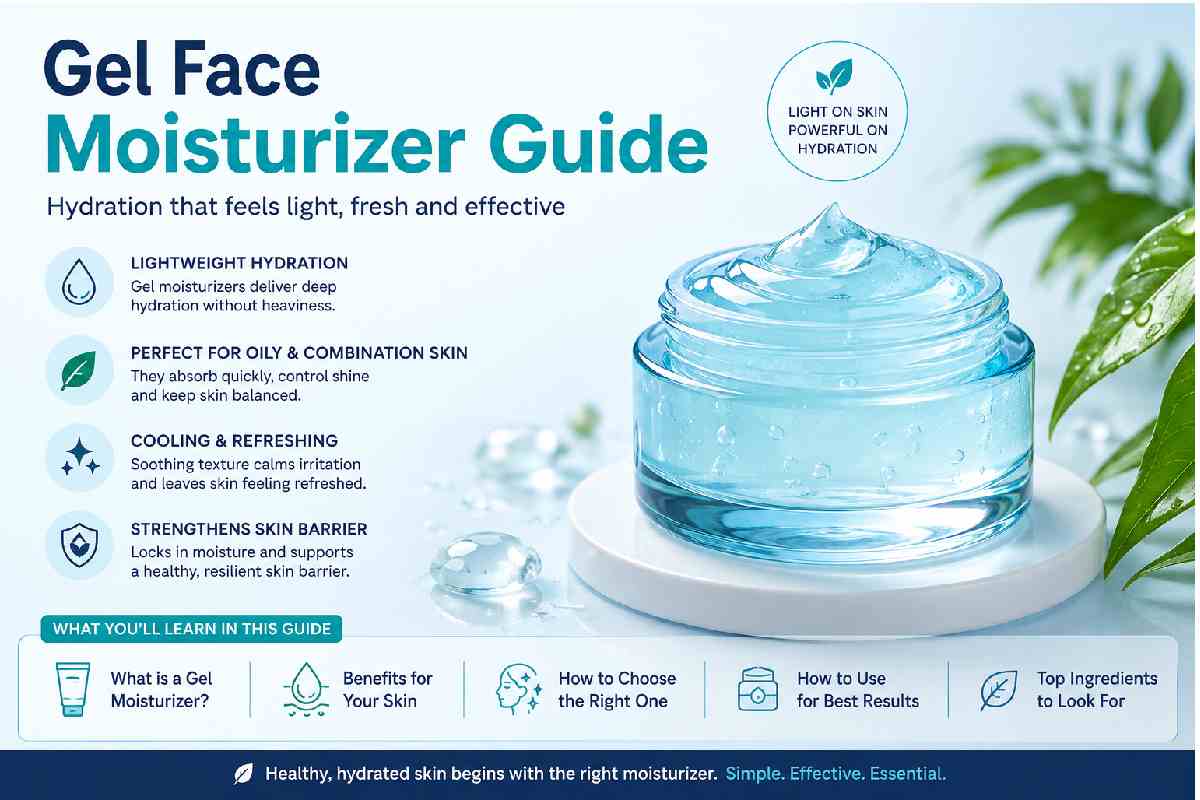
Gel Face Moisturizer Guide: A Complete Guide to Lightweight, Everyday Hydration
 Khizrana Begum
Beauty & Lifestyle Writer
Khizrana Begum writes clear and reader-friendly content covering beauty, lifestyle and related topics.
Read Full Bio of Author →
Khizrana Begum
Beauty & Lifestyle Writer
Khizrana Begum writes clear and reader-friendly content covering beauty, lifestyle and related topics.
Read Full Bio of Author →
 Sameena Begum
Health, Technology & Digital Content Reviewer
Sameena Begum reviews content for clarity, accuracy and overall reader usefulness.
Read Full Bio of Reviewer →
Sameena Begum
Health, Technology & Digital Content Reviewer
Sameena Begum reviews content for clarity, accuracy and overall reader usefulness.
Read Full Bio of Reviewer →
Gel Face Moisturizer Guide: An effective moisturizer doesn’t just leave your skin smooth for the time being. It helps prevent damage to your skin barrier, supports water retention, and maintains a pleasant complexion throughout the day. There are many moisturizer textures on the market; gel face moisturizers, particularly, have become very famous for their water replenishment without the heaviness or greasiness that creams may possess.
Light in texture, they’re great during hot, humid days or if you prefer not to go a thick night cream route. But don’t blindly swipe up any formula with the word “gel” printed on it; the ingredients, skin type, and climate come into play when you need to pick the best gel moisturizer.
❝
This article is a part of
Moisturizing Guide
What is a Gel Moisturizer?
A gel moisturizer is a light face lotion that tends to contain the majority of water and possesses a texture that tends to slide on the skin. Most gels tend to feel relatively cooling as a result of being considerably less thick or occlusive in nature.
Hydrating the skin, the intention is to assist moisture retention or limit moisture loss; however in the situation of moisturisers are normally acquired through making the utilization of of 3 kinds of substances: humectants, emollients, as well as occlusives.
- Humectants: draw and retain water in the superficial skin layers.
- Emollients: smooth and soften the skin surface.
- Occlusives: form an impervious film and prevent the loss of water.
As far as ingredients go, gel formulas usually highlight ultra-hydrating humectants like hyaluronic acid, panthenol, and glycerin – but they do vary by product.
| Texture | General feel | Often preferred by |
| Gel | Light, fresh, quick-absorbing | Oily or combination skin |
| Lotion | Lightweight to moderate | Normal or combination skin |
| Cream | Rich and nourishing | Normal to dry skin |
| Ointment | Very rich and protective | Very dry skin |
Most significantly, gel does not automatically equal more hydrating/better. A thick cream can be indicated in a severely dry or broken barrier state.
Who Should Use It?
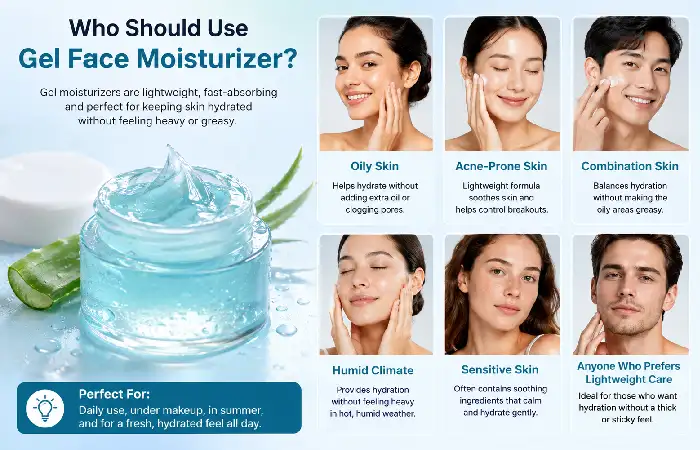
Gel cream moisturizers can provide lightweight hydration while offering a comfortable texture for everyday skincare. For a broader look at choosing the right formula, explore our complete face moisturizer guide.
Gel moisturizers may work very nicely with oily and combination as well as normal skin. If you happen to be somewhere that is very hot or humid, a lighter finish might be good for you to have too. Oily skin will see that you are able to provide your skin with the hydration it needs without the thick feel other, more oily products can entail.
Combination skin benefits as there will be enough hydration to benefit dry spots on your skin without making the oily areas on your face overly saturated with product.
Dry skin can benefit from gels too, so do not write them off automatically if they do use several different moisturizers depending on your skin, though if your skin feels dried out or flaky soon after application, it’s likely that you already need to use a cream for another more occlusive treatment.
Dry skin may need more nourishing hydration, especially when lightweight formulas do not provide enough moisture. Explore our best face moisturizers for dry skin for practical guidance.
The AAD states that there is no type of moisturizer to which everyone’s skin responds best, and a variety of different moisturizers might be of benefit.
A simple guide
| Skin type | Gel moisturizer suitability | What to look for |
| Oily | Excellent | Lightweight, non-greasy formula |
| Combination | Excellent | Hydration without heavy oils |
| Normal | Very good | Balanced humectants and emollients |
| Dry | Good, depending on formula | Glycerin, HA, ceramides; consider layering |
| Sensitive | Can be good | Fragrance-free, gentle ingredients |
Key Benefits
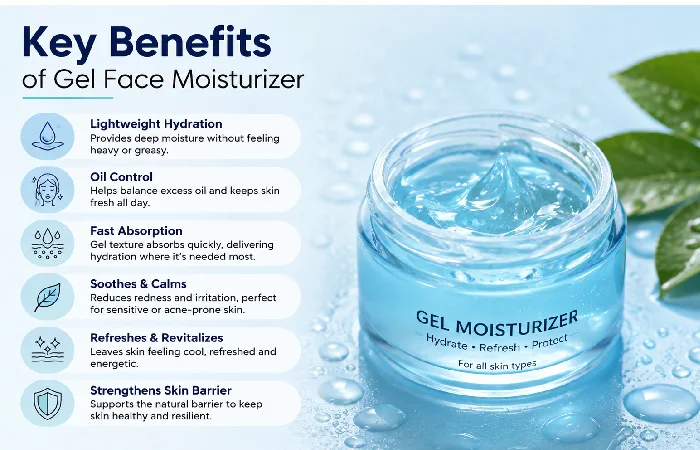
1. Lightweight hydration
The main appeal of these types of facial moisturizers is a lighter texture. They still give a hydration boost but with less of that “heavy and buttery” feel.
2. Helps support the skin barrier
Your skin barrier is the protective outermost layer. It maintains the balance of water inside the skin and stops irritants from the outside world from entering it. Moisturisers can help keep this healthy.
3. Comfortable under sunscreen and makeup
Most gel formulas are spread easily and absorb into the skin relatively fast, making them easy to layer under your morning skincare and makeup routine.
Oily skin often benefits from lightweight moisturizing formulas that hydrate without feeling overly heavy. Explore our face moisturizers for oily skin for helpful tips.
4. Refreshing texture
If you are cream-phobic, try a moisturizing gel. It is so smooth and cooling that it does not feel like one more tedious task, but one of easy indulgence.
5. Useful for dehydrated skin
Dehydrated skin is a lack of water and not necessarily oil; even oily skin can be dehydrated! Gel formulas rich in humectants will attract water to the skin’s outer layers.
Best Hydrating Ingredients
When choosing a gel moisturizer, don’t focus only on its texture. Turn the container around and look at the ingredient list.
| Ingredient | What it does | Why it can be useful |
| Glycerin | Humectant | Attracts and holds water |
| Hyaluronic acid | Humectant | Helps hydrate the outer skin layers |
| Panthenol | Humectant/conditioning ingredient | Supports comfortable, hydrated skin |
| Urea | Humectant | Helps increase water content |
| Sodium PCA | Humectant | Supports skin hydration |
| Ceramides | Barrier-supporting lipid | Helps support the skin’s protective barrier |
Humectants: Glycerin may be the most well-known ingredient to help hydrate skin. Urea, sodium PCA, and hyaluronic acid are a few other hydrating humectants you may have seen used in skincare.
What you see in many of these formulas combines both ingredient types that both attract and retain water in a single formulation. In most cases, utilizing only humectants isn’t quite enough, especially if you are in a particularly arid climate.
Daily Application Tips
Getting the most from a gel moisturizer is largely about when and how you apply it.
Step 1: Cleanse gently
The first step to your cleansing should involve a cleanser that is made for the type of skin that you have. Be sure you do not wash with very hot water if you can get away with it, since hot water very simply and can strip your skin of everything it has to keep you healthy.
A daytime gel cream can also be paired with sun protection as part of a simple skincare routine. Explore our face moisturizers with SPF for practical advice on daily hydration and sun protection.
Step 2: Leave skin slightly damp
Rather than rubbing or drying aggressively, just pat the skin on the face. By applying moisturizer while your face is still damp, you help “lock it in.” Dermatologists have recommended moisturizing just after cleansing to trap that water.
Step 3: Apply a thin, even layer
Normally, you don’t need a deep layer. Lightly spread the gel onto your skin and over your neck, with concentration on any parts of skin which feel tense or dry.
Step 4: Follow with sunscreen in the morning
There is an exception: sunscreen can replace a moisturizer if there are effective sunscreens and SPF levels, as a final one. In conclusion, apply on the face sunscreens with a broad-spectrum as the last step of your day care routine.
Step 5: Adjust according to the season
The requirements of your skin can vary from day to day; what might be sufficient as a light gel on a warm day could turn out to be too light on cooler, drier days, and an added barrier layer will be needed.
FAQs
Is gel moisturizer good for oily skin?
Yes. Gel moisturizers are often a comfortable choice for oily skin because their lightweight texture can provide hydration without the heavy feel of many rich creams.
Can dry skin use a gel moisturizer?
Yes, it depends on the formula. Keep an eye out for hydrating ingredients, such as glycerol, hyaluronic acid, and panthenol. If your skin is still feeling tight or has flakes, perhaps switch to a richer moisturizer or use cream over a gel.
Can I use gel moisturizer every day?
Absolutely. A moisturizer can be part of both a morning and evening routine, provided the formula suits your skin and does not cause irritation.
Should I apply moisturizer before or after serum?
Generally, moisturizer is applied after lighter, watery products such as many serums. The exact order can vary depending on the products you’re using.
Nighttime skincare may call for a moisturizer that focuses on maintaining hydration and supporting a comfortable evening routine. Explore our nighttime face moisturizer guide for useful routine ideas.
Does gel moisturizer cause acne?
Not necessarily. The gel base alone doesn’t make any product likely to break you out. It totally depends on the whole product formulation and you personally. If you do tend to get pimples, make sure products are non-comedogenic and patch-test any product for a bit before trying a full amount.
Those who prefer simpler skincare routines may also be interested in naturally focused moisturizer options. Explore our natural face moisturizer guide for helpful information.
Final Thoughts
Face gel moisturizer is a good go-to product you can use daily when you seek hydrating qualities that feel fresh, light, and are easily wearable. It may not work for everyone, but it has one amazing advantage, which is the comfortable balance of both hydration and light texture. Ignore the name gel, and check out their ingredients list carefully.