

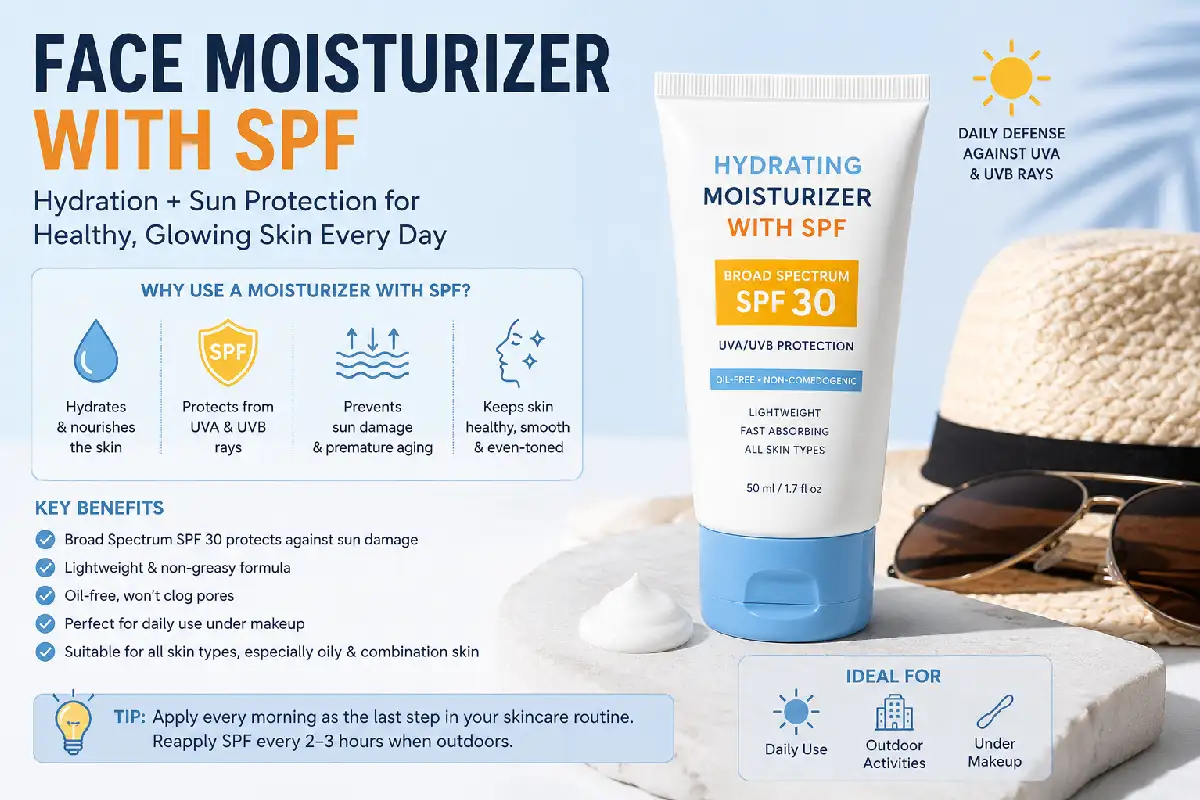
Face Moisturizer with SPF: A Complete Guide to Hydration and Daily Sun Protection
 Khizrana Begum
Beauty & Lifestyle Writer
Khizrana Begum writes clear and reader-friendly content covering beauty, lifestyle and related topics.
Read Full Bio of Author →
Khizrana Begum
Beauty & Lifestyle Writer
Khizrana Begum writes clear and reader-friendly content covering beauty, lifestyle and related topics.
Read Full Bio of Author →
 Sameena Begum
Health, Technology & Digital Content Reviewer
Sameena Begum reviews content for clarity, accuracy and overall reader usefulness.
Read Full Bio of Reviewer →
Sameena Begum
Health, Technology & Digital Content Reviewer
Sameena Begum reviews content for clarity, accuracy and overall reader usefulness.
Read Full Bio of Reviewer →
Face Moisturizer with SPF: Having an awesome skincare routine doesn’t mean you should have an arsenal full of products. The savviest decision you can make is to simplify with products that do double duty. One of the MVP players here is a face moisturizer with SPF.
This is the ultimate – hydration meets sun protection – product for those seeking to minimize their morning routine. The concept is simple: moisten skin and simultaneously provide UV-blocking qualities. But the type of SPF moisturizer you pick, the amount you wear, and even the time at which you still want – or need – an extra shot of SPF can make all the difference.
❝
This article is a part of
Moisturizing Guide
What Is a Moisturizer with SPF?
An SPF face moisturizer is really just a moisturizer in facial form that includes added benefits to defend from the sun. A moisturizer that would help retain moisture yet protect from the sun damage and sunburn. If you’re in a hurry that means one less product to glob on, an average moisturizer takes care of moisturing while an SPF moisturizing lotion takes care of the moisture and protection too.
What Does SPF Mean?
The first thing you need to know about SPF. Which stands for Sun Protection Factor, refers to how effective a sunscreen product is at providing protection against the effects of UVB radiation, and this type of UVB radiation is closely tied to sunburn.SPF also doesn’t reflect the number of hours that a person may sunbathe. In fact, according to the U.S. Food and Drug Administration (FDA), UVB – and hence SPF – is based on the level of UV exposure, not how long one is outdoors.
Choosing the right moisturizer with SPF can help simplify your daytime skincare routine while supporting hydration and sun protection. Explore our complete face moisturizer guide for practical tips and recommendations.
What Does Broad Spectrum Mean?
This is where broad-spectrum comes in. UVA is also suspected to be one of the leading causes of skin aging while UVB is one which may cause sunburning/tanning so regarding your daily facial treatments it might not actually be essential for you to be considering SPF within your face treatment at all, however if any part of this process will cover your face you should generally use a broad-spectrum with all your protection in mind as part of daily wear
| Feature | What it does |
| Moisturizer | Helps maintain skin hydration |
| SPF | Helps protect against UVB-related sunburn |
| Broad spectrum | Protects against UVA and UVB |
| Facial formula | Designed for use on facial skin |
| Water resistance | Helps maintain protection during swimming or sweating, when specifically tested and labeled |
Benefits of Daily Sun Protection
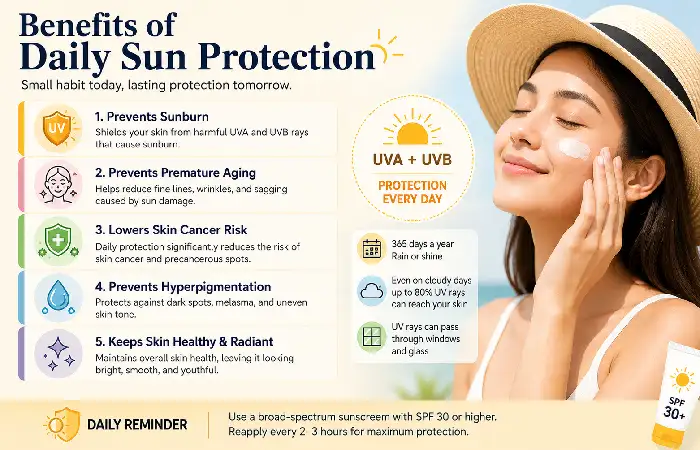
Having to be religious with sunscreen in the sun at the beach for a whole day! But walking in the park, getting the bus to work, sitting at the table by the sunny shop window, or walking along the shop front, all cause your skin to get damaged.
Dry skin may need both consistent hydration and daily sun protection to stay comfortable throughout the day. Explore our best face moisturizers for dry skin for helpful skincare guidance.
With consistent protection of your face, this accumulated UV damage can be minimized. Sunscreen that provides UVA and UVB coverage with at least SP 30 is recommended by the dermatologist.
Helps Prevent Sunburn
Reddening and the effects of a sun burn (one of the more direct effects of too much UV, with a decent SPF product and liberal application to properly apply the product, should result in less UVB exposure
Supports Healthier-Looking Skin
Frequent and ongoing exposure to the sun without adequate protection could trigger more noticeable premature aging marks, such as dark circles, eye bags, wrinkles, and age spots of your skin and sunscreen use on a day-to-day basis is capable to prevent its occurance.
Helps Protect Against Skin Cancer
Sun protection is one step to decrease sun exposure for both reducing tanning and decreasing the risk of skin cancer. But even, protection with skin sunscreen does not have a good meaning for skin. Sunblock, shade, or wearing a cap and sunglasses are important tools as well to limit your sun exposure.
Makes a Morning Routine Easier
One easy-to-see benefit is the convenience. If your moisturizer already contains sufficient broad-spectrum SPF, it’s one fewer item on the morning shelf to keep track of.
For a person who currently skips their sunscreen-wearing routine due to their routine already being too complicated, an SPF moisturizer could encourage consistency.
SPF Levels Explained
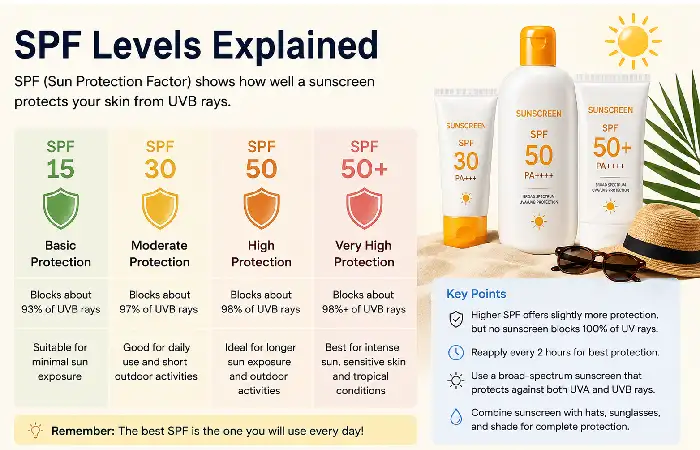
Navigating SPF in Skincare: Don’t know what number to choose for sunscreen on your products? You might pick up an SPF 15, 30, 50 (and higher) when you’re shopping for skincare products, but don’t assume the SPF number correlates to the number of hours of protection provided. If you use SPF 30, for instance, don’t figure you can stay out in the sun any 30x longer as though there won’t be consequences.
Oily skin can benefit from lightweight hydration and suitable sun protection without an overly heavy feel. Explore our face moisturizers for oily skin for practical tips.
SPF tells you how well products are able to protect against sunburn under standard conditions; don’t purchase anything below SPF 30.
The American Academy of Dermatology is an organization recommending 30 SPF (and above).
| SPF | General meaning |
| SPF 15 | Provides basic UVB protection |
| SPF 30 | Filters approximately 97% of UVB radiation under testing conditions |
| SPF 50 | Provides greater UVB protection than SPF 30 |
| SPF 50+ | Higher-level protection, depending on the product and testing |
This only seems like a tiny difference on the labels, but the extra protection afforded by SPF50 can be helpful, especially if you spend a long amount of time outside. -Important Note: No amount of sunscreen will totally block out UV, which is why even with sunscreen it is ideal to incorporate shading and covering.
How to Apply Correctly?
No matter how good SPF face moisturizers are, it can not give you labeled protection when you do not apply them.
Gel cream moisturizers can offer a lightweight texture while providing hydration for everyday skincare. Explore our gel cream moisturizer guide to learn more about this type of formula.
One bad habit of using facial SPF moisturizer is that people think it’s only a normal face moisturizer and you only need a very small quantity to apply. However, the quantity of application plays an important role because the test of sunscreen is applied with enough quantity and
A Simple Morning Method
Step 1: Cleanse your face.
Start with clean, dry skin if cleansing is part of your routine.
Step 2: Apply your skincare products.
If you use serums or other treatments in the morning, apply them before your SPF moisturizer according to their directions.
Step 3: Apply enough SPF moisturizer.
Spread it evenly across your face, including commonly missed areas such as the nose, ears and hairline. The AAD emphasizes applying enough sunscreen to achieve the protection stated on the label.
Step 4: Apply before going outdoors.
The FDA recommends applying sunscreen about 15 minutes before sun exposure.
A nighttime moisturizer can complement your daytime SPF routine by focusing on hydration without the need for sun protection. Explore our nighttime face moisturizer guide for practical routine ideas.
Step 5: Reapply when needed.
When spending time outdoors, sunscreen should generally be reapplied at least every two hours and sooner after swimming or sweating, according to product directions.
Don’t Forget These Areas
The face is more than just the cheeks and forehead. Pay attention to:
- Ears
- Nose
- Neck
- Hairline
- Temples
- Around the jaw
- Exposed areas near the eyes, while avoiding direct contact with the eyes
If you are outdoors for extended periods, a moisturizer with SPF may not be enough on its own. A dedicated, water-resistant sunscreen can be more practical for repeated application and active outdoor use.
Moisturizer with SPF vs Sunscreen
These products may be similar but can’t be used instead for everything. A moisturizer that contains SPF typically is focused around regular facial skincare. So it’s likely to feel lightweight, offer a moisturizing barrier and sit nicely under your foundation. A sunscreen, meanwhile, is built for sunblock and might incorporate qualities like water-resistance helpful for outdoor adventures.
| Moisturizer with SPF | Dedicated Sunscreen |
| Combines hydration and sun protection | Primarily designed for sun protection |
| Convenient for everyday routines | Useful for extended outdoor exposure |
| Often designed with facial skincare in mind | Available in many face and body formulas |
| May be comfortable under makeup | Often available in water-resistant versions |
| Can simplify a morning routine | Easier to select specifically for high sun exposure |
The choice does not have to be either-or. Someone might use an SPF moisturizer on an ordinary workday and choose a dedicated broad-spectrum, water-resistant sunscreen for a beach trip, hiking, sports or another prolonged outdoor activity.
FAQs
Is a moisturizer with SPF enough for everyday use?
However, as a daily facial application, it’s a convenient choice when it offers good broad-spectrum SPF in a plentiful amount. According to the AAD, sunscreen must have broad-spectrum and water-resistant protection along with an SPF rating of 30 or above.
If you prefer simpler skincare options, natural moisturizer formulas may be worth considering based on your skin’s individual needs. Explore our natural face moisturizer guide for helpful information.
Should I use SPF moisturizer every day?
Consider making sun protection a regular part of your morning skin care regimen. If any part of your face will be in contact with daylight out-of-doors, take precautions. Sun “rays” come into contact with you every day of the year, even on cloudy days.
Can I use moisturizer and sunscreen together?
Yes. If your regularly used moisturizer isn’t strong enough for sun protection, use this and then follow with an actual sunscreen, if your preferences make such usage practical.
Is SPF 30 better than SPF 15?
SPF 30 provides greater UVB protection than SPF 15. The AAD recommends SPF 30 or higher for sunscreen.
Does SPF moisturizer prevent skin aging?
Sun protection can help reduce UV-related premature skin aging. However, no skincare product can completely stop natural aging. Consistent sun protection, along with other healthy skincare habits, can help maintain healthier-looking skin over time.
Final Thoughts
You can make sun protection less of a chore and more of a step in your existing routine with a moisturizing face lotion with SPF. It’s not about selecting a product with high-end packaging and a number on the label, but an acceptable amount of adequate protection.
With regard to appropriate broad-spectrum usage of a face lotion, a minimum broad-spectrum SPF of 30 is a generally acceptable rule of thumb to dermatologists for everyday wear. With stronger exposure, reapply sunscreen as part of a regime that includes sun-dappled or covered areas, a hat, and sunglasses.