

Natural Face Moisturizer Guide: Benefits, Ingredients & How to Choose
 Khizrana Begum
Beauty & Lifestyle Writer
Khizrana Begum writes clear and reader-friendly content covering beauty, lifestyle and related topics.
Read Full Bio of Author →
Khizrana Begum
Beauty & Lifestyle Writer
Khizrana Begum writes clear and reader-friendly content covering beauty, lifestyle and related topics.
Read Full Bio of Author →
 Sameena Begum
Health, Technology & Digital Content Reviewer
Sameena Begum reviews content for clarity, accuracy and overall reader usefulness.
Read Full Bio of Reviewer →
Sameena Begum
Health, Technology & Digital Content Reviewer
Sameena Begum reviews content for clarity, accuracy and overall reader usefulness.
Read Full Bio of Reviewer →
Natural Face Moisturizer Guide: The ability to keep your skin soft and supple, resilient, and protected against further dry is dependent upon giving your skin a good face moisturizer that will serve to supply it with proper hydration to keep it comfy. Natural face moisturizers have come into their own with people who prefer the skin loving benefits of botanical extracts, seed butters, plant oils, and other natural elements for moisturization of the skin. That something is Natural doesn’t equate to works for All Skin Types.
But the very best moisturizer is the right choice for your particular Skin Needs, offering your skin pleasant Skin Tolerating ingredients.
Whether to go with something you put together in your own kitchen or buy a commercial product, knowing the Best Skin Moisturizer makes finding the choice that’s perfect for your skin less taxing.
❝
This article is a part of
Moisturizing Guide
What Makes a Moisturizer Natural?
No single definition for ‘natural’ in cosmetics really exists. An natural moisturiser usually implies a cosmetic containing naturally occurring substances, either partly or completely. An example of this would include a cosmetic which contains plant matter, natural minerals or organic matter which could include aloe, shea butter, jojoba oil, sunflower seed oil, coconut oil, or any other botanical extract.
Natural skincare can be a simple way to build a moisturizer routine around your skin’s hydration needs and personal preferences. Explore our complete face moisturizer guide for practical tips and recommendations.
There are three distinct categories of moisturizing agents that a natural moisturizer can offer:
| Ingredient Type | What It Does | Common Natural Examples |
| Humectants | Help attract and hold water in the skin | Aloe vera, honey, glycerin |
| Emollients | Smooth and soften the skin | Jojoba oil, sunflower oil, squalane |
| Occlusives | Help reduce moisture loss | Shea butter, cocoa butter, plant oils |
| Botanical extracts | May provide soothing or antioxidant properties | Green tea, chamomile, calendula |
Most likely, your moisturizer already includes one, or more, of the groups listed above. For instance, one that contain the humectants glycerin and aloe vera, will have skin benefiting humectants that help draw moisture into skin, and shea butter may reduce the rate at which skin moisture is lost. Keep in mind: All plant derived ingredient can cause irritation, or allergies. The aroma from natural essences (also know as essential oils), including fragrant extracts from plants, may be a concern for many people.
Dry skin often benefits from consistent hydration and moisturizing formulas that help maintain skin comfort. Explore our best face moisturizers for dry skin for helpful guidance.
Popular Natural Moisturizing Ingredients
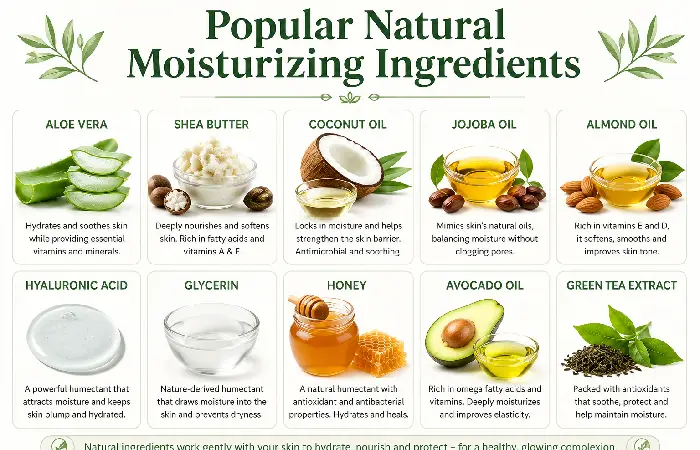
There are many moisturizers found in natural cosmetics, but the different ones provide different benefits or are more suited to specific skin types in terms of their textures; thus, it’s perhaps much easier to make the selection of an ingredient depending on your own skin type rather than simply sticking with one that says “natural.”
Aloe Vera
Aloe vera extracts feature extensively in some lighter creams and all kinds of soothing gels. It’s refreshing and helps your skin feel moisturized without it being at all oily and heavy. It could be particularly suitable for those who dislike heavier products. That said, not all aloe products are formulated the same way, so investigate the ingredient list rather than making a global decision about any products with aloe vera extracts.
Jojoba Oil
This plant-based emollient is a common product and has a slightly lighter feel. It is softening for skin and can be used either alone or as a part of lotions and facial oils. Combination or normal skin types may benefit from its texture, while very dry skin may prefer it as an addition to a more heavily moisturizing formula.
Shea Butter
This is a rich butter used to create creams, balms, and lotions. It conditions dry, rough skin and helps form an occlusive layer to help lock moisture in. The thicker texture may be easier on dry skin than a very oil-based moisturizer.
Oily skin still needs hydration, but lightweight moisturizer options may feel more comfortable for everyday use. Explore our face moisturizers for oily skin for practical skincare tips.
Sunflower Oil
Sunflower oil contributes fatty acids and vitamin E that could contribute moisturizing characteristics to the skin product. When incorporated in a skin care product, it contributes moisturizing properties; skin should feel soft, and skin may have comfort/good skin barrier. It appears in several face moisturizers because of its thinner consistency:
Squalane
Squalane is the perfect example of an ingredient where “natural” and “naturally derived” can be the same. Nowadays we often use squalane derived from plants (like sugarcane, olives). The silky and non-greasy texture is easy on the skin while helping to ease dryness without the feel of some old-timey plant butters.
Honey
Raw honey is a natural humectant and can attract moisture. It is also one of the ingredients in some masks and moisturizers.
It’s not always practical to put things from the kitchen directly onto your face, however. Store-bought products have been made with cosmetics in mind and can offer you the desired stability.
Oat Extract
Products that are intended to give skin a ‘dry’ or ‘sensitive’ feel often incorporate an ingredient that comes from oats. Colloidal oatmeal (finely ground oat powder) can work to moisturize and calm dry skin. If you have sensitive skin, you may want to choose fragrance-free products containing popular soothing ingredients as an alternative to strongly fragranced “natural” products.
Natural Oils
These can include some plant-based oils: Rose Hip oil, Argan oil, sunflower oil, grapeseed oil.
| Natural Ingredient | Best Suited For | Texture |
| Aloe vera | Normal, combination, dehydrated skin | Lightweight |
| Jojoba oil | Normal, combination, dry skin | Light to medium |
| Shea butter | Dry skin | Rich |
| Sunflower oil | Dry or normal skin | Light to medium |
| Squalane | Most skin types | Lightweight and silky |
| Oat-derived ingredients | Dry or sensitive-feeling skin | Depends on formula |
| Rosehip oil | Normal or dry skin | Lightweight oil |
| Argan oil | Dry or normal skin | Medium |
DIY vs Store-Bought Moisturizers
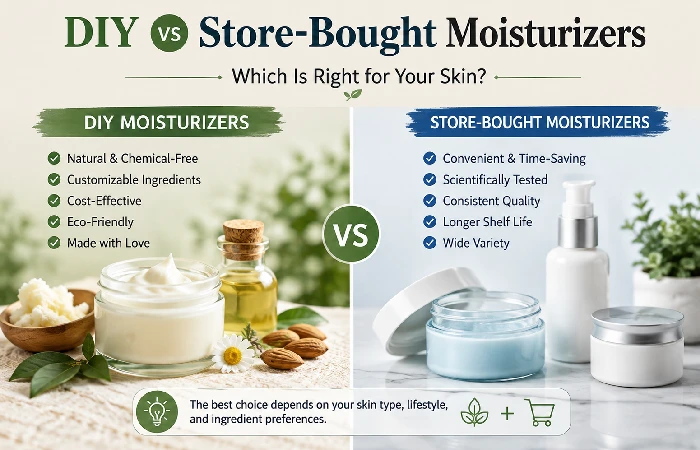
Why Buying Your Own Moisturizer Makes Sense: There’s obvious appeal in trying to make your own, as it gives you full control over the ingredients and the things you exclude. However, whilst there are some uses for your easy DIY concoctions, homemade skincare comes with significant drawbacks. It’s about more than just selecting which nice oils and butters you think you’ll throw into the mix, what with concerns over things that affect commercial formulas such as preservation, preservation and that also is the meaning, well preserved.
Daily sun protection is an important part of a daytime skincare routine, alongside choosing a moisturizer that suits your skin. Explore our face moisturizers with SPF for helpful information.
How Commercial Moisturizers are Stabilized and Protected: Commercial moisturizer products have normally undergone the rigors of the laboratory, being formulated with stability, protection, texture/feel, and application in mind.
Product formulation that is water-based obviously requires a sound preservative system that will combat bacteria, yeast, and mould; these elements should be fought. Fresh mixtures that include things such as water, aloe vera, honey, etc., without adequate preservatives are likely to rapidly begin to ferment and spoil, so although storing in the fridge can offer a little temporary protection, it doesn’t mean your concoction will last the day safely.
DIY Moisturizer Considerations
Most oil-based recipes are easier than oil-and water–based lotions. That’s because there are no bacteria or fungi to worry about since oil doesn’t provide them with the liquid needed to multiply. But don’t forget that oil can also eventually break down and irritate your skin or leave it feeling greasy or heavy.
So when you start making skin-care recipes yourself, please resist putting too many trendy ingredients together in one go.
Gel cream formulas can provide lightweight hydration and a comfortable texture for different skincare routines. Explore our gel cream moisturizer guide for practical ideas.
All that does not make it a better recipe.
Store-Bought Moisturizer Considerations
Advantages of professionally formulated products: The right combination of ingredients, preservatives, if required, and packaging for adequate product protection. Choose a product with a clear ingredient list and suitable for your skin type.
| Factor | DIY Moisturizer | Store-Bought Moisturizer |
| Ingredient control | High | Moderate |
| Convenience | Low to moderate | High |
| Preservation | Difficult | Professionally managed |
| Consistency | Can vary | Usually consistent |
| Customization | High | Limited |
| Stability | Often limited | Usually tested |
| Risk of contamination | Higher | Lower when properly manufactured |
Store-bought moisturizers, if formulated properly, seem to be easier and a safer choice for the masses.
Benefits and Limitations
Natural moisturizers have a range of potential benefits if you are using ingredients suited to your skin.
Potential Benefits
Promotes skin hydration: Humectants bind water, emollients lubricate, and occlusives help to retain moisture within the skin.
Softens dry skin: Skin-smoothing plant oils and butters.
Wide range of feel and texture from lightweight and oil-free, via Aloe and Squalene to buttery Shea Butter.
Good for basic routine: Individuals who require a less complicated and shorter ingredient list are more likely to find them.
Natural oils derived from plants are commonly available: High levels of naturally derived moisturizing compounds and oils.
Nighttime skincare can focus on maintaining hydration and choosing a moisturizer that fits comfortably into your evening routine. Explore our nighttime face moisturizer guide for helpful routine tips.
Limitations
The notion that natural means allergy-friendly is inaccurate. A plant ingredient, fragrance or essential oil may be irritant or allergenic for you. They may be good for some skin types or skin concerns and irritating to another.
If dry-skinned women appreciate a rich, oily formulation, the oily/acne prone women will find it oily and even heavy and pore-clogging on the other hand.
Some natural ingredient quality depends on the origin of its supply.
| Potential Advantage | Possible Limitation |
| Plant-derived ingredients | May still cause irritation |
| Familiar ingredients | “Natural” has no single universal meaning |
| Variety of oils and butters | Some can feel heavy |
| Simple ingredient lists | Simple does not always mean safer |
| Rich moisturizing properties | May not suit oily skin |
| Botanical extracts | Fragrance components may irritate sensitive skin |
The key is to evaluate the entire formula rather than relying solely on marketing terms.
Choosing Safe Natural Products
Figure out your skin type and concerns prior to beginning your hydrating treatment. Some individuals have drier skin and may require a richer moisturizer with emollient and occlusive properties. Individuals with oily skin are often well-suited to the utilization of lighter lotions, gels, and also other non-greasy choices. A moisturizer that does not just pack your skin would likely be great for combination skin.
Check the Ingredient List
Don’t pick up just because the front says “natural,” “organic,” or “clean.” Flip it over, and read through those ingredients. If you tend to have a more sensitive complexion, you might want to be wary of products with intense fragrance and skip the essential oils – natural fragrances can be a skin irritant.
Consider Your Skin Type
| Skin Type | Ingredients to Consider | Texture to Try |
| Dry | Shea butter, squalane, sunflower oil, oat ingredients | Cream or balm |
| Oily | Aloe vera, lightweight humectants, squalane | Gel or light lotion |
| Combination | Aloe vera, jojoba oil, lightweight emollients | Lotion |
| Normal | Jojoba oil, squalane, aloe vera | Lotion or cream |
| Sensitive | Oat-derived ingredients, simple fragrance-free formulas | Gentle cream |
Patch Test New Products
If it’s a new skin care product, first try a small patch on a very small part of your skin and face before applying it to your whole face. This way, you will likely discover the signs of an obvious reaction before spreading the product all over your face.
Stop using any product if you experience a lot of burning, swelling, rash, or irritation that is not receding. If the reaction is so bad it’s burning, you get swelling, you get a rash, you have had irritation before, if you get any of these that lasts or is that intense, you may need professional medical advice.
Think About Packaging
The method of packaging has a role to play in how well your moisturizer is preserved against air, light, and contamination. Pumps and tubes can be more practical and hygienic than applying to your face with the repeated dipping of your finger into a jar and can help to reduce spoilage.
Always ensure that you are following all storage instructions from the manufacturer, and noting expiry dates or periods after opening.
Keep Your Routine Simple
Moisturizing shouldn’t require so many botanical ingredients just to be useful. A minimalist routine that includes a wash, moisturizing, and a daytime sunscreen may be less difficult for you to stick with long-term than an elaborate one. Soak with a wash and follow it up with a wash if you haven’t recently done it. You don’t really have to use it just after taking a shower, as you can use it with the water still drying on your skin.
FAQs
Is a natural moisturizer better than a regular moisturizer?
That’s not always the case. Natural moisturizing agents can be wonderful, but their ability to work depends on the entire formulation. Certain naturally sourced ingredients may be problematic for your particular skin, just as certain synthetic chemicals are. The reverse is also true: natural and synthetic ingredients alike can be perfectly healthy and benign.
Can I use coconut oil as a face moisturizer?
Coconut Oil is another item that may help to soften dry skin, and the use is quite simple – apply just a few drops, and if you’re prone to breakouts, this could be the one to use; but it could possibly prove a little too heavy to use, so just be careful.
Is aloe vera good for dry skin?
Aloe vera will deliver cool lightness and hydration, but if your skin is extremely dry, consider combining aloe vera-like humectants with emollients and occlusives to boost and contain moisturizing benefits.
Are essential oils safe in facial moisturizers?
This doesn’t mean that because they are ‘essential’ the oil would be harmful, as they can be sensitizing to your skin or cause you to react to the skin depending on sensitivity level – a ‘fragrance-free’ version can always be another option!
What is the best natural moisturizer for oily skin?
No single answer is better for everybody. If you desire lightweight stuff, you ought to try some components like squalane, as well as aloe vera, rather than rich oils and butters. You need to be able to locate something that doesn’t leave your skin really oily afterward.
Can natural moisturizers cause acne?
13/ Why the Moisturizer You’re Using Simply Isn’t For You. It could just simply be down to the product you use. Heavy Butters And Oils Can Feel A Lil’ Too smothering on acne-prone skin, and something more lightweight and pore-safe is a Much Better choice
Should I moisturize if I have oily skin?
Right. Oily skin can become dehydrated too! Do try not to completely stop moisturizing; choose lightweight lotions or gels, which can add hydration with minimum layers.
Can I make a natural moisturizer at home?
You can make simple preparations out of oil such as the kind described in recipes, but if your diy preparations involve water in them, such as in gels and lotions, then you are going to have to add the preservative chemicals in there so that bacteria cannot develop. You can of course always use a professionally purchased Facial preparation as a safe alternative to buy for use on your face.
Final Thoughts
For a more minimal ritual, a natural moisturizer would probably do the trick – as it’s typically packed with oils, extracts, butters, etc. That your skin will love. Some popular natural moisturizer ingredients include: aloe vera, jojoba oil, shea butter, sunflower oil, squalane – and so on. However, beware; all ‘natural’ is not ‘gentle’ or ‘safe’ or even necessarily effective. Review all ingredients listed and go with what your skin likes (and if a product consistently makes you break out), then you might want to consider a formula a professional helps you make. At the end of the day, whichever moisturizer you use is fine as long as it makes your skin soft and happy but doesn’t throw off your entire process!