

Night Face Moisturizer Guide: How to Choose the Right Moisturizer for Overnight Skin Care
 Khizrana Begum
Beauty & Lifestyle Writer
Khizrana Begum writes clear and reader-friendly content covering beauty, lifestyle and related topics.
Read Full Bio of Author →
Khizrana Begum
Beauty & Lifestyle Writer
Khizrana Begum writes clear and reader-friendly content covering beauty, lifestyle and related topics.
Read Full Bio of Author →
 Sameena Begum
Health, Technology & Digital Content Reviewer
Sameena Begum reviews content for clarity, accuracy and overall reader usefulness.
Read Full Bio of Reviewer →
Sameena Begum
Health, Technology & Digital Content Reviewer
Sameena Begum reviews content for clarity, accuracy and overall reader usefulness.
Read Full Bio of Reviewer →
Night Face Moisturizer Guide: The nighttime can be as simple and skin-rejuvenating as possible. After all of the sunscreen, makeup, sweat, and general grit your skin collected during the day has been wiped away, slap some moisturizer on so your skin can recover its moisture overnight.
Nighttime face moisturiser is just that-a face moisturiser designed for use overnight to retain moisture in your skin and decrease water evaporation, possibly by means of heavier formulations, or with the main intention of using the formula for reasons that address dry or barrier-weak, etc conditions. Because its priority is to hydrate, the presence of SPF isn’t generally crucial in a night cream since this is the primary purpose of the day cream.
However, this means that the best night moisturizer isn’t necessarily the heaviest or the most expensive; your skin type, weather conditions, sensitivity, and other products all come into play when choosing the ideal product.
❝
This article is a part of
Moisturizing Guide
Why Nighttime Moisturizing Matters?
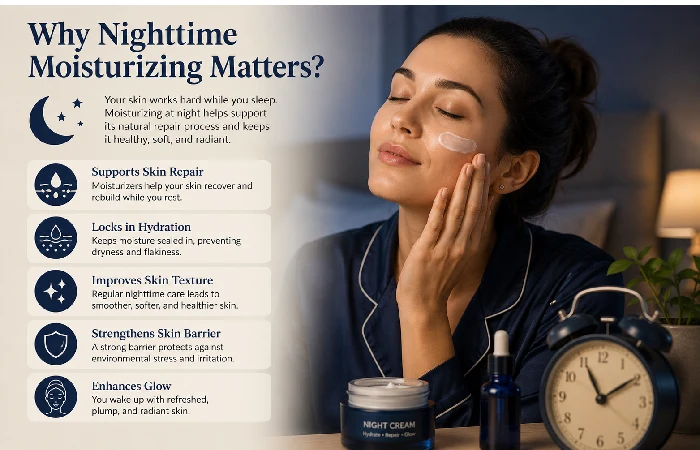
During the day, we lose water from our skin, and our skin becomes dry from the environment, our cleanser, or over-exfoliation, and even more when we live in an area where the air is dry. Moisturising is a great way to lock in what we’ve lost and to also prevent further dehydration through the surface of the skin. After washing at night: Washing removes a few of the elements of our skin’s barrier, which are meant to contain oil and water.
A good nighttime skincare routine starts with choosing a moisturizer that fits your skin’s hydration needs and overall routine. Explore our complete face moisturizer guide for practical tips and recommendations.
Therefore, it’s a good time to put on moisturiser while the skin is still a bit moist, in order to trap the water.
For this reason, the American Academy of Dermatology advises using moisturiser immediately after having a shower.
What does a night moisturizer actually do?
| Function | What it means for your skin |
| Hydration | Adds or attracts water to the outer layers of skin |
| Moisture retention | Helps slow water loss |
| Softening | Smooths rough, dry-feeling areas |
| Barrier support | Helps maintain the skin’s protective outer layer |
| Comfort | Can reduce the tight feeling associated with dryness |
A good nighttime moisturizer should leave your skin comfortable in the morning—not excessively greasy, irritated, or congested.
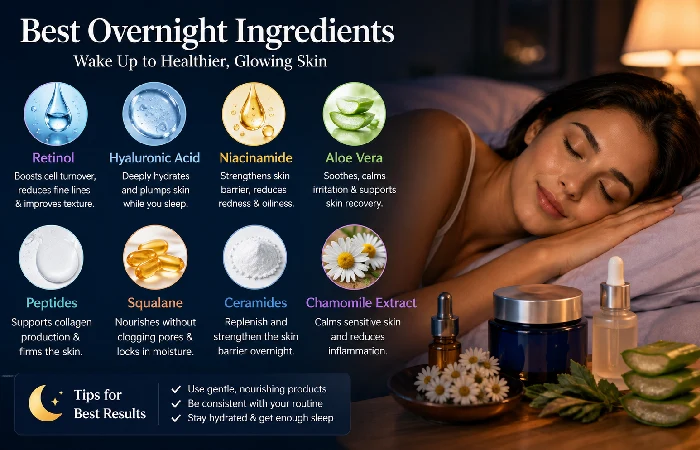
Best Overnight Ingredients
Dry skin can benefit from richer hydration at night to help maintain comfort and support a consistent skincare routine. Explore our best face moisturizers for dry skin for helpful guidance.
Many of us often find that ingredients have more to offer than sophisticated packaging or an overinflated price tag. Ingredients carry out various functions; thus, a good moisturizer may include one or two in combination.Humectants are a type of ingredient that attract moisture and water. Glycerin and hyaluronic acid are examples of commonly used humectants. Effective moisturisers also often include emollients that soften and soothe the skin, and occlusives that seal in moisture, preventing evaporation
| Ingredient | Main purpose | Best suited for |
| Glycerin | Attracts moisture | Most skin types |
| Hyaluronic acid | Helps increase hydration | Dehydrated skin |
| Ceramides | Support the skin barrier | Dry or sensitive skin |
| Squalane | Softens and moisturizes | Normal to dry skin |
| Shea butter | Provides rich emollient moisture | Very dry skin |
| Dimethicone | Helps reduce moisture loss | Dry or compromised-feeling skin |
Special consideration needs to be given to ceramides. These are lipids naturally occurring in the skin to form the barrier the retain moisture. A moisturizing product with ceramides is an excellent option for when skin is dry, coarse, and sensitive or irritated.
Even oily skin needs hydration, and lightweight formulas can be a comfortable option for nighttime use. Explore our face moisturizers for oily skin for practical skincare tips.
Likewise, a basic moisturizer works wonders after an evening application of certain retinoids and exfoliative acids, as it can ease irritation from certain formulas.
Night Skincare Routine
A nighttime routine does not need ten different products. In fact, keeping it simple can make it easier to understand what your skin actually likes.
A practical routine looks like this:
- Cleanse gently. Remove makeup, sunscreen, excess oil, and daily dirt without aggressively scrubbing.
- Apply treatment products if needed. This might include a dermatologist-recommended treatment or a suitable hydrating serum.
- Put on your night moisturizer. The goal here isn’t a huge chunk. You don’t want your face feeling as if you slathered a cake of moisturizer on it.
- Wait for your moisturizer to absorb, especially before plunging your face into your pillow.
Also, making sure that you moisturize immediately after washing your face will help lock in all the moisture that it has on your face anyway. For very dry areas, you may need to have a heavier formula, but you can use a more lightweight one for different regions of your face. Your face won’t require the same moisture all over the place every day.
Repairing the Skin Barrier
Skin Barrier Function: When your skin barrier is compromised, it may look tight, feel rough or flaky, and become excessively dry and/or highly sensitive. A few things may trigger a poor skin barrier, like over-cleansing your skin or using really strong products, over-exfoliating, or environmental dryness.
Moisturizers you might see within Barrier creams often contain ceramides, humectants, emollients, and occlusives. Their purpose is to hydrate and stop moisture from being lost from within the skin, instead of simply preventing your skin from feeling dry until that effect wears off. I’d be wary of using fragrance-free on irritated skin/a damaged skin barrier and not introducing more than 1 new product at a time, though… Seeing as you have redness/burning/cracking/itchiness, then maybe see a dermatologist.
While SPF is mainly important during the daytime, understanding how moisturizers with sun protection fit into your routine can help you choose the right products. Explore our face moisturizers with SPF for more information.
Lasts for more than an extended period of time.
Choosing the Right Night Cream
There is no universal “best” night cream. The right choice depends on how your skin behaves.
| Skin type | Look for | Texture to consider |
| Oily | Lightweight, non-comedogenic hydration | Gel or light lotion |
| Combination | Balanced hydration | Lotion or light cream |
| Normal | Humectants + barrier-supporting ingredients | Lotion or cream |
| Dry | Ceramides, glycerin, richer emollients | Cream |
| Very dry | Rich occlusives and emollients | Thick cream or balm |
| Sensitive | Fragrance-free, simple formula | Cream or lotion |
Key words to look for as suggested by the AAD if you have acne prone skin products to use on your skin is that the product is oil-free and non-comedogenic or will not plug pores. The final but arguably the most important tip to consider is that simply because your skin is more acne-prone doesn’t mean you can skip the moisturizer; very dry skin is more difficult to handle our treatments!
While the price may be a good initial gauge for determining quality, it does not have an impact on the ingredients used in the product.
FAQs
Is a night moisturizer necessary?
You know, you don’t need a separate thing to use at nighttime to call night cream if your normal moisturizer already helps hydrate you and if it works perfectly on you at night times.
Should I moisturize before bed every night?
If your skin frequently feels dry, tight, or uncomfortable, moisturizing regularly before bed can help you out. Consistency often plays a larger role than slathering it on in large amounts less often.
Can oily skin use night cream?
Absolutely. Oily skin still needs hydration. Choose a lightweight, non-comedogenic moisturizer rather than automatically selecting a heavy cream.
Gel cream formulas can offer lightweight hydration and may work well for those who prefer a comfortable texture in their evening routine. Explore our gel cream moisturizer guide for helpful ideas.
Is hyaluronic acid good for nighttime use?
Yes, hyaluronic acid is a humectant used to increase moisture and can be added as an overnight serum.
Are ceramides good in a night moisturizer?
Yeah. Ceramides provide some skin barrier support and are really good in a product formulated for dry or sensitive skin.
If you prefer simpler skincare options, naturally focused moisturizers can be considered based on your skin type and individual needs. Explore our natural face moisturizer guide for practical information.
Final Thoughts
The ideal nighttime moisturizer for any face should be nothing complicated. First, consider what your face wants you to say: “It’s becoming oily, so I want a light moisturizer” – “The skin feels so dry, I require a heavier product” – “The skin is very sensitive, I want some skin-friendly ingredients supported.” The most straightforward skincare route should be the one you don’t lose from. After cleansing with something delicate, use some topical treatments, a moisturizing lotion to stick in, and leave your regimen to rest for a while sleep.