

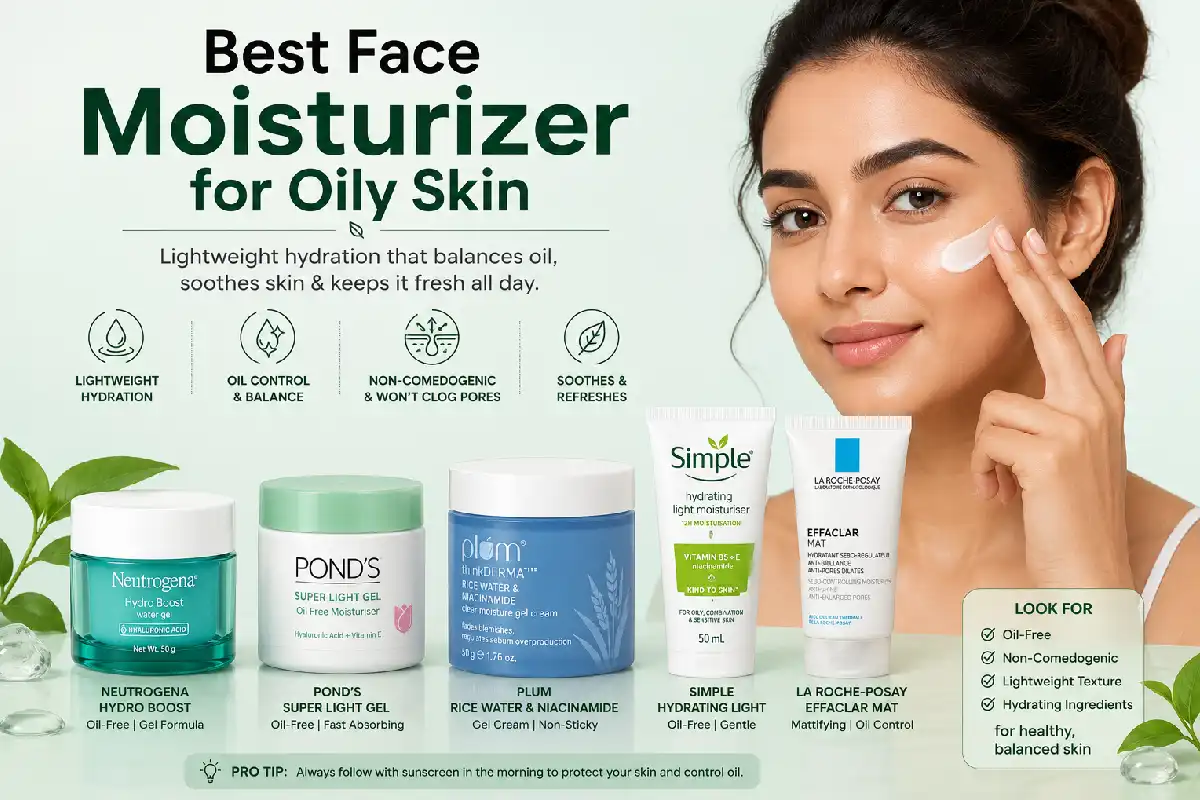
Best Face Moisturizer for Oily Skin: A Simple Guide to Hydrated, Balanced Skin
 Khizrana Begum
Beauty & Lifestyle Writer
Khizrana Begum writes clear and reader-friendly content covering beauty, lifestyle and related topics.
Read Full Bio of Author →
Khizrana Begum
Beauty & Lifestyle Writer
Khizrana Begum writes clear and reader-friendly content covering beauty, lifestyle and related topics.
Read Full Bio of Author →
 Sameena Begum
Health, Technology & Digital Content Reviewer
Sameena Begum reviews content for clarity, accuracy and overall reader usefulness.
Read Full Bio of Reviewer →
Sameena Begum
Health, Technology & Digital Content Reviewer
Sameena Begum reviews content for clarity, accuracy and overall reader usefulness.
Read Full Bio of Reviewer →
Best face moisturizer for oily skin: It’s complicated to tell what’s a “good” one from a “bad” one!. Especially if you’ve got some oily skin to work with! If your skin tends to be naturally oily or greasy, you’d probably think that moisturizer is about the last thing you’d ever need.
Well… guess what?
If you don’t moisturize oily skin, it can lead to drier skin than you’d think, with that tight feeling we all know and hate. Moisturizing is not just for dry skin because there may be reasons that you actually want to moisturize; you don’t want to strip your oily skin dry, you just want it to be hydrated without being greasy or weighing down the skin. After all, a moisturizer suitable for use on an oily face should not feel particularly unpleasant as it sinks into your skin and is light on skin feel.
❝
This article is a part of
Moisturizing Guide
Can Oily Skin Skip Moisturizer?
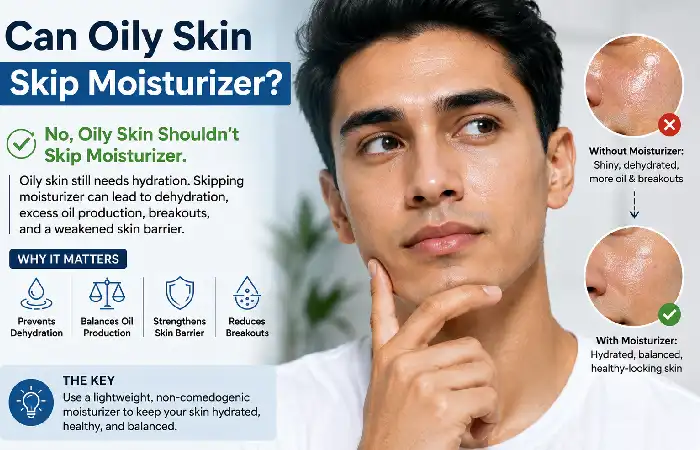
Oily skin still needs proper hydration, and choosing the right moisturizer can help maintain a comfortable skincare routine. Explore our complete face moisturizer guide for practical tips and recommendations.
No. Oily skin still needs moisturizer. It’s a sign that your skin is producing more oil than it needs; however, oil is different to water. Your skin can be very oily at the surface, while still being internally deficient in water. As a result, if you constantly forget to use moisturizer – more so when your skin is dry immediately after cleansing and it feels tight or dry- then your skin barrier function will decline, and it loses water.
| What oily skin needs | What to look for |
| Hydration | Humectants such as glycerin and hyaluronic acid |
| Barrier support | Ceramides and other skin-identical lipids |
| Lightweight texture | Gel, gel-cream, or light lotion |
| Less greasy feel | Oil-free or non-comedogenic formulas |
| Comfortable daily wear | Fast-absorbing, breathable formulas |
Why Moisturizing Matters for Oily Skin?
Stripping off oil from your skin’s upper layer with a strong cleanser like this can dry you out to hell. And with few drying ingredients layered straight on top, this may not just make you feel dry but maybe even itchy.
Rather than full oil removal, what skin really craves is gentle washing plus light hydration.
Dry skin often needs richer hydration and formulas designed to support moisture levels and skin comfort. Explore our best face moisturizers for dry skin for helpful guidance.
For those with oily/acne prone skin, using a moisturizer labeled “non-comedogenic” may also be an added benefit. Remember that a product labeled ‘non-comedogenic ’ isn’t a complete guarantee of success for all skin types.
Lightweight Hydrating Ingredients
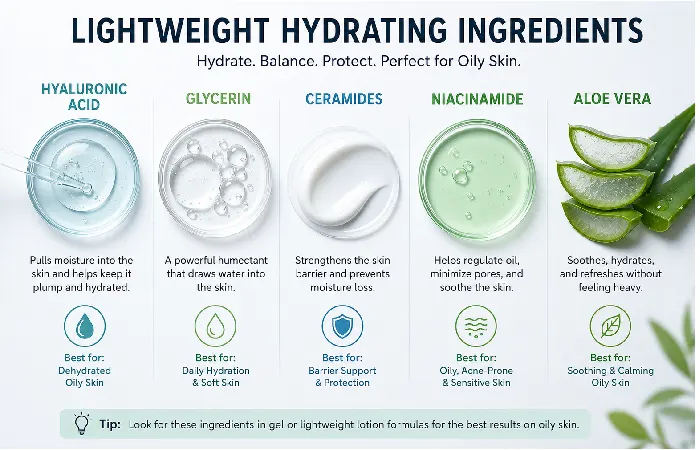
The best moisturizer to use would generally be one designed for oily skin as it would be more inclined not to leave skin feeling sticky and grimy.
1. Hyaluronic Acid
A humectant that draws water to the skin and binds with it. Look out for it in lighter moisturizers and gel products.
Ideal for oily but tight skin after cleansing.
2. Glycerin
Glycerin acts as a powerful humectant as well. By drawing water towards the skin, and not being selective to any one skin type, it is commonly utilized in facial moisturizers.
3. Ceramides
Ceramides (which are technically fats) live naturally in your barrier. If the oiliness on your face is also from the breakdown of your barrier from dehydration and/or inflammation, applying a face moisturizer specifically designed for the oily skin with ceramides will help with the oil as well.
4. Niacinamide
Niacinamide is form of vitamin B3. It is thought to strengthening the skin barrier and often in oily, acne prone products.
5. Aloe Vera
Because Aloe vera soothe and moisturizes, is frequently found on lightweight hydrating products. It can be for someone who doesn’t enjoy thick cream a comfortable ingredient in their cosmetic product.
| Ingredient | Main role | Best for |
| Hyaluronic acid | Attracts moisture | Dehydrated oily skin |
| Glycerin | Hydrates skin | Daily use |
| Ceramides | Supports skin barrier | Oily, dry, or sensitive skin |
| Niacinamide | Supports barrier and balanced-looking skin | Oily or combination skin |
| Aloe vera | Lightweight hydration and soothing | Warm-weather routines |
Gel vs Cream Moisturizers
People have texture needs too. One does not mean other is wrong in anyway (rich creams are not to be avoided). The fact remains that people with oily skin do favor the lightest textures.
Daily sun protection can be an important part of caring for oily skin while keeping your routine simple. Explore our face moisturizers with SPF for practical skincare ideas.
Gel Moisturizers
A lot of us think that a gel moisturizer is lightweight and really refreshing – it’s a wonder for getting on in the day when it’s warm and humid. Many that have skin who are inclined to be a little more on the shiny and oily side during daytimes would find using a gel moisturizer particularly beneficial.
Best for:
- Very oily skin
- Hot or humid climates
- People who dislike heavy products
- Daytime skincare
Cream Moisturizers
How To Use On Oily Skin? These contain more emollients, so they have more ‘slip’ and can feel rich and a touch heavy on the skin. In fact, if you’re oily, you might even get away with a very rich cream, particularly if you’re prone to a very damaged, or inflammation skin.
Lightweight gel cream formulas can provide hydration without the heavier feel some oily skin types may prefer to avoid. Explore our gel cream moisturizer guide for more information.
Best for:
- Oily and dehydrated skin
- Colder weather skin
- Skin treated with drying agents
- Nighttime application where a richer application is welcome.
| Feature | Gel | Cream |
| Texture | Very lightweight | Richer |
| Finish | Usually fresh or light | Usually more moisturizing |
| Oily skin | Often preferred | Can work if lightweight |
| Hot weather | Excellent choice | May feel heavy |
| Dry or compromised barrier | May need additional support | Often more suitable |
The ‘best’ texture varies with the feel of your skin.
Daily Moisturizing Routine
Your oily skin doesn’t require a complicated routine in order to be moisturized. Consistency is usually the only factor that makes a difference, rather than an overstocked collection.
Morning Routine
Step 1: Cleanse gently
Nighttime skincare can focus on maintaining hydration and supporting a consistent routine without adding unnecessary steps. Explore our nighttime face moisturizer guide for practical tips.
Start the day by rinsing away oil and perspiration accumulated during the night without stripping your skin.
Step 2: Apply moisturizer
Apply a light layer to your wet, but not dripping wet, skin a thick layer won’t make your skin any happier
Step 3: Finish with sunscreen
Slather on a broad-spectrum sunscreen during the day. If you hate layering the different products, you can opt for a moisturizer with added sun protection or a sheer sunscreen and moisturizer duo that’s appropriate for your skin.
Evening Routine
Wash your face at night to get rid of sunscreen, makeup, oil, and grime. Next, apply your moisturizer. There’s no need to use a thick face cream at night just because it’s dark if your skin is happy in a gel.
How Much Moisturizer Should You Use?
Begin with the least and apply lightly to the face and neck, using more product as needed for your tight skin.
| Time | Routine |
| Morning | Cleanser → Moisturizer → Sunscreen |
| Evening | Cleanser → Treatment if needed → Moisturizer |
| After exercise | Cleanse/rinse → Moisturizer → Sunscreen if daytime |
Common Mistakes
However, even a good moisturizer won’t do you much good if the rest of your routine is not benefiting your skin.
Using No Moisturizer at All
This is probably the biggest mistake we all make. Even oily skin still needs to be hydrated and its barrier function supported.
Choosing an Extremely Heavy Formula
Very occlusive, thick creams aren’t inherently BAD for your skin, but they’re def not the best option when you are already oily.
Over-Cleansing
You can use facial cleanser on your skin many times over because you want to keep the glare under your eyes at a distance. Using too much can irritate the skin and feel very irritating. Normally, a simple and consistent facial cleansing routine is often more successful.
Using Too Many Oil-Control Products
Clay masks, powerful exfoliants, acne medication, and oil-absorbing powders can sometimes get to be too much.
Assuming Every “Oil-Free” Product Is Better
By definition, there’s nothing better about oil-free formulations either. Oil and water have the ability to cooperate and your skin doesn’t necessarily hate a formulation with the right emollient.
Applying Too Much Product
You do not have to slop on plenty of moisturizer to get yourself all hydrated. A small, thin application will do for all of your everyday use.
Those who prefer simpler skincare options may consider natural moisturizer formulas that suit their individual skin needs. Explore our natural face moisturizer guide for helpful ideas.
FAQs
Can oily skin use moisturizer every day?
Sure. A good daily moisturizer could keep your skin hydrated and its barrier healthy. Use a formula that is neither greasy nor heavy on the skin.
Is gel moisturizer better for oily skin?
Gel-based moisturizer: If your skin is oily, a gel-based moisturizer will be a good option for you as it doesn’t feel heavy. However, those with oily but dehydrated skin could opt for a very light lotion or cream.
Should I use moisturizer if I have acne?
Most of the time, yes! Since some acne treatments can cause dry or itchy skin, moisturizer can help you achieve balance. If that’s right for you, we suggest using a lightweight, non-comedogenic moisturizing lotion.
Can moisturizer make oily skin oilier?
Face moisturizing doesn’t have to create more facial oil, but a heavy formula will certainly contribute to feeling oily on your face; therefore, make sure you’re selecting the appropriate texture and that you do not apply an excessive amount.
Should I moisturize before sunscreen?
Absolutely. A basic morning routine would be cleanser, moisturizer, and then sunscreen. If the sunscreen is providing enough hydration and a moisturizing effect for the skin, there would be no need to apply a separate moisturizer every day.
What should I avoid in a moisturizer for oily skin?
There’s not one definitive ingredient blacklist. Focus on those ingredients found in products that you find regularly lead to skin that is oily, plugged up, itchy, or irritated. You might opt for a lighter, unscented product if you’ve sensitive skin.
How do I know if I’ve found the best face moisturizer for oily skin?
Seek a moisturizer that feels great on the skin –hydrating, soft, and balanced without becoming too greasy. What works best for your friend might not work well for you, considering texture preference, climate, other ingredients you might already be using, etc.
Final Thoughts
Finding the Right Moisturizer for Oily Skin If you are struggling to choose, the most ideal face moisturizer for oily skin is certainly not likely the one with the thinnest consistency you may have seen previously. However, with an appropriately hydrating selection, one must ensure that their oily skin surface does not seem excessively oily. For a beginner, select some kind of gel, fluid-and-gel, or lotion that could be made with hyaluronic acid, glycerin, ceramides, or niacinamide.
So, keep your routine simple as well as moisturize day by day, adapting it depending upon climate and pores and skin feel. Having the option to handle your oily skin areas will mean you can have the very best of face to use a number of your products!