

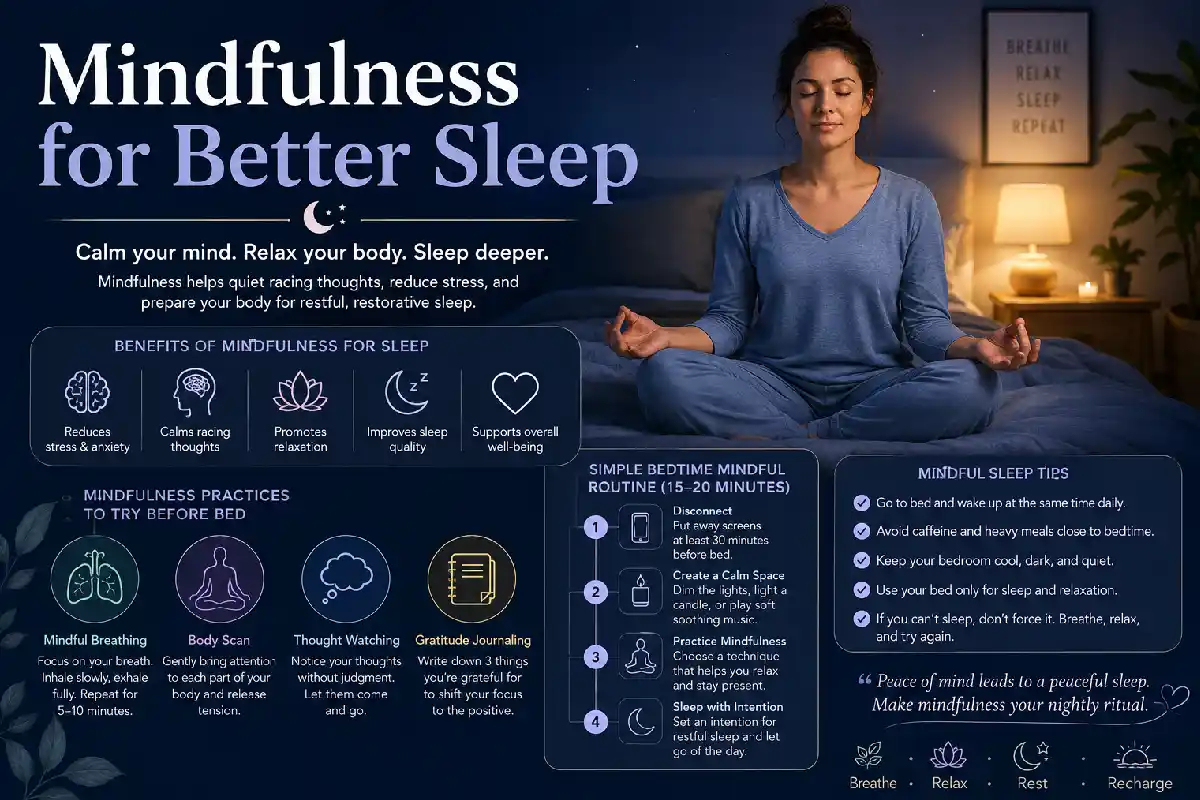
Mindfulness for Better Sleep: A Simple Guide to Restful Nights
 Khizrana Begum
Beauty & Lifestyle Writer
Khizrana Begum writes clear and reader-friendly content covering beauty, lifestyle and related topics.
Read Full Bio of Author →
Khizrana Begum
Beauty & Lifestyle Writer
Khizrana Begum writes clear and reader-friendly content covering beauty, lifestyle and related topics.
Read Full Bio of Author →
 Sameena Begum
Health, Technology & Digital Content Reviewer
Sameena Begum reviews content for clarity, accuracy and overall reader usefulness.
Read Full Bio of Reviewer →
Sameena Begum
Health, Technology & Digital Content Reviewer
Sameena Begum reviews content for clarity, accuracy and overall reader usefulness.
Read Full Bio of Reviewer →
Sleep is meant to be simple and natural; yet, sleep time for some becomes the peak of productivity! Bedtime approaches, darkness, away with the cell phone, and in comes a flurry of what will need to be achieved by 7 am tomorrow: every single discussion, incomplete tasks, worries, even the most absurd little thing seemed to go unnoticed until bedtime.
Perhaps this is where mindfulness can help – Mindfulness for sleep. No, there’s no mind state where we force ourselves to fall asleep and try and blank our minds – Mindfulness for sleep is really about taking a curious and accepting approach to our thoughts, feelings and bodily sensations, to allow ourselves to be present with ourselves without getting carried away or pushed by them. Although the research looks somewhat encouraging, there are not as many conclusive, well-conducted studies as are out there currently for the research underpinning more traditional techniques such as CBT-I.
❝
This article is a part of
Mindfulness Guide
What is Mindfulness for Better Sleep?
Mindfulness basically means the practice of observing the breath, for example, and simply being aware of your current moment in time without any judgment. Rather than gripping tightly to every single passing thought, you recognise the thought for what it is, then release it. It is an extremely useful practice when trying to sleep when the cause of insomnia is perhaps not physical tiredness. In the above example, then what you might practise is, instead of ‘I have to get sleep what might be said is, “I feel physically tense shoulders; I am physically ready for rest, but I feel anxious about how I will do my job tomorrow,” and so on.
Mindfulness can be incorporated into different parts of your daily routine, including habits that encourage relaxation and present-moment awareness. For a broader overview of mindfulness practices, explore our complete mindfulness guide.
You might find that making this shift decreases frustration with your sleeplessness. Mindfulness could even improve your relationship with insomnia by building on strategies that are effective for other difficulties. When a few poor nights become concerning for you, and your mind itself is anxious about sleeping, then any visit to your bed becomes an anxious event for any of your other family members and yourself also.
Mindfulness vs. Trying to Force Sleep
| Trying to force sleep | Mindful approach |
| “I must sleep immediately.” | “I can allow myself to rest.” |
| Fighting unwanted thoughts | Noticing thoughts without judgment |
| Checking the clock repeatedly | Paying attention to the present moment |
| Becoming frustrated by wakefulness | Accepting that wakefulness is happening. |
| Worrying about tomorrow | Returning attention to breathing or body sensations |
The goal is not to guarantee sleep. The goal is to reduce the mental struggle surrounding sleep.
Why Sleep Problems Happen?

Relaxation can be especially useful when stress makes it difficult to wind down at night. Explore our mindfulness practices for stress relief for techniques that can fit into a calming routine.
A problem with sleep can have various reasons. Sleep can be affected by stress, changed routines, caffeine, the use of screens, an unsuitable bedroom, and physical pain or emotional concerns. It seems that the difficulty arises in the first place during a phase of increased stress, but persists as the brain learns to link the scheduled times of sleep with feelings of anger or Frustration.
Common Reasons for Poor Sleep
| Possible factor | How it can affect bedtime |
| Stress | Keeps the mind alert and active |
| Irregular sleep schedule | Makes the body’s sleep rhythm less predictable |
| Excess caffeine | Can make relaxation and sleep more difficult |
| Screens before bed | Light and stimulating content may interfere with winding down. |
| Heavy late meals | May cause discomfort |
| Worrying about sleep | Creates pressure to fall asleep |
| No relaxing transition | Moves the mind directly from activity to bed |
Bedroom atmosphere. The bedroom ambiance is important in this regard too. The bedroom needs to be cool, dark, and quiet at night, according to the recommendations of the National Heart, Lung and Blood Institute. This also means a fixed sleep and wake schedule, and avoiding alcohol, nicotine, and caffeine when trying to sleep.
The Role of an Overactive Mind
One of the most annoying sleep situations is physical tiredness vs an alert mind.
Whether you are reliving an argument, sorting through tomorrow’s to-do list, recalling something you had previously forgotten, or practicing what it’s going to feel like to overcome certain future obstacles, the harder you attempt to shut out that thought, the larger and bigger it grows.
Mindfulness can also help you become more aware of thoughts and emotions that may interfere with relaxation. Our mindfulness guide for anxiety provides additional practices to explore.
But there is another choice with awareness: you can note the thought without bringing it into a dispute to be resolved while you are trying to sleep. You can inform yourself that, “This is a thought. I don’t need to solve it right now.” This is not ignoring problems, just deciding when to solve them.
Mindfulness Before Bed
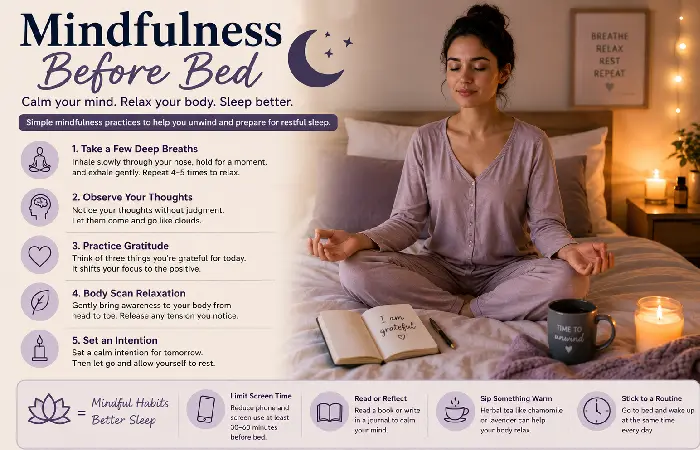
How can a simple activity create a space to transition from your days of busy tasks into the darkness of slumber? It doesn’t take 20 minutes or longer of sitting in stillness; however, a few 5–10 quiet minutes here and there can become a useful transition signal for you that activity is ending.
There are many ways to practice mindfulness, from focused breathing to body awareness and other forms of intentional attention. Explore our mindfulness techniques and exercises to find an approach that works for your routine.
The results of mindfulness research have been somewhat inconsistent. A 2019 meta-analysis of 18 studies involving 1,654 individuals showed that while mindfulness meditation led to better sleep compared to education-based controls, it was not significantly superior to evidence-based interventions such as exercise or CBT. This is a vital distinction – in many ways, mindfulness may be helpful, but it does not and should not be claimed to be a panacea for insomnia.
Relaxation and Breathing Exercises
A simple, yet effective place to start is your breath; it is a simple, immediate anchor for your attention.
Gentle Belly Breathing
Lie down, put one hand on top of your abdomen, and breathe in through the nose slowly to make your abdomen rise. Blow out and make your abdomen lower.
You do not have to take extremely deep breaths; natural and slow breaths suffice.
Practice this for a few minutes, and focus all attention on this physical action of breathing.
Progressive Muscle Relaxation
This is done by systematically tightening and then releasing each of your muscle groups.
For example:
- Gently tense your feet.
- Relax them completely.
- Tense your calves.
- Release the tension.
- Continue upward through your legs, abdomen, shoulders, hands, and face.
- Finish by noticing the difference between tension and relaxation.
This skill can assist you in being more aware of bodily strain or muscle tension, which you won’t recognize throughout the course of your hectic days. Relaxation skills typically make up parts of CBT-I, and the American Academy of Sleep Medicine, with the caveat, offers a “weakened recommendation” that relaxation remedies may be prescribed for individual factor treatment of power insomnia.
Creating moments of mindfulness during the workday can also help you transition away from professional demands when the day ends. Explore our mindfulness practices for work for ideas you can incorporate into your daily schedule.
However, there’s less help for relaxation treatments used on their own than as part of an effective insomnia treatment, like sleep training or CBT-I.
Which Exercise Should You Choose?
| If you experience… | Try… |
| Racing thoughts | Mindful breathing |
| Tension in your body | Progressive muscle relaxation |
| Difficulty focusing | Body scan |
| Worry about tomorrow | Mindful observation |
| Restlessness | Slow breathing and gentle stretching |
The best technique is usually the one you can practice consistently without making bedtime feel like another task.
Creating a Night time Routine
Your routine doesn’t have to be extensive. In reality, simple routines work best. It is the connection between the things you’re doing and the things you should be doing. Instead of waiting till the last minute to respond to emails and check the gram just before hitting the sheets, extend a sequence that tells your mind that playtime is over.
Example Nighttime Routine
60 minutes before bed: Finish demanding work and reduce stimulating activities.
45 minutes before bed: Dim the lights and put away unnecessary screens.
30 minutes before bed: Take a warm shower, read something relaxing, or listen to quiet music.
15 minutes before bed: Practice mindful breathing or a short body scan.
At bedtime: Make yourself comfortable and relax without focusing on whether or not you are sleeping.
Consistency is paramount here, rather than perfection: The NHLBI recommends trying to go to bed and wake up at roughly the same time each morning, every night-even on days when you don’t have to go to work-as well as trying to establish a restful before-bed routine.
Meditation can provide a structured opportunity to slow down, focus your attention, and establish a calming evening habit. Learn more with our mindfulness meditation guide.
Make Your Bedroom Sleep-Friendly
Your surroundings can either support relaxation or keep your attention active.
Consider:
- Keeping the room comfortably cool
- Reducing unnecessary noise
- Making the room as dark as practical
- Choosing comfortable bedding
- Keeping work materials away from the bed
- Limiting stimulating phone use at bedtime
A quiet, dark, comfortable bedroom combined with a consistent schedule can make mindfulness practice much easier.
Common Sleep Mistakes
Many of the things we do in our pursuit of better sleep can end up sabotaging our bedtime, in retrospect.
Mistake 1: Trying Too Hard to Sleep
Do not see sleep as an exam; sleeping when you push and think: I must fall asleep’ puts a strain upon it. Lie as quiet as you are able: that is all. 17. Sleep is never a passing; but always falling.
Mistake 2: Checking the Clock Repeatedly
Mindfulness is not ceasing thinking about anything. Mindfulness is recognizing thoughts, and we don’t necessarily have to buy into or do it. You catch a glimpse of 1:00 AM, start to add up the hours before dawn. Glance again. If it does this more than once, turn the clock around.
Mistake 3: Treating Every Thought as an Emergency
An idea that occurs to me when I’m heading to sleep doesn’t require an immediate fix. If it’s something I really must think about, I jot a note down quickly and get back to my breath.
Mistake 4: Using Your Bed as a Workplace
Your bed can then slowly get used to being somewhere you are on your phone all the time, where you are watching stressful shows, where you are working in bed or lying in it to go study. This can prevent your brain from being able to connect with anything else.
Mistake 5: Expecting Mindfulness to Work Immediately
Mindfulness is a practice, not a sleeping pill.
Some nights may feel peaceful. Other nights may still be restless. Success means practicing the skill rather than demanding a particular result.
A Simple 7-Day Mindfulness Sleep Plan
You do not have to change your entire lifestyle overnight.
| Day | Practice | Time |
| Day 1 | Observe your natural breathing | 5 min |
| Day 2 | Body scan | 5–10 min |
| Day 3 | Gentle belly breathing | 5 min |
| Day 4 | Progressive muscle relaxation | 10 min |
| Day 5 | Mindful reading before bed | 10–15 min |
| Day 6 | Combine breathing + body scan | 10 min |
| Day 7 | Repeat your favorite practice | 10 min |
After a week, notice what actually feels helpful. You do not need to continue every technique. Choose one or two practices that fit naturally into your evening.
FAQs
Is mindfulness good for sleep?
Mindfulness practice might be beneficial for some to increase perceived sleep quality and reduce Bedtime Struggle. c
How long should I meditate before bed?
Not fixed duration. Begin for 5-10 minutes. If you feel relaxed then you can take more time gradually.
Can mindfulness stop racing thoughts at night?
Mindfulness is not to stop thinking altogether. Mindfulness means recognizing thoughts without needing to dwell on and/or enact it. Through practice, this can lessen the intrusive effects of rapid or looping thinking patterns.
Should I meditate in bed?
It is totally okay to meditate in bed if you are comfortable with that and you do a body scan or a breathing practice. Other people like to meditate somewhere else and not get into bed until they are ready to go to sleep.
What if mindfulness makes me more aware of my worries?
For instance, that’s sometimes true. Awareness in mindfulness is awareness of what is already present – and sometimes awareness brings what wasn’t there before. If the practice of meditation continues to be distressing, stop and possibly consider seeking the advice of a qualified mental health provider.
Final Thoughts
Mindfulness to improve sleep is not so much an intervention, but more a change in the way we APPROACH night. The process not fighting each thought but witnessing each one; the process of not marking time, but feeling time come through you; not demanding rest, but allowing your body to rest. A moment or two of quiet breath-work, a body check-in, Progressive Muscle Relaxation, along with your regular evening habit would leave a room with so many points of exit into your dreamy oblivion. Mindfulness might not cure all your ills but mindfulness just might be the tool that allows for safe crossing into slumber.