

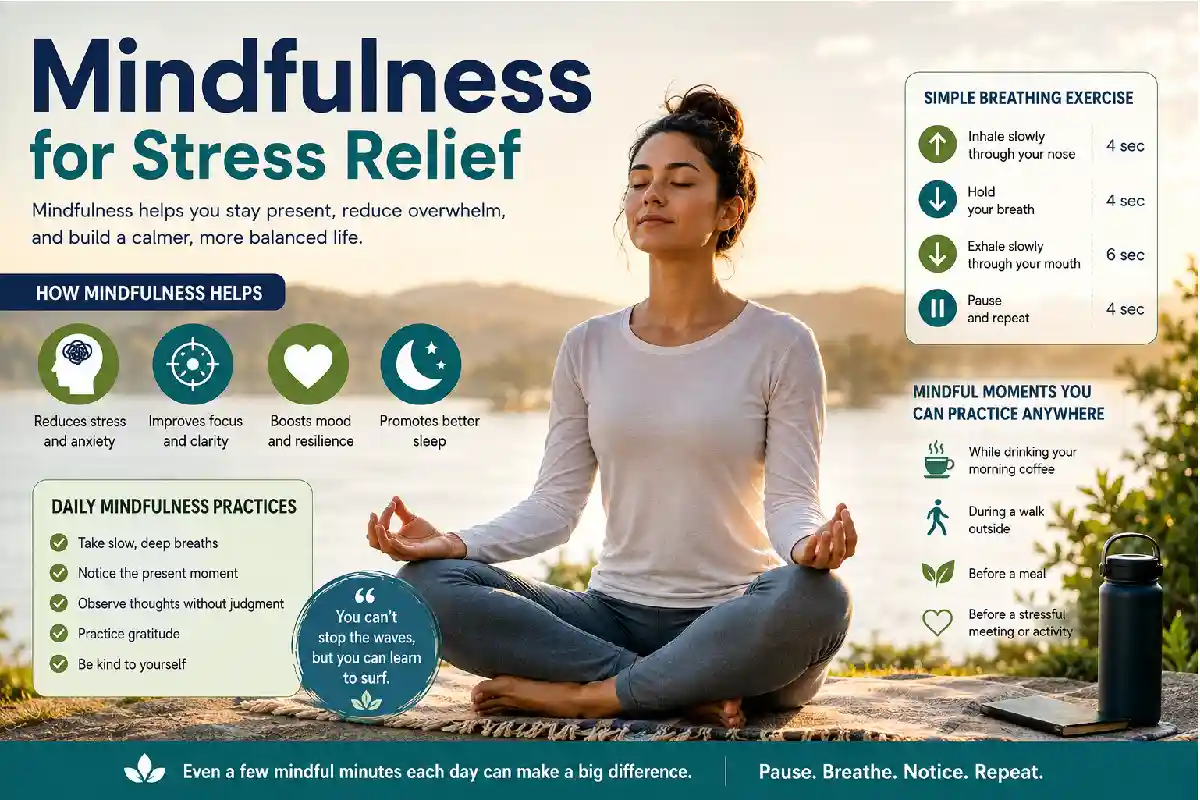
Mindfulness for Stress Relief: Simple Techniques to Calm Your Mind and Body
 Khizrana Begum
Beauty & Lifestyle Writer
Khizrana Begum writes clear and reader-friendly content covering beauty, lifestyle and related topics.
Read Full Bio of Author →
Khizrana Begum
Beauty & Lifestyle Writer
Khizrana Begum writes clear and reader-friendly content covering beauty, lifestyle and related topics.
Read Full Bio of Author →
 Sameena Begum
Health, Technology & Digital Content Reviewer
Sameena Begum reviews content for clarity, accuracy and overall reader usefulness.
Read Full Bio of Reviewer →
Sameena Begum
Health, Technology & Digital Content Reviewer
Sameena Begum reviews content for clarity, accuracy and overall reader usefulness.
Read Full Bio of Reviewer →
Mindfulness for Stress Relief: The symptoms of stress do not always make themselves obvious, but may include an inability to concentrate, being keyed up or agitated and disturbed sleep patterns; being highly irritable and feeling that your mind is always “on”. A certain amount of stress is natural to the majority of people, but can greatly affect our mental and physical well being.
Mindfulness as a technique for dealing with stress is a straightforward technique that involves taking a moment out of your day to attend to what is going on here and now, and finding out how to react appropriately to stressful situations.
You do not have to have any special equipment or a quiet meditation space or lots of free time at your disposal. But just a few minutes taking a mindful breath, walking, or of quiet watching can add up to a useful approach for managing your stress.
The aim of mindfulness is not to stop thinking as there would be no point. No, it is the capacity to be aware of all thoughts, feelings, sensations or surroundings occurring at the present moment in your life, with none passing a judgement or with your automatic reactions.
❝
This article is a part of
Mindfulness Guide
How does stress affect our mind and body?

Stress – what is stress? Simply, it is your natural defence of body to meet or get to overcome pressure.
When you’re faced with anything stressful, you feel stress and ready to react.
Your heartbeat quickens, muscles might tense, your breath gets faster, and your focus is drawn to problem you identify. It can helpful for short periods of time – the issues with stress often arise when stress occurs much more regularly or if there’s insufficient time between stressful times to allow you to recovery.
Mindfulness can be a useful part of a balanced daily routine, especially when you want to develop greater awareness and create moments of calm. For a broader introduction to mindfulness practices, explore our complete mindfulness guide.
Mental Effects of Stress
You are most likely to find that chronic high levels of stress will affect the clarity of your thoughts, and your emotional control. You may see this in terms of anxiety about the future, running conversations over and over in your head, worrying about things that could happen to you or an inability to concentrate on tasks.The range of effects that you are likely to experience on your mind and emotions can include:
- Worrying all the time
- Feeling it’s difficult to focus
- Getting frustrated
- Easily becoming annoyed
- Being overly anxious
- Racing thoughts
- Being unmotivated
- Find it hard to relax
- Mood swings
However, when you continue to carry your mind onto past or problem issues this will make you be not truly take pleasure in your now. One aspect of mindfulness can be incredibly handy; it provides a place for our attention to remain productive.
Physical Effects of Stress
Stress is not a state that only affects the mind. The body reacts to chronic stress. The body may experience:
Stress and anxious thoughts can sometimes overlap, so learning mindfulness approaches for anxiety may complement a broader stress-management routine. Explore our mindfulness guide for anxiety for additional practices.
| Area affected | Possible effects of ongoing stress |
| Muscles | Tense tight shoulders jaw clenching |
| Sleep | Trouble falling or staying asleep |
| Digestion | Stomachaches or change in eating habits |
| Heart and breathing | Accelerated pulse rate or respiration, decreased tidal volume. |
| Energy | Low energy due to tiredness |
| Immune function | The longer the strain, the greater its weakening potential |
| Concentration | Trouble concentrating, or accomplishing tasks. |
These reactions are very individual and each person can experience those differently. Also it’s very sensitive to your state such as your sleep, your life style, work, relationships, etc.
The Stress-Thinking Cycle
One stressed-filled thought leads to another… For instance, maybe your first stressed-filled thought is “I have too much work.” that makes us feel an uncomfortable, aroused way that we will then physically tense. That discomfort then can increase our urgency to follow this initial thought. Mindfulness can cut this cycle down: mindfulness works by NOT continuing your stress-filled thought cycle by taking it a bit farther up in your hierarchy where you go, “Ok I’m going to observe I am having this thought that it would be better to get this done before anything else I can consider” so by having a little bit of Space this will help we’ll say to step back and not engage.
How Mindfulness Reduces Stress?
Relaxation is also important when preparing for sleep. If you want to incorporate mindful habits into your evening routine, explore our mindfulness practices for better sleep.
Mindfulness Is a way of doing this intentionally in the moment, by bring an open non-judging awareness. If you take a few minutes to just sit and concentrate on your breathing. Your thoughts might start drifting off to thoughts of work and your job, your money, other people or what has to happen tomorrow.. If this happens you stop, become aware that your mind has jumped back in, and instead of feeling frustrated you gently bring your focus back to your breath.
There are several ways to practice mindfulness, including breathing exercises, body awareness, and focused attention. Our mindfulness techniques and exercises can help you explore different approaches.
That simple process is mindfulness.
Mindfulness Helps You Notice Stress Earlier
Some of us don’t know we’re stressed out at all and before they’re any of the wisest, they’re just worn-out. Mindfulness helps you identify and heed early symptoms, you may recognize these:
- Tightness in your shoulders
- Faster breathing
- A clenched jaw
- Racing thoughts
- Irritability
- Restlessness
- Difficulty staying focused
When you recognize these warning signs you may stop stress from spiraling to that point of breaking.
Mindfulness Creates Space Before Reacting
Many of these automatic responses are triggered by stress. Someone sends an irritating message and you immediately reply. You forget it’s a due date again, you start to panic. You mess something up, your internal drill sergeant kicks in. Mindfulness inserted a pause in there, the pause does not solve the problem, but the pause gives you a opportunity to choose your next reaction.
Mindfulness can put attention into the present the future is when you think about it, and we think that the only way our life will work and be the best is if something is accomplished.
Mindfulness brings focus back into the moment
If you were at work one minute, and you were stress, take one minute at your desk and focus on the feel of your feet on the ground, the pace you are breathing, the noise in room around you, and then focus on how much pressure you have on pen in your hand… It is not what you think in order to have your job run it needs to work. Mindfulness is a way in order to elicit a state where you are able to turn off the external focus and turn on a sense of you, by using mindful breathing it is able to elicit the relaxation.
Work-related demands can make it difficult to stay present throughout the day. Learn how to incorporate mindful habits into your professional routine with our mindfulness practices for work.
Using mindful breathing techniques will give you an advantage. The most effective and calming technique of this nature is when stress is provoking rapid, shallow breaths.
Your aim won’t be to be stress free.
Rather, the purpose is to be stress aware, able to manage yourself and refocus.
Daily Stress Relief Techniques
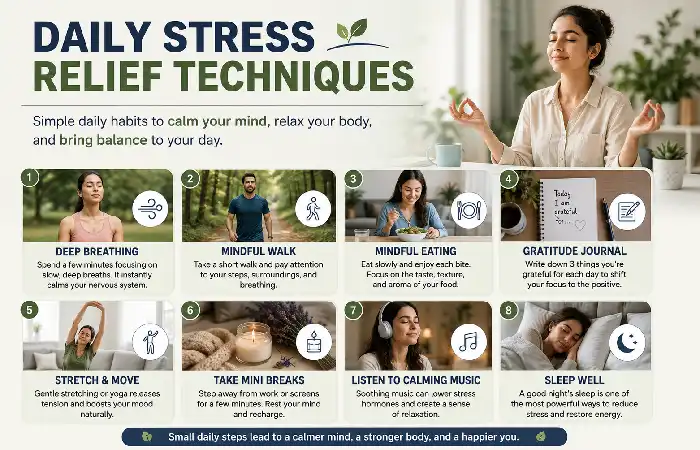
Here are three non-meditative mindfulness activities You don’t have to sit in a formal mediation for thirty minutes each day to be mindful of your present-day reality. In fact, you can even weave simple mindfulness in to what you’re already doing.
1. The One-Minute Mindful Pause
Set aside one minute.
Sit comfortably and notice:
- Your breathing.
- The sensation of your feet or body against the chair.
- Sounds around you.
- Any tension in your body.
- Your current thoughts and emotions.
You do not have to change a thing. Just watch.
2. Mindful Walking
Walking can actually be turned into an easy mindfullness workout.
Turn off your screen and remove the looming thought-list of what you need to get done that day in favour of solely focusing on your walk. Feel your feet sink into the floor as they stride, the cadence of your feet, your ribcage and torso that expand and contract with your breath, and use your different senses to observe the world around you. Even a five-minute focused mindful walk is a real reset!
3. Mindful Eating
Food often serves to disconnect rather than ground us, but not necessarily.
Turn on no television, disconnect your phone completely and use your entire range of sensory faculties to comment upon the appearance of, texture, temperature of, smell of and taste of your food.
Eat each bite slowly and notice when you are feeling full. Mindful eating is not a restrictive diet – it is a practice.
4. Body Scan
Body scan A body scan is simply noticing sensations in the body one by one, moving your awareness from top to toe. Take your awareness to your feet and slowly move it up through your whole body. Feel for warmth, pressure, tightness or release in any parts of your body.
Meditation is another structured way to develop mindfulness and create dedicated time for focused awareness. Explore our mindfulness meditation guide for more information.
So if you are holding a lot of tension in your shoulders, just feel it.
Then gently invite relaxation to be there.
5. Mindful Listening
When you’re having a conversation, make a real effort to listen to other person. Instead of planning what you’re going to say next while the other person is speaking to you, give full and undivided attention to what they say, how they say it and where they hesitate. Allow yourself to note your own feelings and take note of their reactions but don’t just immediately have to respond to them; this is particularly useful at times of stress when there may be communication breakdowns.
6. The 5-4-3-2-1 Grounding Exercise
Your grounded for when you want to have your thoughts somewhere else and just to return yourself to right now. Note:
| Step | What to notice |
| 5 | Things you can see |
| 4 | Things you can physically feel |
| 3 | Things you can hear |
| 2 | Things you can smell |
| 1 | Thing you can taste |
Just modify the exercise for your own surroundings. You want to shift your mind away from your looping, overactive thoughts and focus your awareness on the current moment.
7. Mindful Technology Breaks
Continuous notifications, social media posts, and emails or texts could mean your brain is buzzing all day. When there are periods of no unread communications, why not turn off your notifications temporarily? Focus on one task, rather than flipping between devices. This often turns into mindfulness without you even trying it if you are actively and intentionally present with the activity that is occupying you, instead of reflexively grabbing your phone and losing the moment.
Breathing Exercises
Simply a way to add mindlessness to a busy day: After all, they’re already with you. When we are stressed or nervous, our breathing generally shortens and we increase our respiration rate.
Simply paying attention to our breath and helping ourselves to do this may promote a breath which is more shallow and faster as we begin to breathe intentionally.
Simple Mindful Breathing
Comfortable position of sitting and breathing. (Place yourself in a comfortable, relaxed position for sitting. Either closed your eyes, either a soft focus on the nearest object).
Breathe naturally and observe:
- The air entering your nose
- The movement of your chest
- The movement of your abdomen
- The temperature of the breath
- The sensation of breathing out
There is no need for any consciously deepened breath. Continue as if just observing and following your breath coming in and out on its own. When your thoughts pull you away, gently guide your attention back to your breathing.
Longer Exhale Breathing
Here’s another simple practice: take slightly more time with your exhale. You might inhale gently for a count of four, then exhale slowly for a count of six.
Practice for several smooth repetitions. Avoid stretching to much, do not hold your breath if its uncomfortable – feel comfortable in your stretching.
Box Breathing
Box breathing includes 4 equal sides, that are the breathing and the hold, where you just hold your breath.
- Inhale
- Hold
- Exhale
- Hold
Often people use 4 seconds for each part of the phase, although you can also use less if that feels better.
A number of people use the structured breathing when feeling overwhelmed as it provides something for the brain to focus on.
60-Second Breathing Reset
Got 1 minute? Then try this technique.
In the first 0-15 seconds take note of what breathing is.
Next from 15-30 seconds relax your jaw as well as your shoulders
After another 15 seconds allow your breath in feel relaxed within your mind from 30-45 seconds
The final 15 secs 45-60 seconds, gently bring attention into your bodies attention just once more after the body takes you where its need be. You don’t seek to meditate or find some form of ultimate inner peace just to find a mindful connection back into the present.
Building a Stress Management Routine
You’ll notice greater benefit from practicing mindfulness consistently instead of only when you’re feeling completely overcome.
The ideal mindfulness schedule is one that you’ll be sure to continue doing.
Start Small
If you’re just getting into mindfulness, commit to only five minutes – you’ll feel so much better than failing the goal of meditating 30 minutes a day. Here is a possible daily routine:
| Time | Mindfulness practice | Duration |
| Morning | Mindful breathing | 3–5 minutes |
| Midday | One-minute pause | 1 minute |
| Afternoon | Mindful walking | 5–10 minutes |
| Evening | Body scan | 5–10 minutes |
| Before bed | Slow breathing | 2–5 minutes |
You can change this schedule according to your lifestyle.
Connect Mindfulness to Existing Habits
Make sure that you connect any new habit to an established one that you currently do.
For example:
- Practice mindful breathing after brushing your teeth.
- Take three mindful breaths before checking work email.
- Mindful Walking – even during a short break.
- Bedtime Body Scan.
- Mindful stop before responding to a text message and while experiencing distress.
- These small associations make mindfulness easier to remember.
Don’t Aim for Perfect Practice
Your mind is going to drift. That’s natural.
You’ll sit down to meditate and instantly start pondering what’s for dinner, what work you’ll be facing, money issues or something someone said at lunch. Just because you notice thoughts have a mind of their own is not evidence of not meditating the “right” way; The core of the technique is simply accepting and gently (but consistently) bringing those thoughts back. “Don’t worry if your thoughts waver, and don’t get down on yourself, because your journey back from straying toward present, focused thought counts-a lot.” Blend Mindful Practice with Healthy Regimens mindfulness isn’t a practice alone.
You might have success combining with
- Exercise regularly
- Get adequate rest
- Outdoors Enjoy family time.
- Eat healthy food time, and unplugging.
- Spend time on recreational activities
- Work, sleep, and balance
The key thing about stress management techniques is it is rarely just one technique, and more so about building up many small habits to cope with it.
When to ask for extra help
Mindfulness can be useful for managing day-to-day stress; however it should not replace professional treatment when dealing with ongoing or problematic levels of stress. A professional can be consulted if stress is affecting: your work/ability to function, your relationships, or sleep.
FAQs
I’m not sure how long I should be practicing mindfulness to reduce stress?
There’s not one ‘best practice’ here. If you are just starting out, just a few 5-minute breathing mindful moments can really make a difference and then you can increase your mindfulness practice time if that has made a positive difference. Realistic and short 5–10 minute mindfulness sessions every day is going to be far better that having a 30-minute break every other day.
Will Mindfulness Take Away All of My Stress?
Mindfulness practice is not designed to take away any stressful life situations that cannot be changed; for stress is an element of the human condition that should not be ignored, and when we take a less judgmental approach to these, we get to the bottom of our problems.
Meditation and Mindfulness: Are They The Same Thing?
Mindfulness practice and meditation differ in one specific aspect Mindfulness practices aim for a mental clarity, a level of nonjudgment and a space for observers from the thought the, whereas some meditations aims at reducing and stilling the mind. In other words it depends on the form of Meditation.
What’s the Best Mindfulness Exercise For beginners?
I am not aware of the ideal number for everyone to go over this is one-breath awareness and taking 5 minutes to do simply as above. After this, the most practical, basic and, what has been demonstrated to be quite beneficial is an aware approach the life like.
The most simple form would be the noticing mindful process, by means of conscious, intentional observation with the aid of your normal senses.
When my mind begins to wander during practice, what do I do?
Recognize that your mind may begin to wonder – Mindfulness is not an idea to try not to “turn off,” then do, try again; it actually focuses the attention, “it has all but always started to have come in, a very normal-mindfulness way to have thoughts to the observer the body can get on with what it is doing without reference to anything else other.”
Conclusion
Mindfulness for stress relief doesn’t demand a complex lifestyle overhaul. Instead, it’s about starting simple with an act as basic as taking a single breath, unclenching your shoulders, taking a brief walk in mindful presence, or simply noticing what’s happening around you.
Consistency is where real value comes in. In time mindfulness practice can enable you to identify stressful thoughts and bodily tensions earlier, carve out a gap before you respond, and even relax into redirecting your attention to the here and now.
All that is required is just a few minutes at a time, keep it simple and be kind to yourself- a wandering mind isn’t a failed mindfulness practice but an additional reminder to notice, pause, and start again.