

Mindful Breathing Techniques for Stress Relief and Everyday Calm
 Khizrana Begum
Beauty & Lifestyle Writer
Khizrana Begum writes clear and reader-friendly content covering beauty, lifestyle and related topics.
Read Full Bio of Author →
Khizrana Begum
Beauty & Lifestyle Writer
Khizrana Begum writes clear and reader-friendly content covering beauty, lifestyle and related topics.
Read Full Bio of Author →
 Sameena Begum
Health, Technology & Digital Content Reviewer
Sameena Begum reviews content for clarity, accuracy and overall reader usefulness.
Read Full Bio of Reviewer →
Sameena Begum
Health, Technology & Digital Content Reviewer
Sameena Begum reviews content for clarity, accuracy and overall reader usefulness.
Read Full Bio of Reviewer →
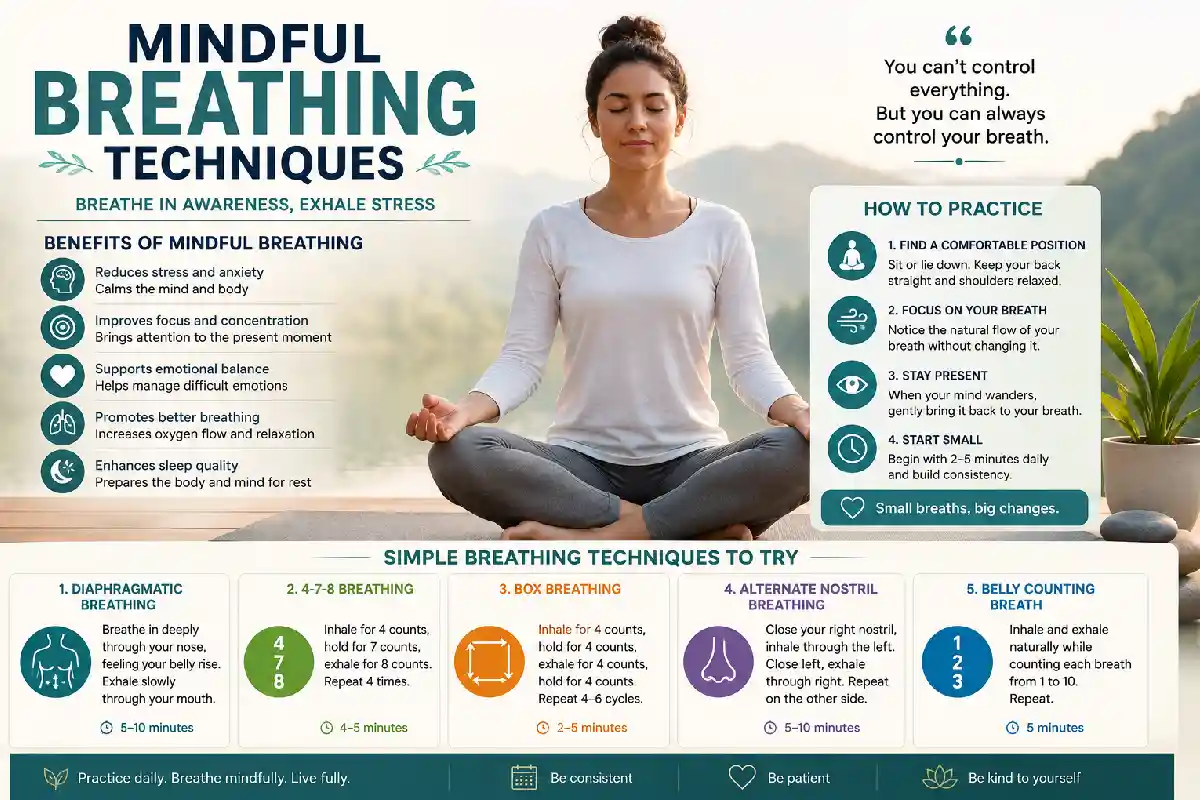
Mindful Breathing Techniques – Breathing into your day. Here’s one easy path toward adding presence to daily life. Breath practices are among the most accessible ways to incorporate Mindfulness in the simplest of forms. Mindful breathing can occur at work, at the desk, while you sleep at night, during your lunch break, or even for a “reset” during the middle of any difficult moment.
How’s it done?
It’s pretty simple.
Just start monitoring your breath, following the rise and fall as you breathe without any judgment, while the process of simple mindful breathing in essence helps to redirect your focus to the present moment
The practice calls for no equipment or a great investment of time.
A couple of minutes of mindful breathing will make a beneficial addition to your overall practice.
| Mindful Breathing Technique | Best For | Suggested Time |
| Natural breath awareness | Beginners | 2–5 minutes |
| Slow diaphragmatic breathing | Relaxation | 5–10 minutes |
| Box breathing | Focus and composure | 2–5 minutes |
| 4-6 breathing | Calming practice | 3–5 minutes |
| Counting breaths | Reducing distractions | 5–10 minutes |
| Mindful breathing before bed | Evening relaxation | 5–10 minutes |
❝
This article is a part of
Mindfulness Guide
What is Mindful Breathing?
Mindful breathing involves purposefully taking the time to just be aware of your breath. Rather than having your awareness absorbed in tasks or in worrying or talking to someone or even just thinking about anything, just pay attention to the physical experience of breathing. Just pay attention to what’s happening as your nostrils fill with air as your chest lifts or falls as your belly rises and falls as you exhale: just pay attention to your breathing in whichever way is easy and natural.
Mindfulness can be practiced in many different ways, depending on your goals, preferences, and daily routine. For a broader overview of mindfulness and its different applications, explore our complete mindfulness guide.
Just notice what you notice about the breath’s quality, whether it’s fast or slow or deep or shallow, strained or open-ended. With mindful breathing, all practice, not perfect performance! Don’t try to alter your breathing when simply noticing.
A beginner’s exercise of mindful breathing could look a bit like this:
- Find any comfortable pose where you will be on your back or seated. Relax your shoulders and jaw (a big sigh might help).
- Place your awareness on the rise and fall of your breath, both the inhale as it enters your body, and the exhale.
- Pay attention to each in-breath and the out-breath as well.
- Your attention will surely drift away from the breathing – it always happens, and there is no need to scold yourself for it.
- When the attention begins to roam…just lovingly and gently guide it back to observing the breath; each time you do, you are mindful.
Mindful Breathing vs. Ordinary Breathing
Your breathing takes care of itself throughout the day. Conscious attention on your breath as part of a focused relaxation exercise is all that we will do.
| Ordinary Breathing | Mindful Breathing |
| Usually automatic | Intentional attention is added |
| Often unnoticed | Breath sensations are observed |
| Attention may be elsewhere | Attention returns to the present |
| No particular goal | Focus is placed on awareness |
| Happens continuously | Can be practiced for a set period |
Breathing thoughtfully means to change not each breath but to notice what happens.
Benefits of Breath Awareness

If you are looking for mindfulness practices that can help you create a calmer routine during stressful periods, explore our mindfulness practices for stress relief.
Integrating awareness of one’s breath would also serve as a good addition to a mindfulness practice. All you have to have for a breathing exercise is no props, special setting or accessories. When practiced on a regular basis this may enhance relaxation, focus, awareness of your emotions, and sense of presence.
Encourages relaxation
The act of intentionally slowing down and observing your own breath creates a space between you and whatever demands are being made at that given moment, making a breathing exercise beneficial for moments of stress or a hectic schedule. A few moments of breathing silently can give the individual permission to disengage from external stimuli and ground attention within yourself and your breath.
Supports awareness in the present moment
The mind can frequently become distracted throughout the day. However, the breath is a direct pathway to awareness, for as you inhale and exhale, you can feel this present moment phenomenon occurring between yourself and what may be happening at that very moment. You may find it helpful to focus your attention back toward your breath, which should then pull it back to wherever you are and whatever is happening at that very second.
May improve focus
Simply using your breath as an anchor to return to when distracted requires your attention, and this mental task when repeated will in due time allow the person to easily turn attention back where the mind needs it to be.
Helps acknowledge physical tension
The body sends clues regarding your experience of the present moment, as you breath be open to sensations throughout your body; tight shoulders, tense muscles, faster than normal breathing rate. Once you recognize that the body is carrying tension you can take action by breathing and consciously letting go of muscle tightness.
Can facilitate the use of the evening routine
A short breathing exercise fits into a bedtime ritual nicely. Rather than use screen time or continue working throughout your evening until bedtime, dedicate just a few moments to conscious breathing. As with anything though, although breathing can assist with sleep problems it can also be a component that supports healthy sleep.
Encourages self-awareness
Physicality and emotionality may alter your perception of your own breathing. You may breathe faster when agitated and shallow when nervous. As you observe yourself and how you breathe without judgement, you will be much more aware of and can recognize these patterns in your body.
Simple Breathing Exercises
The way mindful breathing is practiced can vary. A novice must begin with the easiest and most natural way to achieve deep and steady respiration.
1. Natural Breath Awareness
The simplest technique of them all. Sit comfortably. Breathe naturally – feel the air going in your body – into the mouth or nose and feel your breathing moving between your nostrils, chest and abdomen.
Mindfulness exercises can also be incorporated into routines focused on becoming more aware of anxious thoughts and emotions. Our mindfulness guide for anxiety provides additional ideas to explore.
If your mind is wandering – acknowledge the wandering and come back to the next breath.
Do it for two to five minutes at first.
2. Counting Your Breaths
Counting can provide an anchor for an easily distracted mind.
Try counting each complete breath:
Inhale and exhale = one breath.
Count to 10 and then start again from 1. If you lost track, do not be critical and just go to one and start counting again.
| Step | Action |
| 1 | Sit comfortably |
| 2 | Take a natural breath |
| 3 | Count the complete breath as one |
| 4 | Continue counting to 10 |
| 5 | Start again from one |
| 6 | Gently redirect attention when distracted |
3. Slow Breathing
Take your time and slowly make your breathing more pleasant and unhurried: try breathing out for six seconds and in for four seconds. Don’t force yourself if the breathing doesn’t feel relaxed or comfortable the number second for breathing out isn’t super important, more the relaxed feeling.
Some mindfulness techniques can be especially useful as part of a relaxing evening routine. Learn more about incorporating mindful habits into your nighttime routine with our mindfulness practices for better sleep.
4. Box Breathing
Box breathing consists of 4 even stages: Inhale pause, exhale pause. A typical four- second for each phase is prescribed, but if that’s not feasible for some users, they should adjust their timing.
| Phase | Example |
| Inhale | 4 seconds |
| Hold | 4 seconds |
| Exhale | 4 seconds |
| Hold | 4 seconds |
Do it for several rouinwith a comfortable position. Those who can’t hold their breath comfortably can pick up an alternative method to breathe.
Mindfulness does not have to be limited to dedicated practice sessions. You can also use simple awareness exercises during your working day with our mindfulness practices for work.
5. Abdominal Breathing
Diaphragmatic breathing – Also known as abdominal breathing. This means that you let your stomach move freely and naturally as you breathe. Lie back or sit in a comfortable position. Have one hand resting on your stomach and the other resting on your chest.
Breathe naturally to feel the rise and fall of both. Don’t puff the stomach out or make a tremendous effort. You just want to be aware of what is happening.
Using Breathing During Stress
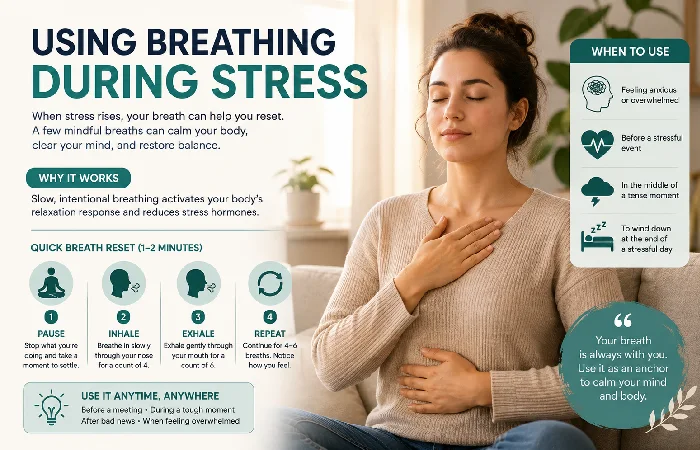
Stressed out, it’s hard to think straight, or just be here, there’s a breathing pause, that offers and easy break to an automatic response: Here’s how to catch this, “when I am…”, then try to:
Meditation is one of the most structured ways to practice mindfulness and develop focused awareness. Explore our mindfulness meditation guide to learn more about incorporating meditation into your routine.
Pause → Notice → Breathe → Return
As you feel that, stop your activity if you can. See what your body feels like. Notice your breathing and let a few more conscious breaths drift through. Notice you can then return to the situation more effectively.
A One-Minute Breathing Reset
Almost anywhere: A simple breathing reset. You could take this mini-reset at your desk (or anywhere).
Inhale: Focus on your posture and comfortable breathing (20 seconds).
Inhale: Notice the feelings in your body while breathing (20 seconds).
Inhale: Release tension in your shoulders and relax.
Breathe normally, enjoying the breath (20 seconds).
How is this an easy habit?
The breathing reset is so quick that you can implement it between appointments, during work breaks, or right after you’ve come out of a tough meeting or faced a stressful situation.
Breathing Before a Difficult Situation
Practice mindful breathing ahead of typical stressors like presentations, discussions with your boss, exams, or busy meeting times. Instead of trying to cancel all the anxious thoughts that fly through your head, use the breathe as a cue to pause and pay attention.
Don’t Force Your Breath
However, not all breathing can be better breathing. Very deep and fast breathing can cause discomfort or a light headed sensation in some of the participants. The best thing for any general mindfulness practice, is breathing slow and comfortable. If you start feeling very light headed, have chest pains or trouble breathing or whatever other symptoms arise then the exercise needs to stop.
Building a Daily Habit
Consistency, not necessarily the technique, is a difficult point of mindfulness. You do not need long periods of training to start building a ritual. Begin with short sessions, only 2 to 5 minutes, and as you feel more comfortable, extend it over time.
Choose a Regular Time
By tying mindful breathing into a established habit it should be more readily remembered.
For example:
- After waking up
- Before starting work
- During a lunch break
- After exercising
- Before bedtime
- After turning off electronic devices
Create a Simple Routine
“What a typical day could look like:
| Time | Practice | Duration |
| Morning | Natural breath awareness | 3 minutes |
| Midday | One-minute breathing reset | 1 minute |
| Evening | Slow mindful breathing | 5 minutes |
| Before bed | Quiet breath observation | 3–5 minutes |
Don’t have to do it all. Do whatever you can fit.
Consistency is key
Skipped one day so I’m failing? Take it again tomorrow.
Meditation is not to enter a state of calm. Mind-fullness is not to reach pure rest. It’s the repeatedly noticing where your mind is, bringing it back to its place.
Make It Comfy
This could be on a comfortable chair, a pillow, a mat, anyplace that you can sit more or less undisturbed with natural, awake but relaxed posture. Whether your eyes are closed or not are up to you. Maybe they are a little, softly open, perhaps closed, maybe shut completely, who says?
Frequently Asked Questions
How much time should i spent practicing mindful breathing?
For beginners, two-five minutes. Once it comes natural, you will find 10 (or even more) works well. It’s important not to use “all or none” to determine if the practice is successful.
Is mindful breathing another way to do meditation?
Mindful breathing (aka breath awareness) could be a part of meditation, which can mean many things (scan of the body, loving-kindness meditation, Vipasana, Kirtan…); any practice directed toward bringing awareness, focus, clarity; a space between us all.
Is mindful breathing portable?
With just awareness of the breath, YES! You could take to anywhere you’ll be able to dedicate few moments in solitude-a commute, an office break, while working-class at your computer, a relaxing stop at house. Just ensure you’ll do the work in a safe, peaceful atmosphere.
During meditation, I need to breath deep, do i?
The trick isn’t to attempt to deepen or broaden the breath; just observe what’s normally happening. Any alterations you add, simply acknowledge them too.
What do i do after my thoughts wander from breath meditation?
Whenever you notice that your mind has wandered from the breath or a point of awareness, just bring your awareness back, or gently, return your intention to the present point. There is no good/poor mindfulness – there can ONLY be awareness.
Will meditating breath calm me during an episode of stress?
Mindful breathing can serve as a quick way to bring yourself into the present, when going through tension. Use it in these moments as a form of personal attention. It is not meant to be a substitute for professional support in acute or chronic psychological conditions. It may help to breathe mindfully before going to sleep. When sleep is approaching, you might want a time to wind down. Mindful breathing will help you with just that. Just make sure the exercise remains comfortable and not over-stirring.
What if I’m feeling unwell/unpleasant during a breathing exercise?
Take an immediate pause and return to your usual breathing form. You might feel unusual on while holding your breath for extended amount of time or changing the breath pattern. If the issue be new or persisting in nature, please seek expert medical help right away.
Key Takeaways
With this practice, anyone can establish a habit of mind-full awareness that fits naturally into the demands of daily life. Be mindful of their breath and they will quickly find a pause: an open area of rest where they can check within themselves and then returning into life, more connected, calm and present.
For starters, one doesn’t always practice complex breath meditations; one only practices being mindful. Just to take a number of mins at a time at once at intervals; one can implement mindfulness of their own breathing naturally, at a moment. You could develop this personal mindfulness into your Morning/evening routines or simply take a couple of time from your day for some simple natural mindfulness of the air. The primary, vital precept here is straightforward: Breathe comfortably, awareness, gently return.