
Mindfulness at Work: How to Stay Focused, Calm, and Productive
 Khizrana Begum
Beauty & Lifestyle Writer
Khizrana Begum writes clear and reader-friendly content covering beauty, lifestyle and related topics.
Read Full Bio of Author →
Khizrana Begum
Beauty & Lifestyle Writer
Khizrana Begum writes clear and reader-friendly content covering beauty, lifestyle and related topics.
Read Full Bio of Author →
 Sameena Begum
Health, Technology & Digital Content Reviewer
Sameena Begum reviews content for clarity, accuracy and overall reader usefulness.
Read Full Bio of Reviewer →
Sameena Begum
Health, Technology & Digital Content Reviewer
Sameena Begum reviews content for clarity, accuracy and overall reader usefulness.
Read Full Bio of Reviewer →
Mindfulness at Work: Do you ever reach the end of a complete working day and can hardly remember what you’ve accomplished? Working amidst all of the emailing, meetings, alerts, deadlines, and task-hopping it is overwhelmingly easy to go through our working day in a semi-conscious autopilot state.
Mindfulness at work is a method to zoom out, center yourself in the here and now, and take a more conscious and responsive approach towards work and others. It doesn’t require hours of meditation nor big commitments in terms of time and energy. Several mindfulness techniques used throughout your workday would give you skills to work in a more aware, relaxed, and valuable manner.
❝
This article is a part of
Mindfulness Guide
Benefits of Mindfulness at Work
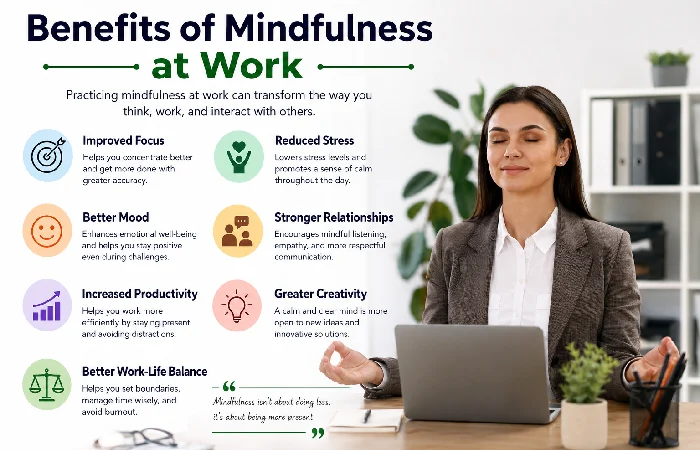
Mindfulness, in it’s most basic form, is defined as “the awareness of where one’s attention is on an hour-by-hour basis”. For the work environment this could apply to something as simple as actually hearing what others are saying in a meeting, committing your full attention to only ONE part of a task (not five or six at once) or even a proactive acknowledgement of mounting tension before it becomes an overwhelming disaster.
The long-term result of employing a mindful approach is simply a more manageable workday.
1. Increased concentration
Trying to multitask may seem like an infinitely productive thing to do but instead the constant “switching” between tasks can be detrimental to your concentration and product quality. Mindfulness means truly dedicating your complete attention to whatever task you’re engaged in.
A classic example here is working on a report and finding your attention continually wavering to check emails that may arise, then returning to the report just to immediately return again to your email or another task. Mindfulness would advocate finishing a particular part of the report then dedicating time to attending to your inbox and subsequent reply to emails.
2. Reduced Workplace Stress
Most workplace stress develops due to you considering everything you must do on your plate at once. Mindfulness involves bringing your attention back to the specific task that’s in front of you. Even just taking three or four long, slow breaths before answering a resentful, accusatory email will give you the space to respond appropriately rather than having an emotional one.
3. Enhanced Emotional Awareness
Regarding your emotions: With mindfulness, you will not be bombarded, yet you will gain an understanding.
You’re able to pinpoint exactly what you’re feeling-frustration, anxiety, anger, exhaustion- before the aforementioned emotions affect how you communicate, behave, or deal with a project. This type of awareness will be very useful during disagreements, as well as demanding and crucial moments in projects and negotiations.
4. Improved Workplace Relationships
Stronger relationships on the team If you were to actually be there to listen (to actual conversations), coworkers would begin feeling more heard and not dismissed. Active participation can help resolve a lot of workplace tension and foster teamwork.
5. Increased Job Satisfaction
A distracted workplace often leads to a highly demanding workday. Remaining fully aware and grounded will help you feel more engaged and connected to your job; as such, work should no longer feel entirely exhausting.
| Workplace Benefit | How Mindfulness Can Help |
| Focus | Encourages attention on the current task |
| Stress management | Helps you pause before reacting |
| Communication | Supports active and attentive listening |
| Productivity | Reduces unnecessary task switching |
| Emotional awareness | Makes it easier to recognize reactions |
| Teamwork | Encourages patience and understanding |
| Work-life boundaries | Helps create intentional transitions |
Staying Focused During the Day
One of the most useful applications of mindfulness in the workplace is improving our ability to concentrate. You need not be a Zen master in order to focus no attention but what can, at work, be honed is the ability to know if the mind is meandering and gently pulling back.
Start With One Clear Priority
Your priority for the first few hours of the workday is that most crucial thing you must get done – gives you focus.
Ask:
“What is the one thing I would feel good about completing today?”
While you can knock off few little loose ends from your ‘to-do’ list, to make sure your day doesn’t just become an email-notification service.
Practice Single-Tasking
Do one thing for some time. If you are on a browser close everything you are not on. Turn off notifications.
Don’t look at your phone.
If your mind Wanders just notice it and come back to the task. Bringing the mind back is the activity of mindfulness.
Use Short Mindful Pauses
Give your brain a 30-60 second break without getting up:
- Notice your breath,
- Your posture,
- Any tension in your shoulders and jaw,
- Any noises,
- What is your brain thinking about
- And then start working again.
Try the 3-Breath Reset
Before you start the task take three breaths in deep from your body.
You breath in and relaxed body
Breathe in for the second breath and recognize what thoughts pass through your mind.
Breathe in for the third breath and acknowledge the task that you’re embarking on.
This exercise takes less than one minute, but helps distinguish from task to task.
Managing Workplace Stress

While many jobs create stress, continuously working in a high-stress environment often hinders us to see and communicate with clarity. It is not to say Mindfulness magically solve job pressures, but rather helps approach the pressures in a mindful way.
Notice Early Signs of Stress
Notice your physical & mental signals:
- Tensed shoulders.
- Shallow breathing,
- Racing thoughts
- Problems with concentration
- Hurry
- Checking messages every so often
Catching these early warning signs buys you a chance to stop.
Pause Before Reacting
If someone sent you an email that got you enraged,
What’s your first reaction?
Think of an insult, and maybe have an exchange and go at each other.
Before hitting that respond button or even writing an email of your own though, take some time.
Take some deep breath’s.
Maybe even walk away from your desk if you have the ability. Once you are back and if you still feel a need to discuss the email, you are more apt to be doing so in a level-headed way.
Separate Facts From Assumptions
Your Workplace stress can be higher when we fill in gaps with assumptions.
For example:
My manager did not reply; therefore, they must be mad about my job. This is an assumption as well as a personal interpretation and is not necessarily fact. Mindfulness enables us to identify the thought without acting upon it as if it were real.
| Stress Trigger | Mindful Response |
| Difficult email | Pause before replying |
| Heavy workload | Identify the next manageable task |
| Workplace disagreement | Listen before responding |
| Back-to-back meetings | Take a short breathing break |
| Constant notifications | Turn off nonessential alerts |
| Feeling overwhelmed | Stop and assess priorities |
Mindful Communication
It isn’t just about selecting words and using your brain. But, It is about listening skills and reaction time. Your perception of another person. Mindful communication involves active listening where you are at the point while the other individual speaks instead of just thinking what to say and how to say.
Listen Without Interrupting
Try and listen when people is talking but really to the person and not the your answers for questions he or she ask. Listen to their tone, pitch, worry etc.
Ask if anything doesn’t make sense. Don’t assume.
Think Before Speaking
You could try to stop and really have athinkabout what is about to come out of your mouth – particularly on a topic close to your heart. Is it true? Is it worth saying?
Is now the right time?
Can I say this more kindly?
All this isn’t to say that we shouldn’t have honest discussions; just be mindful of them.
Practice Digital Mindfulness
What works naturally on people and in everyday speech may prove ineffective when putting it in an email or text because it does not translate an expression or tone of voice. When composing a message of importance, read over it a first time before you hit ‘send’. Make sure you review the message for tone of language.
For instance, words that may cause unintended perceived harshness, aggression, or lack of clarity.
Take those few extra seconds to stop it from having an unnecessary 2 days of misunderstanding.
Creating Healthy Work Habits
Mindfulness works great when incorporated into your day-to-day rather than only being applied when stressed. Try habit stacking around items you already have on your workday.
Create a Mindful Start
Take a minute or two to decide your main goals rather than having all the notifications open at the earliest opportunity. Look at the schedule, see what your urgent tasks are, and then continue.
Take Real Breaks
A real break should mean really breaking away. If it’s something you can, step away from the computer. Stand up and stretch; walk a bit; get a drink of water; just sit quietly and do absolutely nothing for a minute or two. Short breakspush the fog back significantly.
Eat Mindfully
When you’re accustomed to eating lunch while dealing with email, take time to create opportunities for separate mealtimes. Focus on your food and eat slowly to experience a true break.
Set Boundaries
Mindfulness also involves recognizing that the job is going to run your entire day. Keep a basic transition out of work: write down what work tasks you can’t do today, brainstorm your goals/work priorities tomorrow, exit your computer programs, leave your workstation.
This helps distinguish between work and personal life.
Build a Simple Mindfulness Routine
| Time | Mindful Habit |
| Start of work | Choose your main priority |
| Before a meeting | Take three slow breaths |
| During work | Practice single-tasking |
| Midday | Take a screen-free break |
| During conversations | Listen without interrupting |
| During stressful moments | Pause before reacting |
| End of work | Review tasks and disconnect |
A Simple 5-Minute Mindfulness Practice at Work
Practice mindfulness incrementally if you’re a beginner.
Minute 1: Settle yourself in to your favorite sitting position, and do absolutely nothing but breathe.
Minute 2: Now observe your body. Is your jaw-face, neck, hands, shoulders-tight?
Minute 3: Notice your thinking mind. However, don’t aim to make anything clear.
Minute 4: After thoughts go running a marathon after the present, bring your attention back to your breath.
Minute 5: And commit yourself to what to do next.
Practice either at your workstation, in the most peaceful environment you can discover or on a quick break from that job that holds you tight! The intention is not clear in the mind: That purpose may be nearly impossible to grasp in the present moment. Rather, try to locate exactly where you are, right now, in time to, in the appropriate amount of time, softly, guide yourself back to wherever your intention would have you to be.
Common Mistakes When Practicing Mindfulness at Work
Mindfulness should not be another ‘thing to get right. Just don’t be frustrated that you are not “mindful” of your life 24/7; that is unrealistic. You are bound to get stressed, overwhelmed, and just down.
Avoid trying to multitask.
Don’t expect immediate benefits. Don’t think of it as a fix for workplace problems. Don’t expect to be a perfectly serene meditator for two hours every day. Don’t get hung up on your wandering thoughts.
Don’t ignore boundaries about workload and breaks.
Mindfulness is a practice. A couple of minutes regularly will get better than a wildly optimistic plan.
FAQs
What is mindfulness at work?
What mindful work really involves is directing your focus to your current activities in the present moment. This is anything from complete project devotion, a period for conscious breathing, functioning as an outstanding listener, and even pausing to take a second to touch base prior to responding to the tough obstacle of a project at work.
Can mindfulness improve productivity?
How does this get you more work? You will stay concentrated. It will reduce interruptions you do not wish. It enables you to do stuff with more awareness. It’s not just about working non-stop – mindfulness is about devoting your attention to the thing that you have work to do.
How can I practice mindfulness during a busy workday?
Think of little habits: three breaths before your meeting, do one thing at a time. Short screen-free breaks. “Stop for a moment before answering” stressful text messages.
How long should I practice mindfulness at work?
It is not defined as exact minutes required; even one or two minutes will help as a first practice for starters. Try to keep consistency and practice mindfulness during the normal course of the day.
Does mindfulness mean ignoring workplace problems?
No, mindfulness does not imply ignoring the problems as if they don’t exist. It helps to respond to issues in a conscious and less knee-jerk reaction way. This should not be interpreted as lack of action when there is work, harassment, safety or organizational issues.
Final Thoughts
A tranquil office or a dedicated quiet room is not necessary. It is possible to cultivate presence at work on a much smaller scale, as when one takes one single breath prior to reading the subject line of an email, is attuned to someone else’s contributions in conversation, or is entirely focused upon task completion.
Just a few small shifts in how we conduct ourselves at work can make our day much less reactionary, and more intentional.
You can make one change, maintain that behavior for a week, then consider adding the next, and so on. We’re not necessarily shooting for a workplace entirely free of stress here. We are shooting for being far more aware as to how you do business, connect with colleagues, react and take care of yourself throughout your day.