

The Complete Guide to Mindfulness: Benefits, Practices, and Everyday Techniques
 Khizrana Begum
Beauty & Lifestyle Writer
Khizrana Begum writes clear and reader-friendly content covering beauty, lifestyle and related topics.
Read Full Bio of Author →
Khizrana Begum
Beauty & Lifestyle Writer
Khizrana Begum writes clear and reader-friendly content covering beauty, lifestyle and related topics.
Read Full Bio of Author →
 Sameena Begum
Health, Technology & Digital Content Reviewer
Sameena Begum reviews content for clarity, accuracy and overall reader usefulness.
Read Full Bio of Reviewer →
Sameena Begum
Health, Technology & Digital Content Reviewer
Sameena Begum reviews content for clarity, accuracy and overall reader usefulness.
Read Full Bio of Reviewer →
The Complete Guide to Mindfulness: Mindfulness is a remarkably easy method for getting your head screwed back on properly – being clear, feeling more relaxed and not letting your thoughts and feelings get on top of you.
In our hyper-connected and always on the run world it’s not uncommon for us to feel like we spend most of our day worrying about the future, ruminating on the past, or generally feeling like our minds are elsewhere than this exact moment in time. Mindfulness is a way to guide that mental focus back.
If you are: a first-time learner new to the concept of mindfulness, a long time practitioner interested in understanding the process of it more deeply, interested in learning the science behind Mindfulness and its amazing benefits; I encourage you to take a read through this ultimate mindfulness beginners to beyond guide which will not just make you aware of all the concepts but will help you embrace Mindfulness practices in your life seamlessly!
❝
This article is a part of
Mindfulness Guide
What is Mindfulness?
Being in the moment, mindful, and nonjudgmental is known to bring calm. Instead of feeling your head buried in thoughts about the past or future, being in the moment means that you are more concentrated on the current situation. You are more aware of what is happening in the given moment without an obligation of any nature that you should act on or adjust to those feelings, thoughts or the experiences in the present moment.
Mindfulness can be practiced in different ways depending on your goals, lifestyle, and daily challenges. For a complete overview of mindfulness practices and their potential benefits, explore our complete mindfulness guide.
Enjoying a hot cup of tea you might just allow your mind to focus only on the warmth and smell, the taste and the physical sensations each time you take a mouthful to swallow. Having a perfectly blank mind is the aim, not so much to push out thoughts, rather noticing their rise as they emerge then returning again to the situation.
If stress is affecting your daily routine, simple mindfulness practices may help you create a calmer approach to everyday challenges. Explore our mindfulness practices for stress relief for practical ideas.
Key Components of Mindfulness
| Component | Description |
| Awareness | Noticing thoughts, emotions, and sensations |
| Presence | Focusing on the current moment |
| Acceptance | Observing experiences without judgment |
| Intention | Choosing where to place attention |
| Compassion | Treating yourself kindly during challenges |
How can mindfulness be used?
You can work through meditation as a formal practice and include mindfulness in everyday life: meditation, breathing, walking and more. You may start mindfulness with simple meditation that focuses your attention on anything.
The Science Behind Mindfulness
While it’s thousands of years old, there’s a great deal of cutting-edge science taking place to understand the effects mindfulness practice has on your mind and your body. Here’s a look at the research currently underway (and completed!) and what science says about mindfulness.
How Mindfulness Impacts the Brain?
Over the past several decades, an increasing amount of study in the fields of psychology, neuroscience, and medicine has begun to shed light on just what impact a mindfulness practice can have not only on your brain, but on your body and overall health.
Mindfulness can also be incorporated into routines focused on managing anxious thoughts and promoting greater awareness. Our mindfulness guide for anxiety explores practices that may help you develop a more mindful routine.
And results are in: it’s good stuff. Mindfulness trains the mind to pay attention to and be aware of what’s going on around you and inside you. Mindfulness is the training of the mind to pay attention to the present. Though it sounds relatively easy, learning how to apply this training can have some major benefits due to the changes it produces in your brain.
The human brain loves to predict the future and recall the past. While this provides us with incredible ability, a constant stream of this prediction of the future and past can cause a slew of anxiety and “thinking.” Mindfulness practice helps break through automatic thought processes with a focus that builds your awareness and self-regulation. Researchers have been observing an improvement in various neural regions through MRIs.
| Brain Region | Function | Impact of Mindfulness |
| Prefrontal Cortex | Decision-making and concentration | Better focus & self-regulation |
| Amygdala | Stress and fear responses | Reduced emotional reactivity |
| Hippocampus | Learning and memory | Enhanced memory and emotional resilience |
| Insula | Self-awareness and body awareness | Increased awareness of emotions and sensations |
| Anterior Cingulate Cortex | Attention regulation | Better focus and cognitive flexibility |
So these may indicate that mindfulness is an efficient way to help people become more perceptive, less reactive, and better able to cope with the unpleasantness in life.
Neuroplasticity and Mindfulness
A consistent mindfulness practice can also be part of a relaxing evening routine. If you want to learn more about mindful habits for nighttime, explore our mindfulness practices for better sleep.
Probably the most thrilling scientific findings related to mindfulness concerns neuroplasticity which means that the adult brain can reorganize itself, to build new neural pathways.
For a long time scientists considered that the adult brain was relatively static. Now they have found that our experiences and actions are capable of molding the neural pathways of the brain. Mindfulness is to the brain, what weight training is to muscles – it reinforces the pathways of neural pathways associated with attention, emotional regulation, and attention.
Daily practice of mindfulness can help you to:
- Raise the number of positive thoughts
- Improve focus
- Reduce automatic stress responses
- Develop emotional resilience
Even just a few minutes each day, when added up regularly, will create massive amounts of change in your life for the positive!
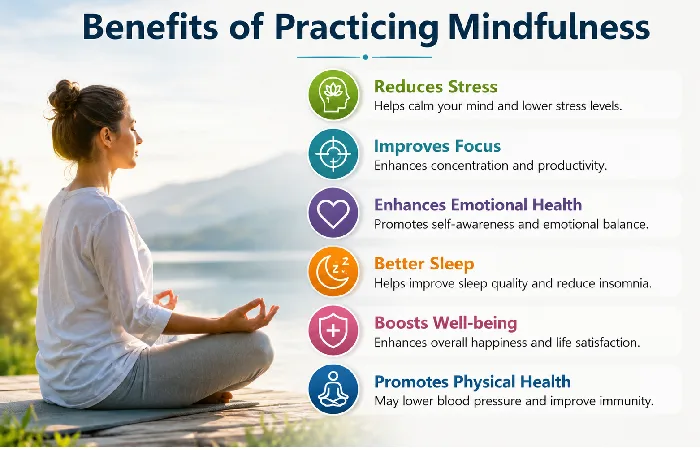
Benefits of Practicing Mindfulness
| Area of Life | Benefits |
| Mental Health | Enhanced Focus, Concentration and Clarity of Thought |
| Emotional Well-Being | Lowered levels of stress, anxiety, and emotional reactivity |
| Physical Health | Reduced anxiety and blood pressure, and good rest |
| Relationships | With greater understanding, kindness, and conversation. |
| Work & Productivity | Better decision-making and improved efficiency |
| Self-Awareness | Greater understanding of thoughts and emotions |
| Resilience | Enhanced ability to cope with challenges and setbacks |
Your life can be positively transformed through consistent practice of a few minutes each day.
How Can Mindfulness Improve Your Mental Health?
This gives you much more awareness of your thoughts, feelings, and practices, which is how you make mindfulness work for you to promote your mental health. Mindfulness helps increase your self-awareness. It helps to equip you with the abilities you need to step away from the immediate automatic responses to stress, anxiety and negative thoughts, and allow yourself to witness these feelings as an independent observer with non-judgmental acceptance of what is there, which leaves you with time in which to decide whether you respond to that thought and behaviour and allows for more effective emotional regulation to take place.
Functioning at a higher current present moment level can be achieved through regularly using the techniques related to mindfulness, as shown they help reduce levels of anxiety, stress, and depression. Anxiety and depression are sometimes a result of obsessive thinking regarding the future or memories. Mindfulness allows one to enter a controlled present moment and in doing so regain control of the self and reduced sense of overwhelming anxiety. There is some evidence it reduces resilience, self awareness, and psychological well-being.
There are many ways to practice mindfulness, from focused breathing to body awareness and other exercises. Explore our mindfulness techniques and exercises to find approaches that fit your routine.
Mental Health Benefits of Mindfulness
| Mental Health Challenge | How Mindfulness Helps |
| Stress | Reduces mental tension and promotes relaxation |
| Anxiety | Decreases excessive worrying and fear-based thinking |
| Depression | Helps break cycles of negative thoughts and rumination |
| Emotional Overwhelm | Soothes and observes. |
| Low Self-Esteem | Encourages self-compassion, and self-awareness |
| Burnout | Supports recovery through increased awareness and balance |
| Poor Focus | Strengthens concentration and attention skills |
Through the frequent cultivation of mindfulness skills, an individual can foster better ways of coping and, thereby enhance his/her general mental and emotional health.
Mindfulness for Physical Well-Being
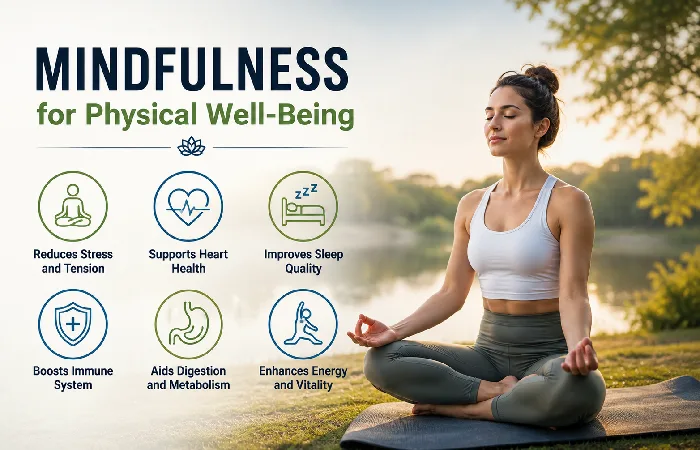
While mindfulness is used most commonly in relation to mental health, there are also advantages to physical mindfulness. The physical body functions more smoothly when mindfulness is engaged and the present moment is centered upon, since stress is reduced. In addition to physical symptoms that include headaches, muscle tightness, upset stomach, and fatigue, chronic stress will likely result in a lack of sleep.
Mindfulness techniques like meditation, body scans, and deep breathing may all encourage the relaxation response and help reduce the risks associated with physical health disorders.
There is even evidence to suggest that the most directly perceived benefit from practicing mindfulness meditation is that the relaxation response begins to occur, which leads to reduced heart rate and blood pressure along with lesser amounts of body cortisol production.
Mindfulness does not have to be limited to personal time. You can also incorporate simple practices into your professional routine with our mindfulness practices for work.
It is also correlated with improved sleep habits and more body awareness, in addition to healthier decisions such as not overeating due to stress. Individuals who practice mindfulness will become more attuned to their body’s cues of hunger, of discomfort, and when they need rest or to move more. Mindfulness can also be a component in dealing with pain because you learn not to react immediately to physical stimuli. It can go well together with a healthy lifestyle, but don’t let it substitute the use of medicine and treatment by the doctor.
Physical Benefits of Mindfulness
| Physical Health Area | Potential Benefits of Mindfulness |
| Heart Health | May help lower blood pressure and heart rate |
| Sleep Quality | Promotes relaxation and better sleep |
| Muscle Tension | Encourages physical relaxation |
| Immune Function | Aid general health and resilience |
| Digestion | Promotes improved digestion associated with stress relief. |
| Pain Management | Improves coping with chronic pain |
| Energy Levels | Helps reduce fatigue caused by stress |
Regular mindfulness can give you a greater sense of mind and body connection that increases well-being.
Different Types of Mindfulness Practices
There are countless ways people around the world practice mindfulness day in and day out. People’s practice might have a particular focus — movement, eating, breathing, or even generating certain emotions—but all of their efforts point to the same desired outcomes: awareness, focus, emotional balance, and presence.
For those who want a more structured form of mindfulness practice, meditation can be a useful approach to explore. Our mindfulness meditation guide provides additional information on incorporating meditation into your routine.
What we want to aim for through Mindfulness practice Is to cultivate the practice of simply pay(with openness) attention without judgement. The amount of time that you invest in your practice does not matter! A mindful meditation is far better than a non-mindful one… five minutes focusing on breathing or a short period of Mindful walking during your lunch break will work just as effectively!
Common Types of Mindfulness Practices
| Mindfulness Practice | Description | Main Benefit |
| Mindful Breathing | Concentrating your thoughts on your breath | Decreases and enhances stress levels can enhance attention |
| Body Scan Meditation | Body sensations: Scanning the body for any unpleasant sensations | Improve body awareness |
| Mindful Walking | Concentrated on each step and action | Increases relaxation and presence |
| Mindful Eating | Fully experiencing the taste, texture, and smell of food | Increases awareness of eating habits |
| Loving-Kindness Meditation | Sending well-wishes to you and others. | Builds compassion and empathy |
| Mindful Yoga | Synchronizing movement with present moment awareness. | Improves flexibility and calmness |
| Mindful Listening | Paying rapt attention when talking | Boosts verbal and written communication skills |
Once you become more accustomed to a variety of different Mindfulness techniques, you’ll know which are most effective, natural and useful for daily practice.
How to Practice Mindfulness Every Day?
A daily dose of mindfulness may help manage symptoms of problems related to stress. Don’t feel that you need to spend hours per day meditating!
Just try to implement 5 to 6 short mindful moments throughout your routine and you’ll notice a reduction in stress levels, improvement of your attention, and many more benefits regarding your well-being. Bring your awareness into every part of your daily life: while walking, while washing dishes, while listening…while doing whatever you discover you can. You can bring your awareness to anything just by bringing your attention to what is present in your current situation. Don’t blast yourself into your morning headfirst using your phone: use some of your breath as an anchor instead.
Simple Daily Mindfulness Practices
| Activity | Mindful Practice |
| Morning Routine | Take three to five deep breaths and begin. |
| Eating | Concentrate on flavors and textures, and every bite. |
| Walking | Notice your steps and surroundings. |
| Working | Just take a 1- minute breathing break each hour |
| Conversations | Listen intently and let him talk. |
| Exercise | Pay attention to body movements and sensations. |
| Evening | Reflect on three positive moments from your day |
Tips to Build a Mindfulness Practice
- Try to focus on one task and practice mindfulness through it.
- Begin with 5 minutes of mindful action daily.
- Use alarms or mindfulness apps to cue you to do a mindful action daily.
- If you lose practice, just get back on track!
Using these habit-building tips, your chosen 5 minutes of mindfulness could turn into a mindfulness habit over time.
Mindfulness Meditation for Beginners
Another fairly simple practice in mental training is mindfulness meditation; when used to relax, its objective is to use your full attention on a certain phenomenon in the environment; when your attention stray, gently brings it to the element chosen in this manner is typically chosen because it remains stable and ever-changing. Often, the element chosen is respiration; otherwise, the practitioner focuses their attention on an object, place, or sensation currently in their sensory field.
Meditation has the benefit of teaching you how to relax, focus and calm yourself when trying to reach your personal peace.
How to Start Mindfulness Meditation?
There is no requirement for any skills at all, not for meditation, nor for yoga, nor for anything. Simply a place that does not disturb you where you have to sit comfortably. From this point, you will observe your natural breath and become aware every time that you are inhaling or exhaling.
As you continue you will notice that your mind wanders from the present moment – this is completely natural and all that you should do when you notice this is Acknowledge it and refocus on your breath.
Beginner meditation steps
1: Sit comfortably in a quiet place
2: Close your eyes or soften your gaze
3: Focus on your natural breathing
4: Notice thoughts without judgment
5: Gently return attention to your breath
6: Continue for 5-10 minutes
Tips for Success
Practice for 5 minutes a day to start. Be kind to yourself – It’s okay to have thoughts in your head, that’s completely normal. Frequent shorter durations are more efficient than infrequent long session. Consider trying out Guided Meditations when you need that nudge.
Beginners, Benefits of Mindfulness
Consistent mindful breathing in a shorter duration regularly will aid to build greater attention, develop skill to regulate the emotion with greater consciousness about their own thoughts, feelings, experiences with overall reduction in anxiety & stress. With continued meditation in the future the person who responds from mindfully is capable of transforming themselves from the situation or difficulties, developing in to positive relationship for the thoughts & feelings. Every a few minutes each day can impact the overall life in significant ways.
Breathing exercises for mindfulness
Mindful breathing can be described as relatively easy and one of the effective ways to practice this type of mindfulness . By making your own respiration to focus you can turn yourself calm, relaxed in addition to help you realize the present second. You wouldn’t need any item and that’s why breathing exercises for mind may be a form regarding mindfulness which all types of individuals can perform no matter wherever and whenever needed.
Breathing Techniques for Mindfulness
Popular Mindfulness Breathing Techniques
| Technique | How to Practice | Main Benefit |
| Deep Belly Breathing | Inhale deeply through the nose, allowing the abdomen to expand, then exhale slowly. | Promotes relaxation and reduces tension |
| Box Breathing | Inhale for 4 counts, hold for 4, exhale for 4, hold for 4. Repeat. | Improves focus and stress management |
| 4-6 Breathing | Inspire in 4 seconds, exhale in 6 seconds. | Stimulates your body to relax |
| Counting Breaths | Simply count each inhale & exhaling to 10, then begin again. | Strengthens concentration |
| Alternate Nostril Breathing | You can alternate breathing through each nostril with your fingers closed. | Encourages balance and calmness 14.5 |
Getting Started
- 3-5 min mindful beginning Instead of all that, before doing anything else, try 3-5 mins of simply focusing on your breath.
- Return to your breath in a tall, straight posture with soft shoulders.
- Softly gaze straight ahead or close your eyes and then feel the sensation of your breath on your nostrils, or wherever you feel it most strongly.
- If your mind drifts to thoughts about other matters just notice that it’s drifting without judgement, and then gently bring your focus back to the sensation of your breath.
- In the fullness of time, even this will have begun to expand your emotional intelligence, mindfulness, and overall perspective.
Mindful Living at Home, Work, and School
In practice, mindfulness should not be restricted to your time on the meditation cushion but extends to how you live all the areas of you life – school life, school, home life and at work. Approach every activity with intention the activity is much richer with meaning for you and helpfully in order to you to begin to have insight into your experiences thus creating a feeling of overwhelming-focused and peace
Mindfulness at Home
Besides experiencing the world mindfully with our senses when on vacation, home should be our personal natural habitat for living mindfully.
Simple everyday processes we normally conduct in an automated state: cooking, dishwashing, even chopping a carrot can become mindful exercises. We can integrate these experiences into family activities, perhaps eating our meals together at the dinner table each night without electronic devices and practicing gratitude together.
Mindfulness at Work
At work, the professional setting provides us with a plethora of opportunities for practicing a mindful orientation toward the tasks before us.
By fully focusing on the individual we are speaking to, the problem, and the specific process. Taking little 1-minute mindful breathing breaks between our work tasks (ie between tasks, conversations, after a challenging conversation) is simple to do and can make an impact on how we transition from one to another without carrying emotional baggage.
Mindfulness at Schools
Schools: Teaching children mindful breathing, a simple focus in their lessons or learning. Mindfulness practices and learning strategies for school may help to increase academic performance and regulate academic stress and emotions for students.
Everyday Mindfulness Applications
| Environment | Mindful Practice | Benefits |
| Home | Mindful eating and listening | Better relationships and relaxation |
| Work | Deep breathing and single-tasking | Improved productivity and reduced stress |
| School | Focused attention and mindful breathing | Better concentration and lower anxiety |
| Social Settings | Active listening | Stronger communication skills |
| Daily Commute | Mindful observation | Increased awareness and calmness |
Mindful living is about being grounded in the now and appreciating the little joys and experiences your day has to offer – and also about responding rather than reacting to the situations that come your way in life.
Mindful living for stress and anxiety
Generally, you experience stress and anxiety a lot of times because the brain rushes for various concerns of the past or are constantly worrying for the future. Mindfulness brings you to that present moment, so you no longer are spinning your fear-based thoughts from place to place. Mindfulness works by helping you observe, accept without judging and re-orienting yourself to the here-now rather than allowing yourself to get consumed by your thoughts of dread and anxiety.
It is healthy for the body to practice some of the form of mindful breathing, body scan or focused meditation for several minutes on a daily basis to quiet our nervous system, lessen mental rumbling, and develop our ability to be resilient toward our emotions and to bring our awareness back to being able to respond versus react.
How Mindfulness Helps
| Stress or Anxiety Challenge | How Mindfulness Helps |
| Racing thoughts | Encourages focus on the present moment |
| Constant worry | Reduces overthinking and rumination |
| Physical tension | Promotes relaxation and body awareness |
| Emotional overwhelm | Improves emotional regulation |
| Difficulty concentrating | Improved focus and attention power |
Easy mindful practices: Try mindful breathing for even just minute: try the breathing practice slow the body down and around you and identify five objects around me to look at mindfully becoming aware of sensations in your own body.
Try a brief meditation session each day.
Watch your thought-life as the observer without the judgmental tag of good or bad.
Long-term benefits:
Continuing practice of the mindful awareness tool is going to aid in reducing anxiety and stress in life, enhancing focusing power and increasing peace of mind.
Just a few minutes a day of mindfulness can be practiced each day to assist with a better response to what is going on in the rest of your life.
Mindfulness for Better Sleep
You need quality sleep to enable your physical health to be sound, your mind to be lucid, and your emotional balance to be maintained. However, the majority of our sleep problems have arisen because most of us carry around Far Too Much anxiety and stress and a far too fast and busy mind!
Mindfulness helps by bringing more peace and relaxation to your mind and your body before going off for a good night’s sleep.
Mindfulness exercises and methods
It is basically try to bring you to the present and not focus on future activities or yesterday’s experiences. Try mindfulness meditation techniques, body scan relaxation, or simply a short reflection about what you felt thankful for; all you have to do is make use of and practice Mindfulness techniques.
How Mindfulness Supports Better Sleep?
| Sleep Challenge | How Mindfulness Helps |
| Racing thoughts | Redirects attention to the present moment |
| Stress and anxiety | Activates the body’s relaxation response |
| Difficulty falling asleep | Promotes calm and relaxation |
| Frequent nighttime waking | Reduces mental restlessness |
| Poor sleep quality | Encourages deeper, more restorative sleep |
Simple Mindfulness Techniques Before Bed
- Take 5 slow, deep breaths.
- Listen to your body during a body scan meditation.
- Power off all electronic devices about 30 minutes before bed.
- Recall the things that you are grateful for.
- Listen to a guided meditation for mindfulness.
So let’s use mindfulness to create some much needed peace for a peaceful, restful night’s sleep. By taking on board some mindful techniques for bedtime and developing the sense of peace at the moment you’ll start to drifting off to sleep to enjoy peaceful rest and less to and Fro.
Mindfulness and Emotional Regulation
Emotional regulation is the skill of identifying, interpreting, and managing one’s emotions in a balanced and beneficial way. It is strongly linked to increased levels of emotional intelligence. While that definition feels fairly easy to grasp, one of the most impactful ways mindfulness can change and transform this specific skill is through what it does to how we respond to our own emotional experiences. Essentially, through mindfulness, you will observe the experiences that cause anger, anxiety, frustration or sadness, but you will attempt to not get immediately caught up in those experiences. So it’s about not letting an emotion overwhelm or prevent you from going into these complex feelings, it’s that you will have room to have the experiences of feelings. And therefore less to react more quickly into those emotions.
How Mindfulness Supports Emotional Regulation?
| Emotional Challenge | How Mindfulness Helps |
| Anger | Encourages a pause before reacting |
| Anxiety | Brings attention back to the present moment |
| Stress | Promotes calmness through awareness and breathing |
| Frustration | Increases patience and perspective |
| Sadness | Encourages acceptance and self-compassion |
Practical Mindfulness Techniques
These simple mindfulness practices can improve your ability to regulate your emotions:
* Take slow deep breaths when stressed
* Observe your emotions without labeling good or bad
* Do a body scan meditation by noting your body’s tenseness
* Employ mind journal to increase your self understanding of emotions
* Pause before speaking in heated emotional moments.
Long-Term Benefits of Mindfulness for Emotions
Over time with practice, you should reap rewards with better emotional self-regulation skills and self awareness, along with a more reduced and less intensified emotional response. You will start to naturally experience more peace and be able to have better relationships as you consciously try to hear, rather than react, first.
Using Mindfulness in Relationships and Communication
There may well be a role for you to play in your effort to enhance the relationships by using your mindfulness to add presence and alertness to discussions and dialogue. Oftentimes issues within a relationship can occur because neither party truly hears one another – due to thinking about how to best reply. Mindfulness helps us listen attentively and respond rather than react.
How Mindfulness can improve your relationships?
The practice of mindfulness enhances awareness in the practitioner of his or her emotions, triggers, or style of conversation. Such elevated self -consciousness will make for more proficient verbal correspondence or communications and bring about more meaningful and significant encounters with different persons, to be more specific, a spouse or your best buddy. Also, actually just by being fully here in conversation will help the other party feel honored, appreciated, as well as heard.
Mindfulness cultivates:
- Active listening with no interruption
- Deeper understanding of and empathy for the other person
- More patience with others during difficult interactions
- Decreased reactivity to difficult emotions.
- Deeper connection with others.
- Mindful Communication Techniques
Before responding take a breath and identify what is being felt or thought and in the body. Take attention to hearing the other’s perspective than the argument. In order to clearly reflect you hear the argument hold eye contact.
| Mindfulness Practice | Relationship Benefit |
| Active listening | More comprehension – less miscommunication |
| Waiting to Respond | Less strife, fewer snap reactions |
| Emotional Self Awareness | Better understanding and care for others |
| Non-Judgmental Observation | Greater acceptance of others |
| Present-Moment Attention | Build connection & loyalty |
| Deep Breathing During Conflict | Calmer, more productive talks |
Mindfulness will help you to foster better communication habits all within your framework of presence, patience and compassion toward others. In doing so, mindful practice over time can positively reinforce relationships within friendships, families and with colleagues in the workplace, in a much more satisfying way.
Common Mindfulness Myths
Mindfulness continues to grow in popularity, and with popularity comes misconceptions or untruths. Dispelling some common mindfulness myths can be what makes practice not only possible, but rewarding.
Reasons for the misconceptions
So when individuals claim to practice mindfulness often, in our society this image comes forth in the form of Buddhist meditation retreats or complete quietude. Mindfulness has become synonymous with: spiritual retreats or long sessions of complete stillness, and some kind of supernatural exercise.
Common Mindfulness Myths vs. Facts
| Myth | Reality |
| Mindfulness means emptying your mind. | Mindfulness involves observing thoughts, not eliminating them. |
| You must meditate for hours every day. | Even 5–10 minutes of daily practice can be beneficial. |
| Mindfulness is only for spiritual people. | Mindfulness can be practiced in both secular and spiritual settings. |
| You have to sit still to be mindful. | Mindfulness can be practiced while walking, eating, working, or exercising. |
| Mindfulness instantly removes stress. | It helps you respond to stress more effectively over time. |
| Only calm people can practice mindfulness. | Mindfulness is especially useful for people experiencing stress and anxiety. |
The Truth About Mindfulness
Mindfulness is Not Getting Nirvana in a Single Session And Mindfulness is Not Suppressing All Thoughts and Finding Inner Silence. Mindfulness is all about paying attention to your experience and, as you get more involved with the process, you will see that you don’t need to identify thoughts and emotions as positive or negative. As all things which improve, Mindfulness is all about gaining a skill set and, consequently Mindfulness skill can develop to a new level with regular practice.
Before diving into to few of Mindfulness Mistakes to avoid, lets re-imagine your expectaions towards Mindfulness with a Myth-busting round.
Mistakes to Avoid When Practicing Mindfulness
Top common Mindfulness mistakes by many new Mindfulness meditation students is made out of ignorance that they do the practice but fail to see improvement even with regular sessions.
While mindfulness is quite simple , it is still to many a complex process with few basic Mindfulness mistakes made by students that makes it frustrating.
Common Mindfulness Mistakes
| Mistake | Why It’s a Problem | Better Approach |
| Expecting Instant Results | Mindfulness is a skill that develops over time. | Be patient and focus on consistency. |
| Trying to Stop Thoughts | The mind naturally produces thoughts. | Observe thoughts without judgment. |
| Being Too Self-Critical | Self-judgment creates frustration and discouragement. | Practice self-compassion and acceptance. |
| Inconsistent Practice | Sporadic practice limits long-term benefits. | Set aside a few minutes daily. |
| Multitasking During Practice | Divided attention reduces mindfulness effectiveness. | Focus on one activity at a time. |
Focus on Progress, Not Perfection
Many people believe that if they could ever attain a quiet, blissful state of mental blankness, they’d “know” they’re doing mindfulness correctly. But in truth, every time you notice your mind drifting away (as it WILL!), gently bring your attention back. That’s the ‘practice’!
Be Consistent
The best way to cultivate mindfulnes is to shorten session times, improve it. Many people think it’s necessary to practice for an hour at a time but short sessions of 5 or 10 minutes regularly are much more effective.
Here’s what makes your practice so successful, by avoiding these common mindfulness mistakes:
Creating a Personalized Mindfulness Routine
Create a mindfulness routine that works for you. Mindfulness will be more effective if you make a personalized mindfulness routine a habit. If you plan it around your unique lifestyle, goals and your personal schedule the practice will be more impactful and beneficial whether your primary purpose of practicing mindfulness for you is decreasing stress, increasing concentration, better sleeping or managing moods.
Steps to Building Your Mindfulness Routine
1: Determine your primary goal in practicing mindfulness
2: Select a mindfulness meditation practice that will help you achieve
3: Set a time each day for you to practice
4: Begin with short periods of 5-10 minutes and if you would like to begin and expand the practice, start increasing the length or begin using various techniques.
Mindfulness Routine Planner
| Goal | Recommended Practice | Duration |
| Reduce Stress | Deep breathing meditation | 5–10 minutes |
| Improve Focus | Mindful breathing | 10 minutes |
| Better Sleep | Mindful Body scan meditation | 10–15 minutes |
| Emotional Balance | Love and kindness meditation | 10 minutes |
| Raise Awareness | Mindful walking | 10–20 minutes |
Sample Daily Routine
| Time of Day | Activity |
| Morning | 5 minutes of mindful breathing |
| Afternoon | Mindful walking break |
| Evening | Body scan or gratitude reflection |
Track Your Progress
Steps For Your Journey To a Calm Mind:
Track it – Maintain a journal of your feelings,focus, sleep and stress. Although they are not noticeable in the beginning, with regular and consistent effort, positive changes over time do happen, especially when practicing mindful eating as this should be practiced with the motto:slow and steady.
Mindfulness, in a nut shell, is just about bring your focus to the current present in the here and now, without any judgement. Mindfullness helps you to train your mind to focus solely on what is real and actually occurring now, rather than on past events, or future events that have no real occurrence.
Frequently Asked Questions About Mindfulness
How much time must I practice mindfulness daily?
Even 5 to 10 minutes per day will be effective and suitable for beginners, consistency more than duration, but I’d suggest trying to dedicate yourself to this practice for at least 10 minutes every day.
What differs meditation from mindfulness?
Meditation is merely the formal practice that lets mindfulness bloom whereas using mindful activity in the most informal of settings(e.g: whilst traveling,at work, eating your dinner) is how mindful application is best made.
How will this practice effect my life day to day?
Eminently. Mindfulness helps to turn down the constant chatter in the mind and, if you implement the above suggestions to get the human bodies nervous system calm as the case may be- Mindfulness helps you to be more capable of a healthy response to life’s occurrences.
Do I need specific equipment for practicing mindfulness?
No! Mindfulness is an activity where no equipment is needed what so ever, and it can be practiced by performing the breathing exercise that I previously touched upon or by being attentive to the immediate environment that surrounds you (you might even notice things right in the room with you).
Does mindfulness contribute to having more sleep?
Yes. Overall, mindfulness gives your body the opportunity to relax itself and your active, hyper,mind to take a well-deserved rest.
Will mindfulness help my child?
Definitely! When implemented correctly, children too can benefit from more effective coping skills, mental and emotional clarification as well as better regulation through a minimum of a 10 minute mindful practice or the application of mindful movement practices as part of the mindful art form!
How far into the future until I personally experience the positive effects?
This differs from individual to individual. Some feel more awareness right away, whereas it will take some weeks of steady mindful practice for many others to notice tangible effects.