

Skin Care for Sensitive Dry Skin: Complete Routine (2026)
 Khizrana Begum
Beauty & Lifestyle Writer
Khizrana Begum writes clear and reader-friendly content covering beauty, lifestyle and related topics.
Read Full Bio of Author →
Khizrana Begum
Beauty & Lifestyle Writer
Khizrana Begum writes clear and reader-friendly content covering beauty, lifestyle and related topics.
Read Full Bio of Author →
 Sameena Begum
Health, Technology & Digital Content Reviewer
Sameena Begum reviews content for clarity, accuracy and overall reader usefulness.
Read Full Bio of Reviewer →
Sameena Begum
Health, Technology & Digital Content Reviewer
Sameena Begum reviews content for clarity, accuracy and overall reader usefulness.
Read Full Bio of Reviewer →
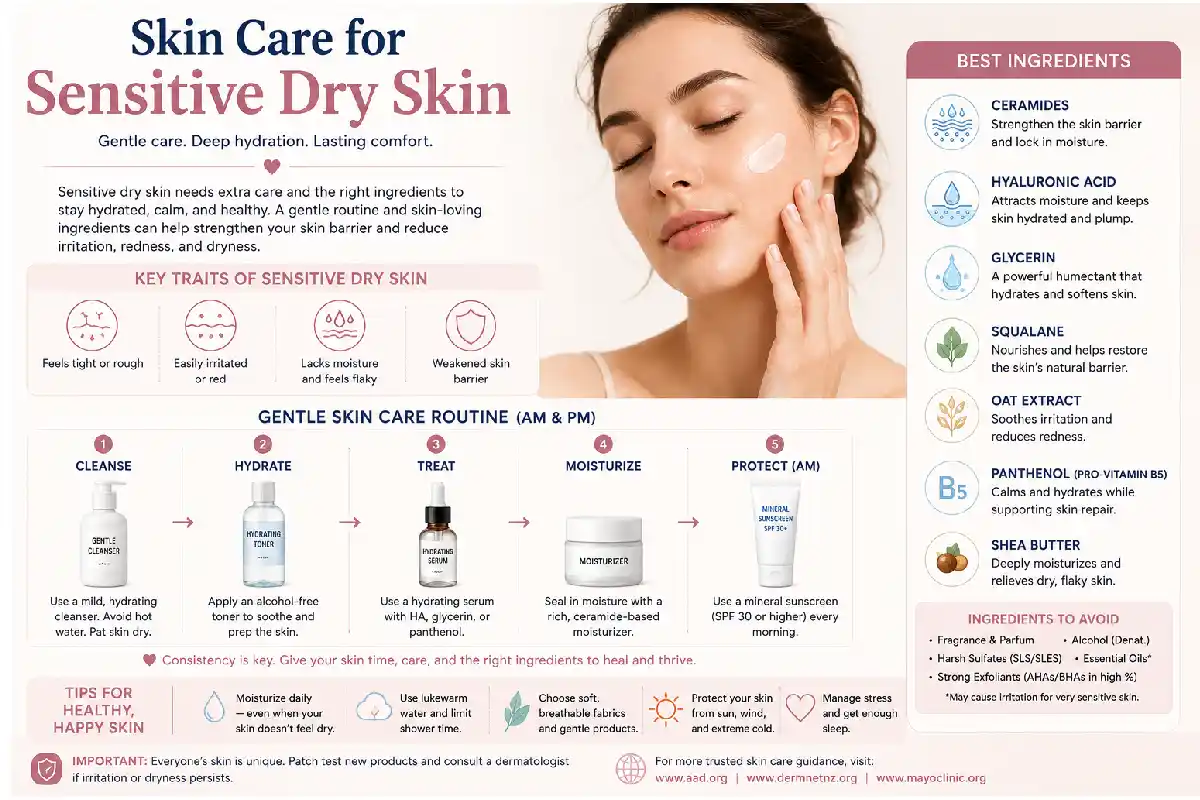
Skin Care for Sensitive Dry Skin: Dry sensitive skin require more than an ordinary moisturizer. When the skin‘s barriers are weakened due to irritating products, weather, or even water; skin can feel tight, itchy, burning with increased redness. Specific Skin Care for Sensitive Dry Skin will help restore the skin barrier back to health and help lock in essential moisture, minimizing the irritation potential.
This article discusses the reasons of sensitive dry skin, safe ingredients, known irritants and how to formulate a low maintenance regime according to the latest dermatology recommended practice in 2026.
❝
This article is a part of
Dry Skin Care Guide
Why Dry Skin Becomes Sensitive?
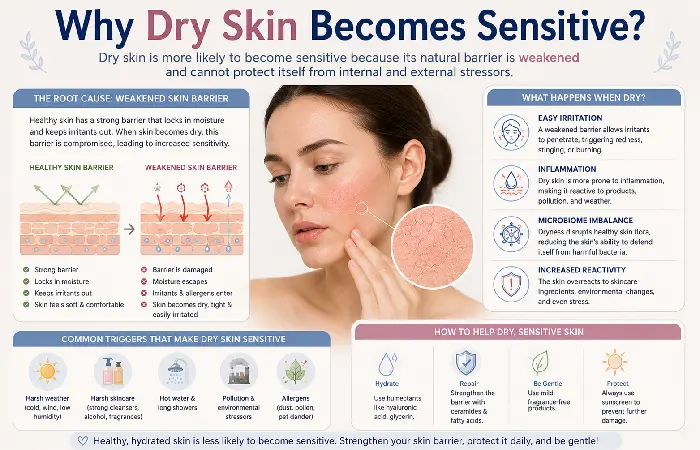
Dry skin and sensitive skin are quite often confused with each other. Sensitive skin is a condition whereas dry skin is a skin type. Sensitive skin is when the skins barrier over-reacts to environmental factors, products on the skin or what could be an allergen whereas dry skin does not have enough oil or moisture. If a dry skin does lose too much moisture, then it may become sensitive/irritable.
Building an effective skin care routine for dry skin is especially important if your skin is also sensitive and prone to irritation.
Common causes include:
- Cold weather
- Low humidity
- Hot showers
- Harsh cleansers
- Over-exfoliation
- Aging
- Genetics
- Eczema
- Contact dermatitis
Symptoms
- Tightness
- Flaking
- Redness
- Burning sensation
- Itching
- Rough patches
Recent dermatology literature also suggests that the approach of skin barrier repair is far better than intense symptom treatment.
Using one of the best moisturizers for dry skin can help soothe irritation while restoring the skin’s natural moisture barrier.
Skin Barrier Damage Comparison (2026)
| Healthy Skin Barrier | Damaged Skin Barrier |
| Holds moisture well | Rapid moisture loss |
| Soft texture | Rough texture |
| Minimal redness | Frequent redness |
| Rare irritation | Easily irritated |
| Strong protection | Allergens enter easily |
Resources
| Source | Link |
| American Academy of Dermatology | https://www.aad.org |
| National Eczema Association | https://nationaleczema.org |
Gentle Cleansing Methods
The correct cleansing routine is essential to any skincare routine, but for sensitive dry skin this is especially important as harsh products and vigorous washing can further deplete the skin of its fragile barrier. A mild cleansing regime however will cleanse the skin of dirt, dead cells and other pollutants leaving the skin free of debris and free from irritants.
Start with a gentle cleanser for dry skin that removes impurities without causing redness, tightness, or discomfort.
Choose cleansers that are:
- Soap-free
- Sulfate-free
- Fragrance-free
- pH-balanced
- Non-foaming or low-foaming
Avoid washing more than twice daily.
Proper Cleansing Routine
Morning
- Lukewarm water
- Gentle cleanser
- Moisturizer
- Sunscreen
Evening
- Gentle cleanser
- Barrier repair moisturizer
Cleansing Method Comparison
| Method | Sensitive Skin Rating | Notes |
| Cream cleanser | 5/5 | Best choice |
| Milk cleanser | 5/5 | Very gentle |
| Gel cleanser | 4/5 | Good if fragrance-free |
| Foaming cleanser | 2/5 | May dry skin |
| Soap bars | 1/5 | Often irritating |
Resources
| Dermatology Resource | Link |
| CeraVe Skin Care Guides | https://www.cerave.com |
| La Roche-Posay Skin Education | https://www.laroche-posay.us |
Safe Ingredients for Sensitive Skin
The ingredients you use are important when it comes to vulnerable dry skin. Looking for skincare that is made up of caring, skin barrier helping ingredients can over time decrease the chances of irritation, support the skin‘s hydration levels and bolster the skin‘s defenses. Avoid following after trendy actives, instead get skin support from proven ingredients that are safe for daily application.
Following a consistent daily skincare routine for dry skin can reduce flare-ups and keep sensitive skin hydrated throughout the day.
Recommended Ingredients
| Ingredient | Benefit | Suitable Daily? |
| Ceramides | Repairs barrier | Yes |
| Glycerin | Hydration | Yes |
| Hyaluronic Acid | Moisture retention | Yes |
| Squalane | Locks moisture | Yes |
| Colloidal Oatmeal | Soothes irritation | Yes |
| Panthenol | Repairs skin | Yes |
| Niacinamide (2–5%) | Reduces redness | Usually |
Ingredients Requiring Caution
| Ingredient | Reason |
| High-strength Retinol | Can irritate |
| Alcohol Denat. | Drying |
| Strong Vitamin C (L-Ascorbic Acid 20%) | May sting |
| Physical Scrubs | Damage barrier |
| Essential Oils | Common irritants |
Common Irritants to Avoid
More prone to sensitive dry skin and perhaps the most common skin condition, the protective barrier is weakened, thus making it more susceptible to irritation from the moisturisers and daily cleansing products we use, as well as the environmental factors we are subjected to.
Choose serums for dry skin with calming, fragrance-free formulas to provide hydration without irritating delicate skin.
Even the ingredients that suit other skin conditions or types can result in an irritation of redness, stingy, dry patches. The most effective way to keep calm, healthy skin is to identify and avoid the most frequently used irritants.
Avoid:
- Artificial fragrance
- Menthol
- Peppermint
- Lemon oil
- Eucalyptus oil
- Harsh exfoliants
- High alcohol products
- Strong acids
- Overwashing
Building a Minimalist Routine
Concentrate on your Skin Care for Sensitive Dry Skin. The less you use, the better. Too many products or layers of active ingredients may be too much for a skin barrier compromised by a threat condition. Skin care that is minimal and focused on just a few dermatologist-recommended products will cleanse, hydrate and protect your sensitive dry skin.
Understanding the best ingredients for dry skin makes it easier to select products that nourish sensitive skin while minimizing the risk of irritation.
Morning Routine
- Gentle Cleanser
- Moisturizer
- SPF 30–50 Sunscreen
Evening Routine
- Gentle Cleanser
- Barrier Repair Cream
Optional:
- Hyaluronic Acid Serum
- Ceramide Serum
Minimalist Routine Comparison
| Routine | Steps | Best For |
| Basic | 3 | Most beginners |
| Standard | 4 | Mild dryness |
| Advanced | 5 | Barrier repair with targeted treatments |
Managing Flare-Ups
Readily Irritated flare-ups happen too frequently with dry sensitive skin, even if a very good and consistent skin care regime is being followed. Factors such as seasonal variations, irritants or allergens, stress and use of harsh/strong products/over exfoliation may all cause a compromised skin barrier, which results in redness, itching, dehydration or burning sensations. During these flare-ups it is best to keep the calming routine going and to be very kind and gentle and non aggresisve with your skin until it has healed.
During Flare-Ups
- Stop exfoliants
- Pause retinoids
- Increase moisturizer frequency
- Use fragrance-free products only
- Avoid hot water
- Reduce active ingredients
Any persistent symptoms, greater than 2 weeks or worsening with gentle treatment, should be assessed by a dermatologist.
2026 Product Type Comparison
| Product Type | Hydration | Irritation Risk | Best For |
| Cream Moisturizer | Very High | Low | Sensitive dry skin |
| Lotion | Medium | Low | Normal skin |
| Gel Moisturizer | Medium | Moderate | Oily skin |
| Ointment | Highest | Very Low | Extremely dry skin |
| Facial Oil | Medium | Depends on oil | Night routine |
Frequently Asked Questions
How to take care of sensitive dry skin?
A simple regimen of mild soap, moisturizer without fragrance, and broad spectrum sun protection during the day suffices for most individuals.
What should I avoid?
If you‘ve sensitive skin, please steer clear of fragrance, alcohol denat., harsh exfoliants, high strength retinoids and essential oils.
Allergies: is hyaluronic acid dangerous?
Yes. Hyaluronic acid is well tolerated and will need to be used with a moisturizer afterwards.
How often do I exfoiliate?
If you have sensitive dry skin then it should be avoided or kept to a minimum if you are experiencing flare ups of the skin. If it is to be used then use no more than once a week to two with a mild chemical type exfoliation.
Can sensitive dry skin be cured?
Although this will always not be entirely cured, consistent good skincare will have a positive impact on prevention and significantly reduce the severity of symptoms and flare-ups.
Conclusion
A well-rounded Skin Care for Sensitive Dry Skin routine is not about overload, but packing a regime full of gentle barrier repairing, non-irritating ingredients. Gentle cleansing, the familiar moisturizing ingredients like ceramides and glycerin and daily SPF will be the mainstays of a well looked after complexed in 2026. Simple products formulated with proven ingredients are the way to reduce inflammation and regain skin health.