

Best Makeup Tips for Combination Skin: Guide for Long-Lasting, Balanced Makeup
 Khizrana Begum
Beauty & Lifestyle Writer
Khizrana Begum writes clear and reader-friendly content covering beauty, lifestyle and related topics.
Read Full Bio of Author →
Khizrana Begum
Beauty & Lifestyle Writer
Khizrana Begum writes clear and reader-friendly content covering beauty, lifestyle and related topics.
Read Full Bio of Author →
 Sameena Begum
Health, Technology & Digital Content Reviewer
Sameena Begum reviews content for clarity, accuracy and overall reader usefulness.
Read Full Bio of Reviewer →
Sameena Begum
Health, Technology & Digital Content Reviewer
Sameena Begum reviews content for clarity, accuracy and overall reader usefulness.
Read Full Bio of Reviewer →
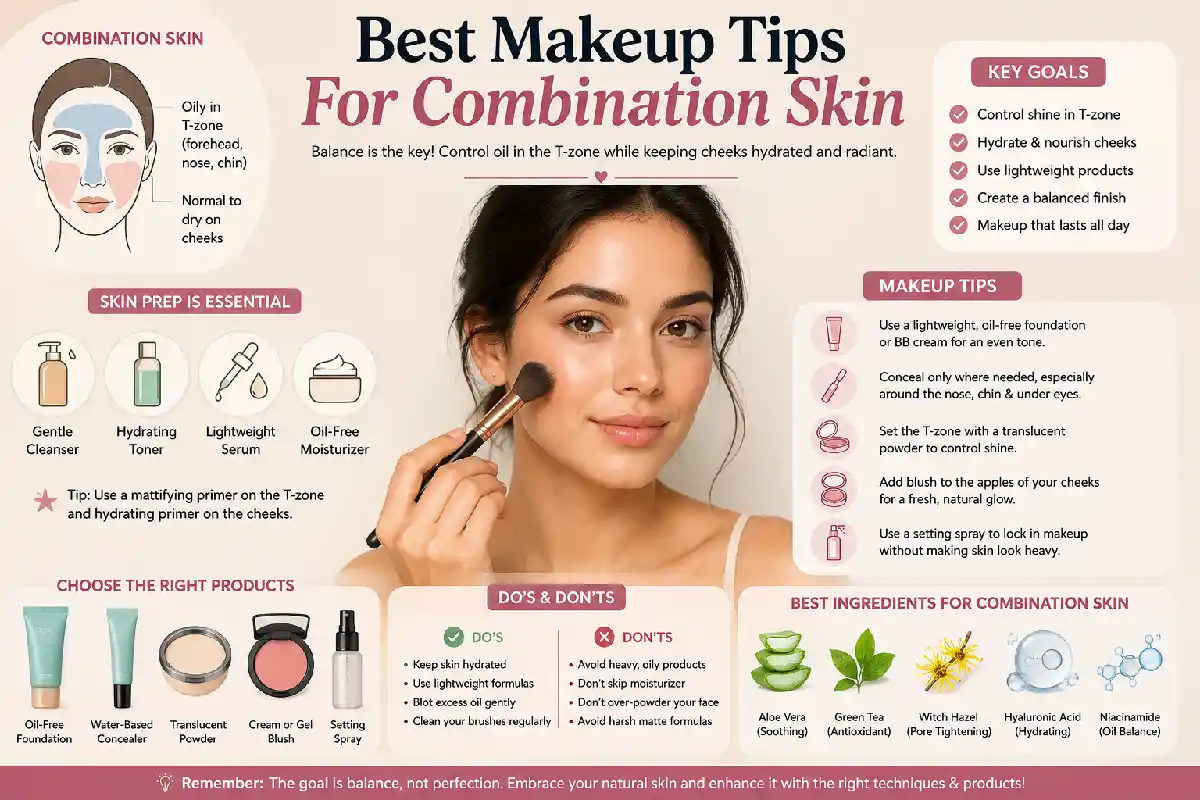
Best Makeup Tips for Combination Skin – Make-up application can feel like playing an balancing act on your combination skin. One area of your face, most often the T zone (forehead, nose, chin) will begin to feel greasy within a few hours whereas the cheeks on your face are often dry or even normal. It’s this imbalance that results in your make up sliding off your oily skin, but being held by the dry areas of your face.
Combination skin is far from impossible to control if you’re aware of your specific skin type.
It isn’t about wearing more make up but more so, about making sure your skin is primed and set. This will be a comprehensive guide that will ensure you know the very best makeup application techniques and tips for combination skin. You will find tips regarding skin preparation, primes, selecting foundation, preventing the dreaded shiny T zone, making sure you can remove your make up and a few professional make up secrets.
❝
This article is a part of
Combination Skin Care Guide
Understanding combination skin can help you choose makeup products that work well with both oily and dry areas.
What is Combination Skin?
Combination skin- the one that’s oil in some spots and dry elsewhere is fairly common.
| Feature | Combination Skin |
| Forehead | Oily |
| Nose | Oily |
| Chin | Oily |
| Cheeks | Normal to Dry |
| Makeup Challenge | Uneven wear |
| Common Concern | Shine and dry patches |
Because different areas behave differently, your makeup routine should address both hydration and oil control simultaneously.
Why Combination Skin Needs Special Makeup Techniques
Unlike oily or dry skin, combination skin requires balance.
Preparing your skin with the best skincare routine for combination skin helps makeup last longer.
Common makeup problems include:
- Foundation separating on the nose
- Dry patches around the mouth
- Excess shine after a few hours
- Makeup settling into fine lines
- Patchy blending
- Uneven coverage
Using products designed for only oily or only dry skin often makes these issues worse.
Signs You Have Combination Skin
You probably have combination skin if:
- Your nose gets shiny by midday.
- Your cheeks feel tight after cleansing.
- Foundation fades only around the T-zone.
- Powder works on the forehead but dries the cheeks.
- You experience occasional breakouts only in oily areas.
When you learn your skin type, it’s much easier to come up with a makeup routine that will last.
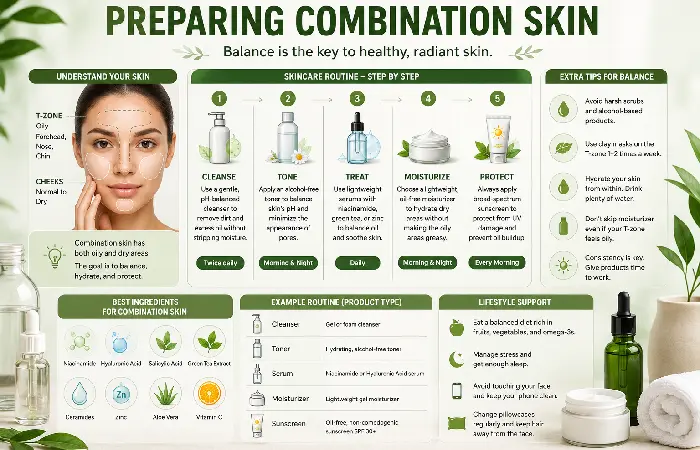
Preparing Combination Skin
If you experience breakouts, these tips for combination skin with acne can help you achieve a flawless look without clogging pores.
You should always be able to use a good canvas to start a look with any cosmetic. If the surface layer has not been appropriately primed, high-end foundations will not apply effectively.
Step 1: Cleanse Gently
Find a mild cleanser that removes oil while also leaving moisture in the skin.
Do not use strong soaps which will make your cheeks dry.
Step 2: Apply Lightweight Moisturizer
Hydration is essential—even for oily skin.
Look for moisturizers that are:
- Oil-free
- Lightweight
- Non-comedogenic
- Fast absorbing
Apply slightly more moisturizer to dry areas than the oily T-zone.
Step 3: Use Sunscreen
Daily sunscreen protects your skin while preventing premature aging.
Gel or fluid sunscreens work especially well for combination skin.
Step 4: Wait Before Makeup
Allow skincare products to absorb for 5–10 minutes before applying primer.
This prevents makeup from pilling.
Skin Prep Routine Comparison
| Step | Dry Areas | Oily Areas |
| Moisturizer | Moderate amount | Thin layer |
| Primer | Hydrating | Mattifying |
| Foundation | Light hydration | Oil control |
| Powder | Minimal | Moderate |
| Setting Spray | Full face | Full face |
Best Primers

Primer creates the perfect base for makeup and helps balance combination skin.
Still unsure about your skin type? Compare combination skin vs dry skin before selecting makeup products.
Instead of using one primer everywhere, professional makeup artists often use multi-priming.
Hydrating Primer
Apply on:
- Cheeks
- Jawline
- Around the mouth
Benefits:
- Prevents flaky makeup
- Smooths dry patches
- Improves foundation blending
Mattifying Primer
Apply only on:
- Forehead
- Nose
- Chin
Benefits:
- Controls oil
- Reduces shine
- Minimizes pores
- Extends makeup wear
Primer Comparison
| Primer Type | Best For | Finish |
| Hydrating | Dry cheeks | Natural glow |
| Mattifying | T-zone | Matte |
| Blurring | Large pores | Smooth |
| Silicone-based | Long wear | Velvet finish |
| Water-based | Everyday makeup | Lightweight |
Foundation Tips
Foundation is what counts the most when you have combination skin.
Using the right ingredients for combination skin creates a smoother base for makeup application.
Perfect combo of hydrating and controlling.
Choose Medium Coverage
Heavy foundations often become cakey on dry areas and greasy on oily zones.
Medium-buildable coverage works best.
Satin Finish Is Ideal
Avoid completely flat matte formulations for dry cheeks.
Do not use overly dewy foundations for oily foreheads.
A dewy glow and natural radiance lies in the middle.
Blend Strategically
Apply foundation:
- Thinly over the T-zone
- Slightly more on dry cheeks if needed
This creates an even complexion without looking heavy.
Use Damp Makeup Sponge
A damp sponge helps:
- Blend evenly
- Prevent streaks
- Avoid cakey makeup
- Create natural coverage
Foundation Formula Comparison
| Formula | Combination Skin Rating | Finish |
| Matte Liquid | ★★★★☆ | Matte |
| Satin Liquid | ★★★★★ | Natural |
| Powder Foundation | ★★★☆☆ | Matte |
| Cream Foundation | ★★★☆☆ | Rich |
| Skin Tint | ★★★★☆ | Natural |
Avoid these common combination skin mistakes to keep your skin healthy under makeup.
Concealer Tips
Apply concealer only where needed.
Avoid covering the entire face with heavy concealer.
For combination skin:
- Hydrating concealer under eyes
- Matte concealer on blemishes
Blend quickly before it sets.
Cream vs Powder Products
Combination skin works well with both.
| Product | Best Option |
| Blush | Cream or Liquid |
| Bronzer | Powder |
| Highlighter | Liquid |
| Contour | Cream or Powder |
Use cream products on dry areas and powder products where oil develops.
Setting Makeup
Setting makeup properly prevents fading throughout the day.
Use Powder Selectively
Don’t powder your entire face.
Instead, focus on:
- Forehead
- Nose
- Chin
Leave cheeks with minimal powder for a natural finish.
Loose Powder
Loose powder offers:
- Better oil control
- Lightweight finish
- Longer wear
Pressed Powder
Ideal for:
- Midday touch-ups
- Travel
- Quick shine control
Finish With Setting Spray
Setting spray melts powder into the skin.
Benefits include:
- Longer wear
- Natural finish
- Less cakey appearance
- Improved hydration
Powder Comparison
| Powder Type | Best Use |
| Loose Powder | Daily makeup |
| Pressed Powder | Touch-ups |
| Translucent Powder | All skin tones |
| Tinted Powder | Extra coverage |
Preventing Shine
Shine control doesn’t always require adding more powder.
Instead, use smart techniques throughout the day.
Blotting Papers
Before adding powder:
- Remove excess oil first.
- Then lightly powder if needed.
This prevents cakey buildup.
Avoid Touching Your Face
Hands transfer oil and bacteria.
Frequent touching also breaks down foundation.
Choose Oil-Free Makeup
Products labeled:
- Oil-free
- Long-wear
- Non-comedogenic
usually perform better for combination skin.
Layer Thinly
Many thin layers look more natural than one thick layer.
This also prevents foundation from separating.
Daily Shine-Control Checklist
| Tip | Benefit |
| Blot first | Removes oil |
| Powder lightly | Prevents cakiness |
| Setting spray | Locks makeup |
| Oil-free products | Longer wear |
| Avoid touching face | Less transfer |
Eye Makeup Tips
The eyelids tend to get oily because of the nature of the combination skin.
To prevent smudging:
- Apply eye primer.
- Use waterproof eyeliner.
- Choose waterproof mascara.
- Set eyeliner with matching eyeshadow.
These simple steps dramatically improve wear time.
Lip Makeup Tips
Hydrate lips before lipstick.
Then:
- Remove excess balm.
- Apply lip liner.
- Add lipstick.
- Blot.
- Apply a second layer.
You will also gain a long-lasting life without any dryness of lips.
Makeup Mistakes to Avoid
Avoid these common mistakes:
| Mistake | Better Alternative |
| Heavy powder everywhere | Powder only T-zone |
| Skipping moisturizer | Use lightweight hydration |
| Thick foundation | Thin buildable layers |
| No primer | Use dual primers |
| Over-touching makeup | Use blotting paper |
Seasonal Makeup Tips
Summer
- Gel moisturizer
- Mattifying primer
- Oil-free foundation
- Waterproof products
Winter
- Richer moisturizer
- Hydrating primer
- Satin foundation
- Less powder
Humid Weather
Focus on:
- Oil control
- Setting spray
- Waterproof mascara
- Long-wear formulas
Makeup Removal
The importance of proper make-up removal as much as make-up application.
If you wear makeup in your sleep, it can clog your pores, make your breakouts even worse, and leave your dry skin itchy and flaky.
Step 1: Remove Makeup
Use:
- Cleansing balm
- Micellar water
- Gentle cleansing oil
Massage gently to dissolve makeup instead of rubbing.
Step 2: Double Cleanse
Follow with a gentle facial cleanser.
This removes leftover makeup, sunscreen, and excess oil.
Step 3: Hydrate
After cleansing:
- Apply toner (optional)
- Use lightweight serum
- Finish with moisturizer
Hydration helps restore the skin barrier overnight.
Makeup Removal Routine
| Step | Product |
| Remove makeup | Micellar water or cleansing balm |
| Cleanse | Gentle face wash |
| Tone | Alcohol-free toner |
| Moisturize | Lightweight moisturizer |
| Overnight care | Hydrating serum |
Professional Makeup Artist Tips
Professional makeup artists often recommend:
- Prep skin according to each facial zone.
- Apply foundation in thin layers.
- Blend using a damp sponge.
- Powder only where necessary.
- Finish with setting spray.
- Carry blotting papers instead of extra powder.
- Replace makeup sponges regularly to maintain hygiene.
These habits create a more natural finish and improve the longevity of your makeup.
Quick Morning Routine for Combination Skin
| Time | Step |
| 2 Minutes | Cleanse |
| 2 Minutes | Moisturizer |
| 1 Minute | Sunscreen |
| 2 Minutes | Dual primer |
| 5 Minutes | Foundation and concealer |
| 3 Minutes | Powder and blush |
| 2 Minutes | Eyes and lips |
| 1 Minute | Setting spray |
Total: 18 minutes
Final Thoughts
You Don’t Need a Complicated Regimen For Combination Skin you just need a balanced one. From preparing and priming strategically to using a satin foundation, setting strategically, and removing your makeup at the end of the night, you can ensure you always have that flawless and fresh complexion. “No one-product-fits-all is ever a reality,” she says, and this is also true for combination skin.
“Listen to your skin: what works in summer may not work in winter, so be prepared to tweak your routine,” she notes, before advising women to: “Focus on revealing, rather than concealing.”
With the right regimen and a bit of attentiveness to what your skin is telling you, combination skin could very well be one of the simplest types to manage for beautiful everyday makeup.