


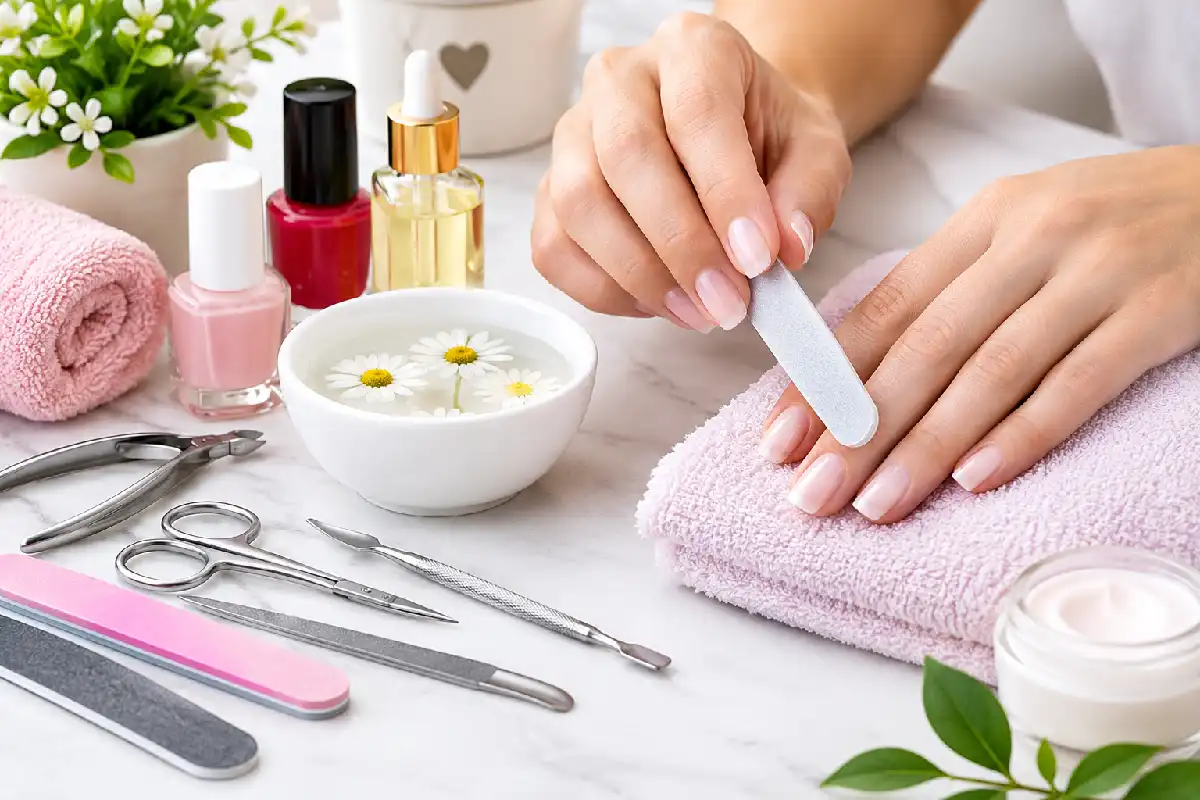
Nail Care: A Complete Guide to Healthy and Beautiful Nails
Last Updated: September 18, 2026
Nail Care: Beautiful nails mean more than selecting the best nail polish color or the latest manicure; it‘s about maintaining clean, healthy, moisturized, tough, protected nails, cuticles, and the skin around them.
Having healthy nails has always been about the basics. You don‘t need an expensive salon treatment or dozens of different products. Keep them in good shape by careful trimming, filing, moisturizing, the regular use of your non-glitzy products, and being observant of subtle changes.
If you are suffering from naturally thin, brittle, dry, ridged, or weak nails, setting up a routine will help you to take better care of your nails. This complete guide covers all you need to know about your nails – from your nails to your cuticles.
What Is Nail Care?
What is nail care? Nail care refers to the aspect of keeping the fingernails and the toenails clean, neat, and attractive, as well as well-manicured and healthy. This includes a daily nail care routine such as a pedicure and a manicure, or even just simple daily nail care such as getting your nails trimmed and filing them, washing and cleaning the nails, and moisturizing and caring for the cuticles without damaging the nails.
Keratin, the more robust protein that makes your hair and skin strong, is also used to toughen up the nails. The part of the nail which is visible as the nail plate is produced by the nail matrix, which is the part of the skin below your nail. Perhaps it is worth familiarising yourself with some of the anatomy of a nail.
| Nail Part | Definition | Main Function |
| Nail plate | The hard, visible part of the nail | Protects the fingertip |
| Nail bed | Skin underneath the nail plate | Supports the nail |
| Nail matrix | Area where new nail cells develop | Produces nail growth |
| Cuticle | Thin layer of protective tissue around the nail | Helps protect against bacteria |
| Nail folds | Skin surrounding the sides of the nail | Supports and protects the nail |
| Free edge | The part of the nail that extends past the fingertip | The part that is normally cut and filed |
Differences in each nail are expected but should be very visible, such as an increasing difference of rapidly changing in the texture, colour, thickness of the nail, or growth rate.
Essential Nail Care Routine
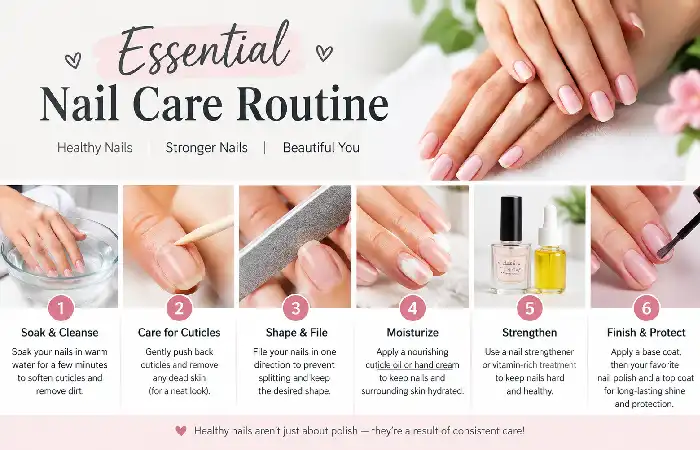
A simple nail care routine doesn‘t have to be complicated. It‘s about consistency.
Think of nail care the same as skin care. You don‘t need ten steps every day. A few good habits carried out consistently tend to be better than occasional deep treatments.
1. Keep Your Nails Clean
Always wash your hands frequently with soap and water thorough washing under your nails (but don‘t keep slicing with something sharp under your nails). Scraping or scrapping vigorously can result in skin irritation and do terrible damage to the region below the nail.
2. Moisturize Your Hands and Nails
The skin and nails can feel dry, so wipe the skin and nails after washing with Moisturizer wherever possible.
Massage a small amount of moisturizer over:
- Fingertips
- Nail plates
- Cuticles
- Skin around the nails
- The backs of your hands
A thicker cream or ointment can be particularly useful before bedtime.
3. Trim Nails Regularly
Long nails are absolutely normal, but they’ll break more easily if they are too long.
If you want long nails, just cut them to the length needed to keep up with your life (maybe shorter nails are better for you if you use your hands a lot).
4. File Rough Edges
Once the tapering has been completed with an emery board or file, make sure to round off all of the pointed, pointed edges. Filing also helps the nail not to catch on clothing, etc.
5. Protect Your Hands
Chemicals, cleaning products, chemicals, and detergents, solvents, and prolong Contact with water. Wear household gloves when doing the laundry, in the bathroom, or working in the garden, as well as if you are using any irritant products.
6. Give Damaged Nails Time
If you’re suffering from peeling or breaking nails, take it easy on your manicure attacks. The best nail treatment, at times, is less manipulation.
Essential Nail Care Products
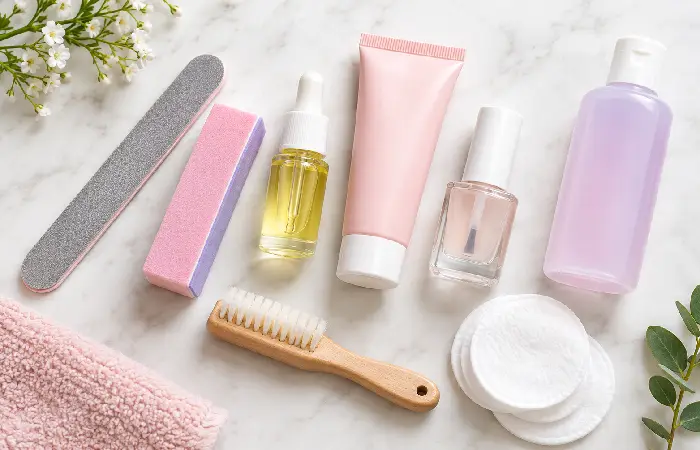
To keep health Nails, you do not require dozens of products. Based on your nail needs, not more than a few good products are generally required.
Basic Nail Care Kit
| Product | What It Does | How Often to Use |
| Nail clippers | Shortens nails | As needed |
| Nail file | Smooths and shapes edges | As needed |
| Nail brush | Helps clean around nails | Occasionally |
| Hand cream | Moisturizes hands and nails | Daily |
| Cuticle oil | Softens and moisturizes cuticles | Daily or as needed |
| Gentle nail polish remover | Removes polish | Occasionally |
| Nail polish | Adds color and protection depending on formula | Optional |
| Household gloves | Protects hands from water and chemicals | During chores |
Nail Clippers
Select a good quality, comfortable clipper that will cut swiftly rather than crush the nail. Ensure proper cleansing of personal nail tools is regularly performed, and do not share them with others without proper cleansing.
Nail File
The nail file. Smoothing out the edge of the nail should be achieved with this. However, you shouldn’t be filing with vigorous forward and backward strokes if your nails are delicate. Use gentle strokes.
Cuticle Oil
Cuticle oil is a moisturizer designed specifically for the cuticle and skin surrounding it. It may be made with any combination of plant oils, mineral oil, vitamin E, or any other emollient.
Its primary function is to provide moisture rather than to grow nails faster. Hand Cream
The hand cream with moisturizing components can be helpful to prevent the dryness of the skin around the nails. Using it regularly rather than occasionally with an intensive product can be more beneficial.
How to Keep Nails Healthy
Healthy nails are influenced by both external care and general health.
Keep Nails Dry After Washing
Water by itself is not damaging, but in some individuals, that is repeated wetting and drying can result in splitting or peeling.
After washing your hands, dry your hands, including the area around the nails, this was by clean paper towel.
Avoid Using Nails as Tools
This is one of the easiest habits to overlook.
Do not use your fingernails to:
- Open cans
- Scrape labels
- Pry objects open
- Remove stickers
- Scratch hard surfaces
- Separate tightly sealed packages
Your nails may look strong, but they are not designed to replace household tools.
Avoid Picking at Peeling Nails
When a nail starts peeling, it can be tempting to pull the loose section. Unfortunately, pulling can extend the split.
Rather, cautiously shave the flawed part away and patiently file the cut edge flush.
Be Careful With Nail Products
Some of the nail products can be irritating. This is particularly so if the application is excessive.
If burning, redness, swelling occurs or persists, stop the use of this product.
Eat a Balanced Diet
His nails need nutrients to grow. However, taking supplements just because you want better and stronger nails is not always required. A balanced diet containing adequate:
- Protein
- Iron
- Zinc
- Vitamin B12
- Folate
- Other essential vitamins and minerals
supports normal body function, including nail growth.
If you tend to have slow nail changes, even if you believe you are lacking in vitamins, speak to your doctor and avoid taking mega doses of supplements yourself.
How to Trim and File Your Nails?
Trimming your nails sounds simple, but technique matters.
Step 1: Choose the Right Time
May be easier to trim after a shower or hand washing, as the nails are typically softer. But don‘t leave them soaking for a long period of time.
Step 2: Use Clean Tools
Check that the clippers or scissors are clean before using them.
Step 3: Trim Gradually
Do not cut too much of the Nail off at one time. Do not cut too far in with too heavy a cut.
Cut thin, two, and even ends until they are the length you desire. Step
4: Follow Your Natural Shape
You should typically be able to preserve the natural form of the fingertip by using the nails. Toenails: Cut them using a fairly straight line to prevent the nail edge from growing into the periungual tissue.
Step 5: File the Edges
Use a nail file to smooth rough areas.
Move softly and do not overfile. Shearing too much from filing, due to friction, can cause a weak nail.
Should You Cut Your Cuticles?
Cuts were made to protect. Instead of harshly cutting cuticles, moisturize them and only push back them back if you have healthy skin and it is necessary.
Cuticle Care
Cuticles are often misunderstood.
Cuticles comprise a thin band of tissue located at the boundary of a nail on its bottom edge. It’s a link between the nail plate and your skin. You shouldn’t need your cuticles to be perfectly invisible.
How to Care for Cuticles
A simple routine is enough:
- Wash your hands gently.
- Dry your hands.
- Use cuticle oil or a moisturizer.
- Coat the cuticle and the area surrounding the cuticle with the oil or lotion.
- Don’t ever cut the cuticle or pick at hangnails.
What Is a Hangnail?
A hangnail is a small torn, split, or partially detached portion of skin bordering the side of the nail. It is not part of the nail.
Don‘t pick hangnails with your fingers. Gently cut the overhanging skin using clean nail scissors or nippers and follow up with a moisturizing crème.
If the skin becomes increasingly painful, swollen, hot, or begins to discharge pus, see your doctor as there may be an infection.
Nail Care for Different Nail Types
Everyone‘s nails are different. Some naturally have strong nails and some peel, split, or break.
1. Brittle Nails
Brittle nails have a tendency to split or peel.
Predisposing factors. Children are born with the imperfections of premature aging; repeated exposure to water, harsh chemicals used in the nail industry, trauma, or bad conditions of the nails predispose the nails to damage. Helpful tips: Short, but still manageable.
Moisturize regularly.
- Wear gloves during household chores.
- Avoid aggressive buffing.
- Minimize unnecessary exposure to harsh chemicals.
2. Thin Nails
You will notice if you have light, fragile nails. Think about whether they are easily bendable and/or prone to breaking.
Don‘t over-file and don‘t manicure too hard. Shorter length will help prevent bending too much.
3. Peeling Nails
Peeling can involve splitting of the layers of the nail plate:
Please cut the loose edge with scissors, not tease the layers apart. Also apply moisturizer often to your nails.
4. Dry Nails
Dry nails are commonly associated with the skin surrounding the nail and are associated with dry cuticles.
Use a richly moisturizing hand cream and/or cuticle conditioner(s), particularly after cleaning and før hitting the sack.
5. Strong, Healthy Nails
Even naturally strong nails need care. Long nails can still break if they are repeatedly exposed to impact or used as tools.
A little prevention goes a long way.
Nail Type and Care Approach
| Nail Concern | Common Care Focus |
| Brittle | Moisturize and reduce chemical exposure |
| Peeling | Avoid picking and excessive filing. |
| Thin | Keep moderate length and handle gently. |
| Dry | Use hand cream and cuticle moisturizer. |
| Frequently breaking | Reduce trauma and consider professional advice if persistent. |
| Healthy | Maintain regular trimming and protection. |
Common Nail Care Mistakes
Sometimes nail damage comes from habits that seem harmless.
Cutting Cuticles Too Deeply
If the living tissue is cut around the nail will become inflamed and at greater risk of infection.
Instead, apply moisturizer to the cuticle and damage the tissue as little as possible.
Over-Buffing
Buffing gleams and polishes, and if overbuffed, the upper layers of the nail can be worn off. If you do use a buffer, then use it lightly and softly.
Removing Gel Polish Aggressively
The removal of gel off the nails by peeling or scraping can cause damage to the nail plate.
Methods such as proper removal are a lot closer to perfect than picking.
Constantly Wearing Nail Enhancements Without Proper Care
Gels, acrylics, and any other extensions can appear attractive, but when it comes to the application and removal, they can cause stress to the natural nail.
Raise awareness of the nails. Don‘t keep doing a treatment that keeps aggravating or even breaking down the nails.
Using Old or Dirty Tools
Dirty nail tools can harbor microorganisms.
Clean your personal tools regularly and avoid sharing them casually.
Ignoring Nail Changes
Nails that have developed a sudden aberration in colour, become noticeably thick, become painful, separate from the nail bed, or become easily identified as different from other nails should not be painted.
Any unexplained or progressive changes should be examined by a health care practitioner.
Nail Care at Home
Have a quick, easy, simple manicure routine at home, without making it a full-blown beauty regimen.
Simple At-Home Nail Care Routine
Step 1: Remove Nail Polish
If your nails are polished, be careful when taking the polish off. Don‘t rub your nails any longer than I have shown.
Step 2: Wash Your Hands
Wash with mild soap and rinse with tepid water.
Step 3: Trim Your Nails
Trim them to the length you find most comfortable for actually digging.
Step 4: File the Edges
Grooming: Trim to remove the rough areas, and shape the nails.
Step 5: Moisturize
Keep hands moisturized generously; massage the hands properly. Focus more on the fingertips. Step
A Simple Weekly Routine
You do not need to perform a full manicure every day.
Daily:
- Moisturize hands
- Apply cuticle oil if needed
- Keep nails clean
Weekly or as needed:
- Check nail length
- Trim and file
- Clean nail tools
- Look for unusual changes
Occasionally:
- Take a break from enhancements if your nails appear damaged
- Replace old products
- Clean your manicure tools thoroughly
Nail Polish and Nail Enhancements
Nail polish is a cosmetic, and there is nothing wrong with brightly colored nails; however, a lot of the preparation and taking-off part can do more damage than the polish.
Tips for Safer Nail Polish Habits
- Avoid picking off polish.
- Give damaged nails a break from enhancements.
- Follow product instructions.
- Avoid applying products to irritated or infected skin.
- Keep bottles and tools clean.
- Stop using products that repeatedly irritate.
Gel and Acrylic Nails
Gel and acrylic also prolong a manicure; however, an even application and removal must be done too.
The major errors are perhaps the peeling off or the forced removal of the enhancement. If you use artificial nails on a regular basis, select a trained professional and have them examine the state of your natural nail during your visit.
Nail Care for Men
Nail care is not solely for women or women who have their nails painted.
For men, a basic routine can be remarkably simple:
- Keep nails clean.
- Trim them regularly.
- File sharp edges.
- Moisturize dry hands.
- Avoid biting nails.
- Protect hands during physical work.
- Do not ignore persistent nail changes.
Short, clean, well-maintained nails are part of good personal hygiene and grooming.
Nail Care for Toenails
Now, even the toenails.
As our feet are inside socks and shoes for much of the day, moisture and roughness from daily activity can provide an abrasive nature of the foot abrasive.
Basic Toenail Care
- Wash feet regularly.
- Dry thoroughly, particularly between the toes.
- Change socks regularly.
- Choose comfortable shoes.
- Trim toenails appropriately.
- Do not cut deeply into the corners.
- Avoid sharing nail clippers.
- Keep feet and footwear clean.
Consult your GP if any pain is experienced, thickening or discoloration occurs, or separation of the toenail from the nail bed takes place.
Natural Nail Care: What Actually Helps?
Most of the online websites offer thousands of home remedies to make your nails stronger or grow faster. Some of the remedies are weak moisturizers, and a couple of remedies are probably irritating.
The most reliable basics remain surprisingly ordinary:
Moisturize. Protect. Trim. File gently. Avoid unnecessary trauma.
Oils such as coconut or an ordinary emollient can be usefully used to soften the surrounding dry skin.
However, they can not be used as a cure for this nail disease.
However, the skin can be damaged by harmful rubbing substances such as baking soda, lemon juice, strong acids, and testing agents.
When Should You See a Doctor or Dermatologist?
The majority of the non-pathological nail changes observed in the daily practice are not significant, however there are some exceptions:
You should consider consulting a professional if you experience: Nails that are painful in general
Significant swelling around a nail
- Pus or drainage
- A nail becoming detached
- Sudden major color changes
- A persistent dark streak
- Significant thickening
- Repeated nail infections
- Severe or unexplained nail splitting
- Changes affecting several nails without an obvious reason
A dermatologist can look at the nail and identify if it is related to trauma, infection, inflammation, medicine, nutrition, or something else.
Nail Care FAQs
How often should I trim my nails?
All have to do their own who, what, where, when, why, and how, but below are a few past recommendations. Cut your nails whenever they get too long or uncomfortable, or when you when they scratch on something. Some people find once a week to be the perfect time span to check;
Is cuticle oil necessary?
Cuticle oil really is only necessary if you find that your cuticles or the skin around your nails are extremely dry. I also find that your normal hand cream is just as good.
Does cutting cuticles make nails grow faster?
No. Cutting a cuticle will not accelerate the formation of nail cells by the nail matrix. The purpose of the cuticle is to protect the surrounding area.
Is nail polish bad for your nails?
Although the polish itself is a cosmetic, frequent use, and particularly the removal, can cause dryness or damage to certain individuals.
How can I stop my nails from breaking?
Concise and hassle-free: keep your nails lubricated, don’t use your nails as implements, protect your hands from strong cleaning products, and don‘t over buff/ file.
If the breaks are still painful or remain on and off, then this may be something to talk to your doctor about.
Should I file my nails back and forth?
Gentle filing is generally preferable to vigorous sawing action. Good, selected files for your work are a good idea, and handle sympathetically; use gentle, slow action, particularly with brittle nails that are more easily torn.
How can I make my nails grow faster?
Nails are normally grown at their own rate. Good general health, appropriate nutrition, protection of nails from trauma, and the health of the surrounding skin will assist in normal nail growth.
But there is no need for miracle cures.
Why are my nails suddenly changing?
There are a vast number of reasons for nail changes: trauma, infection, inflammation, damage by products, drugs, and other systems also affect nails. If the change is sudden, has been present for some time, and is painful or abnormal, the patient should be referred to a practitioner.
Final Thoughts on Nail Care
Looking after your nails properly doesn‘t mean costly salon manicures, 15-minute rituals, or a bathroom cabinet piled high with potions. Nails that look healthy tend to respond best to a few basic habits carried out on a regular basis.
As demonstrated by this ideal model, maintain good hygiene. Keep your nails clean and well maintained, with a comfortable length. Make your filing s smooth. Don‘t underfile or over-shape. Keep your hands and cuticles well moisturized, avoid exposing your nails to harsh chemicals, and fight the urge to pick, bite, peel, and use your nails as tools.