


Nail Trimming and Filing: A Complete Guide to Healthy, Neat Nails
Last Updated: September 21, 2026
Nail Trimming and Filing: Grooming may not be your favorite time of the day, but they are definitely necessary in order to keep your feet and hands comfortable and well-maintained. Nails that are too long tend to become dirty, snag on to shirts, and even break or splinter without any warning. Too much filing or cutting is enough to peel and split nails, even irritating the skin underneath.
A fast filing and clipping system is a quick and simple way to keep your nails at a reasonable length with a slightly more coordinated appearance. Make sure you are patient. Get the right tools and show some patience.
1. How to Trim Nails Properly?
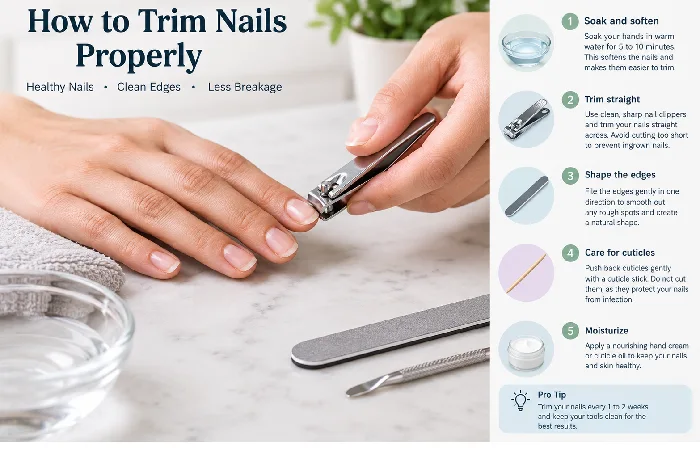
Trim the nail. Use a clean nail clipper or scissors to cut the length of the nail. The aim is to cut back the nail so you don’t cut into the surrounding skin of the nail. Wash your hands and nails with soap and water before cutting nails.
If your nails are very hard, cut them after a shower as they will be softer and easier to cut.
Steps for trimming fingernails
- Maintain your equipment: Wipe your nail clipper or scissors with rubbing alcohol or wash them beforehand.
- Cut at a comfortable length: No need to cut the nail too short. A small free edge may offer some protection to your finger.
- Cut down gradually: Don’t make one cut all the way across, but cut gradually away.
- Follow the natural shape: Normally, you can cut down fingers relatively straight across, then smooth the shape with a file.
- Corners: To avoid snagging as you wash or dress, file the free edges of the nail to smooth away any sharp corners. Top up your hand care regimen with a nourishing hand cream or cuticle oil to support the condition of the skin around the nails.
- Toenails: To protect the nail shape from damage, avoid cutting into the corners of the toenails but rather cut straight across.
| Nail | Basic trimming approach | What to avoid |
| Fingernails | Trim to a comfortable length and gently shape | Cutting extremely short |
| Toenails | Cut mostly straight across | Deeply rounding the corners |
| Brittle nails | Make small, careful cuts | Snapping or tearing |
| Thick nails | Trim gradually after softening | Forcing the clipper |
2. How to File Nails?
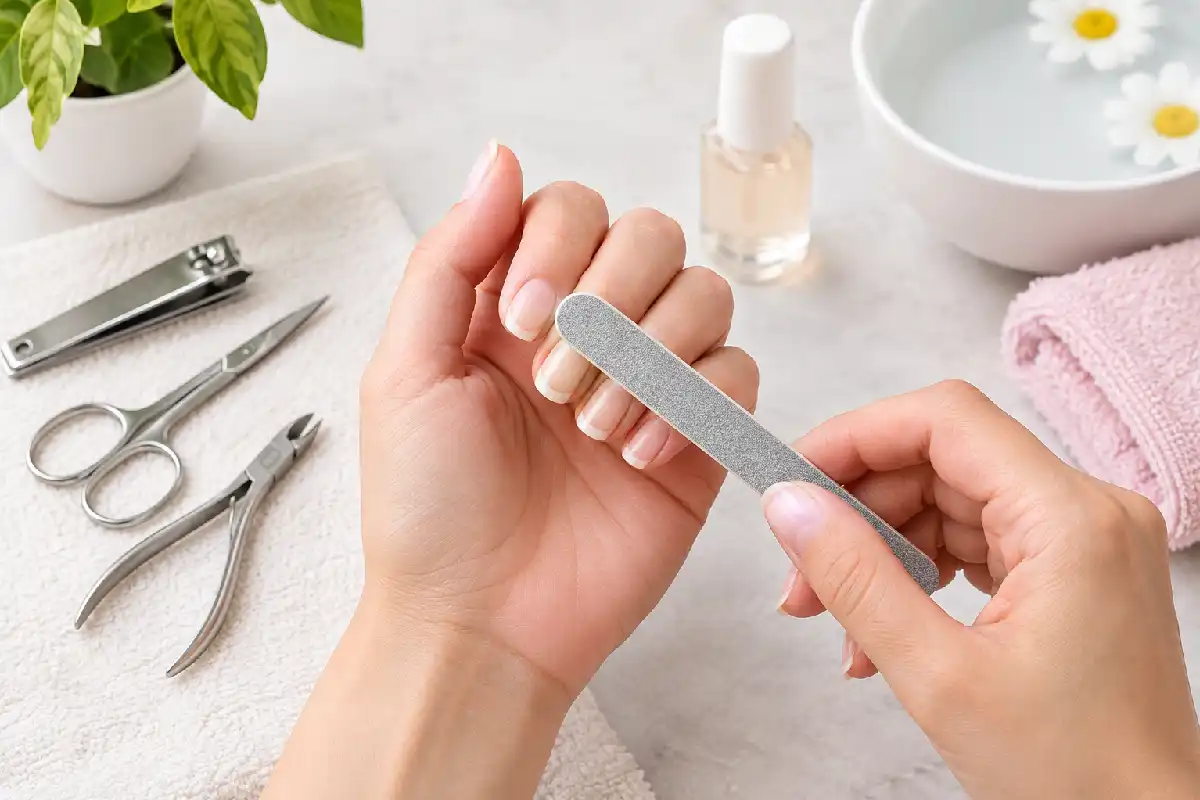
Nail filing is the process of lightly and smoothly smoothing the edge of the nail with a nail file. Filing shouldn’t hurt! If you are feeling heat, irritation, or a lot of resistance, then you may be going too fast with your file. Start with a clean, dry nail. Rest the file at a slight angle against the edge of the nail, then sweep across the edge of the nail to shape the nail you prefer.
Many of these shapes are flattering and easy to maintain on most people. The most flattering and easy-to-maintain shapes on most people include oval, square, and the variations of squoval and oval. Squoval refers to a variation of a square with softly rounded corners.
Be careful not to press and drag the file back and forth over the same spot again and again. Use gentle strokes and examine the edge of your nail regularly.
Simple filing routine
- Trim excess length first if necessary.
- Start with the sides of the nail.
- Shape the free edge gradually.
- Use light pressure.
- Check both sides for symmetry.
- Finish by gently smoothing rough areas.
You do not need to file aggressively to get a smooth finish. A few careful strokes are usually enough.
3. Which Nail File Should You Use?
Not all nail files are created equal. Files can have different grits of coarseness, with grit being a general indicator of the roughness of the file. Files with a lower grit tend to be rougher, and files with a higher grit tend to be finer.
For natural nails, you’re likely going to be more comfortable with a medium or fine grit file, as opposed to an extremely coarse one.
| Nail file type | Best suited for | Main feature |
| Emery board | Everyday natural nails | Affordable and easy to use |
| Glass file | Natural nails | Smooth filing action and reusable |
| Metal file | Stronger nails | Durable but can be quite abrasive |
| Fine-grit file | Finishing and smoothing | Gentle on the nail edge |
| Coarse file | Artificial or very thick nails | Removes length quickly |
A glass nail file might be right for you if you like to have a file on hand that you can reuse and one with a smooth filing surface. Any file you choose, be sure to keep it clean and avoid sharing it without disinfecting it first.
4. How to Prevent Nail Splitting While Filing?
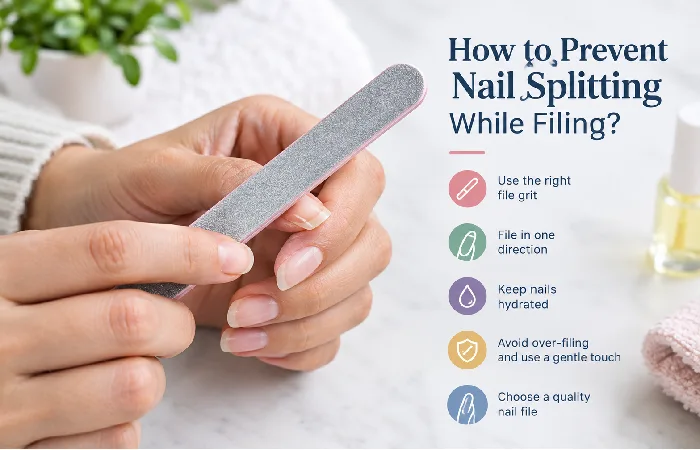
Splitting can occur when the nail is dry, brittle, or compromised, or when it is subjected to repeated assault. Poor filing can exacerbate splitting. -Learn to use the file properly to save damage – Pressure is your enemy, so allow your file to do all the work. -Resist the temptation to hack away at the damaged nail by keeping your nails relatively short, and don’t keep filing back and forth to re-shape the affected edge.
Helpful habits include:
- Use a clean, suitable nail file.
- File gently rather than aggressively.
- Avoid filing deeply into the sides.
- Do not peel or tear loose layers of nail.
- Moisturize your hands and nails regularly.
- Wear gloves when your hands are frequently exposed to water or cleaning products.
- Avoid using damaged or excessively rough files.
A small amount of moisture can also make a significant impact. Consistently use hand cream or an appropriate nail and cuticle moisturizer to avoid the skin around the nail bed from drying out too much.
5. How Often Should You Trim Your Nails?
No one schedule is suitable for everyone. There is not a “one size fits all” schedule. Fingernails grow differently from toenails, and the amount of time you decide to wait before trimming your nails can vary depending on how quickly you grow out your nails and how long you like to wear them. Generally, the fingernails require maintenance every 1-2 weeks and the toenails, less often:
Don‘t stick to a timetable; just assess the condition of your nails.
If this free edge starts growing too long, catches on clothing, interferes with everyday tasks, or becomes too difficult to groom, then it may be time for a trim.
| Situation | Suggested approach |
| Fast-growing fingernails | Trim when length becomes inconvenient. |
| Slow-growing nails | Trim less frequently |
| Toenails | Trim when they become noticeably long. |
| Brittle nails | Keep a moderate length and file carefully. |
| Active lifestyle | Check nails regularly for snags or breaks. |
The important thing is consistency rather than cutting your nails unnecessarily often.
6. Common Nail Filing Mistakes
Even the lightest manicure can be bad if filed with a heavy hand. One of the most common errors is using an overly abrasive file on natural nails just to get speed in filing off length. Sawing quickly back and forth across the edge can cause friction and contribute to rough or frayed edges.
Mistakes to avoid
- Filing with too much pressure
A nail file should not require force. Gentle strokes are generally enough. - Using the wrong grit
Very coarse files may be unnecessarily harsh for natural nails. - Filing too deeply into the corners
The sides of the nail should not be aggressively carved or narrowed. - Filing damaged nails repeatedly
If a nail is already peeling or splitting, excessive filing can make the damaged area larger. - Ignoring tool hygiene
Nail clippers, scissors, and files can collect dirt and microorganisms. Clean your tools regularly and avoid sharing personal nail-care equipment. - Cutting nails extremely short
Shorter is not always healthier. Leaving a small free edge can make everyday nail care more comfortable.
Final Thoughts
Healthy nails at home. Good nail care doesn‘t mean a complicated manicuring kit. Keeping your nails short and filed is just about doing a clean job with your tools, choosing a length you know you can keep well, and being gentle to the nail. Trim slowly, file lightly, and don’t start trimming around, creating a new shape for the edge of the nail.
You can include any of these micro habits into your daily bouts of grooming, and you‘ll have malleable, almost spur of the moment, feeling nails while also allowing you to avoid tears or ragged edges. Changes aren’t necessarily huge, but they’ll make a significant difference to your nails!