
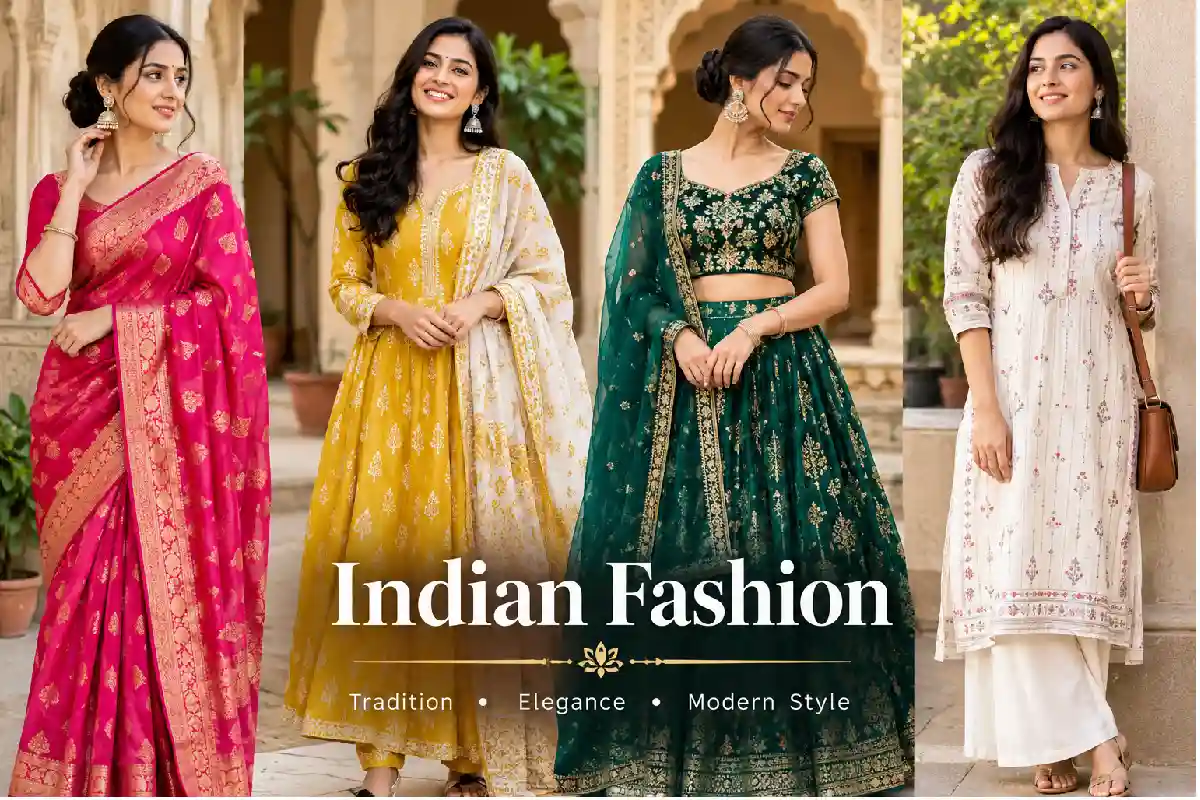
Indian Fashion: A Beautiful Blend of Tradition, Craftsmanship, and Modern Style
 Khizrana Begum
Beauty & Lifestyle Writer
Khizrana Begum writes clear and reader-friendly content covering beauty, lifestyle and related topics.
Read Full Bio of Author →
Khizrana Begum
Beauty & Lifestyle Writer
Khizrana Begum writes clear and reader-friendly content covering beauty, lifestyle and related topics.
Read Full Bio of Author →
 Sameena Begum
Health, Technology & Digital Content Reviewer
Sameena Begum reviews content for clarity, accuracy and overall reader usefulness.
Read Full Bio of Reviewer →
Sameena Begum
Health, Technology & Digital Content Reviewer
Sameena Begum reviews content for clarity, accuracy and overall reader usefulness.
Read Full Bio of Reviewer →
Indian Fashion: Fashion in India is more than merely beautiful outfits. They convey history, community, and artisan craft along with festivals, a family’s history, and, in some contexts, a modern way of life. Whether it’s the drape of a fluid sari or the precise stitching of a lehenga, Indian wear has timeless relevance and a contemporary feel.
Climate, indigenous resources, community groups, tradition, history, religion, and various cultural practices led to varied developments in Indian wear according to each region. Therefore, a Banarsi sari and a Kanjeevaram silk sari can be entirely dissimilar, yet both unequivocally Indian- the same holds good for the Punjabi salwar kameez, Gujarati chaniya choli and Kashmiri embroidered wear. The Indian Council for Cultural Relations is of a similar opinion- Indian dress is emblematic of its vast physical, historic, and cultural complex.
Indian fashion brings together diverse styles, fabrics, and cultural influences that make traditional clothing both distinctive and versatile. Explore our traditional Indian fashion guide for timeless style ideas.
Nowadays, fashion in India has made an uneasy space for itself between weddings, workplaces, festivals, events, fashion ramps, and street style. Wearers and designers continue to mix Indian fabrics & craft with modern cuts, easier volumes, and real, wearable style.
❝
This article is a part of
Indian Fashion Guide
What Is Indian Fashion?
Indian fashion is about the clothes, materials, accessories, shapes, embroideries, draping, and styling of Indian traditions and the diverse cultures and communities of India. Indian fashion designs can be traditionally modern or traditionally traditional. Traditional attire comes in forms such as the sari, salwar, lehenga, dhoti, sherwani, kurta pajamas, and also as regional traditional wear.
Modern clothing styles are derived from unconventional blouses, dresses, cropped tops, contemporary kurtas, pre-draped saris, matching sets, fusion Indo-Westernwear, among other contemporary designs.
Salwar suits are versatile Indian outfits that can be styled for everyday wear, celebrations, and different occasions. Explore our salwar suit fashion guide for helpful styling inspiration.
“Indian handlooms include Cotton, Khadi, Linen, jute fabrics, wide varieties of silks, and traditional weaving patterns. As per the websites the government publishes, there is a specific region-based identity of various textile names like Banarsi Handlooms, Kanjivaram Handloom fabrics, Chanderi, etc. Indian weavers make unique weaves on textiles in specific regions,” an official source said.
Why Is Indian Fashion So Diverse?
India’s diversity is visible in clothing as much as in language, food, music, and architecture.
| Factor | Influence on Indian Fashion |
| Climate | Determines fabric weight and construction |
| Geography | Influences regional textiles and motifs |
| History | Introduces new silhouettes and decorative techniques |
| Culture | Shapes colors, garments, and ceremonial dress |
| Craftsmanship | Creates embroidery, weaving, printing, and dyeing traditions |
| Festivals | Encourages colorful and elaborate dressing |
| Modern lifestyle | Brings comfortable and fusion silhouettes |
Indian fashion therefore cannot be reduced to one particular garment or style. It is better understood as a constantly evolving collection of traditions.
Latest Indian Fashion Trends
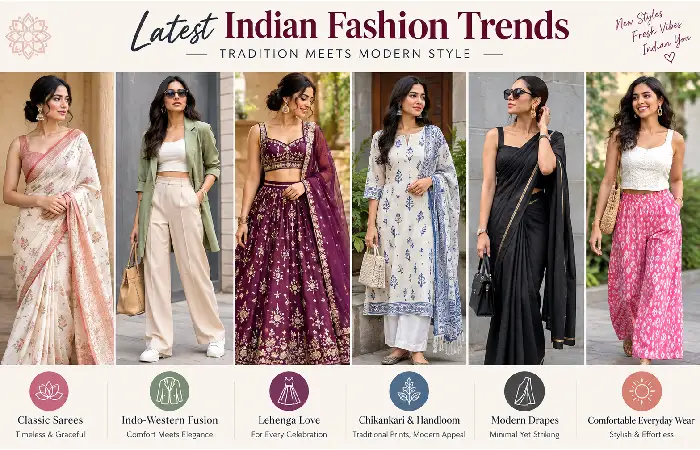
This year’s Indian fashion, 2026, is more about statement wear. Indians are not following the fixed definition of ethnic wear; rather, they are opting for a mixture of ethnic and western, with easy-to-wear, comfortable cotton, rich fabrics, interesting detailing in outfits, as well as experimental styles.
Fusion-centric fashion is evident. While you won’t normally see the traditional drape and wear styles associated with sarees anymore, they may be carried along with a structured blouse, belt, jacket, statement earrings or boots/sandals.
We can also clearly see fashion articles mentioning different regional styles, mixed with modern dressing. The newest looks this year at Durga Puja 2026 could include a western modern dress, co-ordinated sets, contemporary embroidery, kantha detailing, etc as opposed to just the ethnic sarees.
Blouses can add personality and detail to Indian outfits through different necklines, sleeves, fabrics, and designs. Explore our Indian blouse design guide for practical fashion ideas.
Popular Indian Fashion Trends
| Trend | What It Looks Like |
| Modern sarees | Pre-draped, belt-style, structured or minimalist sarees |
| Statement blouses | Dramatic sleeves, unusual necklines and decorative details |
| Lightweight lehengas | Less volume with easier movement |
| Fusion kurtis | Traditional motifs with contemporary cuts |
| Co-ord sets | Matching Indian-inspired tops and bottoms |
| Handloom fashion | Natural textures and artisanal weaving |
| Contemporary embroidery | Traditional techniques used on modern silhouettes |
| Minimal ethnic wear | Clean designs with limited embellishment |
| Jacket-style outfits | Indian garments layered with structured jackets |
| Traditional-modern combinations | Ethnic clothing paired with Western accessories |
In addition, the global environment in 2026 fashion will continue to call for more colour and boldness in shapes, work and the uniqueness of personal expression. All of these aspects provide a fertile ground where Indian design can bring these traditional motifs back in a new, up-to-date way.
Traditional Indian Clothing
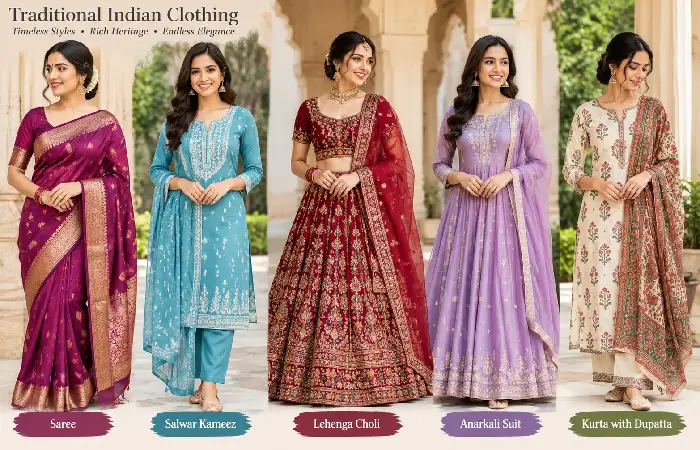
India’s regional fashion traditions showcase unique clothing styles, textiles, patterns, and cultural influences from different parts of the country. Explore our regional Indian fashion guide to discover diverse styles.
Indian traditional clothing is strongly linked to Indian social history and culture. Certain Indian clothes have been in existence, in similar recognisable form for many hundreds of years, while others have evolved with time due to cultural exchange and historical events.
The sari might be the most famous Indian clothing internationally. But Indian traditional clothes go far beyond the sari.
Common Traditional Indian Garments
- Saree
- Lehenga choli
- Salwar kameez
- Kurta
- Kurti
- Anarkali
- Dhoti
- Sherwani
- Achkan
- Churidar
- Ghagra choli
- Mekhela chador
- Mundu
- Regional handloom sarees
Old Indian fashions can be seen as an example of how Indian dress, among other things, came to exist due to its contact and interaction with cultures other than its own. For example, certain features of dress style, such as certain forms of decorative art and styles and types of clothing like the anarkali, lehenga, churidar, sherwani, and achkan owe themselves to the clothing that was worn during the Mughal age.
Traditional Indian clothing has not remained a relic of the past-it has, rather, continuously been modified and evolved.
Indian Ethnic Wear for Women
Indian traditional wear for women encompasses attire derived from Indian traditional fashion. This varies widely, from everyday cotton Kurtis, to heavily decorated bridal lehengas.
Everyday wear generally makes use of lighter, yet comfortable materials like Cotton, Silk-linen mixes, Silk, or even synthetics like rayon. For fancy events, use is made of richer fabrics like Silk, Silk brocade, Silk velvet, silk chiffon, Georgette, synthetic georgette, ornamented fabrics, etc.
Popular Ethnic Wear for Women
- Sarees- Great for daily wear as well as for weddings and social events.
- Salwar suits- Comfortable, appropriate for work as well as casual occasions, great for travel and festive parties.
- Kurtis- An easy way to introduce India to our modern world.
- Lehengas- Mostly for weddings, festivals and parties.
- Anarkalis- Long, flowing, glamorous attire that is easy to carry and move in.
- Sharara sets- Come with a slit with the Palazzo, but there is still ample room. These come with a coordinated kurta or top.
- Palazzo suits- Come with Palazzo bottoms. These are relaxed versions of a traditional suit.
The “best” ethnic outfit does not mean a heavily adorned dress. A nicely draped simple dress of good fabric may look more graceful than a dress that is too overloaded with designs.
Indian Saree Fashion
A saree has to be the most versatile Indian dress. Traditional, smart, stunning, graceful, art, everyday, teenager – according to fabric used, mode of draping, the blouse to wear with, footwear to match, and accessories to complement!
Basically, a saree is a very long piece of material which you drape around yourself, with one part pleated at the blouse and passed over the shoulder.
Indian festivals are a great opportunity to explore colorful traditional outfits and occasion-ready styling ideas. Explore our Indian festival fashion guide for festive outfit inspiration.
The beauty of saree fashion lies partly in its adaptability.
Popular Saree Styles
| Saree Type | Known For |
| Banarasi | Rich silk and elaborate woven designs |
| Kanjeevaram | Traditional South Indian silk and zari |
| Chanderi | Lightweight fabric and elegant texture |
| Paithani | Rich colors and distinctive motifs |
| Pochampally Ikat | Geometric ikat patterns |
| Gadwal | Cotton-silk combinations and decorative borders |
| Kerala Kasavu | White/off-white body with golden border |
| Chanderi | Lightweight elegance and subtle sheen |
| Jamdani | Intricate woven motifs |
| Baluchari | Figurative and narrative motifs |
This regional textile interest is another reason for the interest generated by the saree. For instance, the handloom sector of Telangana, in particular Pochampally Ikat, Gadwal, Narayanpet and the Gollabhama (a dotted saree of a unique variety), represents regional specialities in weaving and design.
Yet another example of the regional specialisation of weaves: Kerala’s Kasavu, with its characteristic white or cream backdrop and gold border, is now synonymous with all celebrations like Onam and Vishu.
Ethnic wear offers a wide range of traditional-inspired clothing that can be styled for everyday occasions, celebrations, and cultural events. Explore our Indian ethnic wear guide for useful styling ideas.
Modern Saree Styling
Modern saree fashion may involve:
- Belted sarees
- Pre-stitched sarees
- Jacket-style blouses
- Contemporary sleeveless blouses
- Statement belts
- Structured handbags
- Minimal jewelry
- Sneakers or modern heels
- Drapes designed for easier movement
The saree’s ability to change with the wearer is perhaps its greatest strength.
Indian Blouse Designs
Blouses make all the difference in a saree. The same saree with one blouse looks utterly ethnic, and with another it looks just sensational, completely modern and happening. A blouse design encompasses not just the necklines but also the sleeve length, back of the blouse and various embellishments, fabrics used, embroidery style, cut and fitting of the blouse.
Popular Blouse Styles
- High-neck blouse
- Boat-neck blouse
- V-neck blouse
- Halter-style blouse
- Sleeveless blouse
- Full-sleeve blouse
- Puff-sleeve blouse
- Peplum blouse
- Jacket blouse
- Backless blouse
- Embroidered blouse
- Corset-inspired blouse
Contemporary designers are increasingly viewing the blouse as an individual fashion statement. Latest celebrity styles have involved architectural blouses that look like necklaces, showing the potential for experimental saree wear as well.
A plain blouse can help in balancing heavily embroidered sarees. An elaborate blouse, on the other hand, can become a centerpiece for a plain saree.
Indian Lehenga Fashion
A common and defining sight at every Indian fiesta, the traditional lehenga essentially includes three pieces: a skirt, a choli or a blouse, as well as a dupatta. The designer lehengas seen today are anywhere from heavy work-based bridal wear to something simpler for wedding functions.
Types of Lehenga Styles
- Bridal lehenga: Heavy embroidery, fine stitching; decorations; use of zari, mirrors, sequins; common Indian designs like paisleys, florals.
- Festive lehenga: vibrant and full of colors, less decorated or embroidered than bridal wear.
- A-line lehenga: Flairs naturally from the waist, giving a more balanced and gracious appearance.
- Flared lehenga: this style is more on the volume and flare part.
- Minimal lehenga: involves less embroidery or ornamentation, clean-cut and elegant.
- Indo-Western lehenga: traditional skirt style incorporated with Western styles for the top, jacket style with the top, with a belt in the Western way and draping that looks atypical.
Comfort has become increasingly critical. Is a gorgeous lehenga that you can’t walk, sit, or even dance in wearable during a long wedding party? Lightweight material, easily managed folds of netting, and properly fitting blouses go a long way.
Indian Salwar Suit and Kurti Styles
The salwar suit is one of India’s most practical forms of ethnic clothing. Traditionally, it combines a tunic or kameez with trousers and a dupatta.
Over time, the basic concept has developed into countless variations.
Popular Salwar Suit Styles
- Straight-cut suit
- Punjabi suit
- Anarkali suit
- Palazzo suit
- Patiala suit
- Churidar suit
- Sharara suit
- Angrakha suit
- Jacket-style suit
Comfort has become increasingly critical. Is a gorgeous lehenga that you can’t walk, sit or even dance in wearable during a long wedding party? Lightweight material, easily managed folds of netting and properly fitting blouses go a long way.
Indian Wedding and Festive Fashion
Weddings are the most significant events for traditional clothing for Indians. Clothes have sentimental value, as the selection process usually revolves around ceremonies, cultural traditions, regions and lasting photographs.
For weddings, women may choose:
- Bridal lehengas
- Silk sarees
- Designer sarees
- Sharara sets
- Anarkalis
- Embroidered suits
- Contemporary lehengas
- Saree-gown hybrids
Festive fashion is usually more flexible.
For Diwali, a silk saree, an embroidered kurta set or a lehenga would be a good choice. Fabrics such as a very light material with little to no embroidery should suffice at an informal gathering as well.
Wedding Outfit Guide
| Occasion | Suitable Outfit |
| Engagement | Contemporary saree or embellished lehenga |
| Mehendi | Colorful lehenga or sharara |
| Haldi | Lightweight bright ethnic outfit |
| Wedding | Silk saree or detailed lehenga |
| Reception | Designer saree, gown-inspired saree or formal lehenga |
| Family celebration | Anarkali, kurta set or elegant saree |
Indian wedding dressing too is seeing a large-scale personalization. Contemporary Indian wedding styling in modern luxury married with a customized silhouette is more often the norm.
Regional Indian Fashion
Perhaps the most beautiful aspect of Indian fashion is its regional diversity.
There is no single “Indian look.” Instead, there are hundreds of regional expressions.
Examples of Regional Fashion
- Punjab: Phulkari embroidery, Salwar kameez, vibrant colors and Punjabi silhouettes.
- Rajasthan: Bandhani, Leheriya, vibrant ghagra cholis with mirror work and big chunky accessories.
- Gujarat: Chaniya Choli, mirror work, bandhani, and colorful textile designs with the use of mirror work reflecting sunlight or lamp light, giving a bright look.
- Maharashtra: Nauvari sari, Paithani textiles.
West Bengal: Traditional Bengali saris, jamdani, baluchari, and kantha-influenced textile designs. - Kerala: Kasavu sari and mundu-settu Tradition.
- Tamil Nadu: Kanchipuram Sarees with traditional South Indian silhouettes.
- Assam – Mekhela Chador and a woven textile design that can never be easily replicated.
- Telangana – Pochampally Ikat, Gadwal, Narayanpet and Gollabhama sarees.
However, the distinctive nature of Indian fabrics, across its many regions, isn’t an aesthetic aspect only. The texture of yarn being used, the design that is chosen, and even its thread colors and texture often help to determine its regions of origin. Telangana tourism talks about specific design and construction features of Pochampally Ikat and Gadwal sarees.
This regional diversity is one reason Indian fashion remains so rich.
Modern Indian Fashion
Fashion today in India is not about denying your tradition, but often a reinterpretation of tradition. It can come about through a formal blouse teamed with a saree or loose trousers with a kurta, or a fitted cropped jacket with a lehenga. Embroidery you thought you’d only find on a traditional outfit can even make an appearance on a modern outfit.
This is the essence of Indo-Western fashion.
Examples of Modern Indian Fashion
- Saree with blazer
- Kurti with jeans
- Lehenga with contemporary crop top
- Indian jacket with trousers
- Embroidered dress
- Co-ord ethnic sets
- Saree with sneakers
- Kurta with wide-leg pants
- Traditional textile used in modern dresses
- Contemporary jumpsuits featuring Indian embroidery
Fashion now also places a strong emphasis on comfort. Customers are increasingly aware that they desire garments which appear fantastic in a photograph and are equally comfortable as you live your day.
At the same time, craftsmanship has been rediscovered. Handloom and traditional production are now gaining ground in discussion as perhaps a viable answer to fast fashion, rather than as just heritage goods. Reports have highlighted the environmental and societal rewards associated with traditional techniques and local production.
How to Style Indian Outfits?
It is not obligatory to match each traditional ornament with one Indian outfit. Moreover, moderation would enhance the ensemble.
1. Balance the Outfit
If the sari has large, heavy embroidery, try to take the jewelry back slightly. Statement earrings, or even a neck piece, would be very effective against the minimalism of a simple dress.
2. Choose Accessories Carefully
Indian accessories can include:
- Jhumkas
- Chandbalis
- Bangles
- Statement necklaces
- Maang tikka
- Potli bags
- Embroidered clutches
- Kolhapuri-style footwear
- Traditional sandals
The accessory should complement the outfit rather than compete with it.
3. Consider the Occasion
While designer wedding lehengas would certainly be the way forward for your wedding, they’d be inappropriate for a casual get-together with friends. The cotton kurti would pass as good attire in the afternoon but would need quite a bit of careful coordination to get to work at night.
4. Pay Attention to Fabric
What clothes look and feel like also depends on the Fabric. Cotton is comfortable for informal daytime wear, and silk may add glamour for an evening out.
5. Experiment With Color
It is incredibly exciting in Indian fashion with regard to the use of color. Jewel tones, earthy colors, pastels, metallics, ivories, reds, greens, pinks, yellows, and blues can be appropriate for the appropriate event.
6. Keep Comfort in Mind
When you’re smartly dressed, you will definitely enjoy the event as a whole. When it’s an all-day affair, you should have absolute surety that it fits, the material, the shoes, as well as the ease in adding layers.
Indian Textiles and Craftsmanship
We can hardly talk about Indian fashion without delving into the incredibly diverse nature of Indian textile traditions and craftsmanship. The production of most stunning Indian fabrics involves complex techniques such as spinning, weaving, dyeing, printing, embroidery, and manual finishes, which have become a legacy of generations. The fabrics thus carry a deep sense of history that manufactured clothing cannot compare to. Handloom means fabric woven on a loom that is powered by hand and is made neither by industrial means nor woven by an entirely automatic machine that does not depend on a person working.
Textiles woven by hand are appreciated for unique weaves, regional patterns, and ties with the artisans. India’s regional weaving traditions are also abundant, and most often cloths derive their names either from the place, the group the cloths belong to, or the group of artisans who have woven the clothes, or even from a particular motif found.
Popular Indian Textile Traditions
Banarasi silk features a beautiful allure and beautifully woven designs. South India’s Kanchipuram silk is mostly worn during wedding occasions, important parties, etc. Chanderi silk is admired for being extremely light as well as delicate, while Pochampally Ikat has a beautiful geometry due to its weaving and dyeing methods.
Apart from fabrics, embellishments make garments so stylish and diverse. Phulkari work, Kantha work, Chinkari work, Zari work, Mirror and Aari work can give any ordinary cloth the most unique look.
An important aspect of these crafts, which people mostly enjoy, is that a lot of imperfections are part of their persona. A hand-woven garment might look nothing like another piece produced with the exact method, but rather than considering this a fault, many see this as a token of hand craftsmanship.
Indian Fashion Accessories
All accessories become far more important-it is these things that make Indian look what it is. Indian jewelry, shoes, and bags can, together or alone, with a tie of the Indian garment/scarf, be called one total new Indian appearance. In Indian jewelry, classics include: jhumkas, chandbalis, bangles, lockets/neclaces, anklets, maang tikas, and nose rings
One can mix this modern look with very simple ethnic wear.
Another aspect is wearing minimal accessories with a really blingy outfit to highlight the garment rather than wearing accessories all over the entire ethnic costume.
The bag category now has to carry its conventional, small potli and embroidered potli and clutches to more structural handbags and designer party bags.
Just the footwear also plays around with choices, jutties and mojaries and also sandals andkolhapuirsisand even embellishments. But this category has an ethnic, ethnic sandal as well, so even for party wear, one could try a sandal on too for its convenience during the length of the ceremony.
Sustainable Indian Fashion
A discourse in which sustainability has gained the forefront is Indian handlooms and indigenous crafts, an area where skilled handiwork and local craft production come into play.
Instead of endlessly disposing of trendy, affordable pieces, one can choose a well-made piece of clothing that one might choose to wear and carry for years. Consumers have a choice of natural fabrics, good construction and durability, and clothes that are repairable or can be versatile in their styling for various occasions.
Indian sustainable fashion does not equate to shunning contemporary style. While a handloom saree can either be styled along traditional lines for an occasion, a contemporary blouse could add a new spark for an event. A classic kurta might find its wearability either with trousers, with jeans or even with a skirt, thereby making fashion more conscious.
The Future of Indian Fashion
In short, the future of Indian fashion will perhaps focus on a dialogue between tradition and modernity, where traditional crafts will be reimagined into new forms of silhouettes and consumers will look for ease, self-expression, durability and utility.
The use of social media in India has also given immense importance to the variety of regional fashion. The sartorial styles traditionally associated with only a specific community or region now inspire people everywhere-not only throughout the Indian subcontinent, but across the globe!
The most beautiful aspect is that there isn’t any need for Indian fashion to pick between tradition and modernity because it could have both; the same century-old hand-weaving techniques can bloom on a contemporary western silhouette, as can a traditional saree adopt completely fresh looks.
Frequently Asked Questions About Indian Fashion
What is Indian fashion known for?
Indian clothing can be attributed to bright clothing, saris, embroidery, traditions in handlooms and craft work with embellishments to Indian textiles, along with diversity of regions and integration of heritage and modern design styles.
What is the most famous Indian traditional dress?
The saree is the Indian traditional attire that is the most internationally recognized in the world. Though many other traditional dresses exist in India, they are important too.
What are the most popular Indian outfits for women?
These sarees, salwar suits, kurtis, lehengas, anarkalis, sharara sets, and regional specialties were mostly chosen by the participants.
What is modern Indian fashion?
Indian wear nowadays refers to those Indian fabrics, embroidery, patterns, or cuts which are then teamed up with Western cuts, styles, techniques, and designs for wear.
Which Indian outfit is best for a wedding?
For wedding functions, you may include the option of wearing a sari, lehenga, embroidered anarkali, sharara and designer ethic sets. You can mix and match items from different categories in such a fashion to complement the occasion, location, the available time span, and your preferences.
Are Indian clothes suitable for everyday wear?
Sure. In your everyday comfortable dressing style: cotton kurtis, lightweight sarees, airy salwar suits, Palazzo Pants, and relaxed ethnic co-ords are some nice, comfy wear.
Final Thoughts
The most accurate descriptor of fashion in India is likely a living tradition; It was never completely fossilized in its original form and doesn’t require all time to continue only to be dressed within a certain prescribed set design. It possesses the charm of where the past and present mingle:
A hand-woven sari might be teamed with an “Indiano style” blouse. A traditional kurta may even be complemented by denim jeans. A technique in textile construction hundreds of years old may appear on a jacket, but updated for modern times. A bridal lehenga might retain classic embroidery but utilize a lightweight, modern-day shape.