

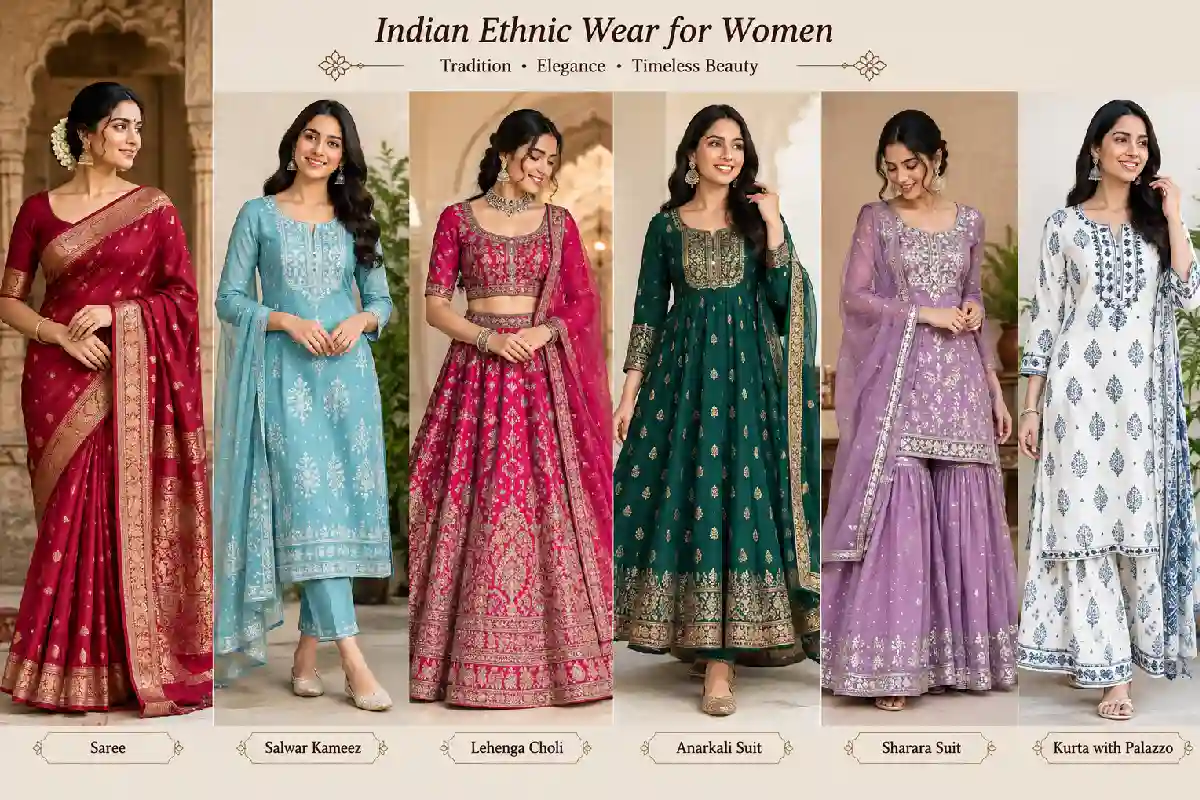
Indian Ethnic Wear for Women: A Complete Style Guide
 Khizrana Begum
Beauty & Lifestyle Writer
Khizrana Begum writes clear and reader-friendly content covering beauty, lifestyle and related topics.
Read Full Bio of Author →
Khizrana Begum
Beauty & Lifestyle Writer
Khizrana Begum writes clear and reader-friendly content covering beauty, lifestyle and related topics.
Read Full Bio of Author →
 Sameena Begum
Health, Technology & Digital Content Reviewer
Sameena Begum reviews content for clarity, accuracy and overall reader usefulness.
Read Full Bio of Reviewer →
Sameena Begum
Health, Technology & Digital Content Reviewer
Sameena Begum reviews content for clarity, accuracy and overall reader usefulness.
Read Full Bio of Reviewer →
Indian Ethnic Wear for Women: What can be said in addition is about indian traditional dressing, including the regionalities, cultures, and diversities of India, and weaving textures, fabrics, embroideries, and dressing traditions of the country. From a beautifully draped sari to sparkling lehengas, and not so much heavy and more comfortable yet stylish kurtis and anarkalis, all kinds of ethnic wear for women can fit into a wedding ceremony or wedding festival, any family function, or business event.
Indian ethnic wear brings together traditional influences, versatile silhouettes, and cultural details that work well for everyday and special occasions. Explore our complete Indian fashion guide for broader style inspiration.
The advantage here, however, is that now you do not need to always wear a traditional look or traditional styling, since Indian ethnic wear has given birth to western cuts, western fabrics, fusion styles, and even statement additions in terms of accessories.
❝
This article is a part of
Indian Fashion Guide
What Is Indian Ethnic Wear?
Indian Ethnic Wear is one whose roots lie in the communities, customs, and ethnography of India. Ethnic wear in India also depends on regions and can be differentiated based on the texture of fabric, print, weave of fabric, embroidery patterns, and style.
Some regional types of ethnic wear ( like Kanjeevaram sarees are specific to Tamil Nadu, and Banarasi sarees to Banaras alone.
Ethnic wear ranges from heavy ethnic wear (for weddings to casual wear in cotton to suit one’s needs.
| Ethnic Wear | Best For | Common Fabrics |
| Saree | Weddings, festivals, parties | Silk, cotton, chiffon, georgette |
| Lehenga | Weddings, receptions | Silk, velvet, georgette |
| Salwar suit | Festivals, work, celebrations | Cotton, silk, rayon |
| Anarkali | Parties, weddings | Georgette, chiffon, silk |
| Kurti | Everyday and workwear | Cotton, rayon, linen |
| Ethnic top | Casual and fusion looks | Cotton, silk, viscose |
Types of Indian Ethnic Wear for Women
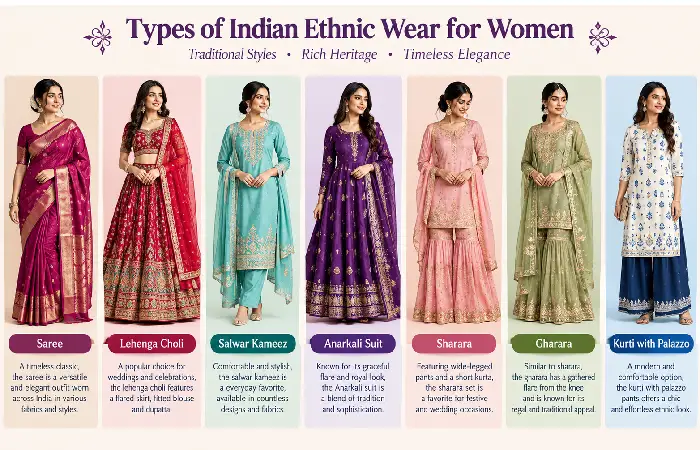
Traditional Indian clothing offers timeless styles through distinctive fabrics, patterns, embroidery, and classic silhouettes. Explore our traditional Indian fashion guide for helpful ideas.
Indian ethnic wear has many options for women, and the dress worn may vary according to the event, comfort level, season, and also based on style.
The dresses that you could wear are:
- Sarees
- Lehengas
- Salwar suits
- Anarkalis
- Kurtis
- Sharara sets
- Ghararas
- Palazzo suits
- Ethnic skirts
- Dupattas
- Traditional blouse styles
Mix them with modern outfits also. An Indo-western outfit in a simple printed kurti and straight trousers is just easy. A simple way of getting Indianized with western would be carrying the saree with a modern-style blouse.
Ethnic Sarees for Women
Salwar suits are a popular choice within ethnic wear, offering comfortable and stylish options for different occasions. Explore our salwar suit fashion guide for practical inspiration.
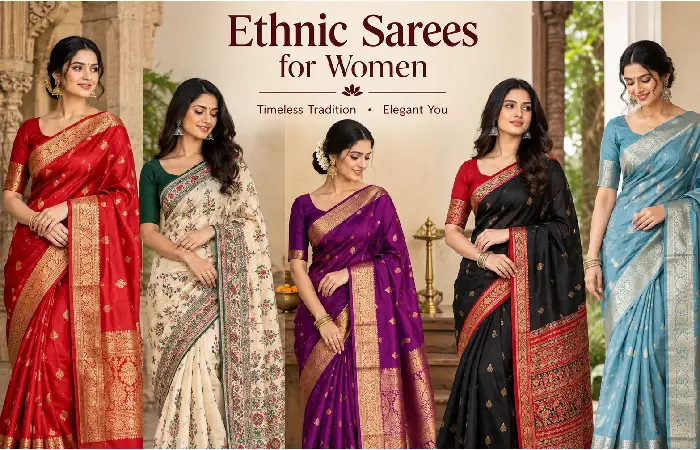
Saree- undoubtedly, still remains the quintessential form of Indian Ethnic Wear for Indian Women. It is simply a long fabric piece wrapped around the body, accompanied by a blouse and a petticoat or suitable innerwear. The kind of Saree depends on:-
- Where you are living,
- The material it is made of.
- The kind of weave and print on the saree.
Some Indian women’s favorites are Banarasi, Kanjeevaram, Chanderi, Chikanari, Bandhani, Pithani, Tant, Tussar silk, and cotton sarees.
| Saree Type | Known For | Suitable Occasions |
| Banarasi | Rich zari and silk weaving | Weddings, receptions |
| Kanjeevaram | Traditional silk and bold borders | Weddings, festivals |
| Chanderi | Lightweight fabric | Festive occasions |
| Bandhani | Tie-dye patterns | Festivals, celebrations |
| Paithani | Traditional motifs and rich colors | Weddings, cultural events |
| Cotton saree | Breathability and comfort | Everyday wear, office |
You might have silk or heavily woven sarees if going to a function. Cotton or mixed fabric lighter ones could be more comfortable during summer gatherings.
Ethnic Lehengas for Women
Weddings, receptions, engagements, and functions-all are decked up in lehengas. Generally, these consist of a lehenga or flair, a choli or a blouse, and a dupatta.
Blouses can add distinctive details to ethnic outfits through different necklines, sleeves, fabrics, and decorative designs. Explore our Indian blouse design guide for useful styling ideas.
There are several variations of the modern lehenga design in various styles and levels of embellishment.
The modern designer outfits in these ensembles would be heavily embroidered with mirrors, sequins, Zari, beadwork, or stylish printed fabrics/embroidery. Lighter colours, fabric will suit for evening; heavier, and brightly coloured for night.
Stylist tip: If the lehenga has plenty of embroidery on it then keep your accessory styling simple or choose to have less embroidery detail on your choli to avoid an ‘oversized’ look.
Salwar Suits and Anarkalis
Perhaps one of the more adaptable outfits in Indian traditional fashion is the Salwar suit. An Indian salwar suit usually consists of a kameez/tunic, a salwar/trousers, and a dupatta.
The fit of the anarkalis is typically form-fitted through the bodice, opening up in a very broad flare at the hem.
Ethnic wear varies across India, with regional traditions influencing textiles, patterns, silhouettes, and styling choices. Explore our regional Indian fashion guide to discover diverse styles.
These are flattering without the complex draping involved in sarees.
Common versions are:
- Straight-cut suits
- Punjabi suits
- Palazzo suits
- Churidar suits
- Anarkali suits
- Sharara sets
- Short kurta sets
The best cotton suits for day-to-day wear would be salwar suits, and for occasions like parties, silk, georgette, or chiffon embroidered suits would be more appropriate.
Kurtis and Ethnic Tops
Out of all Indian wear, kurtis are possibly the easiest piece to wear on an everyday basis. Kurtis match with leggings, palazzos, straight pants, jeans, skirts, and trousers; they match with all. A plain cotton kurti could be a perfect match for your casual everyday attire, and a kurti with heavy embroidery and stone work could give you a party or festive look.
| Kurti Style | Styling Idea | Best For |
| Straight kurti | Pair with cigarette pants | Office and casual wear |
| A-line kurti | Wear with leggings or palazzos | Everyday outfits |
| Printed kurti | Add simple jewelry | Casual occasions |
| Embroidered kurti | Pair with matching bottoms | Festive events |
| Short kurti | Style with jeans or a skirt | Indo-western outfits |
| Long kurti | Add statement earrings | Parties and celebrations |
Ethnic tops are another way that can give a lot of flexibility. In these, prints/embroideries/mirror work/block prints/woven details are combined along with contemporary fits.
Ethnic Wear for Weddings
In India, you get so many occasions to wear traditional outfits. The outfit you want to buy depends on how closely you are related to the bride and groom, as well as on the ceremony the wedding function belongs to. For a close wedding ceremony in the family, you can opt for rich silk sarees and richembroidered lehenga/ Anarkalis. For small weddings and functions, one would better go for formal wear, which can be sarees or a formal suit.
| Wedding Event | Outfit Ideas | Accessories |
| Mehendi | Sharara, printed lehenga | Colorful earrings |
| Haldi | Lightweight saree or suit | Floral jewelry |
| Sangeet | Embellished lehenga | Statement jewelry |
| Wedding | Silk saree or lehenga | Traditional jewelry |
| Reception | Designer saree or contemporary lehenga | Clutch and heels |
The ease of wearing them is worth considering, as you can spend a good part of your evening sitting at a wedding; comfort is almost as important as aesthetics.
Ethnic Wear for Festivals
Festivals allow us to explore our creativity by experimenting with prints, colors, Indian designs, and Indian jewelry. The dresses will all depend upon the specific occasion which you are attending.
You could have a heavily worked Anarkali, silk saree, or striking lehenga on the occasion of Diwali. Or you could have brightly coloured Gujarati or Rajasthani designs at a Navratri event.
Wear clothes on these festival days that you feel comfortable wearing, depending on the current climate and comfort factor.
Simple festive combinations include:
- Cotton kurti + palazzo pants + jhumkas
- Silk saree + statement earrings
- Anarkali + embroidered dupatta
- Printed lehenga + simple blouse
- Kurta set + colorful dupatta
Sometimes too much embroidery is a bit much for the festive look. A lovely material, traditional print, and tasteful accessories can more than suffice.
Ethnic Accessories for Women
Accessories have a transformative way of adding to a woman’s ethnic apparel. “The art lies in complementing the look without being overbearing,” says Madho.
The choice of common Indian ethnic wear accessories available includes:
- Jhumkas
- Chandbalis
- Maang tikka
- Bangles
- Kadas
- Statement necklaces
- Nath
- Anklets
- Potli bags
- Embroidered clutches
- Traditional footwear such as juttis and mojaris
Statement earrings & a heavily studded lehenga, and just a statement clutch will do. In contrast to that, a plain cotton kurti, colored jhumkis, bangles, and a printed dupatta can outshine this one as well!
How to Style Indian Ethnic Wear?
It does not need to be so complicated and so tricky. When it comes to the ethnic look, start with the event and then build your entire look around the outfit you have selected, and then add accessories.
1. Balance Traditional and Modern Pieces
Combine a classic kurti with jeans, or wear a saree with a modern blouse. Indo-western looks can be achieved without detracting from the authentic ethnic style of the clothing.
2. Choose Accessories Carefully
Don’t wear all of the statement accessories; choose only one or two bold accents. If the embroidery on my outfit is very complex, large earrings will suffice.
3. Coordinate Colors
Accessories don’t need to be an exact match to your attire. On the other hand, they could be either matching or a complementary or contrasting shade. The golden jewelry that goes well with the royal blue Indian garment would beautifully complement pastels in silver or pearl.
Festivals are perfect occasions to showcase ethnic wear through colorful outfits, traditional fabrics, and festive styling details. Explore our Indian festival fashion guide for festive outfit inspiration.
4. Consider the Fabric and Weather
The best choice for hot days is light cottons, linens, and breathable mixed blends; silk, velvet, and heavier cloths are most certainly better in wintertime or in the evening for special occasions.
5. Pick Comfortable Footwear
Footwear such as juttis, mojaris, sandals, wedges, and low heels can all go with ethnic outfits. The right kind of comfort during a wedding or at long events can make a lot of difference.
6. Don’t Forget the Dupatta
Dupattas can instantly enhance any suit or lehenga. One can simply wear it over one shoulder, draped from one end to the other, over both shoulders, and for some formal ones, drapes with some structure can also be worn.
Final Thoughts
Indian traditional outfits for women are spectacular, blending traditional craftsmanship, intricate embroidery, textile weaving techniques, along with aesthetics and designs. Be it elegant saris, magnificent lehengas, casual and relaxing kurtis, or formal and stylish Anarkalis, you’ll find attire suitable for your mood and for any occasion. The simplest way to update your look is to pick a fitting Indian outfit suitable for the occasion based on your comfort and add accessories.
Matching the colors, fabrics, and silhouettes of apparel and jewelry makes it appear that traditional clothing is an instant makeover.