

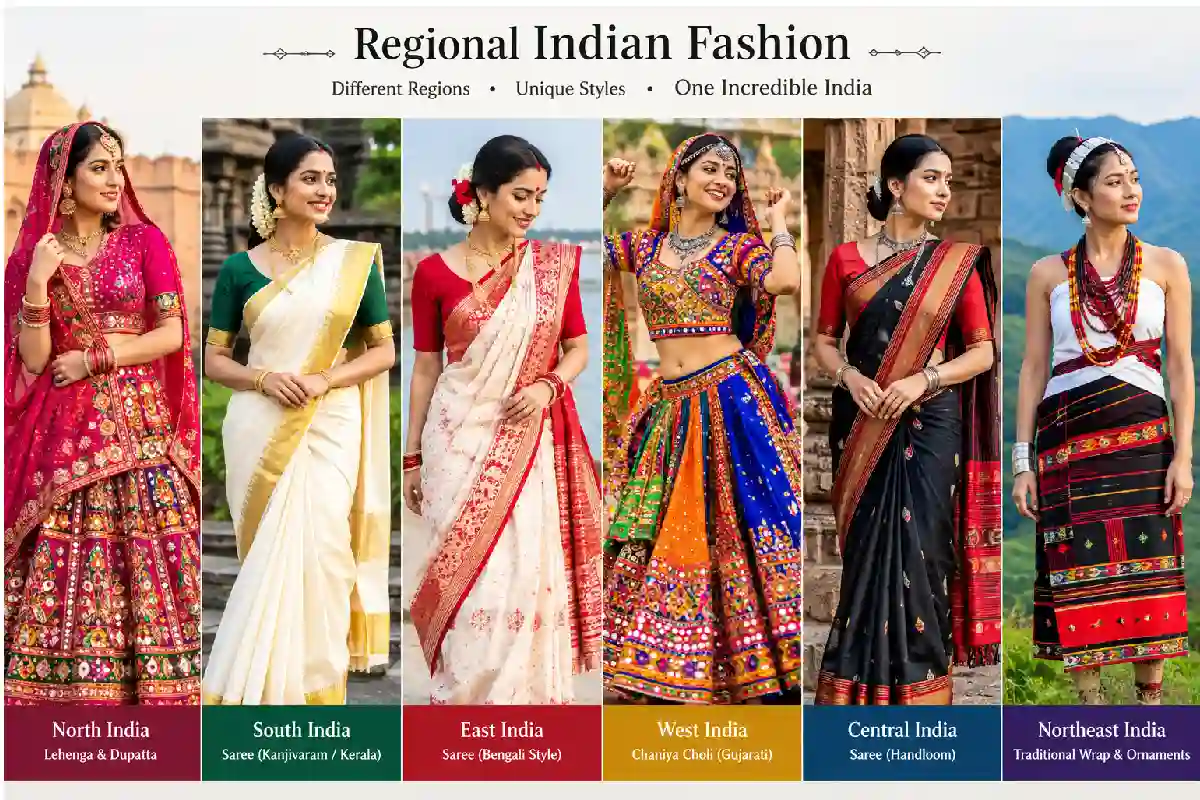
Regional Indian Fashion: A Guide to India’s Diverse Traditional Styles
 Khizrana Begum
Beauty & Lifestyle Writer
Khizrana Begum writes clear and reader-friendly content covering beauty, lifestyle and related topics.
Read Full Bio of Author →
Khizrana Begum
Beauty & Lifestyle Writer
Khizrana Begum writes clear and reader-friendly content covering beauty, lifestyle and related topics.
Read Full Bio of Author →
 Sameena Begum
Health, Technology & Digital Content Reviewer
Sameena Begum reviews content for clarity, accuracy and overall reader usefulness.
Read Full Bio of Reviewer →
Sameena Begum
Health, Technology & Digital Content Reviewer
Sameena Begum reviews content for clarity, accuracy and overall reader usefulness.
Read Full Bio of Reviewer →
Regional Indian Fashion: Indian fashion is not just a mere type of saree, kurta, or lehenga. Every place has a characteristic pattern of weave or embroidery, of material, of colors used, or of the jewelry or the conventional wear itself. The woven materials of Rajasthan or the silken saris of South India- both represent the history, region, and climate of a place, as well as the artisans. Familiarizing oneself with them helps in acquiring an understanding and appreciation of these clothes for different situations.
❝
This article is a part of
Indian Fashion Guide
What is Regional Indian Fashion?
Regional Indian fashion is the variety of traditional and contemporary apparel inspired by the distinct regions of India. These garments have evolved over the generations and are influenced by the local lifestyle, festivals and religions, environment and profession of the people, as well as the textiles used. For instance, the use of fine cotton to remain cool in the hot weather in tropical regions, or ornate, elaborate wear to get in the festive mood at weddings, shows that the style of dress varies from region to region.
| Region | Popular Clothing | Notable Textiles or Techniques |
| North India | Salwar kameez, lehenga, kurta | Phulkari, chikankari, brocade |
| South India | Silk saree, veshti, half-saree | Kanjeevaram silk, Kasavu |
| Maharashtra | Nauvari saree, traditional dhoti | Paithani weaving |
| Bengal | Saree, dhoti-kurta | Jamdani, Kantha |
| Gujarat | Chaniya choli, saree | Bandhani, mirror work |
| Punjab | Patiala suit, kurta pajama | Phulkari |
| Rajasthan | Ghagra choli, angrakha | Bandhani, Gota Patti |
North Indian Fashion
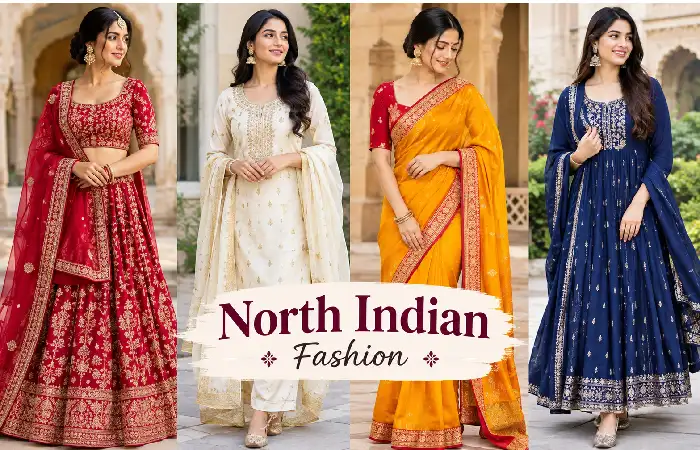
Regional Indian fashion showcases the country’s diverse cultural heritage through unique textiles, silhouettes, patterns, and traditional craftsmanship. Explore our complete Indian fashion guide for broader style inspiration.
North Indian clothing is characterized by the presence of flamboyant embroidery, fabrics in varied richness, and a multiplicity of fabrics used. The traditional wear differs in every state, but generally salwars, kameezes, lehengas, kurtas, sherwanis, and dupattas are well-known pieces across the states.
Lucknow is famous for making awesome-quality chikankari work.
The bright & colorful Phulkari work is popular for its craftsmanship. Also an important part of these kinds of clothes is Banarasi materials of Uttar Pradesh, used especially for marriages as well as official occasions.
The Indian wedding wear in North India consists of rich embroidery and exquisite textures, like silk, velvet, brocade, and georgette.
South Indian Fashion
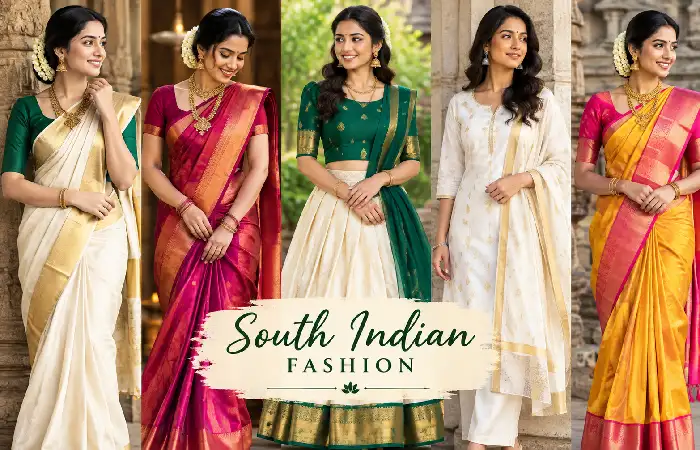
Handlooms are the foundation of South Indian fashion, and the silk and cotton weave stands out as most recognizable. The most recognizable garment ever still reigns, and there are specific weaves to specific states.
Kanjeevaram silken saris of Tamil Nadu have a niche within weddings and ceremonies, while Kerala wears gold-white Kasavu, unornamented yet regal. The Mysore silken beauty of Karnataka too comes into its own, while those of Andhra Pradesh and Telangana trace their history to certain forms of weaving like the Pochampally ikat.
For men, generally, this comes in the form of an aveshti or dhoti paired with a shirt or the typical upper-wear.
Maharashtrian Fashion
Maharashtrian clothes are functional as well as culturally distinctive. Nauvari Saree, worn in a unique draped form, is one of the most special wear of Maharashtrian women, and the Paithani Saree is renowned for its intricately designed patterns and rich woven border that enhance a woman’s wear. Maharashtrian ornaments, particularly worn with traditional outfits, include the nath,thushi necklace, and more bespoke trinkets.
Men traditionally wear a dhoti with a kurti, and in some traditional cases with a ‘pheta’ – which is a cap or turban style. With an ever-increasing blend of tradition, modern Maharashtrian clothing is also adapting to modern and casual styles that include a fusion of traditional attire, for example, modern sarees, dresses, kurtis, as well as accessories with tradition woven into them.
Bengali Fashion
Bengali clothing designs are also largely rooted in beautiful sarees and the diverse tradition of textiles. The most prized form of clothing in Bengal is the cotton and silk sarees, from simple and casual to heavily ornamented ceremonial wear. Jamdani sarees with a wide array of delicate, handwoven designs are truly an art form, while embroidery done with kantha is a traditional form of dress-making.
Many regional styles are rooted in traditional clothing practices that have been passed down through generations. Explore our traditional Indian fashion guide for helpful ideas.
For festivals, traditional Bengali wear generally includes a carefully draped Bengali-style sari with a complete set of antique ornaments and subtle makeup. Typical masculine wear is a panjabi with dhoti, and this formal attire is crafted from silk and luxury fabric, especially for festivals, weddings, and ceremonies
Gujarati Fashion
Gujarati fashion is bold and colorful in its patterns. A very long textile history is evident here, with richly patterned forms and colorful uses of fabric and detail. Chaniya cholis are popular during Navratri, consisting of colorful, flared skirts with tightly stitched, brightly colored embroidered tops along with richly decorated dupattas; this makes it very festive wear. A very distinctive textile craft of Gujarat and a celebrated art form is Bandhani (tie-dye); embellishment and intricate patterns are used, and it’s almost standard that embroidery is incorporated into their outfits.
There will always be vibrant colors used in Gujarat; for example, red, orange, yellow, pink, blue, and green. Contemporary designers also try to use this typical Gujarati style for their textiles.
Punjabi Fashion
Traditionally, Punjabi dress opts for colorful, comfortable silhouettes, and interesting embroidery, exemplified by two traditions: the salwar Kameez and the Punjabi suit. Phulkari, meaning “flower work” and particularly traditional of the Punjab region, is a traditional Punjabi embroidery.
Phulkari can sometimes traditionally include brightly colored flower work embroidered onto the cloth, which is very colorful and recognizable.
Salwar suits also reflect regional influences through different fabrics, cuts, patterns, and styling traditions across India. Explore our salwar suit fashion guide for practical inspiration.
The men’s traditional outfit can be a kurta pajama. Some men continue wearing their traditional turbans as their hair. However, modern Punjabi clothing has come to affect South Asian clothing the world over-this has happened through bright clothing, embroidered marriage outfits, and colorful adornments.
Rajasthani Fashion
Rajasthani dress is known for its colorfully hued textiles, quality fabrics, and individual construction styles. Traditional women’s outfits could be a ghagra choli with odhani (a headscarf also called a dupatta) to cover the head. Popular weaving styles are Bandhani (hand-tied, knot-tied) and Leheriya (circular dyed), and, in wedding garments, Gota Patti ( appliqué work with a gold brocade) is hand-worked on it. Rajasthani fashion favors bright contrasting hues that stand out against the barren desert landscape.
Men traditionally wear the dhoti, kurta, and sometimes the angarkha, topped by a colorfully designed turban. Jewelry such as necklaces also complements many a Rajasthani ensemble; this too includes embroidered shoes.
Regional Saree Styles
India is packed full of variety when it comes to its numerous beautiful sarees – each region brings its own weaving methods, embroidery designs, patterns, and draping styles.
| Saree Style | Region | Key Feature |
| Kanjeevaram | Tamil Nadu | Rich silk and contrasting borders |
| Banarasi | Uttar Pradesh | Brocade and intricate motifs |
| Paithani | Maharashtra | Woven motifs and decorative borders |
| Jamdani | Bengal | Intricate woven patterns |
| Kasavu | Kerala | White or cream with gold detailing |
| Bandhani saree | Gujarat/Rajasthan | Tie-dye patterns |
| Chanderi | Madhya Pradesh | Lightweight fabric |
| Sambalpuri | Odisha | Ikat patterns |
They can be worn in the traditional way. Customize hand-woven regional sarees with modern wear. When a hand-woven saree is worn with a modern blouse, we can create a blend of tradition and fashion.
Regional Traditional Clothing
Indian tradition is way beyond Sarees only. Each part of India has created its own attire, taking into account the region’s habits and practices.
>Lehengas, salwar suits, ghagra cholis, mekhela chadors, half-sarees, and various types of traditional dresses are worn by ladies, while dhotis, kurtas, veshtis, lungis, sherwanis, and traditional Indian head-dress are worn by Indian men.
Blouse designs can vary significantly by region, with different necklines, fabrics, embroidery, and decorative details adding local character. Explore our Indian blouse design guide for useful ideas.
| Garment | Common Regional Association | Typical Occasion |
| Lehenga choli | North & West India | Weddings and festivals |
| Salwar kameez | North India | Everyday and festive wear |
| Nauvari saree | Maharashtra | Cultural occasions |
| Ghagra choli | Rajasthan/Gujarat | Festivals and weddings |
| Veshti | South India | Festivals and ceremonies |
| Dhoti kurta | Several Indian regions | Traditional occasions |
| Mekhela chador | Assam | Festivals and formal occasions |
How Regional Culture Influences Indian Fashion?
Cultural factors have helped to establish the overall look and feel of clothing worn in India. Such elements can include festivals, culture- and religion-specific traditions and events, weather, history, the arts and culture, and belief systems. Weather: It is sensible for people living in hot, humid areas to use light cotton, whereas for the winter evenings, other types of warmer material can be used.
Regional clothing traditions become especially visible during celebrations, when people often choose colorful outfits inspired by local culture. Explore our Indian festival fashion guide for festive outfit inspiration.
Craftsmanship: The level of skill and the quality of artistry shown by the local craftsmen help to define the local looks in Indian fashion and include techniques like Bandhani, Phulkari, Jamdani, Ikat and Paithani, which are skills taught to children as they grow older.
Ethnic wear brings together traditional influences and versatile styles from different parts of India. Explore our Indian ethnic wear guide for helpful fashion ideas.
Weddings/Festivals: Clothes worn for formal and festive occasions more often tend to be of a more ‘festive’ nature, with rich materials such as silk, brocade embroidery, beading, and glittering trimmings. Fashion of today, “Contemporary fusion,” is a burgeoning business in India; designers are using local textiles and traditional body-shape designs in their outfits.
Final Thoughts
Regional Indian wear represents the diverse textiles and culture of India. Regional-specific apparel, fabric, embroidery patterns, colors, and styling methodologies vary across each state of India. Punjab’s Phulkari, Gujarat’s Bandhani, Tamil Nadu’s Kanjeevaram silk, and Maharashtra’s Paithani are a few of the textile traditions that still impact traditional clothing and modern Indian wear.
The significance of regional Indian wear is that heritage is made relatable. Traditional processes continue while silhouette and styling can be molded to suit contemporary style: