

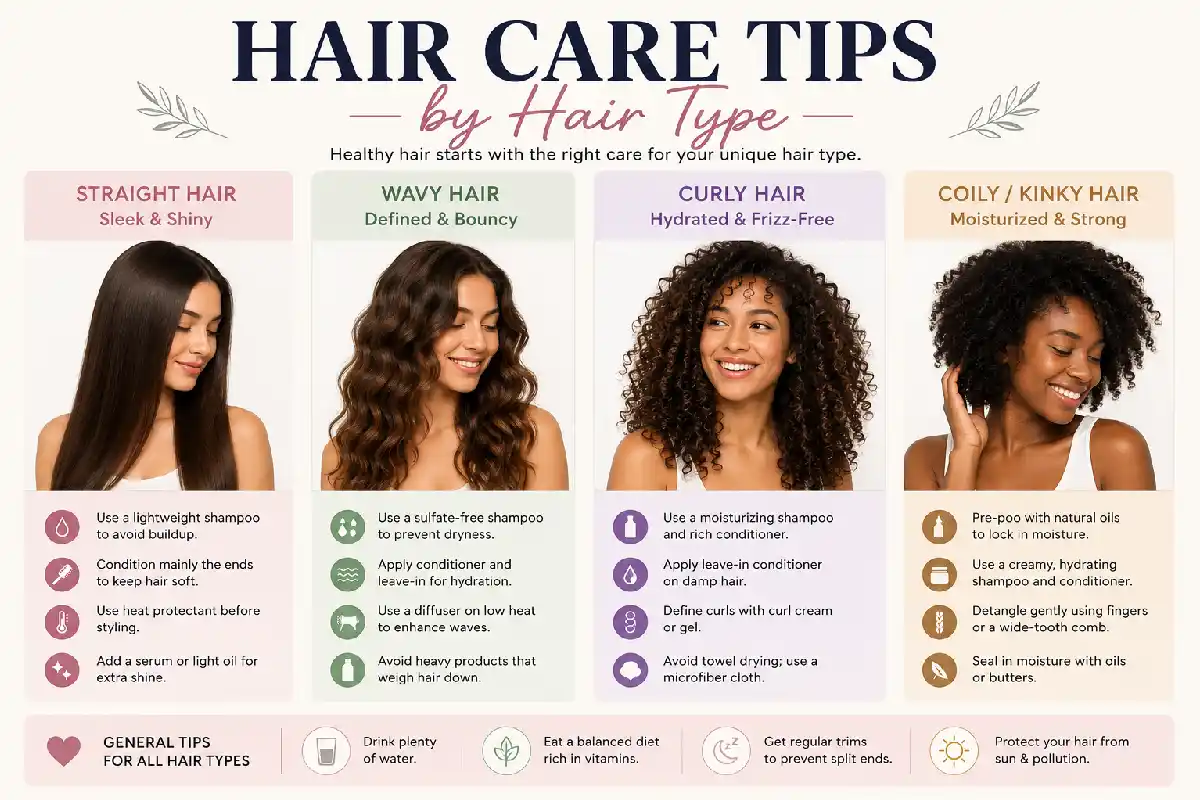
Hair Care Tips by Hair Type: Build a Routine That Actually Works
 Khizrana Begum
Beauty & Lifestyle Writer
Khizrana Begum writes clear and reader-friendly content covering beauty, lifestyle and related topics.
Read Full Bio of Author →
Khizrana Begum
Beauty & Lifestyle Writer
Khizrana Begum writes clear and reader-friendly content covering beauty, lifestyle and related topics.
Read Full Bio of Author →
 Sameena Begum
Health, Technology & Digital Content Reviewer
Sameena Begum reviews content for clarity, accuracy and overall reader usefulness.
Read Full Bio of Reviewer →
Sameena Begum
Health, Technology & Digital Content Reviewer
Sameena Begum reviews content for clarity, accuracy and overall reader usefulness.
Read Full Bio of Reviewer →
Hair Care Tips by Hair Type: It is not about having the greatest range of hair products – rather it is about using products which are suited to your hair type, scalp requirement, hair texture and porosity as well as the way you live. Straight hair will grease up really quickly and for curly/coily hair we tend to require more moisture and gentleness through brushing, whereas wavy hair falls in-between straight and curly/coily hair and products may become too heavy and weigh it down.
❝
This article is a part of
Hair Care Tips Guide
Hair Care Tips for Straight Hair
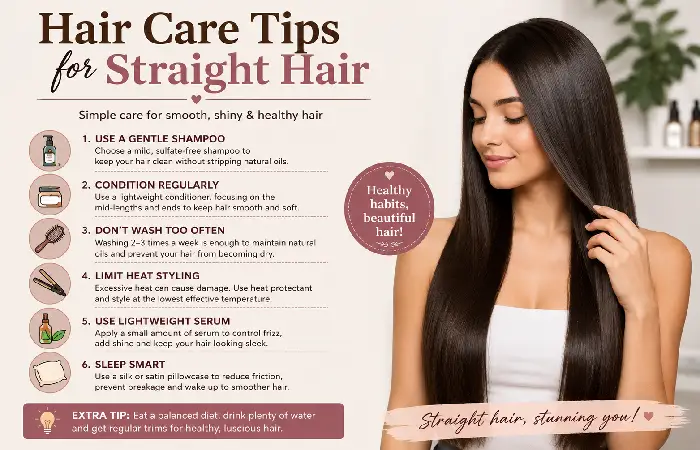
Straight hair usually has a fairly straight hair cuticle and can let your natural scalp oils travel down the strands more quickly; because of this it can sometimes appear to be greasy or flattened earlier than other hair types.
Keep the Scalp Clean
Frequency If you are an oilier type then you might wish to shampoo more often. Concentrate cleaning the scalp – don’t go over the length of your hair more than once.
Don’t Overload With Heavy Products
Avoid a slick, greasy, or even dull look with straight hair using heavy oils, thick lotions, or far too much leave-in. Instead, opt for light formulas and distribute them more on the end if desired.
Understanding your hair type is an important part of building an effective routine for washing, conditioning, styling, and maintenance. For a broader overview of practical hair care strategies, explore our complete hair care tips guide.
Add Volume Without Excessive Heat
For extra volume, try:
- Light body products.
- The roots blown with medium heat.
- Don’t apply too much conditioner around the root area.
- A touch of dry shampoo on a necessary day.
Protect the Ends
However your straight locks do still require conditioning and should ideally be comb/detangled with very little tension to minimize additional breakage.
| Straight Hair Concern | Helpful Approach |
| Oily roots | Regular scalp cleansing |
| Flat hair | Lightweight volumizing products |
| Dry ends | Conditioner or lightweight leave-in |
| Tangling | Gentle wide-tooth combing |
| Heat damage | Heat protection and moderate temperatures |
Hair Care Tips for Wavy Hair
Curly hair has unique moisture and styling needs that can vary depending on curl pattern and texture. Explore our curly hair care guide for practical tips and routine ideas.
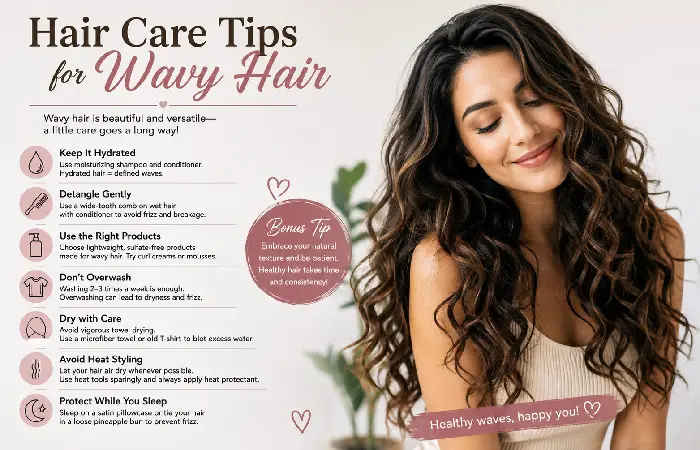
Natural bend, or loose “S” shape in the hair. Can be a challenge because with too many products your waves can get flattened and without enough moisture your hair will get all fuzzy.
Use Lightweight Moisture
Most wavy hair does well with conditioner, but a very rich formulation may weigh down. Look for lightweight conditioners, style aids.
Encourage Your Natural Wave Pattern
Rather than frantically brushing your hair after its been washed and conditioned – when your hair is at its weakest. Work the brush through to loosen things and then gently scrunch your hair up at the back of the head.
Reduce Frizz
Especially when dry the hair tends to fray even more due to the rubbing of the fiber.
Try:
- Gently blotting out water with a microfiber towel or a soft T-shirt
- Not rubbing your hair with a coarse towel
- Using a light Leave-in conditioner
- Letting your hair air dry whenever possible
- When you blow dry, using a diffuser on a medium or low setting
Avoid Too Much Product
It’s too much product If your waves are suddenly appearing greasy, sticky, or even limp, it could all be down to simply using too much.
| Wavy Hair Goal | What to Try |
| Define waves | Lightweight curl or wave cream |
| Reduce frizz | Leave-in conditioner |
| Add volume | Mousse or lightweight styling product |
| Prevent dryness | Regular conditioning |
| Avoid flat roots | Keep heavy products away from scalp |
Hair Care Tips for Curly Hair
Curly-hair can often be more susceptible to getting dry due to the oil in the scalp not being able to travel along the zig-zag pattern of curly hair. Hence, moisturizing, careful manipulation, and less rubbing is crucial.
Don’t Overwash
Curly hair doesn’t require a shampoo everyday. However, this all depends on your individual scal, whether you live an active life, the amounts of products applied on the hair and health of your hair. In this, you should apply only a minimum amount of product on the scal and use the foa m to clean the length as you rinse it from your hair.
Color-treated hair may require specific care to help maintain moisture, shine, and the appearance of your color. Explore our color-treated hair care guide for helpful maintenance tips.
Condition Generously
Curly hair needs a good conditioner when you need to manage the tangles. Work a generous amount through the lengths of the hair, focusing on ends, and comb or finger through any knots.
Detangle Carefully
Start at the ends and pull comb up in small stages. Pulling a comb from the roots to separate a tangling section will just break more hair.
Use Styling Products on Damp Hair
To keep your curls hydrated and bouncy, apply leave-in, cream, or gel when your hair is wet. Don’t run your fingers through your curls as it dries because it creates fizz.
Men can choose hair care routines based on their specific hair type, scalp needs, and styling preferences. Explore our hair care guide for men for practical advice.
Protect Curls Overnight
Use a loose, pineapple style of hairstyle, a satin pillowcase, or a silk scarf. This will help protect against overnight friction and helps maintain definition.
| Curly Hair Need | Helpful Habit |
| Moisture | Regular conditioning |
| Definition | Apply styling products to damp hair |
| Detangling | Start at the ends |
| Frizz control | Minimize touching while drying |
| Night protection | Loose protective style |
Hair Care Tips for Coily Hair
Coily hair refers to hair that is tightly curled. This type of hair has the ability to dry and damage easily so it needs to be treated gently with regular conditioning.
Prioritize Moisture
Use conditioning shampoos and conditioners that are appropriate for your hair. When your hair feels extra dry, you can even include weekly deep conditioning.
Detangle in Sections
It’s quite unnessesary and can actually add pulling when you try and comb out a lot of thick coily hair at once.
Split your hair into sections. Apply conditioner or a detangling lotion or product, then comb from ends up through the section.
Be Careful With Manipulation
Excessive pulling, brushing, teasing and combing can result in breakages.
However, protective styles also shouldn’t be braided or installed too tightly that they begin to feel like an actual burden.
Don’t Ignore Your Scalp
While coily hair may require less washing than others, the scalp still needs to be thoroughly cleaned from time to time. Set a schedule that will work to keep the scalp at ease, while preventing buildup.
Women’s hair care routines can also be tailored to different textures, styling habits, and individual concerns. Explore our hair care guide for women for helpful routine ideas.
Protect Hair at Night
Using a satin or silk-style bonnet or pillowcase to minimize friction and moisture loss from hair and skin versus the rougher fabrics
| Coily Hair Concern | Recommended Practice |
| Dryness | Consistent conditioning |
| Breakage | Gentle handling |
| Tangling | Sectioned detangling |
| Excessive manipulation | Protective styles |
| Nighttime friction | Smooth bonnet or pillowcase |
| Tight hairstyles | Keep styles comfortable and loose enough |
Creating a Routine for Your Hair Type
While type provides a foundation for what type of hair it is that you have, it’s not the ultimate determining factor. Two people with curly hair may require two very different routines as their needs may vary greatly due to density, thickness, porosity, scalp oiliness, and chemical processing of the hair and life style.
Begin with a simple routine and make adjustments as the hair needs them.
Natural hair care practices can be adapted to suit different textures while focusing on gentle handling and proper moisture. Explore our natural hair care guide for practical ideas.
Step 1: Understand Your Scalp
Ask yourself:
- Is your scalp prone to oiliness?
- Dry?
- Tight?
- Are there flakes?
- How much do you end up using to reach that clean-feeling ideal?
To help identify the type of wash you will be using in combination with shampoo to ensure you don’t overload the system:
Step 2: Identify Your Hair Texture
The two first questions we often answer are what pattern your hair fall into (straight, wavy, curly, or coily) then how about texture (fine, medium or coarse)?
Step 3: Choose Your Core Products
Most routines can start with:
- Shampoo
- Conditioner
- Leave-in conditioner if needed
- Styling product if necessary
- Heat protectant if heat styling
Not Every Product for your Hair Type is Required
Step 4: Adjust According to Your Hair’s Response
Greasy and limp: Use less product. Dry and coarse: Add a little more conditioner. Easily breaks off: Be more gentle when detangling and decrease heat styling.
| Hair Type | Main Focus | Products to Consider |
| Straight | Scalp cleansing and volume | Lightweight conditioner, volumizer |
| Wavy | Moisture and definition | Leave-in, mousse, lightweight cream |
| Curly | Hydration and curl definition | Conditioner, curl cream, gel |
| Coily | Moisture and breakage prevention | Rich conditioner, leave-in, styling cream |
Please remember that hair type is not a rigid doctrine. Your routine should be adjusted as your hair needs differ.
FAQs
How do I know my hair type?
Observe the natural pattern of your clean, dry hair before you touch it. Natural hair patterns include straight (with no to very few bends or curves), wavy (loosen bends in a wave pattern), curly (form clearly defined shapes), and coily (form tightly spiraled patterns or kinks).
Which hair type needs the most moisture?
The truth is, Curly and coily hair types usually require more moisture since due to it’s structure, it may be challenging for the natural oils from your scalp to reach the ends of your hair strands. Still, not everyone has the same moisture needs.
Should straight hair be washed every day?
Not necessarily, amount that you shampoo is relative to your scalp oil production level activity rate, what you use to style your hair, and what you have experienced to use.
How often should curly hair be washed?
It’s not one-size-fits-all. Lots of people with curly hair shampoo less often, but it also depends on your scalp and your level of buildup.
How can I prevent frizz in wavy and curly hair?
Concentrate on Conditioning Don’t be afraid to use a good quality conditioner, let it sit for 5 minutes before washing it out, dry your hair gently by not rubbing it with a towel, and also avoid as much handling as possible. Some Styling products used with damp hair will also assist in defining your hair.
Is coily hair more fragile?
Coily hair may be more likely to become dry and brittle. This is as a direct consequence of how the bends are created. The tightness can make mechanical breakages more common. Treating the hair delicately, ensuring regular conditioning, and minimizing physical manipulation can support it.
Can my hair type change?
Your original pattern can look so different due to: • Age • Hormones • Chemical Processes • Heat Damage • Degradation of hair health • Buildup of products or temporary alterations in hairstyle.
Should I follow a routine made specifically for my hair type?
Treat hair type as a guideline, not a hard and fast rule; let your scalp issues, density of your hair, hair thickness, hair porosity, and amount of damage to hair be another guide to know the do’s and don’ts of treating specific hair type.
The core idea behind the best hair tips by hair type lies in this: simply give your hair what it deserves, and don’t make a meal out of your hair care routine. Follow gentle cleansing and conditioning methods; protect your hair as much as possible from being unnecessarily stressed out, and change your hair care methods if and when your hair characteristics change.