

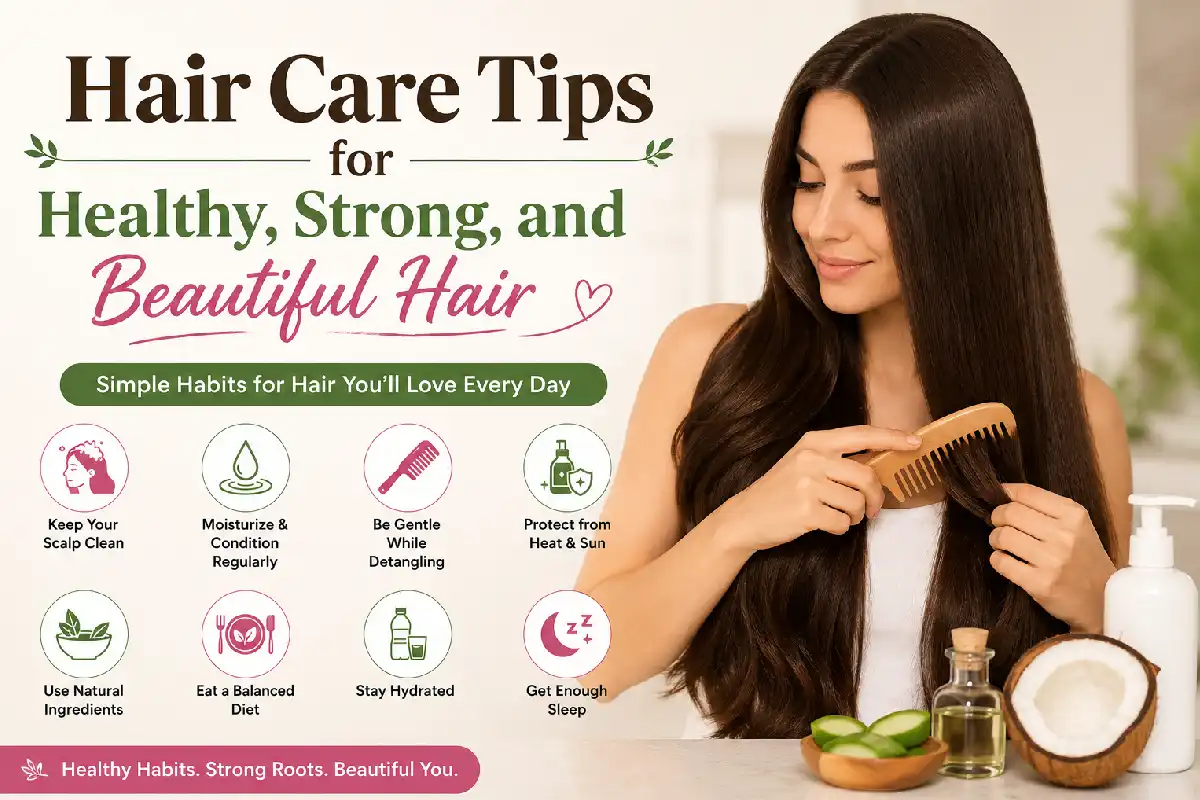
The Complete Guide to Hair Care Tips for Healthy, Strong, and Beautiful Hair
 Khizrana Begum
Beauty & Lifestyle Writer
Khizrana Begum writes clear and reader-friendly content covering beauty, lifestyle and related topics.
Read Full Bio of Author →
Khizrana Begum
Beauty & Lifestyle Writer
Khizrana Begum writes clear and reader-friendly content covering beauty, lifestyle and related topics.
Read Full Bio of Author →
 Sameena Begum
Health, Technology & Digital Content Reviewer
Sameena Begum reviews content for clarity, accuracy and overall reader usefulness.
Read Full Bio of Reviewer →
Sameena Begum
Health, Technology & Digital Content Reviewer
Sameena Begum reviews content for clarity, accuracy and overall reader usefulness.
Read Full Bio of Reviewer →
The Complete Guide to Hair Care Tips for Healthy, Strong, and Beautiful Hair – Healthy hair is definitely more than just the length and the gloss factor. Healthy-looking hair will mostly be a combination of a healthy scalp, mild routine practices, judicious use of product, sufficient nourishment, and protection from avoidable harm. The sweet news? Achieving good-looking hair does not require an overly time-consuming or expensive hair-care routine.
So try and just make your notes accordingly; you know everybody’s hair is a little different- maybe some of us have a bit more oil on our head than others; others might be dry and are really trying to put up a battle for it. Waves and curls can easily get over-moisturized and struggle with tough detangling, but finer, straighter strands are going to instantly feel flattened and dull. Getting to know what your own personal hair is like- that’s the biggest first step to learning how best to care for it.
Taking simple everyday hair care advice that is practical and can be incorporated into everyday life, this guide comprises simple, practical hair-care suggestions that can be woven into daily routines. Be it for improved hair strength or reduction in split ends, for more moisture or better curls, or a cleaner scalp, the tips below can easily equip one to design their desired hair care routine.
❝
This article is a part of
Hair Care Tips Guide
Why Proper Hair Care Matters

Curly hair often needs extra attention to moisture, frizz control, and definition. Explore our curly hair care guide for practical tips and routine ideas.
Hair, for the most part, consists of keratin, a protein. The part you actually see – the hair strand that you touch – is dead, so in the aftermath of serious damage, it just can’t grow back well again, as skin can mend.
Which makes prevention vital. Every action you inflict upon your strands daily will ultimately take its toll over time: shampooing, combing, blow-drying, coloring, relaxing, sun, salt water and chlorine from your summer swims, as well as friction and heat from daily manipulation will eventually break down that outermost shield, leaving you with brittle, frizzy and coarse hair.
The goal with any and all care is to preserve the hair that’s there while encouraging and retaining a happy and healthy scalp.
Color-treated hair can benefit from gentle care and routines that help maintain moisture and preserve its appearance. Explore our color-treated hair care guide for practical maintenance tips.
A good routine can help:
- Keep the scalp clean and comfortable
- Reduce unnecessary breakage
- Maintain moisture and softness
- Improve manageability
- Protect hair from heat and environmental stress
- Reduce tangling and friction
- Keep the hair looking smoother and healthier
It’s also vital to divorce hair health from artificial beauty ideals. Hair has its own set of characteristics – texture, density, fineness, and growth rate; all can vary greatly from the next person, and it doesn’t need to be lustrous, perfectly smooth, and obedient in a particular way.
Understanding Your Hair Type

In most cases, know your hair before purchasing products or trying anyone else’s hair routine. A “hair type” usually means your hair texture, thickness, pattern of wave or curl, porosity of hair, and oiliness of your hair, among others.
Men can build an effective hair care routine based on their hair type, scalp needs, and styling habits. Explore our hair care guide for men for practical advice.
How your hair responds to products is related to these things and how hair is styled.
The most commonly discussed texture classifications are: straight, wavy, curly, and coily.
| Hair Type | Common Characteristics | Main Care Focus |
| Straight | Lies relatively flat and may become oily quickly | Lightweight cleansing and conditioning |
| Wavy | Forms loose waves or an S-shaped pattern | Moisture without excessive weight |
| Curly | Forms defined curls or spirals | Moisture, gentle detangling, and frizz control |
| Coily | Tighter curls or coils with more shrinkage | Moisture retention and breakage prevention |
One other beneficial term to know about this is hair porosity. Hair porosity refers to how easily hair is willing to drink in and let go of water. High porosity means it drinks water right up; however may release it at a comparably quick rate.
Women’s hair care routines can vary depending on hair texture, styling habits, and individual concerns. Explore our hair care guide for women for practical tips and guidance.
If you have low-porosity hair, products may not really be able to penetrate.
You should not even give up on a label. The trick is to really see how you feel along with your personal hair.
Ask yourself:
- Does my scalp become oily quickly?
- Do my ends feel dry?
- Does my hair tangle easily?
- Does it become frizzy in humid weather?
- Does it feel heavy after applying oil or conditioner?
- Does it break during brushing?
- Does heat styling make it noticeably rougher?
These observations can tell you more than a complicated hair-type chart.
Essential Daily Hair Care Tips
Naturally, healthy hair begins to be created from small, repeatable rituals. The one thing most important to remember is not to abuse it. Hair is most fragile once you brush and towel-dry while it’s wet.
1. Detangle Carefully
Start from your ends, working upwards to your roots. You can use your fingers, a wide-toothed comb, or whatever your hair is most inclined to tangle with. Take your time in this process; do not pull your hair. Patience can mean more split ends saved.
2. Avoid Constant Tight Hairstyles
While ponytails, buns, braids, etc are convenient, but it can stress the hairline and roots every time you pull your hair tightly. Vary your hairstyles and do not tie your hair really tight for a long time.
3. Protect Your Hair While Sleeping
To help prevent tangled hair after sleeping, try one of the following methods: loosen the braiding of your hair, or use pillowcases made from a material so friction may not be as irritating
4. Keep Your Scalp Clean
Sweat, oil, products, and other elements get deposited on your scalp. Inappropriate levels of washing or even cleansing your scalp too vigorously can lead to problems – you’re best off having consistent but adaptable washing routines.
5. Protect the Ends
Typically, the part of your hair you should care about for growth is the oldest– the ends – they get the most washing, brushing, blow-drying, styling, and sun exposure. However, using conditioner on the middle section and middle of the hair while staying away from over-friction will definitely take you far. You can also tell the difference on the ends.
Natural hair care can focus on gentle routines, proper moisture, and simple practices that support healthier-looking hair. Explore our natural hair care guide for practical ideas.
Weekly Hair Care Tips for Healthier Hair
The weekly classes should be in addition to, rather than substitute for, your regular fitness schedule. A single, more intensive conditioning weekly may work for some, while regular conditioner after washing is adequate for others.
Deep Conditioning
Deep Conditioner: Similar to a regular conditioner but with added, targeted, powerful conditioning to boost hair’s softness and manageability. They won’t “fix” heavily damaged hair, but they will definitely make your strands feel silkier and softer to touch. Best to focus on your lengths and ends unless you get an oily scalp.
Clarifying
Clarifying shampoo is specifically designed to remove more substantial buildup from products, oils, and such. It’s not about “cleaner being better”, because too much clarifying could actually make your hair dry or stringy depending on the hair type. If your normal shampoo actually works and your hair doesn’t feel weird, maybe you don’t need to clarify.
Trim Damaged Ends
Hair cutting does not make your hair grow faster at the root (at the origin). You just have to cut off the splits (broken or damaged parts). When you cut the damaged ends, you protect your hair from having splits at a farther location up your hairline. How long is the right time to have a hair trimming depends on the type of your haircut, the condition of your hair, as well as your preference.
Hair Washing Tips for Every Hair Type
Showering shouldn’t be a big no! You need to determine what works for your head. If you have a naturally oily scalp, then of course you’ll want to shampoo more often, or there will be times when it feels like the world will end with every second that ticks by without a trip to the basin, but what’s to stop you if that’s a once-every-three-days type of event.
Focus Shampoo on the Scalp
The role of the shampoo is mostly to cleanse your scalp. Use some of it at the level of the roots and massage using the fingertips. You usually do not have to scrub the lengths much. The latter gets shampooed during the rinsing.
Different hair types have different needs when it comes to washing, conditioning, styling, and maintenance. Explore our hair care guide by hair type for practical recommendations.
Use Lukewarm Water
When water is too hot, it may leave the scalp and hair feeling dry. For most, warm water is the best middle.
Condition the Lengths
Conditioner softens, conditions, and allows hair to be easily managed and lubricated. For easy oiled hair, the conditioner shouldn’t be worked right into the roots. It can be applied sparingly to the mid-lengths to ends in easy oiled hair. Extremely dry or curly textured hair can be more evenly conditioned, depending on how it performs.
Do Not Rub Wet Hair Aggressively
After your rinse, wring out all of the excess water from your hair. If you must, you may use a softer towel like the one you use to clean lenses, or a microfiber one if you have it, instead of rubbing it harshly with a towel.
Choosing the Right Hair Care Products
The ideal product is not always the most costly. It would have to be the one designed for your scalp, your texture and type of hair, for the way you like to style, and for what concern you might have.
When considering purchasing products, try to remember what you may use them for.
| Hair Concern | Product Characteristics to Consider |
| Oily scalp | Lightweight cleansing products |
| Dry hair | Moisturizing shampoo and conditioner |
| Curly or coily hair | Richer conditioning and detangling products |
| Fine hair | Lightweight formulas that do not create excessive buildup |
| Heat styling | Heat-protective styling products |
| Tangled hair | Detangling conditioner or leave-in products |
| Chemically treated hair | Gentle cleansing and conditioning |
A word of warning: when examining claims in the marketing material-“miracle growth,” “permanent repair,” or “overnight transformation”-a healthy skepticism needs to be maintained.
A cosmetic can make hair feel and look better while doing nothing to alter the biologically predetermined speed at which new hair grows from the follicle.
Hair Oiling Tips for Stronger Hair
Many centuries before popular treatments, special hair oils, etc, people of various cultures started using oils for hair. Oils create slippage to reduce friction and can increase pliability and softness.
Oil alone isn’t the answer to everyone’s hair woes, and various oils have different qualities as well as varying effects on different people.
How to Oil Your Hair?
For those whose oil itches out, you can work a tiny amount into your length and ends! Dry scalp folk can add a few drops of oil and massage it into your scalp, just not too much (it won’t give more good results – the opposite, actually, if anything). Do this for a time that fits in with your schedule, then go about shampooing, etc.
Don’t rub too much oil on the scalp, just enough!
It may result in itching, redness, pimples, and irritation on the scalp; avoid it.
Scalp Care Tips for Healthy Hair Growth
Every hair follicle begins on your scalp. So our scalps require a certain amount of love and attention, as well as the hair on it, which we know is healthy on our head in the shaft, etc. The scalp, if perfectly healthy, should have a softer feel and be less itchy, less painful, less flaky, and less swollen!
.Keep the Scalp Clean
The purpose of cleansing is to remove sebum, sweat, dead skin cells, and the residue of different products.
The best washing frequency can differ depending on the person. If one showers/washes their hair daily because they exercise every day it would then have to wash their hair daily, whereas for a person with dry hair, it may be less frequently.
Avoid Excessive Scratching
Itching can be scratched to produce new mechanical damage to the scalp. If, even after normal treatment, scratching or rubbing of the scalp does not subside, talk to a dermatologist.
Massage Gently
Itching can cause new mechanical damage to the scalp. Contact a dermatologist even after successful treatment if scratching or rubbing the head does not cause improvement.
Hair Care Tips to Prevent Hair Fall
It is quite common for a person to shed some hair daily. The life cycle of hair follows a period of growth, shortening of the hair follicle, transition phase, shedding, and finally, a resting phase. When is it “too much”? Shedding versus breakage: We often mistake shedding for breakage; they are not one and the same.
Shedding is an occasion where the hair strand comes naturally out of the hair follicle; breakage is more of a break in the hair shaft somewhere away from its root. If you are noticing extremely high rates of shedding or excessive bald patches, or hair that’s constantly thinning, you should always visit an expert rather than trying to just cure the symptom yourself.
There are many different reasons someone can experience abnormal hair loss: perhaps a lack of a certain vitamin, hormone imbalance, trauma, prescription medication, genetic hair loss, certain medical conditions affecting the scalp…
For everyday protection:
- Avoid repeatedly tight hairstyles.
- Detangle gently.
- Limit unnecessary chemical processing.
- Use heat carefully.
- Don’t be too rough on your brush.
- Eat a nutritious diet.
- Persistent hair or scalp problems should be treated, not ignored.
Tips to Reduce Hair Breakage and Split Ends
Prevention is far better than a solution. Breakup of the hair shaft- once broken, the conditioner as well as serum applied can mask the damage for some time but cannot stitch the broken hair shaft back.
Reduce Friction
Abrasion from fabrics such as a favorite hoodie or tight garments, or from bedding.
Be Gentle When Detangling
Never treat a knot like an obstacle that must be defeated. Work through it slowly.
Avoid Excessive Heat
Damage Overtime Excessive use of heat on your hair can cause the structure of your hair to be compromised and leave it weak.
Condition Regularly
It’s easy to drag hair as you comb it. So, conditioner makes hair more slippery, lowering any friction in between.
Trim When Needed
The best way to look after those split ends is to have them cut off.
Heat Styling Tips to Protect Your Hair
And sure, blow dryers, flat irons, and curling irons provide uber-trendy styles; however, they produce such firm structure through such prolonged heat that ultimately wears upon your hair structure as dry/weak.
Use these habits:
- Avoid the highest temperature unless necessary.
- Keep the tool moving rather than holding it in one place.
- Use a heat-protective product designed for your styling method.
- Do not repeatedly pass a hot tool over the same section.
- Allow hair to dry partially before using a blow dryer when practical.
- Give your hair regular breaks from intense heat styling.
What you don’t know: It doesn’t make hair heat-proof. Think of using a heat protectant as an extra layer – not a free pass to crank your hot tools up high daily.
Hair Care Tips for Every Season
Your hair may behave differently throughout the year.
Summer Hair Care
Heat, moisture, perspiration, sun, and swimming can all affect your hair.
Helpful habits include:
- Keep the scalp clean after heavy sweating.
- Protect hair from prolonged direct sunlight.
- Rinse hair after swimming.
- Condition dry lengths regularly.
- Avoid excessive heat styling during very hot weather.
Monsoon and Humid Weather
Humidity tends to swell hair, making it frizzy; this can happen on raised cuticles and also for naturally frizzy hair. It can also contribute to frizzy hair. Make sure to only use lightweight conditioning products; don’t over-brush dry hair if this tends to make it frizzy.
Winter Hair Care
Cold, dry air might be contributing to that dry feeling in some hair and scalps. A change of tack could mean richer conditioning, gentler cleansing, and less hot water.
Nutrition Tips for Healthy Hair
Body processes that require nutrients, which the body need certain nourishment just like how the body needs nutrients to work normally. Nutrients for the body include energy, vitamins, minerals, and proteins. “Rather than a single “hair vitamin “ try a nutritionally balanced diet.”
Include a variety of:
- Eggs, fish, dairy products, beans, lentils, and other protein-rich foods
- Vegetables and leafy green vegetables
- Fruits
- Whole grains
- Nuts and seeds
- Healthy sources of fats
- Adequate fluids
We should also pay more attention to protein, as we stated. A large portion of our hair is the structural protein keratin. It doesn’t mean supplementing them is necessarily good if they are not needed. Sometimes high levels of a particular nutrient might create problems. Professional consultation is always safer than consuming several vitamins when suspected nutritional deficit causes your hair change.
Common Hair Care Mistakes to Avoid
When you want to take really good care of your hair it does not include taking more of them in the products you may use. It often means stripping away what is unnecessary and damaging routine.
Washing Too Aggressively
Scratching the head until your head feels raw can also cause it to break out in a nasty rash. A clean scalp does not need to be “squeaky” clean, however.
Using Too Much Product
Large quantities of conditioner, serum, oil or styling cream create build-up, making your hair feel heavy.
Brushing From Roots to Ends
Starting at the top can push knots downward and increase pulling. Begin at the ends and work upward.
Sleeping With Wet Hair Constantly
Wet hair is more susceptible to breakage from mechanical injury. If you get caught sleeping with wet hair, tie your hair loosely and without force.
Ignoring Scalp Problems
Persistent itching, scaling, pain, sores, or unusual changes should not simply be covered with more styling products.
Chasing Every Hair Trend
What someone else’s routine may be totally detrimental for someone else! Customize your hair regimen in the best way for you!
Natural Hair Care Tips You Can Try at Home
But natural is not necessarily safe or good for you. Raw essential oils, baking soda, and lemon juice could all contribute to damaging your scalp or strands of your hair. The only solace is that there are some relatively harmless and basic home remedies to turn to.
Warm Oil Pre-Wash Treatment
Put a few drops of hair oil in your hair before you wash it if it likes to drink oil. This will make it softer, less frizzy, etc.
Simple Conditioning Routine
After rinsing shampoo (regularly, it doesn’t have to be a complex mixture to be a simple conditioner).
Gentle Scalp Massage
Apply pressure with the flesh of your fingertips – never fingernails. Pressure should not hurt you.
Protective Hairstyles
Low-tension styles like low buns and messy braids help to prevent rubbing and detangling. Normally, the home remedy you succeed with is the one you are having the least bit difficulty with in your home, and also that does not harm your head, so it’s likely ideal for you.
Hair Care Tips for Different Hair Types
Textures require different levels of importance.
Straight Hair
Oils from your scalp reportedly travel more easily down straight hair. The roots can, therefore, appear greasy a lot quicker. Shampoo formulated to suit your scalp type, and try not to apply thick treatments around the roots unless necessary.
Wavy Hair
Wavy hair typically lands halfway between straight and curly. Brushing your wavy hair too much can break up the waves and leave you with fuzzy hair.
Using conditioner to define, carefully combing it out, and scrunching hair as it dries can sometimes maintain these wave forms.
Curly Hair
You want moisture and TLC for your curly hair, since bends create weak spots and are prone to breakage. Use a generous amount of conditioner to create slip and use a smooth hand for detangling.
Building a Personalized Hair Care Routine
The most optimal routine would be the most efficient, NOT a 10-step regimen. Get the fundamentals first, and add products as soon as a real benefit arises.
Morning
Avoid styling aggressively. Brush it with care if you don’t want to ruin the hair because it can cause tangles if you over brush. For dry or frizzy hair, you can use a tiny dab of leave in conditioner or styling cream for hair to make it easier to manage.
Wash Day
A simple wash-day routine might look like this:
Cleanse → Condition → Detangle gently → Dry carefully → Style with protection
The exact frequency depends on your scalp and hair.
Weekly
Consider whether your hair needs:
- Deeper conditioning
- Clarifying
- A gentle scalp-care session
- A trim if the ends are damaged
- A break from heat styling
Review Your Routine
- Listen to your hair.
- Is your scalp greasy? You might be using a routine that’s too moisturizing.
- Is your hair coarse and dry? More conditioning or more gentle shampooing might be needed.
- Does your hair feel weighed down, coat-like, and lifeless? Likely too much product.
Are you experiencing more breakage? That suggests focusing on heat styling, chemicals, tight styles, and how you detangle.
It’s communicating with you all the time. Start paying attention.
A Simple Hair Care Routine at a Glance
| Step | What to Do | Why It Helps |
| Cleanse | Wash according to scalp needs | Removes oil, sweat, and buildup |
| Condition | Apply conditioner to lengths | Improves softness and manageability |
| Detangle | Start from the ends | Reduces pulling and breakage |
| Dry | Blot gently instead of rubbing | Minimizes mechanical stress |
| Protect | Remember heat protection if styling. | Helps reduce heat-related damage |
| Moisturize | Use appropriate leave-ins or oils if required. | Improves softness and reduces friction |
| Trim | Remove severely damaged ends | Keeps split ends from worsening |
Frequently Asked Questions About Hair Care Tips
How often should I wash my hair?
The number varies with the person. You’ll need to wash frequently enough so your scalp feels clean and has a good amount of scalp health. An oily scalp requires more washing, while a very oily scalp needs to be washed more often, if it doesn’t make hair look gross that often. However, dry and curly hair might be fine washed less regularly.
Does cutting hair make it grow faster?
No. Hair growth takes place within the hair follicle that is under the skin of your scalp, whereas trimming the hair takes place just on the shaft part of the hair you can already see. Trimming the hair can make hair look healthier by way of removing broken and split ends.
Is oiling good for hair?
The right oil could add softness, decrease friction, and make some kinds of hair manageable. The fact is that oil alone is not the magic cure for all kinds of hair loss and scalp problems.
How can I reduce hair breakage?
Treat hair with respect and use conditioner often, comb out knots carefully, try not to use too much heat, don’t wear your hair in a very tight style, and reduce too much chemical treatments.
Is daily brushing good for hair?
However, not all everyday brushing benefits either if done in an excessive or harmful manner: The result is purely Mechanical damage. Brush when necessary and use a technique appropriate for your texture.
Can natural remedies make hair grow faster?
There isn’t one specific home remedy that is known to increase the speed of hair growth. This is down to genes, hormones, the body’s health & diet, plus the regular cycle of hair growth.
Final Thoughts
Healthy hair is not perfection; it is repetition. You Don’t need to own your bathroom shelf to have healthy hair. Building healthy hair starts with knowing your hair and scalp, how to wash to meet those specific needs, the importance of conditioning, how to gently detangle wet hair, how to reduce hair-damaging heat, how your diet and lifestyle play a role, and finally – most importantly – don’t compare your hair to the hair of another person. Straight, wavy, curled, coiled, fine, thick- the whole lot – can absolutely be beautiful, and the goal of your healthy hair journey isn’t about creating a different persona out of your mane; it’s about keeping your own natural hair in the best condition.