


Hair Care Tips for Curly Hair: A Complete Guide to Healthy, Defined Curls
 Khizrana Begum
Beauty & Lifestyle Writer
Khizrana Begum writes clear and reader-friendly content covering beauty, lifestyle and related topics.
Read Full Bio of Author →
Khizrana Begum
Beauty & Lifestyle Writer
Khizrana Begum writes clear and reader-friendly content covering beauty, lifestyle and related topics.
Read Full Bio of Author →
 Sameena Begum
Health, Technology & Digital Content Reviewer
Sameena Begum reviews content for clarity, accuracy and overall reader usefulness.
Read Full Bio of Reviewer →
Sameena Begum
Health, Technology & Digital Content Reviewer
Sameena Begum reviews content for clarity, accuracy and overall reader usefulness.
Read Full Bio of Reviewer →
Hair Care Tips for Curly Hair: While curly hair is beautiful it may need a bit more care in general when compared to its straight counterparts. Common issues for curly hair can be: dryness, frizz, tangling, shrinkage, and lost definition in curl. Good news: This doesn’t necessarily mean that a complex hair routine is a must.
A good set of curly hair care tips typically comes down to three factors: moisture retention, being gentle and using styling techniques that enhance rather than work against your curl pattern.
No matter if you have barely-there waves, bouncy curls, or tight coils – figuring out what your hair craves can simplify hair care routines dramatically.
❝
This article is a part of
Hair Care Tips Guide
Understanding Curly Hair
Your hair is curly, because you possess curly-hair follicles; these dictate the angle hair grows at, and it will thus end up straight, springy or springy.
The curvier the follicle, the more chance of waviness or curls (including tight springs), occurring along your strands of hair.
Unlike straighter hair types, the natural oils that are produced from the scalp do not distribute evenly to the ends of naturally curly hair.
Curly hair requires a consistent routine that focuses on moisture, gentle handling, and healthy styling practices. For a broader overview of effective hair care strategies, explore our complete hair care tips guide.
This leads to dryness in the strands of the hair toward the tips.
Curly hair can be more easily damaged by friction and mechanical forces. The harsher you treat your curls when brushing, using hot appliances, wearing scratchy materials that have friction with hair for long periods of time such as some pillow cases; or if you’re one of those curly individuals that constantly runs their hands over their strands, all these can exacerbate dryness and result in breakage.
Different Curly Hair Patterns
Curly hair is commonly grouped into several patterns:
| Hair Type | General Pattern | Common Concerns |
| 2A–2C | Wavy | Flat roots, frizz, loss of definition |
| 3A | Loose curls | Dryness, frizz, curl stretching |
| 3B | Springy curls | Tangles, dryness, shrinkage |
| 3C | Tight curls | Breakage, dryness, tangling |
| 4A | Tight coils | Moisture loss, shrinkage |
| 4B | Z-shaped coils | Dryness, tangles, breakage |
| 4C | Very tight coils | Fragility, moisture retention, shrinkage |
It doesn’t end with just your curl pattern either – other attributes of your hair like texture, density, porosity, and condition can influence how a product should perform, or whether or not it should be applied at all.
Color-treated curls may need extra moisture and careful product selection to help maintain both the curl pattern and color. Explore our color-treated hair care guide for practical maintenance tips.
Why Curly Hair Needs Extra Moisture
Because of all of the bends and kinks, natural oils from your scalp have a harder time working down your hair shaft, so those middle and end lengths can start feeling parched, even if your scalp doesn’t. That does not mean that your hair needs heavy products. Instead, focus on:
- gentle cleansing
- routine conditioning
- leave in conditioner as needed
- heat compromise avoidance
- protection of your ends
- avoidance of over manipulation
How Often Should You Wash Curly Hair?
Everybody’s schedule is going to be a little bit different and there won’t really be a schedule that fits perfectly for you.
Men with curly hair can benefit from routines tailored to their texture, scalp needs, and styling preferences. Explore our hair care guide for men for practical advice.
The more infrequent the washing, the better your dry scalp and tight curls are going to be the opposite of our oily scalps with fine, springy curls that workout everyday, etc. Your scalp state is a way better indicator of wash frequency than the calendar.
| Hair/Scalp Situation | Possible Approach |
| Oily scalp | Wash more frequently as needed |
| Dry curls | Space out washes if comfortable |
| Fine curls | Avoid excessive heavy products |
| Thick/coarse curls | Focus on regular conditioning |
| Product buildup | Use an appropriate cleansing shampoo |
| Very dry or damaged hair | Prioritize gentle cleansing and conditioning |
It seems the intention is a fresh, clean and happy scalp and not necessarily a parched, over-stripped feeling for your curls.
Hydration Tips for Curls
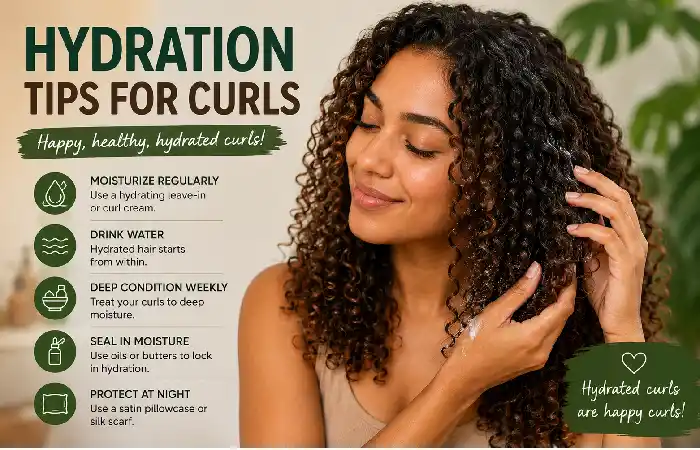
Women with curly hair may need different approaches to washing, conditioning, styling, and maintaining moisture. Explore our hair care guide for women for helpful routine ideas.
One of the largest curl care issues is hydration. If your curly hair does not gets some hydration, you will find yourself with a rather dull curly hair, that appears dry to rough and may feel kind of sticky to rough, not easy to work with when detangling and may become more prone to fray and breakage.
1. Don’t Skip Conditioner
Conditioner is best for slip, softness and manageability.
Apply through mid lengths and ends, unless you have greasy roots. Let stand a few minutes then rinse. A deeper conditioner might be a good choice if your curls are in particularly dry conditions.
2. Use a Leave-In Conditioner
Give your curls a moisture boost between washes with a leave-in conditioner.
Dispense a little into your damp hair and rake through the lengths. Don’t overload the hair because you can make you curly hair looks too weighed down or greasy.
3. Deep Condition Regularly
Use it when curls feel strangely dry, or rough to the touch.
You do not have to use deep conditioner everytime. For many the every week or every other week is sufficient. This varies greatly depending on the condition of your hair, product build up.
4. Apply Products to Damp Hair
Majority of your styling products tend to better distribute into damp curly hair. Don’t wait until its mostly dry- layer in your leave-in, curl cream, gel and anything else you use when there’s lots of water in your hair. Using the same method will also usually reduce the amount of frizz and increase clumping!
5. Don’t Overuse Protein Treatments
However, the protein products may work for certain fragile/damaged hair; but it’s not to have too many of them. If you notice that over-using these treatments will lead to extremely rough, brittle, unmanageable hair then cut down on the amount, do protein treatment less often and have conditioning treatment more frequently instead.
Natural hair care can be especially useful for maintaining moisture and minimizing unnecessary stress on curly hair. Explore our natural hair care guide for practical tips.
6. Protect Your Hair From Excessive Heat
Frequent heat and heatstyling may be more liable to a more or less damaged and a dry hair. When Using a diffuser or another hairstylingtool youwill:
- Use a lower or moderate temperature.
- Keep the tool moving.
- Don’t hold heat on one section for too long.
- Use an appropriate heat protectant.
- Avoid unnecessary daily heat styling.
Hydration Routine for Curly Hair
| Step | What to Do | Purpose |
| Cleanse | Use a suitable shampoo | Remove sweat, oil, and buildup |
| Condition | Apply conditioner | Improve softness and slip |
| Detangle | Work gently through wet hair | Reduce pulling and breakage |
| Leave-in | Apply if needed | Add moisture and manageability |
| Style | Use curl-friendly products | Improve definition |
| Dry | Air-dry or diffuse gently | Reduce manipulation |
Best Styling Practices
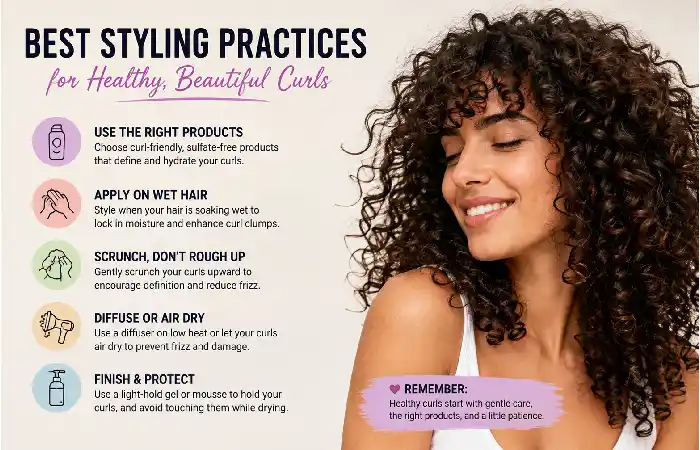
Curly hair styling is about much more than just getting the desired look: how you style your curls also has an effect on your hair’s level of frizz, breakage, definition and health!
Curly hair can vary in texture, density, and moisture needs, so choosing a routine based on your specific hair type can be helpful. Explore our hair care guide by hair type for more targeted advice.
Detangle With Care
Don’t brush dry curls fiercely unless it’s specific to your haircut or hair texture. When your hair is wet or damp, and a decent slip of conditioner or detangling product is present in your hair, try this. First work on your ends and brush the tangles towards the roots.
This prevents you from dragging knots through the entire length of your hair.
Try the Scrunching Technique
Scrunches can prompt the hair to develop into its true formation, and shape.
Once you have used your styling tools; cup hair in to your palms (sections not your whole head of hair!), and push into the hair all the way toward your head shape. This way, the scrunch can begin to take a true form. However, do not do this over and over, or you will eventually start messing with dried out curly hair.
Use Curl-Defining Products Wisely
Every product does something else.
| Product | Main Purpose | Best Used For |
| Leave-in conditioner | Moisture and softness | Dry or tangled curls |
| Curl cream | Soft definition | Loose to medium curls |
| Gel | Hold and definition | Frizz-prone curls |
| Mousse | Lightweight volume | Fine curls and waves |
| Hair oil | Shine and finishing | Dry ends or finishing |
| Deep conditioner | Intensive conditioning | Dry or damaged hair |
And you don’t really have to layer quite as many things. Sometimes leave-in conditioner with one or two styling agents work really well rather than one or all of these other things stacked together.
Avoid Touching Your Hair Too Much
Touch Your Curls While They’re Drying (DON’T DO THIS!) An easy way to get frizz to appear is by constantly fussing with your curls during the drying process. After you’ve applied your styling products, go as little as possible to touching your hair. If gel is leaving your curls with a crunchy and stiff texture you know they were left alone to dry long enough to be gently scrunch-scrunch-scrunch it to a softer texture
Don’t Chase Perfect Curls
Curly hair naturally has variation. One section may be tighter than another. Some strands may curl differently. Humidity can also change your curl pattern throughout the day. Instead of trying to make every strand identical, focus on healthy, hydrated, defined hair.
Reducing Frizz Naturally
It’s natural for curly hair (or ANY hair) to frizz a bit. The goal is not necessarily to get rid of ALL the stray flyaways, but to cut out the excess fuzziness while retaining soft, natural curls.
1. Stop Rough Towel Drying
Frizz can result from the motion of traditional towel-drying.
Gently press the moisture out of your hair with a smooth cotton tee shirt or micro-fiber towel.
Avoid twisting or vigorously rub your curls, which may break them.
2. Avoid Brushing Dry Curls
Brushing dry curls will loosen curl clusters and make the hair look larger and more frizz. If you do need a quick refresh of your curl clump spray lightly with water and your styling product then scrunch softly.
3. Use the Right Amount of Product
Too much product can weigh down curls, make them feel sticky, or leave them dull. On the other hand, too little means the hair becomes exposed to moisture and friction. It’s best to use a dime-sized amount, add more to achieve your desired result.
4. Protect Your Hair From Humidity
When the air’s humid the curly hair can soak this moisture from the atmosphere-and may undo curls, creating extra frizz. Anti-frizz products aid the situation but technique really counts too.
Try to:
- Avoid constantly touching your hair.
- Let curls dry completely before manipulating them.
- Use products designed for your hair’s needs.
- Protect your hair overnight.
- Avoid excessive brushing.
5. Keep Your Ends Conditioned
Dry ends are more likely to look rough and frizzy.
Pay careful attention to the ends when conditioning and styling. The use of regular trims is encouraged in helping to cut away any split and damaged ends.
Common Frizz Triggers
| Frizz Trigger | Better Approach |
| Rough towel drying | Blot or squeeze gently |
| Dry brushing | Detangle when wet |
| Excessive heat | Use less heat |
| Constant touching | Let curls set |
| Heavy product buildup | Cleanse appropriately |
| Sleeping on rough fabric | Use a smoother sleep surface |
| Over-washing | Adjust frequency to your scalp and hair |
Nighttime Hair Care Tips
The steps you take before dozing off can have a serious impact on how your ringlets appear the next morning. As you slumber away, your curls vigorously rub against your pillow and bedding, which can lead to tangles, flyaways and snapping.
Sleep on a Satin or Silk Surface
But a smooth pillow case can help with friction, compared to rough pillow case textures. And if you find it more comfortable, you can always go with a silk or satin pillow case cover, or use a pillow case,bonnet…or even just a smooth silky head wrap. The point, it to apply pressure on your curls in a smooth way.
Try the Pineapple Method
Long curls – Group them loosely on top of your head so your curls don’t get squashed during sleep. Use a soft, loose scrunchie, not a strong elastic The look shouldn’t drag on your roots.
Don’t Sleep With Soaking-Wet Hair
If you go to bed when you’re hair is wet, it can get friction and can become tangled. In the evening when you’re able to, airdry your hair.
Refresh Curls in the Morning
You don’t always need to completely restyle your hair.
For a simple refresh:
- Dampen the edges.
- Apply a littleleave in conditioner or styling product to the edges if they seem especially frizzy.
- Gently scrunch.
- Reshape individual curls with your fingers.
- Allow the hair to dry without excessive touching.
Simple Night Routine
| Step | Nighttime Habit |
| 1 | Gently detangle if necessary |
| 2 | If hair is very dry, apply small amount of leave-in product |
| 3 | Loosely gather longer curls |
| 4 | Get a Satin/Silk Bonnet or Pillowcase |
| 5 | Style hair loosely. |
| 6 | Refresh curls in the morning instead of washing unnecessarily |
Building a Simple Curly Hair Routine
The following: you don’t need 10 steps to have a curly hair routine! Your simple curly hair can look something like this.
Wash day:
Cleanse → Condition → Detangle → Leave-in → Style → Dry
Between washes:
Refresh with water → Add a small amount of styling product → Scrunch → Air-dry
Night:
Protect curls → Reduce friction → Avoid tight hairstyles
Consistency matters more than having a huge collection of products.
Example Weekly Routine
| Day | Routine |
| Monday | Cleanse, condition, style |
| Tuesday | Light curl refresh |
| Wednesday | Refresh or rest |
| Thursday | Light refresh |
| Friday | Cleanse if needed |
| Saturday | Deep condition if needed |
| Sunday | Protective nighttime routine |
The preceding is an example of how you would perform it. Based on your scalp and hair, how you sleep and exercise and you style the hair and the weather conditions around you, should influence how often you would do such a process
Mistakes to Avoid With Curly Hair
An amazing curly hair routine will suffer significantly when you consistently fail at the basics.
Washing Too Frequently
While there’s nothing wrong with doing what’s best for your curls – and that may mean skipping wash day if all your usual treatments still leave hair dry or crispy. However that doesn’t mean that it is safe to do the clean for your scalp by skipping your cleaning days, since when you have a proper routine to your daily Hair care a properly clean scalp is essential.
Using Too Much Product
Too much product won’t necessarily give you good curls.
Too much product will lead to buildup, weighing the hair down.
Pulling Through Knots
Don’t try to pull a comb through a hard knot. Instead, apply conditioner or a detangler to the knot, then pick at the knot carefully with your fingers and work from the bottom to the top.
Using High Heat Too Often
The cumulative damage from straighteners, curling irons, and blow drying at high heat has a small ongoing effect. When heat does reach your hair, try not to use excessively high temperatures and always employ heat protectants.
Tight Hairstyles
High ponies, buns and braids frequently strain the hair and scalp over and over. As far as likely as we are able to (particularly while resting), put it aside loosely.
FAQs
1. How many times a week should you wash curly hair?
There’s no set frequency – wash based on your scalp oil production, accumulation of product/buildup, lifestyle, and how your curls react. Some people wash their hair several times per week, others far less.
2. Can you brush curly hair?
Yes. But, often it’s easiest to detangle your curls when they are wet and covered in conditioner, as this can be less disruptive to curl definition.
3.What if I have frizzy curls?
Combating frizz is about keeping moisture in the hair, handling with care, using correct styling products, minimizing friction by ceasing behaviors like rubbing and the habit of rubbing, and reducing styling. Example of a bad habit of the sort is rubbing your hair excessively with a towel, brushing your hair when dry.
4.Is oil good for curly hair?
Hair oils can offer increased softness, shine and feel for certain people who have dry ends. That being said, they can’t replace the necessity of water-based hydration and conditioner. Use sparingly and pay close attention to the way hair reacts.
5. Can you sleep with loose curls?
You can; however, free curls are more susceptible to friction as you move during the night and can end up flatter. A loose pineapple updo, sleep cap or silk/satin pillowcase will make a big difference in protecting your curls.
6. Why is my curly hair still dry after using conditioner?
There can be a multitude of causes for dry curly hair after conditioning – excessive washing, blow-drying, extreme weather, product buildup, or damage. Adjust your washing frequency, conditioning routine or styling product if necessary.
7. Refresh Your Curly Hair Without the Wash
Lightly mist your curls with water, apply a drop or two of leave-in, styling or smoothing product as required, and gently scrunch. Don’t touch your curls again until they’re dry – excessive playing with your hair when it’s wet, will only bring on frizz instead of shape.
8. Is air-drying curly hair superior?
Although air-drying reduces direct contact with heat, there’s not a clear verdict, so if diffusing your hair works for you, continue doing so but be sure to moderate the use of moderate heat and never keep the air concentrated too long in one spot.
9. What’s the #1 way to prevent tangle curls?
Don’t Get Twisted By Keeping Hair Moisturised, Detangle Gently,Hands Off Your Hair, Sleep With a NightCap,and Moisturise Those Ends.
10. What is the MOST important tip that can keep you curly and cute?
Be nice to them! Always keep it healthy, and hydrated, protected while you sleep with this curl care. It’s a more powerful tactic than switching conditioners/shampoos for fun!
Final Thoughts
Keeping curls healthy and defined isn’t about chasing the latest trendy product or purchasing a whole shelf of items to achieve the ultimate curl care routine, rather it’s about learning about your curls and doing things that will prevent dryness, friction and damage to the best of your ability.
Stay gentle with your hair, continue moisturizing, detangle with great care, apply your products when your hair is damp, minimize excessive heat in Styling, and don’t neglect nighttime protection for your curls. Most importantly, if it takes a few weeks to adapt to a brand-new regimen, don’t worry about it – it can only lead to healthy hair when things finally begin to fall into place.