

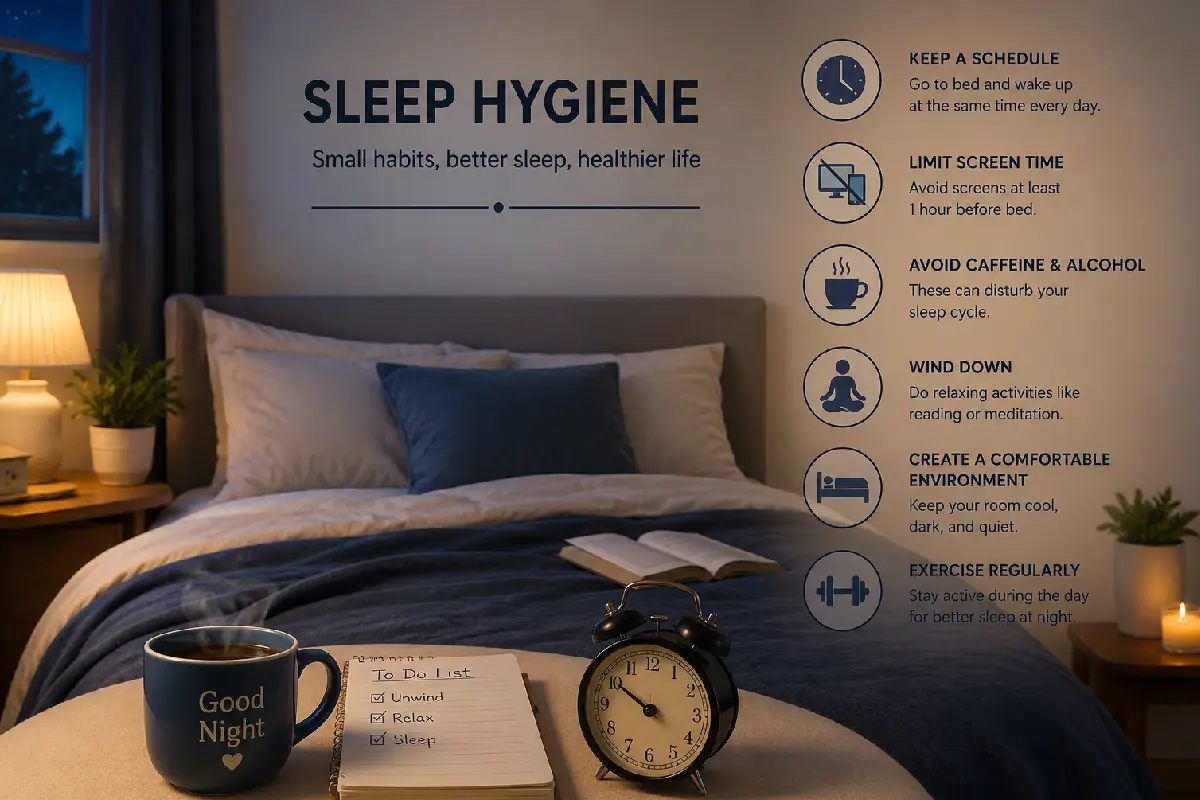
Sleep Hygiene: The Complete Guide to Better Sleep and Healthy Sleep Habits
 Khizrana Begum
Beauty & Lifestyle Writer
Khizrana Begum writes clear and reader-friendly content covering beauty, lifestyle and related topics.
Read Full Bio of Author →
Khizrana Begum
Beauty & Lifestyle Writer
Khizrana Begum writes clear and reader-friendly content covering beauty, lifestyle and related topics.
Read Full Bio of Author →
 Sameena Begum
Health, Technology & Digital Content Reviewer
Sameena Begum reviews content for clarity, accuracy and overall reader usefulness.
Read Full Bio of Reviewer →
Sameena Begum
Health, Technology & Digital Content Reviewer
Sameena Begum reviews content for clarity, accuracy and overall reader usefulness.
Read Full Bio of Reviewer →
Sleep Hygiene: We treat sleep like a bill we can pay late. One last episode, one last scroll, one last “just gotta finish this email” and promise ourselves we’ll sort ourselves out over the weekend. Except really it sort of doesn’t work like that.
You can’t bank sleep. You can’t run a deficit all week and settle it with one long Saturday morning in bed. Your body wants steady, decent rest every single night, and the moment it stops getting that, things start slipping quietly in the background — your mood, your focus, your appetite, even how well you fight off whatever cold is going around the office that week.
This is the plan for doing just that, incrementally. What follows gets into what sleep hygiene is all about, how come it all bother to care about sleep hygiene, a handful of more secretive symptoms that there may be room for improvement to you habits, and a program to use tonight — not “one day next week” or “once the world stops whirling”. Science, day by day small decisions that the whole thing really does 6 inches.
❝
This article is a part of
Sleep Health Guide
What is Sleep Hygiene?
Sounds like something someone at the dentist would say right? Thankfully, that’s not the case! Sleep hygiene means anything- any kind of behaviour, ritual or environmental factor that influences the duration and quality of the time that you spend actually asleep. Think of it like the maintenance you’d do on a car — skip it long enough, and don’t be surprised when things start breaking down on you.
If you’re looking for practical habits that improve sleep quality, follow this sleep hygiene bedtime routine to prepare your mind and body for restful sleep.
It covers more ground than most people assume:
- What time you go to bed and what time you actually get up
- How much light, noise, and temperature control your room has
- What you’re eating or drinking in the hours before bed
- How much screen time happens right up until lights out
- Whether your bedroom is only for sleep, or doubles as your office, your gym, your dining table
No one factor might seem to matter in terms of significance. But together they will steadily accumulate over the course of the evening, either contributing to the conditions for deep sleep or chipping away at them with no apparent impact. The term can trace its origin back to sleep researchers who started using it in the ‘70s and ‘80s, and it’s often the initial consideration physician or psychologist asks about when a patient explains how he or she isn’t sleeping-long before he’s even contemplating a prescription.
Why Good Sleep Hygiene Matters?
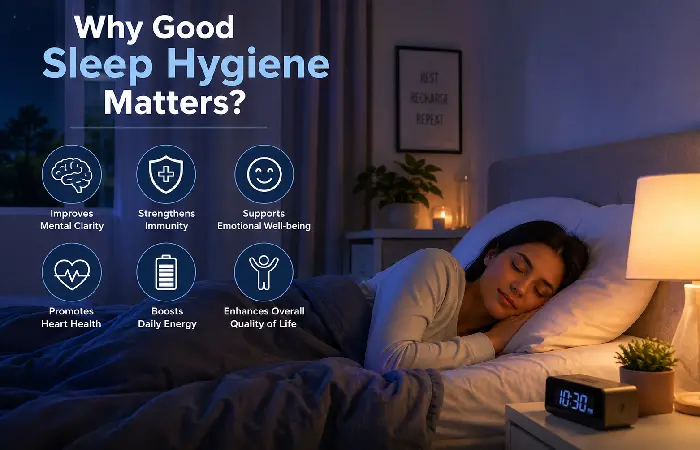
Discover the best sleep hygiene tips for adults to create healthier sleep habits and wake up feeling refreshed each morning.
Here’s the bit everyone sort of skims over: this is not an exercise in feeling tired, the morning after. Sleep- deprivation – that is, getting very little poor- quality sleep over long periods – doubles your risk of being obese, with its attendant risk factors (type 2 diabetes, cardiovascular disease etc etc), with effects of the nervous, nervous-system. We clear out all our metabolism, our muscles restore, we process memories – to do otherwise again, the next night, year after year, it’s not just your day that is impacted, your biological ‘ debt’ rises and manifests somewhere you could scarcely believe
Then of course there’s your affect on others Ever suddenly bark at someone for no particular reason and then later realise you have had almost no sleep at all, Lack of sleep shortens your fuse. It makes people more reactive, less patient, worse at reading how someone else is feeling. Relationships, parenting, working with a team — all of it goes easier when the people involved actually slept the night before.
And performance. Many athletes focus on sleep as much if not more than training, simply because it all goes back to reaction time, coordination, recovery, and so on. Kids who get adequate sleep also do better with memory retention. People at work make fewer mistakes and better decisions when they’re rested. Good sleep isn’t a nice extra on top of a productive life. It’s more like the floor everything else is standing on.
Signs of Poor Sleep Hygiene
Some of these are obvious. Others hide behind excuses like “just a rough patch” or “I’ve been in a mood lately.” Worth a quick honest look.
| Sign | What It Often Looks Like | Why It Happens |
| Trouble falling asleep | Awake a lot 30+ minutes 2 – 3 nights per week | Bedtime being inconsistent caffeine later in the day getting screen time just before bed |
| Waking up often at night | Waking multiple times, struggling to drift back off | Alcohol close to bedtime, a too-warm room, background stress |
| Groggy despite “enough” hours | Feeling unrested even after 7–8 hours in bed | Poor sleep quality, disrupted cycles, an inconsistent schedule |
| Leaning hard on caffeine | Needing coffee just to feel functional by mid-morning | Sleep debt disguised as low energy |
| Big weekend sleep-ins | Sleeping in noticeably later on weekends | Inconsistent wake times throwing off your body clock |
| Short temper or flat mood | Snapping over small stuff, feeling low for no clear reason | Sleep loss interfering with emotional regulation |
| Can’t focus | Rereading the same sentence, losing your train of thought | Impaired memory, slower cognitive processing |
| Dozing off unintentionally | Nodding off in meetings, in front of the TV, or driving | Serious accumulated sleep debt |
If you recognize three or more, you have something to work on. The good news? Most sleep hygiene patterns adjust quickly-as quickly as within a couple of weeks, says Alana Becker.
If you’re struggling with restless nights, learn how to achieve deep, restorative sleep using simple, science-backed sleep hygiene practices.
Benefits of Healthy Sleep Habits
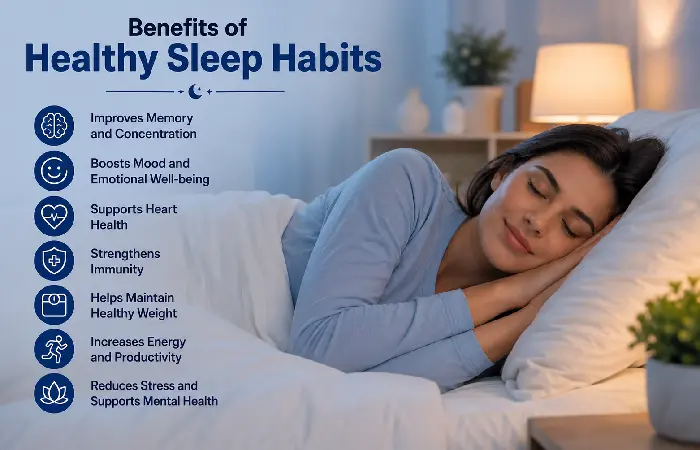
It’s easy to underrate what good sleep actually gives back, mostly because we don’t notice problems we’re not having. But the research here is genuinely convincing.
Reducing evening device use can make a big difference, so explore these screen time and sleep hygiene tips for better nighttime rest.
Sharper thinking and memory come first. During deep sleep your brain transfers information out of your short-term memory and into its long-term memory. In memory and problem-solving tasks those who have a good night sleep out perform sleep-deprived ones. And quite significantly!
Beyond that is emotional state. During sleep, the brain handles emotions in separate sections of the brain-which include part of the amygdala and emotions in that section-more appropriately. When well rested, you will go through less anxiety-induced swings and you have more space to take on a new load of stress.
If stress keeps you awake, these sleep hygiene strategies for anxiety and stress can help you relax before bed and improve sleep quality.
Immune system function is stronger. The body releases cytokines that fight infection when sleep occurs, and individuals getting fewer than 6 hours a night are more prone to common colds if exposed than those getting seven or more.
Weight management works better too. When denied sleep, the hormones that dictate appetite, Ghrelin and leptin, are thrown off, and that’s a major reason it’s so hard for tired individuals to stay away from sugary or carbohydrate-heavy foods; it’s not all about willpower.
Heart health benefits too — consistent, good-quality sleep tracks with lower blood pressure and reduced risk of heart disease and stroke over time.
Your skin could be using your sleep too. And we are not being superficial! Deep sleep makes for better blood flow into the skin and triggers higher collagen; yes, your ‘beauty sleep’ is not just an old wives’ tale after all.
And, longer life. Large population studies keep landing on the same pattern — both too little and too much sleep line up with higher mortality risk, with seven to eight hours sitting near the sweet spot for most adults.
The Science Behind Quality Sleep
To actually fix your sleep, it helps to understand what’s happening while you’re out cold. Sleep isn’t a single flat state. It cycles through distinct stages roughly every 90 minutes, and a normal night runs through four to six of these cycles.
Want an easy way to improve your nightly routine? Use this sleep hygiene checklist to build healthy habits for consistent, restful sleep.
| Sleep Stage | What Happens | Approx. Share of the Night |
| Stage 1 (light sleep) | The drift between awake and asleep; muscles loosen, brain waves slow | 2–5% |
| Stage 2 (light sleep) | Heart rate and temperature drop; brain activity slows further, with brief bursts | 45–55% |
| Stage 3 (deep sleep) | The body repairs tissue, builds bone and muscle, strengthens immunity | 15–25% |
| REM sleep | Brain activity rises near waking levels; most dreaming happens here; memories consolidate | 20–25% |
Sleep-wake cycles are driven by two things: circadian rhythm your body’s roughly 24-hour internal clock governed by a cluster in the back of your brain known as your suprachiasmatic nucleus. Light drives it heavily. Bright light in the morning tells it to wake you and hold off melatonin. Darkness in the evening tells it the opposite, to release melatonin and get your body ready for bed.
The second component of the drive for sleep is pressure, the homeostatic drive. We accumulate more and more of the sleep–promoting molecule adenosine the longer we have been awake, and adenosine will increasingly draw the brain into sleep. By blocking adenosine receptors, caffeine masks this rising pressure of exhaustion to delay the onset of fatigue, rather than to reduce it.
You can experience good, refreshing sleep that arrives quickly and easily when the signals from light, activity and clock as well as the homeostatic process concur you are tired.
When they do get the timing wrong with an odd working pattern, jet-lag or shifts, your sleep time can become fitful and irksome by a cause not entirely relating to how long they had spent in your mattress.
How to Build a Healthy Sleep Routine?
You don’t have to be perfect at it the first day. Find a few things that you like and keep them consistent with time – you’ll see. It’s these few anchors in the day that actually retrain the body clock.
Fix your wake-up time – Most people want to fix their sleep by making them go to bed early. That doesn’t work, though; you can’t command yourself to fall asleep. Fixing the wake-up time, even on weekend, trains your body to be tired at an earlier time.
Get some morning light for about 30 to 60 minutes after waking time – Morning light provides to greatest signal into yours chronometer time; fifteen to ten min walking outdoors ( or beside an window that is bright )will likely do marvel.
Implement a winding down period (30-60 mins before sleep)
Dim lights & reduce stimulation – turn lamps down, close down your email and social media. Stretch, Journal, read, listen to music, or just chill. Create a regular pre-sleep ritual. Rituals like brushing your teeth, changing clothes, doing some light stretching-the same small series of events every night- signal your brain that sleep is on its way, just like a lullaby signalling a toddler.
Monitor your final cup of coffee and meal times – The half-life of caffeine is somewhere in the 5-6 hour range, meaning that 3pm cup of coffee will still be present in your body at 9pm. Aim to limit caffeine in the afternoon, and try to get your final large meal finished 2-3 hours before you sleep.
Use your bed for only sleep and sex – Eating, working, or browsing in your bed at any time that isn’t one of these two will make your brain associate that space with being alert rather than tired. If you stop this behaviour and it’s persistent, the mental connection with bed and sleep will fade naturally.
Loosely monitor your sleep and don’t be a sleep snob – A basic sleep diary, or even very light use of a wearable tracker, can give you some indication. Just don’t become stressed about getting ‘enough sleep,’ as the sleep score will just be another reason to be stressed about not getting enough.
Best Sleep Hygiene Practices
Once the basics are handled, these refinements make the biggest difference:
Keep the room cool.
Somewhere around 60 to 67°F (15 to 19°C) suits most people. Body temperature naturally drops before sleep, and a cooler room supports that instead of fighting it.
Block light out completely.
Blackout curtains or a decent eye mask can noticeably deepen sleep, especially for light sleepers or anyone living somewhere with a lot of ambient city glow.
Handle the noise.
A white noise machine, a fan, or earplugs can mask disruptive sound, genuinely useful in cities or for anyone who wakes easily.
Cut screens in the last hour before bed.
Blue light suppresses melatonin, sure, but the bigger issue is usually mental — an argument online or a stressful headline keeps your mind spinning long after the screen’s off.
Get plenty of exercise, but not too close to your bedtime
Regular motion has been shown to result in much greater quality of sleep, but some individuals feel too charged up by an intense sweat session close to lights-out.
Keep naps to 20 to 30 minutes, earlier in the day.
Short naps refresh you. Long or late ones eat into your nighttime sleep pressure and make falling asleep harder later.
Go easy on alcohol.
It might speed up falling asleep, but it fragments sleep later in the night and cuts significantly into REM.
Try relaxation techniques. Deep breathing, progressive muscle relaxation, a short body scan, these calm a racing mind far better than lying there willing yourself to sleep.
Common Sleep Hygiene Mistakes
Even some people who make honest attempts are sucked in; they may never know that this tendency is precisely what is blocking their progress,
| Mistake | Why It Backfires | A Better Approach |
| “Catching up” with weekend sleep-ins | Shifts your circadian rhythm, causing social jet lag and rough Mondays | Keep wake-up times within an hour of each other, every day |
| Scrolling on your phone in bed | Delays melatonin and keeps your mind switched on | Charge devices outside the bedroom, or at least across the room |
| Late-afternoon coffee or energy drinks | Caffeine’s long half-life keeps it active well into the evening | Cut caffeine off around 2 p.m. |
| Using alcohol as a “sleep aid” | Speeds up falling asleep but fragments deep and REM sleep later | Save alcohol for earlier in the evening, away from bedtime |
| Hard workouts right before bed | Raises core temperature and adrenaline right when you need to wind down | Finish intense exercise 2–3 hours before sleep |
| Lying awake, getting frustrated | Trains your brain to link bed with wakefulness and anxiety | Get up after 20 minutes, do something calm, come back once drowsy |
| Bedtimes that shift night to night | Confuses your internal clock, making sleep onset unpredictable | Anchor bedtime and wake time as consistently as you can |
| Ignoring an old mattress or pillow | Physical discomfort quietly disrupts sleep depth without you noticing | Reassess your sleep setup every 7–10 years, sooner if you’re waking up sore |
Sleep Hygiene Tips for Different Age Groups
Sleep needs, and sleep problems, shift a lot across a lifetime. What works for a teenager won’t suit a new parent, and what works for a new parent won’t suit someone in their seventies.
| Age Group | Recommended Sleep | Common Challenges | Practical Tips |
| Infants (0–1 year) | 12–16 hours (including naps) | Sleep-Wake Disorders Night Feeding | Start the consistent bedtime routine early – keep interactions peaceful & dim after bedtime |
| Toddlers & preschoolers (1–5 years) | 10–14 hours (including naps) | Refusal of bedtime or naps | Maintain a consistent schedule – and remove all devices from sight as bedtime approaches |
| School-age children (6–12 years) | 9–12 hours | Homework, activities eating into evening | Stick to an early, regular sleep schedule and restrict screen time at least one hour prior to bedtime. |
| Teenagers (13–18 years) | 8–10 hours | Natural circadian shift toward later sleep, early school starts, phone use at night | Encourage consistent wake times even on weekends; pull back on late-night phone use |
| Adults (18–64 years) | 7–9 hours | Work stress, caffeine reliance, irregular schedules | Build a real wind-down routine; keep the schedule consistent even on weekends |
| Older adults (65+ years) | 7–8 hours | Lighter, more broken-up sleep; waking earlier naturally; medication side effects | Get plenty of daytime light; keep naps short; talk to a doctor if sleep worsens |
Also just a point of reference for you:more sleep for those that are older isn’t better quantity or consistency for older adults as shallow and light sleep naturally increases.
Frequently Asked Questions
How many hours of sleep do I actually need?
However, most adults require 7–9 hours and the precise number is going to differ between individuals. What is more important is that, whenever you hit the pillow, you actually wake feeling recharged, refreshed and ready to have a day without guzzling litres of caffeine.
Is it bad to sleep in on weekends?
Rarely. But sleeping at least two or three hours later on weekdays than the researchers consider socially normal results in social jet lag – like a short-lived mini, mid-week vacation for your body that often makes Mondays miserable instead of happy-go-lucky.
Can I train myself to need less sleep?
In general, no. A tiny segment of the population has a genetic anomaly that allows them to run on reduced amounts of sleep; it is exceedingly uncommon. More typically, those individuals saying they need “less” sleep are merely taking out sleep debt.
Does melatonin actually help with sleep hygiene?
It may boost your sleep ability at times – particularly after air travel or shift changes. However, it has failed to help improve daily sleep hygiene habits, so while helpful, it should be combined rather than substituted.
Why do I keep waking up at 3 a.m. and can’t fall back asleep?
Generally, it may just boil down to getting the room cooled, maybe giving alcohol a wide berth in the hours before sleep, and of course, if your mind is doing too much you have to just roll out of bed and give it a few minutes of peace to cool it off.
Is napping bad for nighttime sleep?
They really are not necessarily a 20 to 30 minute nap throughout the day helps keep you awake throughout without keeping you up throughout night. Late afternoon… or extended, all afternoon naps, tend to sabotage the sleep that you will hopefully achieve when you come to finally go to bed this evening.
How long does it actually take to fix bad sleep habits?
Many of people who try are able to feel effects within a week and two, but normally, a month time will be need to ‘correct’ this. For these cases, the best of trick that one must use, is nothing. We, at the time will patiently waiting for one, or some, for one to see a real effect.
Should I use an app to track my sleep?
The useful patterns in trackers are sometimes great, but beware of orthosomnia, which comes from chasing that “perfect” night in the pursuit of a better sleep score and leads you to get neurotic. Think of these trackers as a guideline, not a grade.
Final Thoughts
The kind of better sleep that impacts you isn’t often the result of one radical change; instead, it’s a short string of small, consistent decisions made over a couple of weeks that essentially recalibrates your body’s internal clock. Having a regular wake-up time, getting some light in the morning, creating a more peaceful winding-down window before bed, using a cooler, darker bedroom, and being more judicious with both alcohol and caffeine-that combination will do more to improve your sleep than a gizmo or a supplement ever will.
Try this for two or three weeks before throwing the towel in and declaring this approach ineffective. Sleep is a slow system to change, but when it does, the rewards seem to seep into everything-your mood, concentration, health, and in all honesty, your sheer joy of the daytime world. Pick one thing to start tonight, and let the rest follow.