

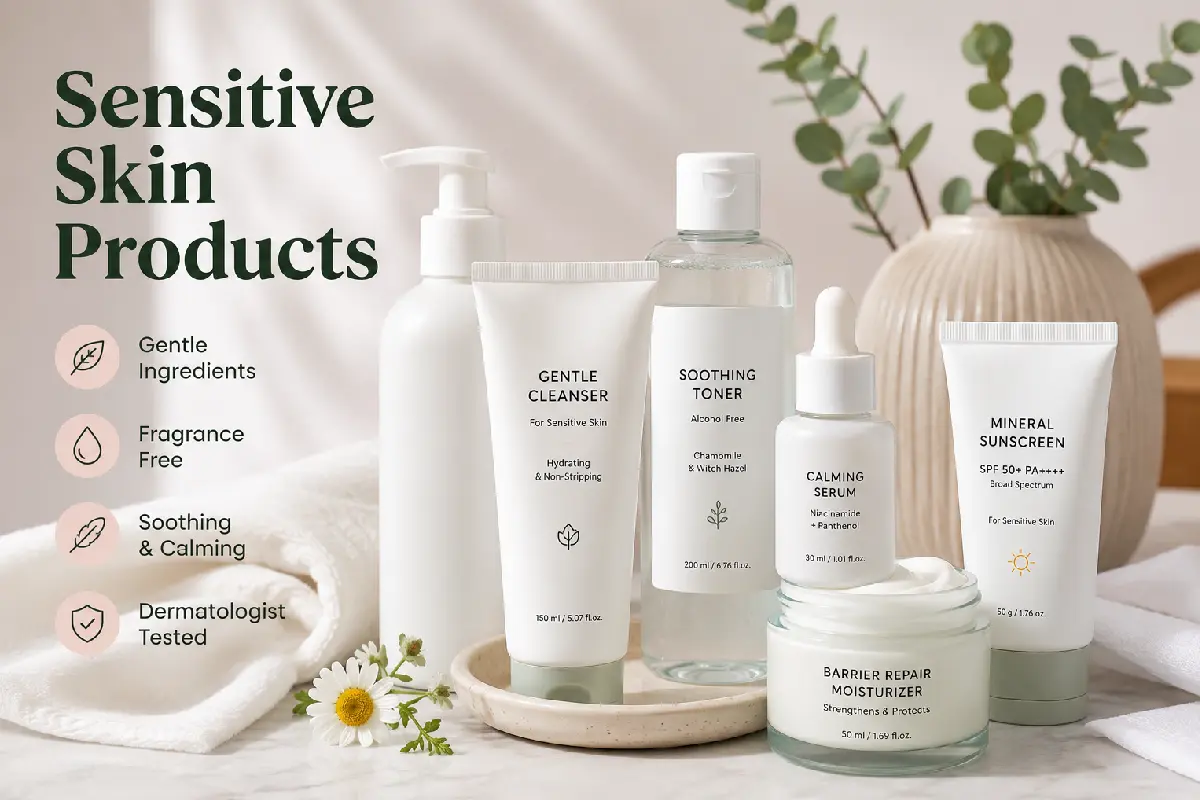
Sensitive Skin Products: The Complete Guide to Choosing Safe and Gentle Skincare
 Khizrana Begum
Beauty & Lifestyle Writer
Khizrana Begum writes clear and reader-friendly content covering beauty, lifestyle and related topics.
Read Full Bio of Author →
Khizrana Begum
Beauty & Lifestyle Writer
Khizrana Begum writes clear and reader-friendly content covering beauty, lifestyle and related topics.
Read Full Bio of Author →
 Sameena Begum
Health, Technology & Digital Content Reviewer
Sameena Begum reviews content for clarity, accuracy and overall reader usefulness.
Read Full Bio of Reviewer →
Sameena Begum
Health, Technology & Digital Content Reviewer
Sameena Begum reviews content for clarity, accuracy and overall reader usefulness.
Read Full Bio of Reviewer →
Sensitive Skin Products: If you have experienced a red flush after a “mild” cleanser, a stinging sensation after a new moisturizer or an unexplained itch after changing your laundry detergent, you know something a great many dermatologists will agree on: sensitive skin isn‘t unusual, and it can be real. Studies of dermatology patients show that a majority of adults report having sensitivity of some kind, which can include recurring stinging, constant redness or adverse reactions to products that are tolerated just fine by others.
The difficult bit is that “sensitive skin” isn‘t actually a single condition. It‘s a blanket term for a skin barrier that reacts more easily than average, and the cause could be anything from genetics to over-exfoliating to an undiagnosed condition like rosacea or eczema. It‘s this exact reason why the skincare aisle can seem like a minefield; a product that says “for sensitive skin” on the front of the bottle can still be jam-packed with fragrance, alcohol or essential oils in the ingredient list on the back.
In this guide, we‘ll go through what sensitive skin products are, how to determine whether the category applies to you, what makes skin sensitive in the first place, and most importantly, what specific ingredients to look for and avoid. We‘ll also discuss routines, shopping blunders, and a category-by-category rundown so you‘re not stumbling in the dark the next time you find yourself in front of a wall of bottles.
❝
This article is a part of
Sensitive Skin Care Guide
What Are Sensitive Skin Products?
Products for sensitive skin products made to increase the likelihood of irritation, allergic reactions, or barrier disruption. In skin care, the practice generally just involves preparing a product made of an assortment of simple, forgiving ingredients. Rather than an explosion of aromatic, irritating. A truly worthwhile product made specifically for sensitive complexions will possess the qualities below-
- Short list of ingredients. The more ingredients, the higher the chance of an ingredient negatively reacting with your skin.
- Fragrance-Free(Not Unscented). Unscented ingredients might have “fragrance” in them to disguise the odour of the ingredients that do the work – but that’s just a mask to mask other fragrances.
- A pH closer to your skin’s level, generally somewhere between 4.5 and 5.5, that encourages maintenance of skin barrier integrity.
- Low usage preservatives or low irritation potential preservative systems.
No unnecessary, market-driven ‘active’ ingredients like additional acids or extracts from non-essential plants.
I think it needs to be stated quite clearly, the word ‘sensitive’ in a product name has absolutely no formal definition when it comes to regulated product claims, nor can it actually be claimed ‘for sensitive skin’ without significant backing, in the majority of countries.
without any independent testing to back that claim. That’s why learning to read the ingredient list yourself is more useful than trusting the front label.
If your skin also feels tight and flaky, explore the best sensitive skin products for dry skin to keep your complexion hydrated without causing irritation.
How to Know If You Have Sensitive Skin?
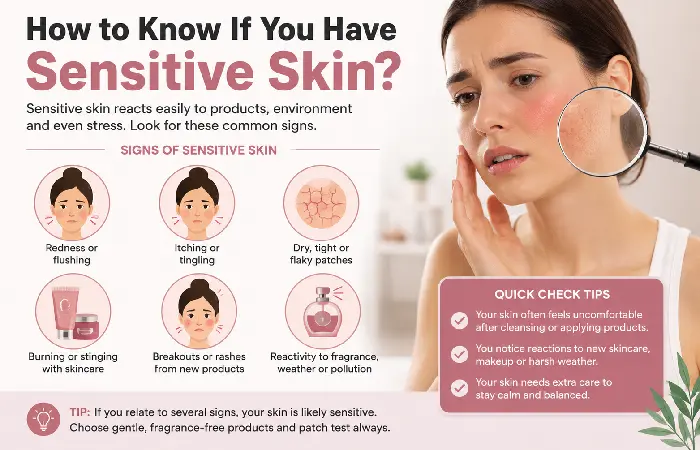
Some know it right away – since they were children their skin has retaliated against almost anything tried on it. For the rest of us, the sensitivity typically appears out of nowhere after feeling like there’s been a major change-taking a new medication, having just moved to a different country, changes in weather, or too many harsh actives loaded onto the face simultaneously.
Not sure when to apply your skincare? Follow this morning and night routine for sensitive skin products to get the most from your daily regimen.
Here are the most common signs to watch for:
| Sign | What It Looks Like |
| Reactivity to new products | Redness, stinging or itching minutes to hours of applying something new |
| Visible redness | Ruddy complexion and visible tiny capillaries or areas that remain pink. |
| Tightness after cleansing | Skin is drying, stretched out and/or ‘squeaky’ post-rinse. |
| Reaction to weather | Rashes from the sun, wind, heat and even the cold can appear and then disappear just as fast. |
| Sting with common ingredients | Burning with alcohol based toners, vitamin c and exfoliating acids |
| Slow healing | Minor irritations that do not recover and clear up and acne, or even a little rash |
| Reaction to fabric or fragrance | Some laundry detergents, perfumes, and synthetic materials may cause itchy skin. |
Chances are, if a few of those sound familiar, you could have sensitive skin, even if you haven’t officially been diagnosed with a specific skin condition. But to be sure, you could always conduct a patch test apply a bit of a new product to the inside of your forearm or behind your ear, and wait 24 to 48 hours to see whether any redness, bumps or itching develop before slapping it on your face.
If you’re prone to allergic reactions, choosing hypoallergenic skincare products for sensitive skin can help minimize irritation while protecting your skin barrier.
Another thing to point out if you have sensitive skin, you may have oily skin or you may have dry skin. Sensitive skin “is” how your skin responds, not what state of condition your skin is in.
Common Causes of Skin Sensitivity
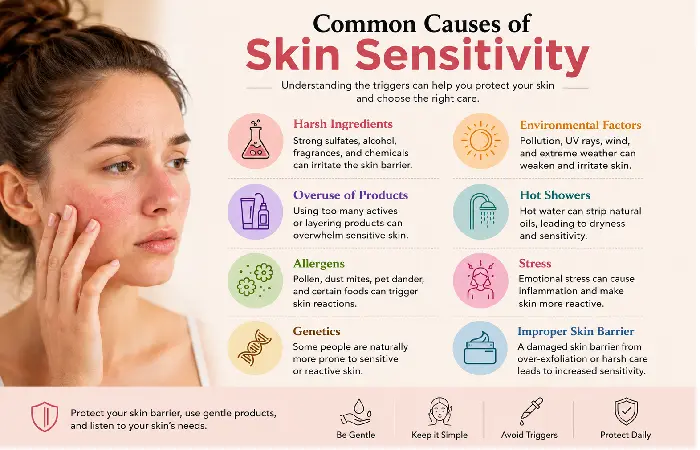
Sensitivity rarely shows up out of nowhere. It’s usually the result of one or more underlying factors working together.
A compromised skin barrier
The topmost layers of your skin, what you probably call the “moisture barrier,” is like a wall of skin cells connected by various fatty acids, or lipids (the most notable examples are ceramides). When the wall is broken-as can happen when you overwash, exfoliate, or live in a very dry climate-all kinds of nasties have easier access, and all the skin has to leave to avoid being dehydrated in the first place.
To reduce the risk of redness and irritation, consider switching to fragrance-free products for sensitive skin that are formulated without unnecessary additives.
Genetics
“We may genetically inherit or be born with a more compromised skin barrier, thinner skin, less oil production, or be susceptible to conditions like rosacea, allergies or eczema, all of which compromise skin barrier integrity and make it more reactive”, says Dr. Ghaswalla.
Underlying skin conditions
Raised sensitivity occurs to different extents, but it is the principle symptom in roseacea, eczema, contact dermatitis, psoriasis, rather than an associated symptom of the condition.
Environmental factors
Dry, cold air sucks water from your skin. Hot showers do this to your skin as well. Pollution and sun rays generate free radicals that may signal your skin to initiate an inflammatory cascade when its reactivity is high.
Product overload
This one really surprises many people. When you overdo the number of actives in your week – going from retinoid, acid exfoliants, vitamin C and even a physical scrub within seven days – your skin may easily develop an oversensitivity from otherwise calm skin. Dermatologists are referring to this as “over-exfoliation syndrome,” and it’s become more of a problem recently. Especially with the popularity of an in-depth, multi-step skin routine, many people have been doing it way too much.
Hormonal changes
As with pregnancy, periods and menopause skin permeability – meaning how well your barrier works – could be different from usual and the skin a little more permeable than normal.
Start your skincare routine with a gentle face wash for sensitive skin that cleanses effectively without stripping away natural moisture.
Allergies
Actual allergic contact dermatitis results from the immune system’s reaction to a specific substance such as an allergen contained within a specific fragrance ingredient or preservation substance. However, instead of clearing up with continued exposure (as it would with irritating ingredients), an allergy generally intensifies.
Ingredients to Look for in Sensitive Skin Products
Good news: there’s an small handful of ingredients that come up over and over in truly gentle formulas. If you know how to spot them on a label you’ll save a lot of guesswork.
| Ingredient | What It Does |
| Ceramides | Renew and help strengthens the skin barrier – that acts to retain moisture – from the inside. |
| Glycerin | Humectant and Skin-Conditioningagent. This ingredient attracts water to the skin but does not irritate the skin. |
| Hyaluronic acid | “Contains a large quantity of water (multiple of its weight), which causes it to rehydrates.” Suitable for all types of skin |
| Niacinamide (low %) | Assists to soothe redness, benefit the skin’s barrior while also controls oil production |
| Colloidal oatmeal | Relieves pain and inflammation. ( Popular among sensitive-skin formulas for eczema.) |
| Panthenol (pro-vitamin B5) | Heals the skin and soothes a distressed surface without clogging pores |
| Squalane | Light non- comedogenic oil that resembles our skin’s natural lipids. |
| Allantoin | Relieves and smoothens dry and rough areas of skin. |
| Centella asiatica (Cica) | What it is: A soothing plant extract found in countless redness formulations. |
| Zinc oxide (mineral SPF) | Guards against the sun, but without irritating the skin of chemical filters. |
A good rule of thumb: the more the ingredient list seems to ‘read like nothing,’ the more likely it’ll work for reactive skin. When products come formulated for barrier repair vs. Innovative actives, start there.
Ingredients to Avoid
As important as what to include, it can be helpful to know what causes problems. None of the ingredients below are innately harmful for every skin type, but they are the most commonly responsible for irritation, burning, stinging, and other allergic reactions that can be so upsetting on sensitive skin.
Before buying new skincare, learn about the best ingredients for sensitive skin products that soothe irritation and support a healthy skin barrier.
| Ingredient | Why It’s a Problem |
| Fragrance / parfum | The most frequent cause of allergic contact dermatitis in cosmetics |
| Essential oils (citrus, mint, lavender, etc.) | Natural is not equal to mild – be warned for all common sensitizers |
| Alcohol denat. (drying alcohols) | Wipes out healthy, skin-natural oils and breaks down skin barrier |
| Sulfates (SLS/SLES) | Sulphate free Harsh detergents that can strip all your oils and can lead to drying and or irritation. |
| Physical exfoliants with rough particles | Abrasive scrubs causing micro-tears on skin barrier |
| High-percentage acids (AHA/BHA) | Over-exfoliation can occur, making the skin sensitive (especially if you apply day-in and day-out. |
| Retinoids (unbuffered, high strength) | Works great but it can sometimes be a little harsh for sensitive or barrier impaired skin. |
| Chemical sunscreen filters (for some users) | The problem of oxybenzone and filters of its group cancause a reaction in people prone to it |
| Formaldehyde-releasing preservatives | Common allergens linked to contact dermatitis |
| Witch hazel | Often contains alcohol and tannins that can be drying and irritating |
Quick note on “natural” & “clean labeling: These labels rarely has any regulated meaning. Poison ivy is natural. A clean product can contain fragrance oils that will cause a reaction for you. I just find that education about ingredient lists is important vs being tricked by labels 🙂
Best Skincare Routine for Sensitive Skin
The keyword here is minimalism. Simply, using few things keeps down the possibilities of a trigger, and also, will make tracing down what had initiated a cause much easier.
Morning routine:
- Cleanser: This can’t be foaming, with no fragrance-though your skin might also be happy simply swiped with some lukewarm water, with just water alone, if it’s very sensitive.
- Hydrating serum: Apply some a hyaluronic-acid- or glycerin-based water product into your skin while it’s still damp, and clean
- Moisturiser: Smooth on another layer- this one non-fragrant with ceramides can do well for dry skin.
- Mineral sunscreen: An SPF at least 30 that’s 30 percent zinc oxide or at least 20 percent titanium dioxide will be the kindest to the environment and your face.
Evening routine:
- Gentle cleanser – similar to this morning or use a micellar water.
- Treatment (alternate nights – not always) – a low strength, buffered actives if your skin tolerates, maybe 2-4% niacinamide
- Moisturiser – slightly richer than in the day, depending on how cold it is
Occlusive (if need be) – a light bit of squalane or a barrier balm over the top to seal in all moisture overnight
A few extra guidelines that make a real difference:
- One new product at a time-wait at least a week before trying a new product.
- Avoid using hot water for your cleanser but make sure the water is not cold-lukewarm water is ideal.
- Dry your skin by patting, don’t rub it dry with your towel.
- Use moisturiser while your skin is still wet, within minutes of cleaning; this will seal in your hydration.
- Be gentle and limit your use of exfoliation to once a week, skip entirely during flares.
How to Choose Products Based on Skin Type?
Since each type of sensitive skin shows itself differently — flaky and dry, oily and breakouts, or the combo of the two — so does the right blend.
| Skin Type | What to Prioritise | What to Avoid |
| Sensitive & Dry | Ceramides-focused rich creams and cream cleansers. Use Occlusives like Squalane | Cleansing foam, alcohol toners, gel format |
| Sensitive & Oily | Moisturizing:non-comedogenic and oil-free light gel-cream moisturisers, niacinamide | My concern with oily or overly buttery or silicon-clogging pore products. |
| Sensitive & Combination | Rebalancing hydration. Applying lighter on the cheeks and more mild formulas on the t- zone | Uniform application of a one-size-fits-all rich cream |
| Sensitive & Acne-Prone | Formulas should contain at low concentration in a fragrance-free non-comedogenic product; azelaic acid or niacinamide. | Too-intense spot treatments for acne that have high levels of benzoyl peroxide or alcohol |
| Sensitive & Mature | Ceramides, peptides, a gentle hydrator – buffered retinol, if tolerated | Potent retinoids, strong acids too frequently |
But with a basic formula that may well suit most types of skin – Moisturise, preserve skin barrier, introduce changes very gradually.
Common Mistakes That Trigger Irritation
Once you know that skin is sensitive, then there are only a limited of ways where some might misstep on some.
Chasing trends instead of results. Being on the internet doesn’t make an ingredient good for reactive skin – a lot of routines will focus on actives that expect a strong, accepting skin barrier.
Skipping the patch test. It takes less than two minutes and can save days of recovery from a bad reaction.
Layering too many actives at once. Morning Vitamin C, night retinol, an exfoliating acid twice a week, and slinging in an entirely new moisturizer – there’s quite a lot to ask of skin in such a concentrated dose.
Over-washing. Over-shampooing and using water that’s too harsh over time depletes the skin of natural oils.
Ignoring SPF. Sun damage has the potential to make sensitivity and inflammation even worse, so the sunscreen avoidance strategy backfires. This applies to anyone prone to rosacea and flushing.
Assuming “fragrance-free” and “unscented” are synonymous. Here’s what we’re talking about; you may need fragrance-free products, but they might be hiding masking fragrances
Switching everything at once after a bad reaction. When your skin misbehaves, your instinct probably may be to clear the clutter in your skin routine. But it’s almost always wiser to whittle down everything to just your cleanser, moisturizer, sunscreen, and then try adding the other products back in slowly.
Using body products on the face2 . Body scrubs may include stronger scents and even too acidic for the delicate skin of face.
Best Sensitive Skin Products by Category
Instead of naming brands- form changes, and availability varies (so this list might get outdated quickly)-here’s your primer on where to shop, what you might expect to find, and the ingredient clues that indicate product compatibility for you:
| Category | Look For | Texture/Format Tip |
| Cleanser | Fragrance-Free, Lather Free , pH 4.5-5.5 , ceramides, glycerin or similar . | Cream and lotion cleansers will be kinder than the foamy gels. |
| Moisturizer | Ceramides, squalane, niacinamide, no essential oils | The gel version is perfect for my oily skin, richer one for dry skin. |
| Sunscreen | Zinc Oxide or Titanium Dioxide (mineral) Fragrance-Free | Tinted mineral products can also serve as sheer foundation |
| Serum | Hyaluronic acid, panthenol, low-strength niacinamide | Apply to damp skin for better absorption |
| Toner/Essence | Alcohol-free, hydrating rather than “tightening” | Optional step — skip if your routine already feels complete |
| Exfoliant | Weak PHA – as mild a acid family as possible: used maybe once a week or never | Try to skip anything with little pieces and granules that don’t break down easily |
| Spot Treatment | Azelaic acid, dilute salicylic acid, sulfur | Apply only the afflicted location, not your total face. |
| Makeup/Base | Mineral-based foundations and concealer, not containing fragrance. | Even try and test your makeup, too much pigment can cause irritation |
Comparison Table: Sensitive Skin Products vs. Regular Skincare Products
| Feature | Sensitive Skin Products | Regular Skincare Products |
| Fragrance | Mostly fragranceless | May include extra scent. |
| Ingredient list length | No minimal | Usually long multiple actives. |
| pH | Balanced, close to skin’s natural pH | Varies widely, sometimes more alkaline |
| Active ingredient strength | Low concentration, buffered | Can be high concentration |
| Preservative systems | Chosen for low irritation potential | May include stronger preservative blends |
| Marketing claims | Focused on calming, barrier repair | Focused on results like brightening or anti-aging |
| Suitable for daily long-term use | Generally yes | Depends on formulation and actives used |
| Risk of irritation | Lower | Higher, especially with active-heavy formulas |
Frequently Asked Questions
Is sensitive skin the same as allergy-prone skin?
They are not the same! Highly sensitive skin can be bothered by all sort of things (the air, a brushstroke, a certain ingredient) and can look to burn, prick, sting and get patches of redness (flushing). Allergic reactions are much more localised immune system reactions to a specific single trigger and tend to get progressively worse each time.
Can sensitive skin become less reactive over time?
Some causes are. If the problem is due to a compromised barrier created from the use of products or treatments that cause over-exfoliation, your gentle and consistent routine can lead to your barrier recovery within a matter of weeks/months. If there are underlying conditions such as rosacea and eczema, a sensitivity associated with such could be managed, or it might not clear at all.
Are natural or organic products automatically safer for sensitive skin?
No. One of the most ubiquitous sources of irritants and allergens in the skin care world is natural ingredients, such as essential oils, citrus extracts and some plant extracts. The terms “natural” and “organic” alone have absolutely no bearing on how mild or not mild the formulation you are buying is; scrutinise the ingredient deck.
How long should I patch test a new product before using it on my face?
Test a patch on your inner elbow or behind your ears 24–48 hours before use. As long as nothing is feeling hot, red or stingy, you should be able to administer a small amount onto your skin.
Do I need to avoid all active ingredients if I have sensitive skin?
Not always! Someone with sensitive skin can tolerate ingredients like niacinamide, azelaic acid or mild acids such as PHAs, in low amounts and introduced a few days a week slowly and gradually.
Why does my skin sting with some sunscreens but not others?
The chemical UV filters found in the usual suspects like oxybenzone, avobenzone or the rest can sometimes cause some sensitivity issues. The natural blockers like titanium dioxide or zinc oxide sits on the skin, don’t get absorbed so is usually well tolerated.
Should I see a dermatologist if my skin is sensitive?
If the irritation continues or worsens or it involves intense swelling or burning, and you are not relieved by very mild cleansing of the face or by a soothing agent and by applying on the face, then you can consider seeing a dermatologist. A dermatologist who screen diagnose and treat skin problem which on a higher level like rosacea, eczema, and dermatitis.
What’s the difference between fragrance-free and unscented?
Fragnance free just means the ingredents on labels aren’t fragnances i.e. Mask frgrance. Unscented may mean a masking fragrance was used in the formula to mask odours of other formula ingredients – and that exposure is still a fragrant exposure that might trigger sensitive skin.
Final Thoughts
Sensitive Skin Doesn’t Have to Mean a Life of Experimentation, Followed by a Bathroom Counter Filled with Opened, Failed, Never-to-Be Replaced Half Bottles. Once you know why you’re areacts – whether the reason is a damaged skin barrier, an unaddressed issue, or you were just asking too many actives to do too much at once – navigating the shelves gets a lot more manageable.
But knowing isn’t everything. You still have to do a new way with sensitive skincare. Find fewer formulations with fewer ingredients and nothing added beyond an underappreciated array of barrier strengtheners – ceramides, ceramides, ceramids! – and your favorite hyaluronic acid Serum. And as for new items? Take it slow; resist the urge for a rapid product rotation; and you’ll be able to take a “wait and see if this works.” Be very ready to see it works.
Skin isn’t doing less just because its skin has difficult skin. You’re meeting the skin’s basic needs. The fewer products you ask it to work with, the less likely it will fight back when they’re applied- and it turns out they won’t be there soon.