


Lip Tint and Lip Stain: A Complete Guide for Naturally Beautiful Lips
 Khizrana Begum
Beauty & Lifestyle Writer
Khizrana Begum writes clear and reader-friendly content covering beauty, lifestyle and related topics.
Read Full Bio of Author →
Khizrana Begum
Beauty & Lifestyle Writer
Khizrana Begum writes clear and reader-friendly content covering beauty, lifestyle and related topics.
Read Full Bio of Author →
 Sameena Begum
Health, Technology & Digital Content Reviewer
Sameena Begum reviews content for clarity, accuracy and overall reader usefulness.
Read Full Bio of Reviewer →
Sameena Begum
Health, Technology & Digital Content Reviewer
Sameena Begum reviews content for clarity, accuracy and overall reader usefulness.
Read Full Bio of Reviewer →
Lip Tint and Lip Stain: A great lip color does not necessarily have to be a very bold one or even look like it has been overly done. In some cases, all that one needs to get great lips is a very light wash of color on their lips. This is where lip tints and lip stains come into play.
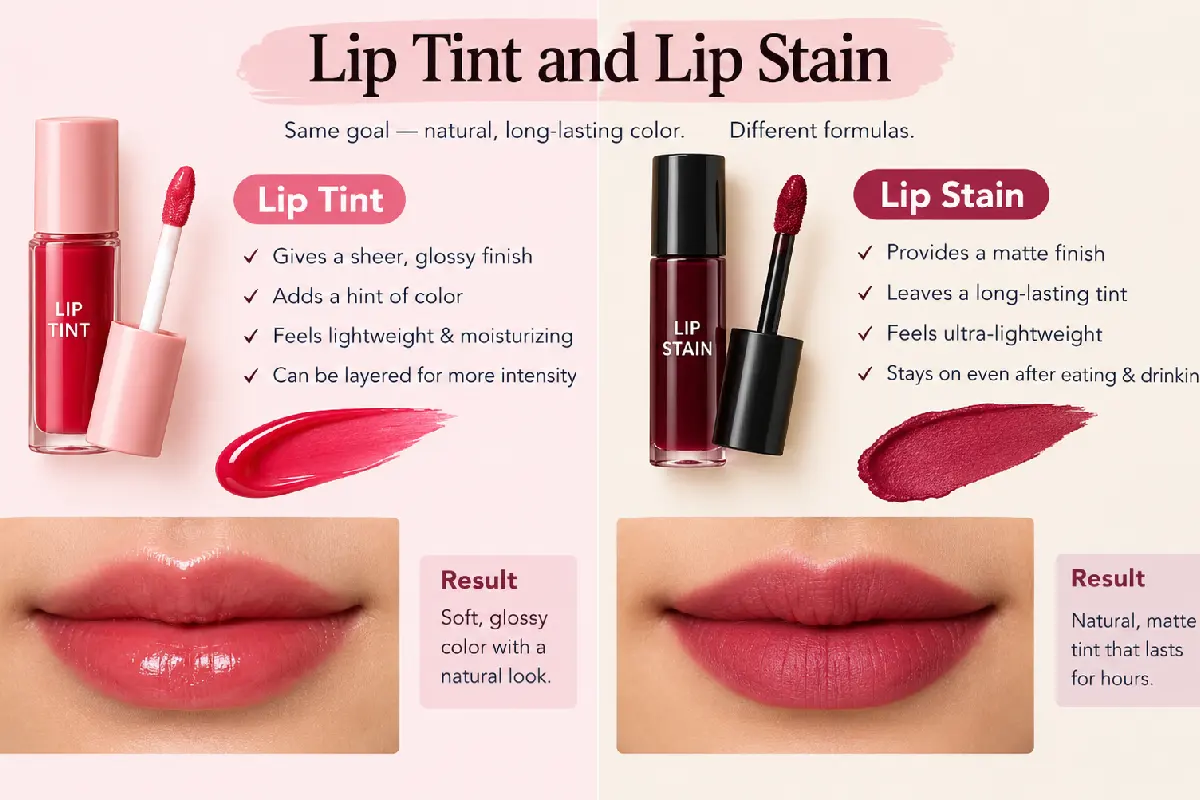
However, even though most people believe that both products are alike, there are certain differences between the two. Lip tints will simply give a hint of color on the lips and make them look hydrated, whereas lip stains color the lips and keep them colored for a long time.
No matter which color you decide to apply on your lips, it will be useful to have some information about lip tints and stains.
1. What Is a Lip Tint?
The lip tint is a very light formula that gives the lips a natural flush of color. This is unlike the traditional lipstick that leaves an opaque layer on the lips. The lip tint is meant to give a very light formula that does not weigh down the lips.
There are various types of formulas of lip tints, and these include liquid, gel, cream, balm, and mousse. There are some formulas that even have moisturizing properties in order to make them wearable throughout the day.
The best feature of the lip tint lies in its ability to build color with layers.
Why People Like Lip Tints
- Lightweight and comfortable
- Natural-looking finish
- Easy to build up
- Suitable for everyday makeup
- Available in glossy, dewy, or soft-matte finishes
- Can sometimes be used on cheeks as well
| Feature | Lip Tint |
| Color intensity | Sheer to medium |
| Texture | Liquid, gel, cream, balm |
| Finish | Matte, glossy, dewy, or natural |
| Feel | Lightweight |
| Wear time | Moderate to long, depending on formula |
| Best for | Natural everyday makeup |
2. What Is a Lip Stain?
A lip stain is an example of a lip coloring product that is made in such a way that it leaves color on your lips even after some amount of it has been wiped off.
It is for this reason that lip stains are very handy when you need lasting color even without applying lipstick repeatedly.
Most lip stains tend to have a watery texture. After application, they will eventually dry up on the lips or settle down and leave color on them.
Due to their highly pigmented nature, it is better to start with a little color at first. You can always add more color later if necessary.
Lip Tint vs Lip Stain
| Feature | Lip Tint | Lip Stain |
| Main purpose | Adds a soft wash of color | Leaves longer-lasting pigment |
| Coverage | Sheer to medium | Sheer to medium/high |
| Texture | Cream, gel, balm, or liquid | Often watery or liquid |
| Appearance | Fresh and natural | More color-focused |
| Longevity | Moderate | Usually longer-lasting |
| Removal | Generally easier | May require more cleansing |
In essence, tint concentrates on the luminosity and comfort of color, whereas stain highlights the durability of the color pigment. However, there are many contemporary beauty products that do not differentiate between these two, and thus the composition comes first in consideration.
3. Lip Tint vs Lipstick
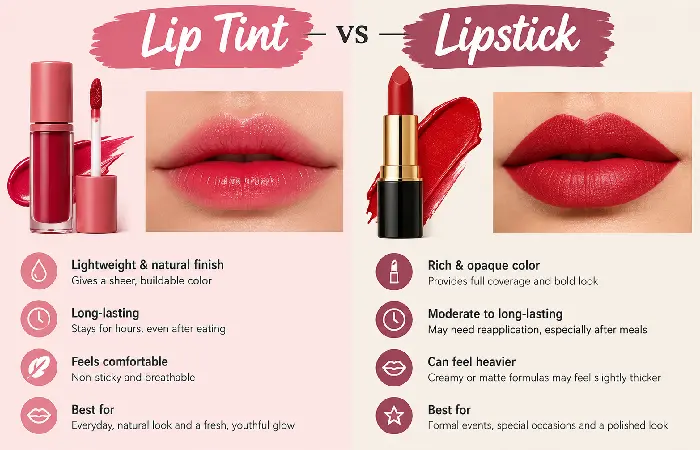
Although lip tints and lipsticks indeed have equal efficiency in adding color to the lips, they produce two entirely different effects.
When we talk about the components, lipsticks normally contain a larger amount of oils, wax, and pigment in comparison with lip tints.
| Lip Tint | Lipstick |
| Lightweight | Creamier and richer |
| Usually sheer | Usually more pigmented |
| Natural appearance | More defined appearance |
| Often easy to layer | Usually gives stronger color in one application. |
| Comfortable for casual wear | Great for dramatic or polished looks |
If you want your lips to look naturally flushed, a tint may be a better fit. If you want clearly defined, intense color, lipstick can provide that effect more easily.
4. Different Types of Lip Tints
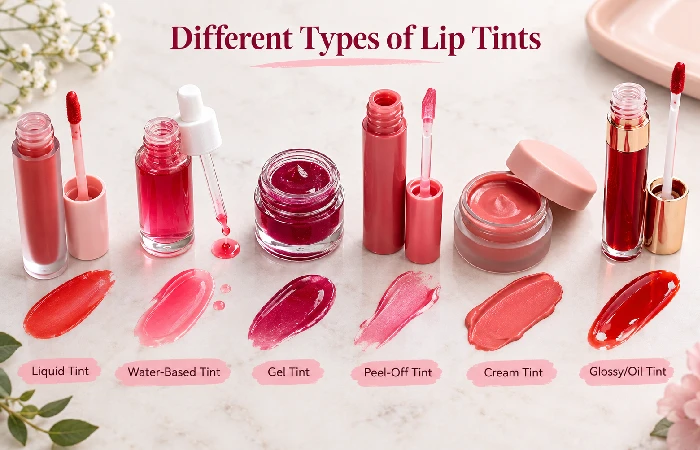
Lip tints are no longer limited to one particular texture. Different formulas are designed for different preferences.
Water-Based Lip Tint
These have a thin, almost watery texture. They usually provide a lightweight wash of color and can create a very natural effect.
Gel Lip Tint
Gels have a smoother feeling and can provide a bit of flexibility when applying them. They might come in handy if you need to gradually add color.
Balm Lip Tint
A tinted lip balm gives both color and a softer, more soothing application. This product can be useful when you just need something quick and easy.
Cream Lip Tint
Cream tints generally feel richer than watery formulas and can offer a softer, more controlled application.
Peel-Off Lip Tint
These products are put on as a coating, left to dry, and then removed gently, leaving behind the color. Always refer to the instructions for that particular product when applying it.
5. How to Apply Lip Tint?
Applying lip tint is easy, but using just a bit of technique can help achieve a better result.
Step 1: Lip prep.
Cleanse your lips and make them smooth. Apply a lip moisturizer if your lips are too dry, and give it time to penetrate.
Step 2: Apply a small quantity.
Apply a minimal quantity to the middle part of the lips initially to have better control over the shade strength.
Step 3: Blend fast.
Some tints tend to settle fast, so blend them over the lips quickly while they are not yet dry.
Step 4: Layer up.
If you prefer a darker shade, apply a second thin layer rather than putting on much product at once.
Step 5: Apply lip balm or gloss.
To make lips more hydrated-looking, apply clear lip balm or gloss if the formula permits it.
6. How to Apply Lip Stain
Lip stains require slightly more attention because they can set quickly.
- Use clean and dry lips.
- Put a small amount of product in the middle of your bottom lip.
- Apply the product towards the edges.
- Do the same for the top lip.
- Blot gently if you have extra product.
- Let the stain set as per the instructions on the packaging.
- Apply a second layer for more color.
For a soft gradient lip, concentrate more pigment toward the center and gently blend outward. This creates a diffused effect instead of a sharply defined lip line.
7. How to Make Lip Tint Last Longer
However, even permanent lip makeup can run while eating, drinking, talking, and moving one’s lips around. Here are some methods to increase their longevity.
Gentle Lip Scrubbing
It is easier for the lipstick or lip gloss to settle on smooth lips. Yet, you should not rub your lips too hard, especially when they are dry or irritated.
Moisturizing Beforehand
Put on lip balm before applying any makeup and wait till it settles. If your lips are covered in a thick layer of balm, it will not be absorbed well enough.
Use a Few Layers
Sometimes two layers work better than one, especially in terms of wearability.
Blotting the Product
When the product is wet on the surface, you can gently blot off extra product without taking away the pigment.
Do Not Touch Your Lips All the Time
Frequent touching can make the lip products smudge faster and unevenly.
8. Common Lip Tint Mistakes
Even an easy product can go wrong when applied too quickly.
Applying Too Much
A lip tint can become surprisingly intense when several layers are applied. Start small and build gradually.
Applying Over Very Dry Skin
Dry flakes can make the color appear patchy. Give your lips some basic care before applying makeup.
Waiting Too Long to Blend
Some formulas set quickly. If you leave a drop sitting in one place, it may create a concentrated patch.
Ignoring Your Natural Lip Color
The same tint can look different on different people because natural lip pigmentation affects the final shade.
Choosing Only by the Color in the Package
The color you see through packaging may not perfectly represent how the product looks on your lips. Whenever possible, consider swatches made on actual lips.
Using an Excessive Amount of Lip Balm
A thick layer underneath a tint can interfere with adhesion. A small amount of moisturizer is usually enough.
Final Thoughts
Lip tints and stains are great options to consider whenever you desire color without the bulkiness of regular lipstick. Lip tints will give you a light and fresh look, whereas stains will come in handy if long-lasting color is what you desire.
However, it is not only about picking the right shade of your makeup product. The way that you prepare your lips for application, how much you apply, proper blending, and finish will significantly impact your final result. Once you get used to the product, it will be one of the fastest things to apply in your daily makeup ritual.