


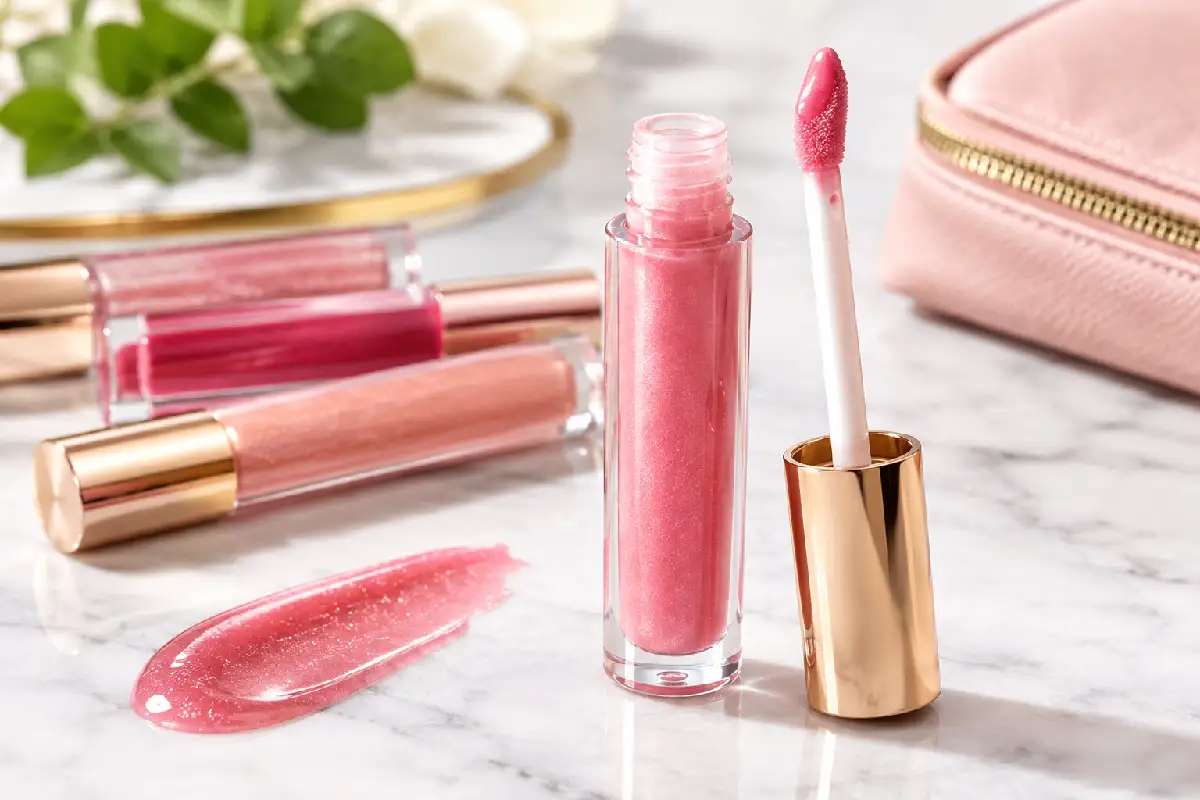
Lip Gloss: A Complete Guide to Glossy, Beautiful Lips
 Khizrana Begum
Beauty & Lifestyle Writer
Khizrana Begum writes clear and reader-friendly content covering beauty, lifestyle and related topics.
Read Full Bio of Author →
Khizrana Begum
Beauty & Lifestyle Writer
Khizrana Begum writes clear and reader-friendly content covering beauty, lifestyle and related topics.
Read Full Bio of Author →
 Sameena Begum
Health, Technology & Digital Content Reviewer
Sameena Begum reviews content for clarity, accuracy and overall reader usefulness.
Read Full Bio of Reviewer →
Sameena Begum
Health, Technology & Digital Content Reviewer
Sameena Begum reviews content for clarity, accuracy and overall reader usefulness.
Read Full Bio of Reviewer →
Lip gloss is one of those makeup products that immediately gives you that refreshed face appearance. Just a swipe of lip gloss and voila! Your lips become shiny, soft, and have a bit more dimension to them without giving them that thicker feel that lipsticks might.
Whether you fancy clear lips or go for pink and bold, there is lip gloss for any kind of makeup look out there- lip gloss (applies directly on the lips, over the lipstick, or to make your lips appear fuller).
We will explore today the truth about lip gloss, the kinds of lip gloss available, how to effectively apply it, and how to maintain those beautiful glossy lips for a longer time.
1. What Is Lip Gloss?
Lip gloss is a cosmetic that can be applied to the lips to provide a shiny, smooth appearance, and sometimes colour. Lip gloss is often seen as a cosmetic for the lips, whereas mascara or eyeliner is intended to be a glossy product.
Today’s lip glosses may vary in texture; there are lightweight versions, which feel like water, as well as thicker cushion-like products. There may be some moisturisers, such as oils and emollients, in lip gloss.
| Feature | Lip Gloss |
| Main purpose | Adds shine and dimension |
| Coverage | Sheer to medium |
| Finish | Glossy, glass-like, shimmery, or glittery |
| Color | Clear, nude, pink, red, brown, and more |
| Application | Wand, tube, squeeze applicator, or pot |
| Best for | Everyday makeup and layered lip looks. |
Among the many benefits of lip gloss is that it is quite versatile. It can be used with little makeup during the daytime and can also be worn with bold eye makeup at night.
2. Different Types of Lip Gloss
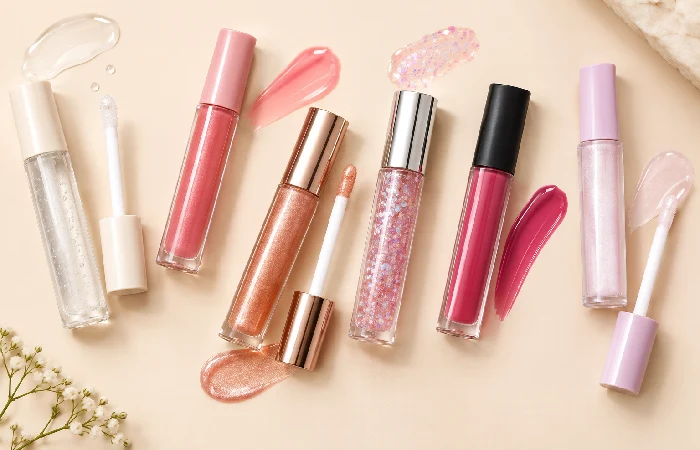
Lip glosses have moved past having just one glossy finish. There are different lip gloss finishes available from various beauty product companies, and one can find the lip gloss suitable for their taste.
Clear Lip Gloss
Glosses that lack colour have minimal to no pigment content. They provide a clean shine for the lips and go well over lip liners and lipsticks.
Tinted Lip Gloss
Colored gloss has only a little bit of colour in it. Colored gloss gives you colour and keeps your lips glossy at the same time. Pink, peach, nude, berry, and brown are very wearable colours.
Shimmer Lip Gloss
Shimmer gloss is made with very tiny particles that reflect light. It can add dimension to the lips while not appearing to be very glittery.
Glitter Lip Gloss
Glitter gloss has more visible sparkle. Used mostly in party, celebration, festival makeup, and various creative looks.
Plumping Lip Gloss
Plumping glosses are designed to give the effect of a set of lips that appear to be bigger than they are. Some contain ingredients that produce a cold/tingling sensation; others will produce reflectiveness and shine.
High-Shine Lip Gloss
If you want the lips to be one of the main features of your makeup, then usually a high-shine formula will be needed in order to achieve an almost glass-like look.
3. Clear vs Tinted Lip Gloss
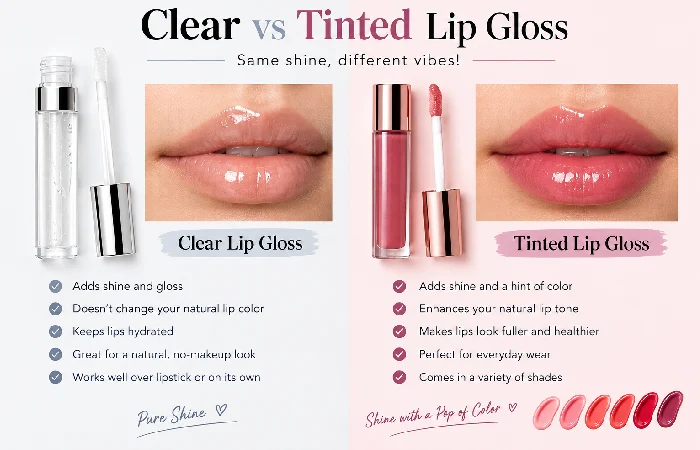
Choosing between clear and tinted gloss usually depends on the type of makeup look you want.
| Clear Lip Gloss | Tinted Lip Gloss |
| Adds mostly shine | Adds shine and colour |
| Works with almost any lip liner | Can be worn alone |
| Excellent for layering | Creates a more finished lip look |
| Usually very versatile | Available in many colour families |
| Gives a transparent finish | Provides sheer colour |
Clear gloss is the best choice if you already have a lipstick or lip liner you love and just want some shine. Tinted gloss is best if you want some colour with less pigment than lipstick.
4. How to Apply Lip Gloss?
Lip gloss application seems very straightforward, but a couple of small tricks can make the result significantly neater.
Step 1: Prepare Your Lips
Begin with a smooth application. Should the lips be dry or flaky, remove any dead skin by gently exfoliating with an appropriate lip exfoliant and apply a light coating of lip balm.
Second, try not to apply too much balm just prior to gloss; too much oil will cause the gloss to run.
Step 2: Define the Lips
To give a more refined look, just use a lip liner close to your lip colour to define. It can also give a gentle place to hold the gloss without it wandering past the lip line.
Step 3: Apply the Gloss
Apply a little gloss to the middle of your lower lip. Close your lips and move the gloss toward the corner of the mouth.
You don’t need a thick coat. A tiny bit can often bring a lovely shine and not make the lips too sticky.
Step 4: Add More Shine Where Needed
For a plumper effect, apply a small dot of gloss in the middle of both lips. A lot of light is reflected from naturally shaded areas, so the lips will appear more dimensional.
5. Lip Gloss vs Lipstick
Although both products are used on the lips, they create noticeably different effects.
| Lip Gloss | Lipstick |
| Focuses on shine | Focuses more on colour |
| Usually sheer to medium coverage | Often medium to full coverage |
| Gives a wet or glossy appearance | Can be matte, satin, cream, or glossy |
| Often feels lightweight or slippery. | Usually has a more substantial texture. |
| May require frequent touch-ups | Some formulas offer longer wear |
For a stronger, more defined colour, choose lipstick. If you want shine and a more subtle look, go for lip gloss.
You do not need to substitute one product for the other. In actuality, using them together can turn out to be one of the most stunning combinations of lip makeup.
6. How to Wear Lip Gloss With Lipstick
One of the easiest ways to create a different look for your makeup is to put extra gloss over lipstick. Firstly, carefully put on lipstick in a smoothly distributed application. Wait for it to set before proceeding further, particularly if it’s a creamy or long-lasting formulation.
Next, with a small quantity of clear, very pale (almost translucent) gloss, deposit some onto the centre of your lips (not over the entire lips). Avoid applying any of your lipstick underneath.
If you want a more full set of lips, then concentrate the gloss towards the centre and not all over, in a really heavy application.
Note: For a nude look, apply a nude lipstick and then layer a shiny gloss over the top for a more natural finish, or for a more dramatic look, apply a brighter hue of lipstick, e. g. A berry, deep brown, or a red, and then a gloss.
7. How to Choose the Right Lip Gloss
The best lip gloss depends on your preferred finish, comfort level, and makeup style.
| If You Want… | Consider… |
| Natural shine | Clear gloss |
| Soft everyday colour | Pink or nude tint |
| Warm makeup | Peach, caramel, or brown |
| Extra sparkle | Shimmer or glitter gloss |
| Dramatic lips | Deep tinted gloss |
| Fuller-looking lips | High-shine or plumping formula |
| Lipstick layering | Clear or lightly tinted gloss |
Also observe the texture. If you are not a fan of sticky products, choose light or non-sticky formulas. If you love a cushiony feeling, choose a thicker gloss.
The condition of your lips is another factor. To help combat dryness, select products with nourishing components rather than only selecting a gloss with a good shine.
8. How to Make Lip Gloss Last Longer
Lip gloss generally adheres more readily than most lipsticks, but there are a couple of tips that will extend the wear of your gloss.
- Start with clean, smooth lips.
- Apply a thin layer rather than a very thick coat.
- Use lip liner underneath for better definition.
- Blot excess balm before applying gloss.
- Apply gloss mainly to the centre of the lips.
- Avoid repeatedly pressing your lips together.
- Carry the gloss for quick touch-ups after eating or drinking.
Use lip liner or lipstick underneath and then add gloss where you want the extra shine. This allows you to have the effect of a traditional colour with some of the definition, but still have the gloss.
9. Common Lip Gloss Mistakes
Any lovely gloss may appear an unmanageable mess if it is not put on properly. The good news is that the majority of mistakes are simple to prevent.
Applying Too Much
More product does not always mean more shine. Excess gloss can feel heavy, become sticky, and travel outside the lip line.
Skipping Lip Preparation
Applying gloss directly over dry, flaky lips can make uneven texture more noticeable. A smooth base usually creates a much cleaner result.
Using Too Much Balm Underneath
A layer of thick lip balm can cause gloss to slip. Wait for your balm to absorb or gently blot away any excess before applying your gloss.
Ignoring the Lip Line
Gloss can migrate outside the natural lip border, particularly in warm weather. A lip liner can provide definition and help create a cleaner shape.
Choosing a Formula Only for Its Appearance
A gloss may look pretty in its container, but is it comfortable to wear on your lips? Texture, stickiness, scent, and wear should all be taken into consideration.
Final Thoughts
Lip gloss is the easiest makeup item to use but can totally alter how your lips look. Whether it’s a subtle, semi-transparent gloss or a glamorous, nighttime look, you can almost instantly add dimension and softness to any makeup look with just the right formula.The fun is in the overdoing. Whether it’s a buttery feeling lipstick or a lightly greasing a gloss over something you know you can wear without backing away from your mirror, apply it in tiny doses. Lip gloss done on its own, like lipstick, or layered on top of a beloved lip color, a single dot of expertly applied gloss can go a long way.