

Combination Skin: Complete Guide to Caring for Oily and Dry Areas
 Khizrana Begum
Beauty & Lifestyle Writer
Khizrana Begum writes clear and reader-friendly content covering beauty, lifestyle and related topics.
Read Full Bio of Author →
Khizrana Begum
Beauty & Lifestyle Writer
Khizrana Begum writes clear and reader-friendly content covering beauty, lifestyle and related topics.
Read Full Bio of Author →
 Sameena Begum
Health, Technology & Digital Content Reviewer
Sameena Begum reviews content for clarity, accuracy and overall reader usefulness.
Read Full Bio of Reviewer →
Sameena Begum
Health, Technology & Digital Content Reviewer
Sameena Begum reviews content for clarity, accuracy and overall reader usefulness.
Read Full Bio of Reviewer →
Combination Skin – By midday, your forehead resembles the shining pinnacle of a disco ball, and your cheeks feel they could grace the latest season of “Planet of the Dry, Scaly Animals.” If any of the above applies to you, then, well, you’re part of the large, complex club of combination skin – quite possibly the most common skin type of all, and arguably the most difficult to master. You can’t get away with a simple “lump in all the oily bits” policy that works for some of your more one-note counterparts.
Your face is essentially navigating two separate microclimates simultaneously, and your skincare ritual has to acknowledge the two realities at play.
We’re going to break down exactly what combination skin is, how to be positive this is indeed your struggle, the forces behind those S-O-S for oil vs. Dry skin regions on your face, and then we’re going to take you through building a skincare routine designed to honor both ends of your face-instead of sparking an all-out war.
❝
This article is a part of
Combination Skin Care Guide
Follow the best skincare routine for combination skin to keep both oily and dry areas balanced.
What is combination skin?

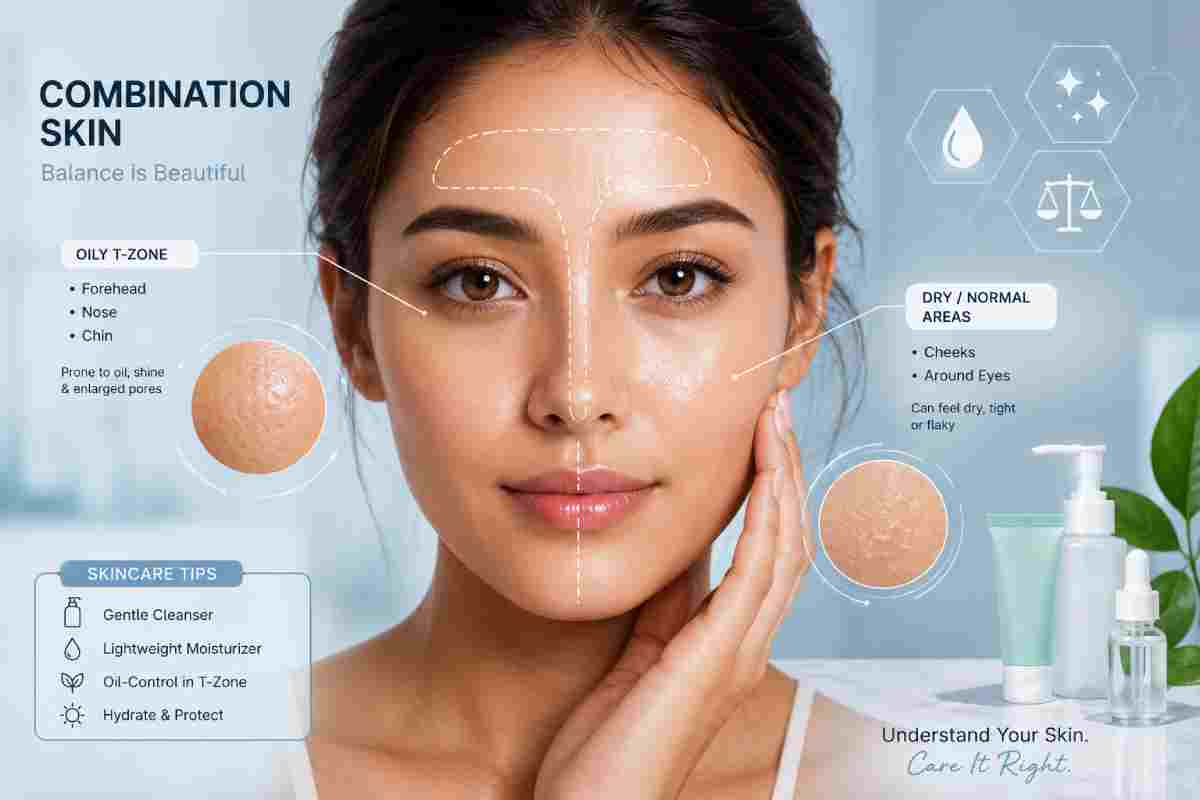
Combination skin is when different parts of your face produce noticeably varied levels of oil. Most people first experience this phenomenon on the so-called “T-zone” – the forehead, the nose, and the chin.
These areas typically appear shiny and often have visible pores and a greasy feel.
The cheeks and skin along the jawline, on the other hand, remain close to neutral or will veer toward dryness and flaking. It’s as simple as this: the T-zone is denser in the oil-producing glands – sebaceous glands – than the rest of your face. So naturally, the more glands, the more oil, the more shine and shine that’s a precursor to the dreaded clogged pore. Whereas your cheeks have far fewer oil glands and they’re the ones that feel tight and thirsty when the temperature drops or your cleanser goes into battle against them. That’s not a disease; it’s just a condition that can be corrected.
If you’re dealing with breakouts, learn how to manage combination skin with acne without over-drying your skin.
Rather, it is simply your genetic makeup.
The range of distinction varies, of course – a person might only have a slightly oily T-zone and only a tad dry skin, or have a greasy midsection and skin that looks utterly dried out from the chin down.”
Both are combination skin. The routine just needs to flex depending on where you fall.
Not sure about your skin type? Compare combination skin vs dry skin to identify the right skincare approach.
A lot of people misread their own skin here. If your T-zone shine is the loudest signal, you might assume you’re just “oily” and pile on mattifying products across your whole face — which then makes the cheeks worse. Or you go the other direction, slather rich cream everywhere to fix the dry patches, and suddenly your nose is breaking out. The fix isn’t picking a side. It’s treating the two zones differently.
How to Identify Combination Skin

Choosing the right ingredients for combination skin can help maintain a healthy skin barrier.
If you’re not sure whether you actually have combination skin or just a bad skincare routine, there’s a quick way to find out — no dermatologist appointment required.
The Bare-Face Test
This is the one that can actually give you true results, but requires you doing literally nothing to your face for the best part of 90 minutes.
Apply cosmetics with confidence using these makeup tips for combination skin.
- Wash with a gentle cleanser and pat dry.
- Skip moisturizer, serum, and makeup completely.
- Wait 60–90 minutes without touching your face.
- Press a blotting paper (or a clean tissue) against each zone — forehead, nose, chin, cheeks, jawline.
- Hold each one up to the light and compare how much oil shows.
| Zone | Oil on blotting paper | How it usually feels |
| Forehead | Moderate to heavy | Shiny, a little greasy |
| Nose | Heavy | Visibly oily, pores stand out |
| Chin | Moderate to heavy | Shiny, sometimes breaks out |
| Cheeks | Barely any | Tight, occasionally flaky |
| Jawline | Barely any | Normal, sometimes dry |
If your results land somewhere close to that pattern — real oil showing up in the T-zone, almost nothing on the cheeks — that’s combination skin.
Other Signs Worth Checking.
The blotting test is the most accurate, but you probably know this intuitively. Watch for the:
- Foundation getting shiny or sliding off your T-zone by afternoon, while it sits flat or clingy on your cheeks.
- Pores that look noticeably bigger on your nose than anywhere else.
- Breakouts that cluster around the forehead, nose, and chin, while irritation or tightness shows up on the cheeks.
- Skin that seems to change personality with the seasons — oilier in summer, drier in winter.
- The nagging feeling that no single moisturizer has ever worked everywhere on your face.
If several of these sound familiar, you’re almost certainly dealing with combination skin, even before you get to the blotting test.
What Makes This Different From Just “Oily” or “Dry” Skin
The dead giveaway is the comparison of zones, not necessarily the presence of oilyness or dry skin alone. If skin is oily only it will feel greasy over the face including cheeks, and if skin is dry only it will feel tight and flaking everywhere, including t zone.
When it comes to combination skin, the one big defining characteristic is that half of your face acts in the opposite manner to the other – this may even be at the exact same time!
It’s important to note that this distinction may not always be as apparent, though, and external factors such as changes in the climate, hormones, and even your current product regime may cause a wider and lesser distinction in your face. Therefore, it makes sense to repeat the blot test a couple of times a year, or whenever there are seasonal changes.
Avoid these common combination skin mistakes to keep your complexion healthy and balanced.You don’t need fancy tools or a professional skin analysis to identify combination skin — a blotting sheet, a mirror, and some honest observation over a few weeks will tell you almost everything you need to know. Once you’ve confirmed it, the real work is building a routine that treats your T-zone and your cheeks as the two different zones they actually are.
Common Characteristics of Combination Skin
Once you’ve confirmed you have combination skin, it helps to know exactly what you’re working with. The traits aren’t random — they follow a pretty consistent pattern, split between your T-zone and everywhere else.
T-Zone vs. Cheeks, Side by Side
| Trait | T-zone (forehead, nose, chin) | Cheeks & perimeter |
| Oil production | High | Low to normal |
| Pore size | Larger, more noticeable | Smaller |
| Breakouts | More frequent | Less frequent, but irritation-prone |
| Texture | Greasy by midday | Tight, rough, sometimes flaky |
| Sensitivity | Usually more tolerant | Often more reactive |
| Shine | Noticeable | Minimal |
| Hydration needs | Lower | Higher |
This table is basically a map of where your skincare effort needs to go. Anything you use across your whole face should account for the fact that one part of it is trying to do the opposite of the other part.
Why the T-Zone Behaves the Way It Does
The forehead, nose, and chin area have far more sebaceous glands than the rest of your face. More glands = more oil, and this excess oil contributes to shine, a bigger appearance of pores, and a greater chance for pores to become blocked and form blackheads or pimples.
This area also tends to be a little more resilient — it can generally handle slightly stronger actives, like salicylic acid or a clay mask, without complaining too much.
Why the Cheeks Behave Differently
Oil Glands Cheek and Jaw The sides of the face, cheeks and jaw are some of the least oily regions of the face and often rely entirely on your skin products to provide moisture rather than produce it themselves. This is also why the region often feels a little rough and tight after washing it with a stripped cleanser, and is the most sensitive area of the face, reacting to new ingredients or strong exfoliators first.
The Oil-Versus-Hydration Mix-Up
One characteristic that trips a lot of people up: oil and hydration aren’t the same thingIt is possible to have a T-zone that is creating excess oil and also be dehydrated on top – which gives the look and feel of shiny skin that feels tight. When this happens, often the answer is less about cutting hydration and more about using the right kind of moisture, a lighter oil-free formula perhaps.
Why This Contrast Matters for Your Routine
Recognizing these characteristics is really the whole point of identifying combination skin in the first place. A product that suits the T-zone’s oil and breakout tendencies will usually be too light or too active for the cheeks. A product built for the cheeks’ dryness and sensitivity will usually be too heavy for the T-zone. Once you can name the specific traits of each zone — not just “oily” and “dry” as vague labels — it becomes a lot easier to pick products, adjust for weather, and stop expecting one formula to do two very different jobs at once.
What Causes Combination Skin?
There’s no single cause — it’s usually a stack of genetic, hormonal, and environmental factors working together.
Genetics. The size and activity of your sebaceous glands is largely inherited. If one of your parents had an oily T-zone, there’s a decent chance you do too.
Hormones. Androgens ramp up oil production, and hormonal shifts — puberty, your cycle, pregnancy, menopause — can tip the T-zone oilier or, later in life, tip the whole face drier as estrogen drops.
Climate. Humid air increases oil output; cold, dry air pulls moisture out of skin. This is the reason so many people notice their T-zone getting oilier in summer and their cheeks getting flakier in winter — it’s not in your head.
Over-cleansing. Strip your skin too aggressively — harsh cleansers, too much exfoliating acid — and it often overcorrects by producing more oil in the T-zone, while the cheeks just get more dehydrated and cranky.
Mismatched moisturizer. One heavy cream slathered everywhere clogs the T-zone. One light lotion everywhere leaves the cheeks parched. This mismatch alone can create or worsen what looks like combination skin over time.
- Age. Our oil production naturally decreases as we age.
Younger skin generally presents more of an oily T-zone and as the face matures, the gap in between oily and dry zones closes and the skin may lean on the drier side all over.
- Diet and lifestyle. This isn’t as much of a primary cause but is not insignificant- a high-glycemic-index diet, dehydration, lack of sleep, and stress can alter oil production and skin barrier functionality to exacerbate oily vs dry differences.
Daily Skincare Routine for Combination Skin
The whole strategy comes down to one idea: gentle, balancing products for the whole face, but don’t be shy about using different textures — or different amounts — on different zones.
Morning
| Step | What to use | Why | How to apply it |
| 1 | Gentle gel or foam cleanser | Clears overnight oil without stripping skin | Lukewarm water, go easier on the cheeks |
| 2 | Hydrating toner or essence | Rebalances pH, adds a first layer of moisture | Pat in across the whole face |
| 3 | Lightweight serum (niacinamide or hyaluronic acid) | Keeps T-zone oil in check, hydrates cheeks | Even layer; add a bit more on cheeks |
| 4 | Gel moisturizer on T-zone, richer cream on cheeks | Hydrates without clogging | Two different textures if your skin needs it |
| 5 | Broad-spectrum SPF 30+ | Non-negotiable sun protection | Apply generously; a matte-finish formula helps with T-zone shine |
Evening
| Step | What to use | Why | How to apply it |
| 1 | Oil-based or micellar cleanser | Lifts makeup, sunscreen, and the day’s oil | Extra attention on the T-zone if you wore makeup |
| 2 | Gentle second cleanser | Actually cleans the skin | Skip scrubbing the cheeks |
| 3 | Retinol, BHA, or AHA (alternating nights) | Targets texture and breakouts | Thin layer on cheeks, or skip them there a night or two a week |
| 4 | Hydrating serum | Replenishes what the day took out | An extra pass on the cheeks |
| 5 | Night moisturizer | Barrier repair while you sleep | Slightly richer than your morning formula, especially on cheeks |
Weekly extras
| How often | Treatment | Where |
| 1–2x/week | Clay mask | T-zone, or whole face if your skin tolerates it |
| Once a week | Hydrating or overnight mask | Cheeks and perimeter |
| 1–2x/week | Chemical exfoliant | BHA on T-zone, gentler AHA on cheeks |
| As needed | Spot treatment (salicylic acid or benzoyl peroxide) | Active breakouts only, not the whole face |
Multi-masking — The technique of applying clay on the T zone and a hydrating serum on your cheeks at the same time is one of the greatest of this kind of skin! Because you’re solving two separate problems in the duration it would normally take for one.
Best Ingredients for Combination Skin.
You’d want to look at the actual ingredients in products as opposed to the hot topic of your Instagram feed for that week.
These are few you ought to incorporate into a mix.
| Ingredient | What it does | Best zone |
| Niacinamide | Regulates oil, tightens the look of pores, supports the barrier | Whole face, especially T-zone |
| Hyaluronic acid | Pulls in moisture without adding oil | Whole face, especially cheeks |
| Salicylic acid (BHA) | Clears out pores, cuts down on blackheads | T-zone |
| Glycolic or lactic acid (AHA) | Smooths texture, evens tone | Cheeks, used sparingly |
| Squalane | Lightweight, mimics your skin’s own oil | Cheeks, dry patches |
| Ceramides | Rebuilds and protects the skin barrier | Whole face |
| Zinc PCA | Mild oil control, some antibacterial benefit | T-zone |
| Green tea extract | Antioxidant, calming | Whole face |
| Glycerin | Hydrates without weight | Whole face |
| Retinol | Improves texture, tempers oil over time | Whole face, introduced slowly |
| Aloe vera | Soothes irritation | Cheeks, sensitive spots |
| Clay (kaolin or bentonite) | Soaks up excess oil | T-zone, mask use only |
Ingredients to Avoid
There are also ingredients that will send things in the opposite direction – making your T-zone too dry and forcing it to go into oil overdrive, or clogging your cheeks – something much easier than you may realize.
| Ingredient | The problem |
| Denatured or SD alcohol | Strips oil, damages the barrier, often triggers rebound shine |
| Heavy mineral oil / petrolatum-heavy formulas across the whole face | Too occlusive for the T-zone, can clog pores |
| Harsh sulfates (SLS) | Over-strips skin — rough on already-dry cheeks |
| Synthetic fragrance | Common irritant, especially where skin is drier |
| Daily, all-over acid exfoliation | Destroys barrier function exacerbated dryness oil rebound |
| Coconut oil as a standalone moisturizer | Comedogenic for the T zone |
| Highly concentrated menthol and/or peppermint. | Refreshment for a time, dehydration in the end. |
| Isopropyl myristate | Comedogenic, sneaks into some lotions and sunscreens |
Seasonal Skincare Tips
As seasons change, so should your skin.
| Season | T-zone | Cheeks | General note |
| Spring | Swap to a lighter gel moisturizer when humidity goes up | You’ll want to start cutting back on that richer cream | Reassess your SPF as sun exposure increases |
| Summer | Oil free, mattifying and Blot at midday if required | Lightweight hydrating gel-cream | Reapply your SPF. Use an oil blotting sheet. |
| Fall | Restore a thicker moisturizer now that air is drier | Introduce skin barrier-repair treatments & hydrating serums | Tone it down on the exfoliation a smidge |
| Winter | Gentle, non-stripping cleanser; go easy on acne treatments | Rich, ceramide-heavy cream, maybe a facial oil | A humidifier helps more than people expect; skip hot showers on your face |
It turns out the climate really does affect how much oil your skin produces, as well as its ability to hang onto hydration, so switching it up seasonally – whether it comes to exfoliation routine or the texture of products you’re using – definitely isn’t overkill; it’s just keeping pace with your skin.
Common Mistakes to Avoid
| Mistake | Why it backfires | What to do instead |
| One moisturizer for the whole face | Either overloads the T-zone or under-hydrates the cheeks | Use two textures — lighter on T-zone, richer on cheeks |
| Washing your face too often | Strips oil, triggers rebound shine | Stick to twice a day, gentle formula |
| Skipping moisturizer because skin “feels oily” | Causes dehydration which makes oil production rise | Moisturize still – just be light oil free |
| Using strong acids or retinol all over, daily | Over-exfoliates drier areas, leading to flaking and irritation | Swipe on zones, varying the amount applied to the cheeks. |
| Pore strips or harsh physical scrubs, often | Weakens the barrier, may worsen pores over time | Slight chemical exfoliation as an alternative |
| Not Wearing Sunscreen Because Your skin Is Oily | Increases sensitivity to sun damage and pigmentation | Wear gel or matte sunscreens every day. |
| Jumping on every new product without patch testing | Higher risk of breakouts or reactions | Patch test for 48–72 hours first |
| Multi-masking without checking your own oil map | Over-treats or under-treats certain zones | Base it on your blotting test results |
| Switching products every couple of weeks | Barrier never gets time to actually adjust | Give a new product 4–6 weeks before judging it |
Frequently Asked Questions
Is combination skin actually the most common type?
Pretty much, yes. Most dermatologists will tell you it’s one of the most prevalent skin types — very few people have perfectly uniform oil production across their whole face.
Does combination skin change over time?
It is! Oils, hormones, your environment and what you consume can result in portions of your face appearing drier or oilier. Generally, the skin becomes drier as it ages, but you can also have an oily T-zone even when the skin on the rest of your face is drying out.
Do I actually need two moisturizers?
Yes is the honest answer – in fact it is one of the most helpful routines you can get for this skin type. Use a lightweight oil-free gel on the T zone and a richer moisturiser on the cheeks and you will combat both conditions.
Do I need to use different cleansers?
Usually fine. Because cleanser is on your skin for such a short amount of time, one gentle, pH-balanced formula for your entire face is fine.
It’s the leave-on stuff — moisturizer, treatments — where zone-specific application actually matters.
Is retinol okay for combination skin?
Yes, and it can actually help regulate oil over time while improving texture. Introduce with 2-3 nights per week, with a lighter touch on your cheeks and always use moisturizer, so you’re not introducing additional irritation on top of dryness.
Why is my T zone oil right after moisturizing?
Some causes: maybe you have an overly heavy moisturizer for the area, you used a ton, or maybe your skin is dehydrated.
Try an oil free gel formula that’s lighter for only the T-zone.
Do I need different sunscreens for oily and dry sections of the face?
Not necessarily — a lot of people with combination skin do fine with one matte-finish or gel-based sunscreen across the whole face. It just needs to control shine in the T-zone without leaving the cheeks feeling stripped.
Is combination skin more acne-prone?
The T-zone side of it, generally yes — more oil, more clogged pores, more breakouts. The cheeks can erupt as well, often thanks to thick and potent products, so it’s wise to treat active pimples in those areas directly, instead of unleashing a full-scale acne-fighting blitzkrieg on your whole face.
How long before combination skin actually feels balanced?
Most people who do a zone and a constant and regular routine will notice that they see real changes around the 4-8 week mark.
Barrier repair and oil regulation both take time — resist the urge to switch products every week, since that basically resets the clock.
Does diet play into this at all?
Some, though genetics and hormones do most of the heavy lifting. High-glycemic foods and dairy have been linked to increased oil and breakouts for some people. Staying hydrated and eating reasonably well supports skin overall, but it won’t replace an actual topical routine.
Conclusion
Combination skin doesn’t present one single miracle cure, it’s two (sometimes three) areas on the same face that have completely different wants and needs, and you’ll find most of the confusion vanishes the moment you stop thinking of it as one uniform landscape. For your T-zone, lean towards lightweight, oil-reducing formulas and the occasional clay treatment.
The cheeks want more hydration, gentler treatment, and richer creams, especially once the weather turns.
None of this requires an elaborate ten-step routine or a shelf full of products. It’s as simple as looking at your actual face – you might need to check back on that blotting test from the beginning of this guide once a season or even every few months, as combined skin changes due to age, hormones and season. Start with the basics: Gentle cleanse, one or two smartly selected actives, differentiated moisturizer, and sunscreen-every day. Pay attention to what your skin tells you, give products at least a month to be judged (either way), and trust your face’s performance over the narrow, category-specific diagnosis you’ve applied to it.